2009 AUDI TT COUPE flat tire
[x] Cancel search: flat tirePage 243 of 316

__________________________________________________ T_ ir_e_ s_ a_ n_d _ w_ h_ e_ e_l_s __ _
•
& WARNING (continued)
• Incorrect tire pressures and/or underinflation cause increased
tire wear and can affect the handling of the vehicle.
• Incorrect tire pressures and/or underinflation can also lead to
sudden tire failure, including a blowout and sudden deflation,
causing loss of vehicle control. •
Checking tire pressure
The correct tire pressure for the tires originally installed
on your vehicle is listed on the tire pressure label located
on driver's side 8-pillar.
The recommended tire pressures are on the tire pressure label and
in the table=>
page 238, "Cold tire inflation pressure". This means
that the pressure must be checked and adjusted when the tire has
not been driven for more than a couple of miles (kilometers) at low
speeds during the previous three hours. Air in the tires expands
when the tire heats up as a result of internal friction as it flexes in
use. The tire pressure is higher when the tire has warmed up than
when it is "cold."
It is the inflation pressure in a "cold" tire that counts. Therefore, you
should never let air out of a warm tire to match "Cold tire inflation
pressure" recommendations =>
page 238. The tires would then be
underinflated and could fail suddenly.
The tire pressure label on your Audi lists the recommended cold tire
inflation pressures for the new, original equipment tires that were
on your vehicle at the time it was manufactured . For the location of
the label =>
page 238, fig. 148.
Most tires lose air naturally over time. They can also lose some air if
you drive over a pothole or hit a curb while parking. It is usually not
possible to see whether the radial tires used today are underinflated
just by looking at them. Therefore,
be sure to check tire pressures at least once a month and
always before going on a long trip. Make sure to take the number of
people and the amount of luggage into account when adjusting tire
pressure for a trip -even one that you would not consider to be
"long." See=>
page 242, "Tires and vehicle load limits" for more
important information.
Always use an accurate tire pressure gauge when checking and adjusting inflation pressures . Check all of the tires and be sure not
to forget the spare tire. If the pressure in any tire is too high when
the tire is "cold," let air out of the tire slowly with the edge of the tire
gauge and keep checking the pressure until you reach the pressure
that is correct for the load (passengers and luggage) and kind of driving you plan to do.
If the pressure in any tire is too low, note the difference between the
pressure in the cold tire and the pressure you need and add the air
that you need to reach the correct pressure for the vehicle load
(passengers and luggage) for the tires on your vehicle as listed on
the on your vehicle and in this manual and the kind of driving you
plan to do.
Never exceed the maximum inflation pressure listed on the tire
sidewall for any reason.
Remember that the vehicle manufacturer, not the tire manufacturer,
determines the correct tire pressure for the tires on your vehicle.
It is important to check the tire pressure when the tires are cold.
• Read the required tire pressure from the tire pressure label
located on driver's side 8-pillar.
• Turn the valve stem cap counter -clockwise to remove it from the
tire valve.
• Place the air pressure gauge on the valve.
• The tire pressures should only be checked and adjusted when
the tires are cold. The slightly raised pressures of warm tires must
not be reduced.
• Adjust the tire pressure to the load you are carrying.
• Reinstall the valve stem cap on the valve.
Vehicle care I t •
Page 244 of 316

-~_T_ ir_e_ s_ a_ n_d _ w_ h_ e_e _l_s _________________________________________________ _
When should I check the tir e pressure?
The correct ti re pressure is especially i mpor tant a t high speeds . The
pressure should therefore be checked at least o nce a month and
a lways before star tin g a j ourn ey.
When should I adjust the tire pressures?
Adjust the tire pres sure to the loa d you are ca rrying. After changing
a wheel
or replacing whee ls you have to adjust the tire pressures on
a ll whee ls. In addition, y ou must the n ini tia lize the new tire pres
sures in the tire pressu re monitoring system*:::::,
page 253.
& WARNING
Incorrect tire pressures and /or underinflation can lead sudden tire
failure, loss of control , collision, serious personal injury or even
death .
• When the warning symbol appears in the instrument
cluster , stop and in spect the tire s.
• Incorrect tire pressure and /or underinflation can cause
increased tire wear and can affect the handling of the vehicle and
stopping ability.
• Incorre ct t ire pressures and /or underinflation can also lead to
sudden tire failure, including a blowout and sudden deflation,
causing loss of vehicle control.
• The driver is responsible for the correct tire pre ssure s for all
tires on the vehicle . The appli cable pressure values are located on
a sticker on the driver' s side B -pillar.
• Onl y when all tires on the vehicle are filled to the correct pres
sure , the tire pre ssure monitoring system* can work correctly .
• The use of incorrect tire pressure values can lead to accidents
or other damage. Therefore it is essential that the driver observe
the spe cified tire pressure values for the tires and the correct pres
sures for the function of the tire pre ssure monitoring sy stem *.
• Always inflate tires to the recommended and correct tire pres
sure before driving off.
& WARNING (continued )
• Driving with underinflated tires bend more , letting them get
too hot re sulting in tread separation, sudden tire failure and lo ss
of control .
• Excessive speed and /overloading can cause heat build -up ,
sudden tire failure and loss of control.
• If the tire pressure is too low or too high , the tires will wear
prematurely and the vehicle will not handle well.
• If the tire is not flat and you do not have to change a wheel
immediately, drive at reduced speed to the nearest servi ce station
to che ck the tire pres sure and add air as required .
0 Note
Driving without valve stem caps can cause damage to the tire
va lves. To prevent this, always ma ke sure that fac tor y in st alled va lve
stem caps on all wh eels are securely mounted on the valv e.
'£> For the sake of the environment
Underinflated tires w ill also increase the fue l consumption. •
Tires and vehicle load limits
There are limits to the amount of load or weight that any vehic le and
any tire can ca rry. A vehicle that is overloaded wil l not handle wel l
and is more difficu lt to stop . Overloading can not on ly lead to loss
of vehic le contro l, but can also damage important parts of the
ve hicle a nd can l ead to sudden t ire fa ilure, i nclud ing a b lowout an d
sudden deflation that can cause the vehicle to crash .
Yo ur sa fety an d that o f yo ur passenge rs als o dep ends on making
sure that load limits are not exceeded . Vehicle load includes every -
b ody and eve rythi ng in and on the vehic le . These loa d limits are
~
Page 245 of 316

______________________________________________ T_ ir_e _s_ a_n_ d_ w_ h_ e_ e_ls __ __
•
technically referred to as the vehicle's Gross Vehi cle We ight Rating
("GVWR") .
T he "GVWR" includes the weight of the bas ic veh icle, al l factory
insta lled accessor ies, a full tank of fue l, oil, coolant and other f luids
p lus ma ximum load. The maxim um load includes the number o f
passengers that the vehicle is intended to carry ("seating capacity")
w it h an assu med weight o f 15 0 l bs (68 kg) for eac h passe nger at a
designated seating position and the total weight of any luggage in
th e veh ic le .
T he
Gross Axle Weight Rating ("GAWR"l is the maximum load that
can be applied a t each of the vehic le's two axles .
The Gross Ve hicle W eig ht Rati ng and the Gross A xle Weigh t Rating
a re l isted on the safety compliance sticker labe l located on the
dr iver's s ide B -p il lar . Y o ur Aud i has 4 seat ing positions, 2 in the fron t
and 2 in the rear for total seating capacity of 4. Each seating posit ion
has a sa fet y b elt
=> page 125, "Safe ty be lts" .
T he fact t hat the re is an uppe r lim it to your ve hicle's G ross V ehic le
Weight Rati ng means tha t the total we igh t of w hateve r is bei ng
ca rried in the vehicle is lim it e d. T he m ore pass engers in t he veh ic le
or passengers who are heavier than the standard weights assumed
mean that less we igh t ca n be ca rried as lu ggage .
T he tire pressure labe l o n you r Audi also lists the max imum
c o m bined weig ht of all of t he oc cupan ts a nd lu ggage or other ca rgo
t h at the ve hicle can carry. For the locat ion of the label
=> page 238,
fig . 14 8.
& WARNING
Overloading a vehicle can cause loss of vehicle control, a crash or
other accident , serious personal injury , and even death .
• Carrying more weight than your vehicle was designed to carry
will prevent the vehicle from handling properly and increase the
risk of the loss of vehicle control.
• The brakes on a vehicle that has been overloaded may not be
able to stop the vehicle within a safe distance.
& WARNING (continued )
• Tires on a vehicle that has been overloaded can fail suddenly,
including a blowout and sudden deflation , causing loss of control
and a crash .•
Determining correct load limit
Use the example below to calculate the
total weight of the passengers and
luggage or other things that you plan to
transport so that you can make sure that
your vehicle will not be overloaded.
Steps for Determining Correct
Load Limit
1 . Locate the statement "THE COMBINED
WEIGHT OF OCCUPANTS AND CARGO SHOULD NEVER EXCEED XXX KG OR XXX
LBS "on your vehicle 's placard (tire infla
tion pressure label)~
page 238, fig. 148.
2. Determine the combined weight of the driver and passengers that will be riding
in your vehicle. ..,
Vehicle care I t •
Page 248 of 316
___ T_ i_ r_e _s_ a_ n_ d_ w_ h_ e_ e _ ls _________________________________________________ _
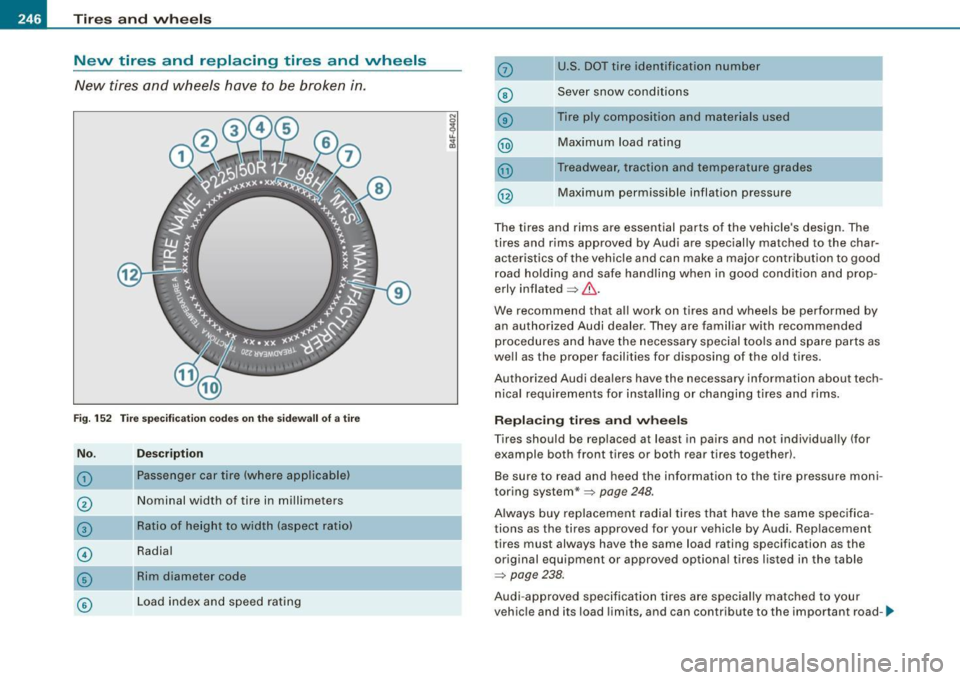
New tires and replacing tires and wheels
New tires and wheels have to be broken in.
F ig . 1 52 Tir e spec ifi cati on co des o n the sid ewa ll of a t ire
No . Desc ription
G)
®
©
©
©
©
Passenger car tire (where a pplicable)
Nominal width of tire in mi llimeters
Ratio of he ight to width (aspect ratio)
Radial
Rim diameter code
Load index and speed rating
0
©
©
@
@
U.S. DOT tire identification number
Sever snow conditions
Tire ply composition and materials used
Maximum load rating
Treadwear, traction and temperature grades
@ Maximum permissible inflation pressure
The tires and rims are essential parts of the vehicle's design. The
tires and rims approved by Audi are special ly matched to the char
acteristics of the vehicle and can make a major contribution to good
road ho lding and safe hand ling when in good cond ition and prop
erly inflated
~ & .
We recommend that all work on tires and wheels be performed by
an authorized Audi dealer . They are familiar with recommended
procedures and have the necessary special too ls and spare parts as
well as the proper facilities for disposing of the old tires.
Authorized Audi dea lers have the necessary information about tech
n ical requirements for insta lling or changing tires and rims .
Replacing tires and wheel s
Tires should be replaced at least in pairs and not individual ly (for
example both front tires or both rear tires together) .
Be sure to read and heed the information to the tire pressure moni
toring system *~ page
248 .
Always buy replacement radial tires tha t have the same specifica
tions as the tires approved for your vehicle by Audi . Replacement
tires must always have the same load rating specification as the
original equipment or approved optiona l tires listed in the table
~ page 238.
Audi -app roved specification tires are specially ma tched to your
vehic le and its load limits, and can contribute to the important road-~
Page 250 of 316

-~_T_ ir_e_ s_ a_ n_d _ w_ h_ e_e _l_s _________________________________________________ _
ture. For example, the numbers 2209 mean that the tire was
produced in the 22th week of 2009. The other numbers are
marketing codes that may or may not be used by the tire manufac
turer. This information is used to contact consumers if a tire defect
requires a recall.
Tire ply composition and materials used
The number of plies indicates the number of layers of rubber-coated
fabric in the tire. In general, the greater the number of plies, the
more weight a tire can support. Tire manufacturers also must indi
cate the materials in the tire, which include steel, nylon, polyester,
and others .
Maximum Load Rating
This number indicates the maximum load in kilograms and pounds
that can be carried by the tire.
Tire quality grading for treadwear, traction, and
temperature resistance
Tread wear, traction and temperature grades => page 249.
Maximum Permissible Inflation Pressure
This number is the greatest amount of air pressure that should ever
be put in the tire under normal driving conditions.
Replacing tires or rims on vehicles equipped with tire
pressure monitoring system*
The wheels on your vehicle are equipped with a sensor which
constantly monitors the air pressure inside the tire, and then trans
mits this information to the tire pressure monitoring system *. If you
are going to replace the wheel rims on your vehicle, make sure the
new rims also have these sensors . The sensors must be compatible
with the tire pressure monitoring system * on your vehicle.
If the sensors are to be installed on different rims , the seal, washer ,
and valve cap for each sensor must be replaced.
If you install rims, which do not have the sensors, or have sensors
which are not compatible, then the tire pressure monitoring system* will not work properly.
In this case, the tire pressure moni
toring system * would not be able to monitor the tire pressure or
warn you if it is necessary .
• The battery inside of the tire pressure sensor has a limited
service life.
• Always drive with the valve stem caps securely mounted. We
recommend using factory installed valve stem caps. Ask your autho
rized Audi dealer to replace lost valve stem caps.
The installation of replacement tires with steel cord body plies in
the tire sidewall may cause malfunction of the tire pressure moni
toring system*, and is not recommended (cord material information
in molded on the tire sidewall) .
Always check your tire pressure monitoring system* indicator after
replacing one or more tires on your vehicle. If the tire pressure
monitoring system* indicator flashes, or is on, your system is not
working properly. Your replacement tire might be incompatible with
your tire pressure monitoring sys tem* , or some component o f the
tire pressure monitoring system* may be damaged.
& WARNING
• Using incorrect or unmatched tires and/ or wheels or improper
tire and wheel combinations can lead to loss of control, collision
and serious personal injury.
• Always use tires, rims and wheel bolts that meet the specifica
tions of original factory-installed tires or other combinations that
have been specifically approved by the vehicle manufacturer .
• Tires age even if they are not being used and can fail suddenly,
especially at high speeds. Tires that are more than 6 years old can
only be used in an emergency and then with special care and at
lower speeds.
• Never mount used tires on your vehicle if you are not sure of
their "previous history." Old used tires may have been damaged
even though the damage cannot be seen that can lead to sudden
tire failure and loss of vehicle control. .,_
Page 251 of 316

________________________________________________ T.:......... ir--=e :....:s:......: a--=n..:.. d.::..:..... w..:....:.... h :....:..:e:....:e:..: 1-=s :...__IJlll
•
& W ARNING (continu ed )
• All four wheels must be fitted with radial tire s of the same type ,
s ize (rolling cir cumference ) and the same tread pattern . Driv ing
with different t ires redu ces vehicle h andling and can lead to a loss
of contro l.
• If the spare tire is not the same a s the tires that are mounted
on the vehicle -for e xample with winter tires -only use the spare
tire for a short period of time and dr ive with extra c are . Refit the
norm al road wheel as soon as safely possible .
• Never drive faster than the maximum speed for which the tires
on your vehicle are rated because tires that are driven faster than
their rated speed can fail suddenly .
• Overloading tires cause heat build-up , sudden tire failure ,
including a blowout and sudden deflation and loss of control.
• Temperature grades apply to t ires that are properly inflated and
not over or underinflated .
• For te chnical reasons it is not always possible to use wheels
from other vehicles -in some cases not even wheels from the
same vehicle model.
• If you install wheel trim discs on the vehicle wheels , make sure
that the air flow to the brakes is not blo cked . Redu ced airflow to
the brakes can them to overheat , in creasing stopp ing distances
and causing a collision .
• Run flat tires may only be u sed on vehicle s that were equipped
with them at the fa ctory . The vehicle must have a chassis de signed
for run flat tires and a factory -installed tire pressure monitoring
system* that indicates a loss of tire pressure. In correct use of run
flat tires can lead to vehicle damage or accidents . Check w ith an
autho riz ed Audi dealer or tire specialist to see if your vehicle can
be equipped with run flat tires . If run flat tires are used, they must
be installed on all four wheel s. Mixing tire types is not permitted .
0 Note
• For techn ica l reaso ns, it is not genera lly poss ib le to use t he
whee l rims from other vehicles. This can hold true fo r wheels of the
same vehicle type .
• I f the s pare t ire is d ifferent from the tires that you have mounted
on your vehicle ( fo r example win te r ti res or wide p rofile tires), then
use the spa re tire for a short period of time on ly and drive with extra
care. Replace t he flat tir e w ith the tire matching the others o n your
vehic le as soon as possib le.
• If you s hould put different whee ls a nd tires on your ve hic le (e.g.
winter wheels and tires), you must be certain that the whee ls and
t ires are co mpa tibl e w ith the tire pressure mon itor in g syste m*.
Otherwise the system w ill reg ister a malfunction and a fault
m essage w ill be d isplayed . For more info rma tion, co ntact your Aud i
dea ler.
0 Note
• When installing new tires, be careful not to damage the va lves or
tire p ressu re m on itoring system senso rs* .
• N ever drive without the valve stem cap. The valves could get
da mage d.
• I f the sensors must be replaced, then the valve must also be
r eplaced at the same time.
ci> For the sake of the environment
Dis p ose o f old tir es in acco rdance with the local requ ireme nts .•
Uniform tire quality grading
• Tread wear
• Traction AA A B C
• Temperature A B C
Vehicle care
I t •
Page 252 of 316

-~_T_ ir_e_ s_ a_ n_d _ w_ h_ e_e _l_s _________________________________________________ _
Quality grades can be found where applicable on the tire side wall
between tread shoulder and maximum section width
=> page 246,
fig. 152.
For example: Tread wear 200, Traction AA, Temperature A.
All passenger car tires must conform to Federal Safety Require
ments in addition to these grades .
Tread wear
The tread wear grade is a comparative rating based on the wear rate
of the tire when tested under controlled conditions on a specified
government test course .
For example, a tire graded 150 would wear one and one half (1 1/2)
times as well on the government course as a tire graded 100 .
The relative performance of tires depends upon the actual condi
tions of their use, however, and may depart significantly from the
norm due to variations in driving habits, service practices and differ
ences in road characteristics and climate.
Traction
The traction grades, from highest to lowest, are AA, A, Band C .
Those grades represent the tire's ability to stop on wet pavement as
measured under controlled conditions on specified government
test surfaces of asphalt and concrete. A tire marked C may have
poor traction performance
=> &.
Temperature
The temperature grades are A (the highest), B, and C, representing
the tire's resistance to the generation of heat and its ability to dissi
pate heat when tested under controlled conditions on a specified
indoor laboratory test wheel.
Sustained high temperature can cause the material of the tire to
degenerate and reduce tire life, and excessive temperature can lead
to sudden tire failure=>& .
The grade C corresponds to a level of performance which all
passenger car tires must meet under the Federal Motor Vehicle Safety
Standard No. 109. Grades Band A represent higher levels of
performance on the laboratory test wheel than the minimum
required by law.
& WARNING
The traction grade assigned to this tire is based on straight-ahead
braking traction tests, and does not include acceleration,
cornering, hydroplaning or peak traction characteristics.
& WARNING
The temperature grade for this tire is established for a tire that is
properly inflated and not overloaded. Excessive speed, underinfla
tion, or excessive loading, either separately or in combination, can
cause heat buildup and possible tire failure. •
Winter tires
Winter tires can improve vehicle handling on snow and
ice. At temperatures below 45 °F (7 °C) we recommend
changing to winter tires.
In some heavy snow areas, local governments may require true
winter or "snow" tires, those with very deeply cut tread. These tires
should only be used in pairs and be installed on all four wheels.
Make sure you purchase snow tires that are the same size and
construction type as the other tires on your vehicle.
I f your vehicle is equipped with all-wheel drive *, this will improv e
traction during winter driving, even with the standard tires.
However, we strongly recommend that you always equip all four
wheels on your vehicle with correctly fitted winter tires or all-season
tires, when winter road conditions are expected. This also improves
the vehicle's braking performance and reduces stopping distances.
Summer tires provide less grip on ice and snow.
Page 253 of 316

Tires and wheels -
----------------
•
Winter tires (snow tires) must a lways be fitted o n all four whee ls.
C om patible ti re p ressu re monito rin g sen so rs must be instal led on
a ll four wint er tires for the tire pr essure mon itor ing system* to func
tion proper ly =>
page 24 8.
As k you r auth orize d Aud i deal er or qua lifie d wo rksho p for per mitte d
winter tire sizes . Use only radial winter tires.
W in te r t ires lose the ir effec tive ness when the t read i s w or n do wn to
a depth of 0. 157 inch (4 mm).
On ly dr ive with w inter tires under winter conditions. Summer tires
h and le be tter when the re is no s now o r ice o n the roads and t he
temperature is above 45 °F (7 °C).
I f yo u have a flat t ire, see n otes on spa re w heel =>
page 246 .
Please a lwa ys reme mbe r tha t w inte r tires may h ave a lowe r speed
rating than the tires origi nally instal led on you r vehic le at t he time
i t was manu fac tur ed. P leas e se e=>
page 247, "S pee d rati ng (lett er
code)" for a list ing of the speed rating lette r codes and the
m axi mu m speed at w hich th e tire s ca n be dr ive n.
T he speed rating letter code(=>
page 237) is on the side wa ll of the
t ir e =>
page 246.
& WARNING
Winter tires have maximum speed limits that may be lower than
your vehicle's maximum speed . Always know the maximum speed
before driving off . Never drive faster than the speed permitted for
your specific winter tires . This will cause damage to the tires
leading to an accident and serious personal injury to you and your
passengers .
& WARNING
Driving faster than the maximum speed for which the winter tires
on your vehicle were designed can cause tire failure including a
blowout and sudden deflation , loss of control , crashes and serious
& WARNING (continued )
personal injuries . Have worn or damaged tires replaced immed i
ately.
• Winter tires have maximum speed rating that may be lower
than your vehicle' s maximum speed.
• Never drive faster than the speed for which the winter or other
tires installed on your vehicle are rated .
& WARNING
Always adjust your driving to the road and traffi c conditions .
Never let the good acceleration of the winter tires and all -wheel
drive tempt you into taking extra risks. Always remember :
• When braking, an all -wheel drive vehicle handles in the same
way as a front drive vehicle .
• Drive carefully and reduce your speed on icy and slippery roads,
even winter tires cannot help under black ice conditions .
ci' For the sake of the environment
Use summer tires when weather conditions permit. They are
q ui ete r, d o not wear as quickl y a nd re duc e fu el cons ump tion. •
Snow chains
Sno w chains may be fitted o nly to t he fro nt whe els, a nd o nly to
certain tire sizes . Ask your authorized Audi dealer on which tire
s iz es sn ow c hain s ca n be use d.
I f you are going to use snow chains, then you must install them on
the front wheels at least .
The s now chains must have l ow- pro file links a nd must n ot be thick er
than 0.53 inc h (13.5 mm), including the lock . .,_
Vehicle care I t •