2009 AUDI S6 flat tire
[x] Cancel search: flat tirePage 323 of 398
Tires and wheels -_______________ _____.
Occupant loading and distribution for vehicle normal load for various designated seating capacities
Designated seating capacity, num
ber of occupants Vehicle normal load
, number of
occupants Occupant distribution in a normally
loaded vehicle
5 3
2 in front,
1 in back seat
Cold tire inflation pressure
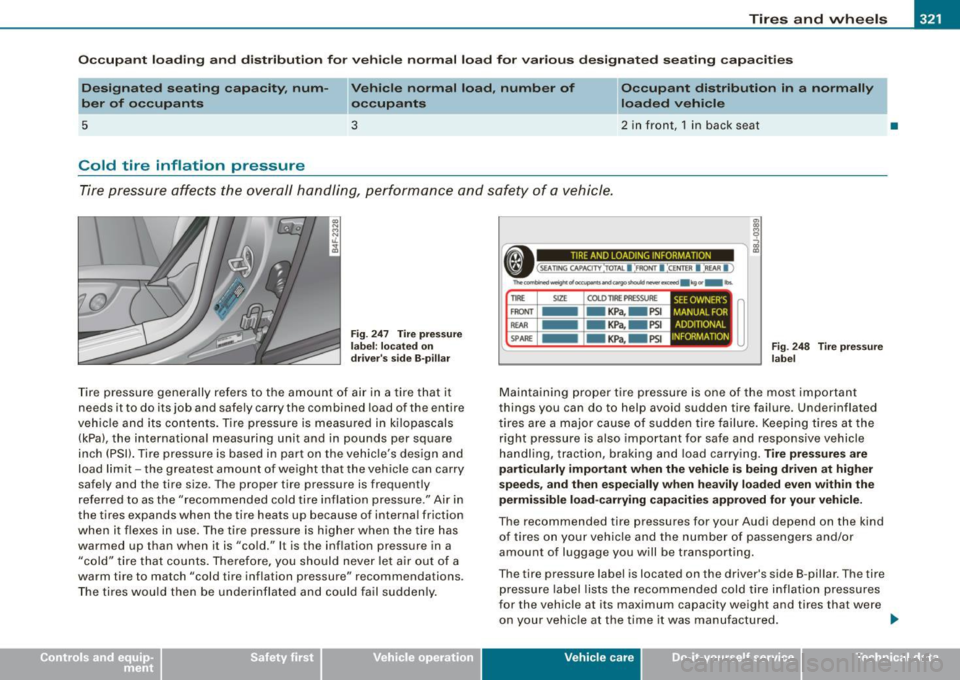
Tire pressure affects the overall handling, performance and safety of a vehicle.
Fig. 247 Tire pressure
label: located on
driver's side B-pillar
Tire pressure generally refers to the amount of air in a tire that it
needs it to do its job and safely carry the combined load of the entire
vehicle and its contents. Tire pressure is measured in kilopascals
(kPa), the international measuring unit and in pounds per square
inch (PSI). Tire pressure is based in part on the vehicle's design and
load limit -the greatest amount of weight that the vehicle can carry
safely and the tire s ize . The proper tire pressure is frequently
referred to as the "recommended cold tire inflation pressure ." Air in
the t ires expands when the tire heats up because of internal friction
when it flexes in use. The tire pressure is higher when the tire has
warmed up than when it is "cold." It is the inflation pressure in a "cold" tire that counts. Therefore, you should never let air out of a
warm tire to match "cold tire inflation pressure " recommendations .
The tires would then be underinflated and could fail suddenly.
i
,,-,~ ---------------- ixl
• (SEATING CAPACITY :roTAL I :FRONT I :cENTER I : REAR I ) al
Thecombh,d""'91wclo«U,,..,.andco,-goshoulcl.......,""""' •1cg., -b.
TIRE AND LOADING INFORMATION
TIRE SIZE COLO TIRE PRESSURE
FRONT -KPa, -PSI
REAR -KPa, - PSI
SPARE -KPa, - PSI
MANUAL FOR
INFORMATION SEE OWNER'S I
ADDITIONAL
Fig. 248 Tire pressure
label
Maintaining proper tire pressure is one of the most important
things you can do to help avoid sudden tire failure . Underinflated
tires are a major cause of sudden tire failure. Keeping tires at the
right pressure is also important for safe and responsive vehicle
handling, traction, braking and load carrying.
Tire pressures are
particularly important when the vehicle is being driven at higher
speeds, and then especially when heavily loaded even within the
permissible load-carrying capacities approved for your vehicle.
The recommended tire pressures for your Audi depend on the kind
of tires on your vehicle and the number of passengers and/or
amount of luggage you will be transporting.
The tire pressure label is located on the driver's side B -pillar. The tire
pressure label lists the recommended cold tire inflation pressures
for the vehicle at its maximum capacity weight and tires that were
•
on your vehicle at the time it was manufactured. _,,,
Vehicle care I I irechnical data
Page 324 of 398
-Tires and wheels
PW-------------------
If you wish to improve comfo rt when operating the vehicle at
normal load (up to 3 occupants) , you can adjust tire pressures to
those spec ified for normal vehi cle load . Before operating the vehi cle
at maximum load, you must in crease the tire pressures to those
specified for ma ximum vehi cle load =>
&.
Bear in mind that the tire pressure monitoring system can on ly
m onito r the t ire pressures you have stored. The syste m does not
recognize the load condition of your vehic le .
The effect iveness of the tir e pr essure moni toring syste m will be
impaired if you store normal load pressures but then operate the
veh ic le a t its ma ximum load=>& . See the
illustrat ion=>
page 321, fig. 247 for the location of the label
on driver's sid e 8-pi llar (c olor of the actual label and exac t loca tion
on the veh ic le wi ll vary slight ly) .
N ote that the fol lowing tab le is accurate at the time of going to
press and is subject to cha nge . In the eve nt of d iscrepa nc ies, t he tire
pressure label is located on the driver's side 8 -pi llar always takes
p recedence .
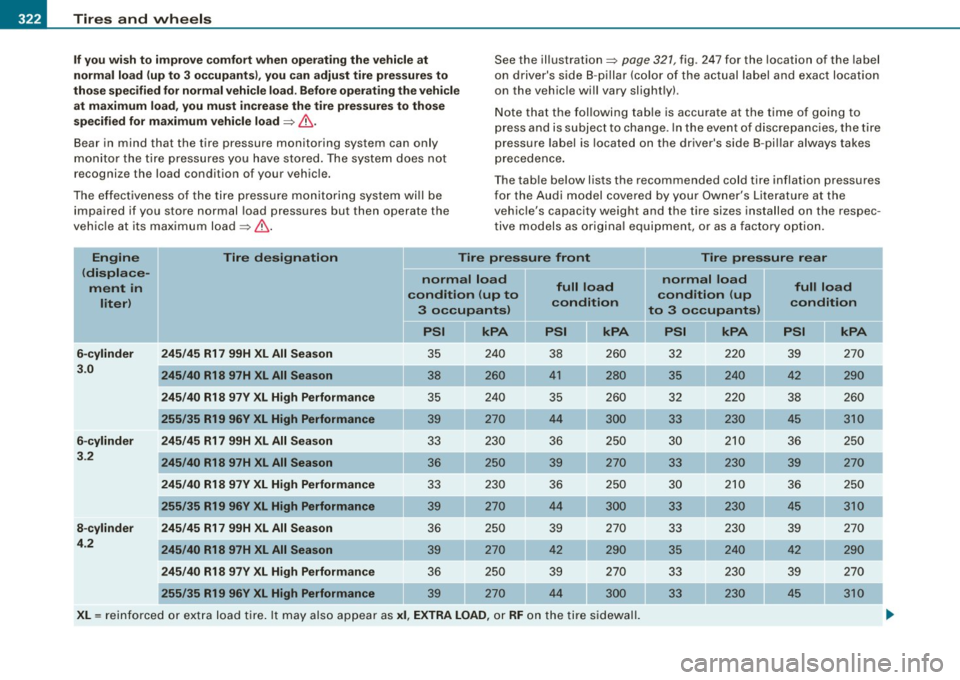
T he tab le below lists the recommended cold tire inflation pressures
fo r th e A udi m odel co ve red by you r Owner 's Litera ture at the
vehic le's capacity weight and the tire sizes installed on the respec
t ive mode ls as o rigi nal equipment, o r as a fac to ry o ption.
Engine Tire designation Tire pressure front Tire pressure rear
(displace- normal load normal load
ment in condition (up to full load
condition (up full load
liter ) condition
condition
3 occupants) to 3 occupants)
PSI kPA
PSI kPA
PSI kPA PSI
kPA
6-cylinder
245/45 R17 99H XL All Season 35 240 38 260 32 220 39 270
3 .0
245/40 R18 97H XL All Season 38 41 280 35 240 290
245 /40 R18 97V XL High Performance
35 240
35 260 32 220 38 2 60
255 /35 R19 96V XL High Performance 39 270 44 300 33 230 45 3 10
6 -cylinder 245 /45 R17 99H XL All Season 33 230 36 250 3 0 210 36 250
3 .2
245/40 R18 97H XL All Season
36 250 39 270 33 230 39 270
245 /40 R18 97V XL High Performance 33 230 36 250 3 0 21 0 36 250
255 /35 R19 96V XL High Performance 39 270 44 300 33 230 45 310
8 -cylinder 245 /45 R17 99H XL All Season
36 250 39 270
33 230 39 270
4 .2
245/40 R18 97H XL All Season 39 270 42 290 35 2 40 42 2 90
245 /40 R18 97V XL High Performance 36 250 39 270 33 230 39 270
255 /35 R19 96V XL High Performan ce
39 270
44 300 33 230 45 310
XL= reinforce d or ex tra load tire . It may als o ap pear as xi, EXTRA LOAD, or RF o n the tire s ide wall.
Page 325 of 398
Tires and wheels -
----------------
•
The correct tire pressure for the spare wheel is located on a label on
the driver's side 8 -pillar.
Because technical changes may be made to vehicle equipment
during the mode l year, always compare the tire size designation on
the tire pressure label on your vehicle with the tires on your vehicle.
Make sure that the tire size information on the vehicle label is the
same as the size of the tires on the vehicle. This is especially impor
tant if the vehicle belongs to someone else or you bought the
vehic le with different rims/tires or you bought the vehicle as a previ
ously owned vehicle.
Remember, your safety and that of your passengers also depends
on making sure that load l imits are not exceeded. Vehicle load
includes everybody and everything in and on the vehicle . These load
limits are techn ically referred to as the vehicle's Gross Veh icle
Weight Rating ("GVWR"l. The Gross Axle Weight Rating ("GAWR"l is
the maximum load that can be applied at each of the vehicle's two
axles. The Gross Vehicle Weight Rating and the Gross Axle Weight
Rating are listed on the safety compliance sticker label located on
the driver's side 8-pillar. The tire pressure label on your Audi lists
the maximum comb ined weight of all of the occupants and luggage
or other cargo that the vehicle can carry. For the location of the tire
pressure label =>
page 327, fig. 247.
& WARNING
Overloading a vehicle can cause loss of vehicle control, a crash or
other accident , serious personal injury, and even death .
• Carrying more weight than your vehicle was designed to carry
will prevent the vehicle from handling properly and increase the
risk of a loss of vehicle control.
• The brakes on a vehicle that has been overloaded may not be
able to stop the vehicle within a safe distance.
• Tires on a vehicle that has been overloaded can fail suddenly
causing loss of control and a crash.
& WARNING (continued)
• Always make sure that the total load being transported -
including the weight of a trailer hitch and the tongue weight of a
loaded trailer -does not make the vehicle heavier than the
vehicle's Gross Vehicle Weight Rating .
& WARNING
• Incorrect tire pressures and/or underinflation can lead to a
serious or fatal accident.
• Incorrect tire pressures and/or underinflation cause increased
tire wear and can affect the handling of the vehicle.
• Incorrect tire pressures and/or underinflation can also lead to
sudden tire failure, including a blowout and sudden deflation,
causing loss of vehicle control. •
Checking tire pressure
The correct tire pressure for the tires originally installed
on your vehicle is listed on the tire pressure label located
on driver's side 8-pillar.
The recommended tire pressures are on the tire pressure label and
in the table=>
page 327, "Cold tire inflation pressure". This means
that the pressure must be checked and adjusted when the tire has
not been driven for more than a couple of mi les (kilometers) at low
speeds during the previous three hours. Air in the tires expands
when the tire heats up as a result of internal friction as it flexes in
use. The tire pressure is higher when the tire has warmed up than
when it is "cold ."
It is the inflation pressure in a "cold" tire that counts. Therefore, you
should never let air out of a warm tire to match "Cold tire inf lation
pressure" recommendations=>
page 327. The tires wou ld then be
underinflated and could fail suddenly. .,_
Vehicle care I t •
Page 326 of 398
--~_T_ ir_e_ s_ a_ n_d _ w_ h_ e_e _l_s _________________________________________________ _
The tire pressure label on your Audi lists the recommended cold tire
in flatio n press ures f or the new, original equipment tires that were
on your vehic le at the time it was manufactured. For the location of
the label =>
page 321, fig. 247.
Most tires lose air natural ly over time. They can a lso lose some air if
you drive over a pothole or hit a curb while parking. It is usually not
possible to see whether the radial t ires used today are underinflated
just by looking at them.
Therefore, be sure to check tire pressures at least once a month and always before going on a long trip. Make sure to take the number of
people and the amount of luggage into account when adjusting tire
pressure for a trip - even one that you would not consider to be
"long." See =>
page 325, "Tires and vehicle load limits" for more
important information .
Always use an accurate tire pressure gauge when checking and adjusting inflation pressures. Check a ll of the tires and be sure not
to forget the spare tire . If the pressure in any tire is too high when
the tire is "cold," let air out of the tire s lowly with the edge of the tire
gauge and keep checking the pressure until you reach the pressure
that is correct for the load (passengers and luggage) and kind of
driving you p lan to do.
If the pressure in any tire is too low, note the difference between the
press ure in the cold t ire and the pressure you need and add the air
that you need to reach the correct pressure for the vehicle load
(passengers and luggage) for the tires on your vehicle as listed on
the on your vehicle and in this manual and the kind of driving you p lan to do .
Nev er e xce ed the m aximum i nflation pr essure listed on the tir e
s ide wall for any rea so n .
Remember that the veh ic le manufacturer, not the tire manufacturer,
determines the correct tire pressure for the tires on your vehicle .
It is important to check the tire pressure when the tires are cold.
• Read the required tire pressure from the tire pressure label. The
tire pressure label is located on the driver's side B -pillar. • T
urn the valve stem cap counter -clockwise to remove it from the
t ire valve .
• Place the air pressure gauge on the valve.
• T he tire pressures should only be checked and adjus ted when
the tires are cold. The s lightly raised pressures of warm tires must
not be reduced.
• Adjust the tire pressure to the load you are carrying.
• Reinstall the valve stem cap on the valve .
When should I check the tir e pre ssure?
The correct tire pressure is especially important at high speeds . T he
p ressure should therefore be checked at least once a month and
always before starting a journey. Do not forget to check the tire pres
sure for the spare whee l =>
page 343.
Wh en shoul d I adj us t th e tir e pre ssu res?
Adjust the tire pressure to the load you are ca rrying . Af ter changing
a wheel
o r replacing wheels you have to adjust the tire pressures on
a ll whee ls . In add ition, you must then store the new tire pressures
in the tire pressure monitoring system=>
page 338 .
& WARNING
Incor re ct t ire pre ssure s and /or und erinf latio n can le ad sudden t ire
failure , los s of control , collision , seriou s per son al injury or even
death .
• When the warning symbol
t appe ars in the in strumen t
c luste r, sto p a nd in spe ct the tire s.
• Incor rect tire pre ssure and /or underi nflati on can cause
i ncrea sed tire wear and can affe ct the h andl ing of the veh icle an d
s topping abil ity .
• Incorre ct t ire pres sur es a nd/or und erinflat ion c an a lso lead to
s udden tir e failure , including a blowout and sudden deflat ion ,
ca usin g lo ss of vehicle control . .,_
Page 327 of 398
Tires and wheels -
----------------
•
& WARNING (continu ed )
• The driver is respon sible for the correct tire pres sures for all
tire s on the vehicle . The applicable pre ssure values are located on
a sticker on the driver 's side B-pillar .
• Only when all tires on the veh icle are filled to the correct pre s
sure , the tire pressure monitoring system can work correctly .
• The use of incorre ct t ire pressure values can lead to a ccidents
or other damage. Therefore it is essential that the driver observe
the specified tire pressure values for the tires and the correct pre s
sures for the function of the tire pressure monitor ing system.
• Always inflate tires to the recommended and corre ct tire pres
sure before driving off.
• Driving with underinflated tires bend more , letting them get
too hot resulting in tread separation, sudden tire failure and loss
of control.
• Excessive speed and /overloading can cause heat build-up ,
sudden tire failure and loss of control.
• If the tire pre ssure is too low or too high, the tires will wear
prematurely and the vehicle will not handle well .
• If the tire is not flat and you do not have to change a wheel
immed iately , drive at reduced speed to the nearest service stat ion
to check the tire pres sure and add air as required.
0 Note
Dr iving w ithout valve s tem caps can cause damage to the t ire
valves . To prevent this, a lways make sure that factory installed valve
stem caps on a ll whee ls are securely mounted o n the va lve.
For the sake of the environment
Unde rin fla ted tires will a lso increase the f uel c onsump tion .•
Tires and vehicle load limits
There are limits to the amount of load or weight that any vehic le and
any t ir e can carry. A veh icle that is overloaded w il l not handle wel l
and is more difficu lt to stop. Overloading can not only lead to loss
o f veh ic le control, but ca n also damage impor ta nt parts of the
vehic le and can lead to sudden tire failure, inc luding a blowout and
sudde n defla tion that can cause the vehic le to crash .
Your sa fety and that o f your passen gers also depends on mak ing
sure that load limits are not e xceeded. Vehicle load includes every
body and everythi ng in and on the veh ic le. T hese load lim its a re
technica lly referred to as the vehicle's
Gross Vehi cle We ight Rating
(" GVWR") .
T he "GVWR" includes the weight of the basic vehic le, all factory
insta lled acces so ries, a ful l ta nk of fuel, oil, coolant an d othe r flui ds
p lus maximum load. The maximum load inc ludes the number o f
p asse ngers that the vehicle is inte nded t o carry ("sea ting capacity")
w ith an assu med we ight o f 150 l bs (68 kg) fo r each passe nger at a
designated seating position and the total weight of any luggage in
t he vehicle. If you tow a trailer, the we ig ht o f the tra iler h itch an d th e
tongue weight of the loaded trailer must be included as part of the
ve hicle l oad.
The
Gross Axle Weight Rating !"GAWR") is t he maximum load that
can be applied a t each of the vehicle's two ax les.
The Gross Veh icle Weig ht Rating and t he G ross Axle Weig ht Rat ing
are listed on the safety comp liance sticker labe l located on the
d river 's s ide B -pi llar . Y o ur Au di h as 5 s eating positi ons, 2 i n the fro nt
and 3 in the rear for total seating capacity of 5 . Each seating position
has a safe ty bel t~
page 205, "Safe ty belts".
The fact that th ere is an upper limit to your vehicle's Gross Vehicle
Weight Rating means that the total weight of whatever is being
carried in the vehic le (includ ing the we ight of a trai ler hitch and the
tong ue weight of the loaded trai ler) is limited. The more passengers
i n the v ehicle or pass engers wh o are heavie r than t he sta nd ard
we ights assumed mean that less weight can be ca rried as luggage . .,_
Vehicle care I t •
Page 328 of 398
ll'JI Tires and wheels
The tire pressure labe l on your Audi also lists the maximum
c o m bined w eigh t of all o f th e occ upant s a nd l uggage o r oth e r ca rgo
that the vehicl e can carry . For the location of the label~
page 3 21,
fig . 247 .
& WARNING
Overloading a vehicle can cause loss of vehicle control , a crash or
other accident , serious personal injury , and even death .
• Carrying more weight than your vehicle was designed to carry
will prevent the vehicle from handling properly and increase the
risk of the loss of vehicle control.
• The brakes on a vehi cle that has been overloaded may not be
able to stop the vehicle within a safe distance.
• Tires on a vehicle that has been overloaded can fail suddenly ,
including a blowout and sudden deflation , causing loss of control
and a crash .
• Always make sure that the total load being transported -
including the weight of a trailer hitch and the tongue weight of a
loaded trailer -does not make the vehicle heavier than the
vehicle's Gross Vehicle Weight Rating .•
Determining correct load limit
Use the example below to calculate the
total weight of the passengers and luggage or other things that you plan to
transport so that you can make sure that
your vehicle will not be overloaded.
Steps for Determining Correct
Load Limit
1. Locate the statement "THE COMBINED
WEIGHT OF OCCUPANTS AND CARGO SHOULD NEVER EXCEED XXX KG OR XXX
LBS"on your vehicle's placard (tire infla
tion pressure label)=>
page 321 , fig. 247.
2. Determine the combined weight of the driver and passengers that will be riding
in your vehicle.
3 . Subtract the combined weight of the
driver and passengers from
"XXX" kilo
grams or
"XXX" pounds shown on the
sticker=>
page 321 , fig. 247.
4. The resulting figure equals the available amount of cargo and luggage load capacity. For example, if the
" XXX"
amount equals 1400 lbs. and there will
be five 150 lbs. passengers in your
vehicle, the amount of available cargo
and luggage load capacity is 650 lbs. (1400 -750 (5
X 150) = 650 lbs.) t,,,
Page 331 of 398
__________________________________________________ T_ ir_e _ s_ a_ n _ d_ w_ h_ e_ e_ls _ ____. 11111
New tires and replacing tires and wheels
New tires and wheels have to be broken in.
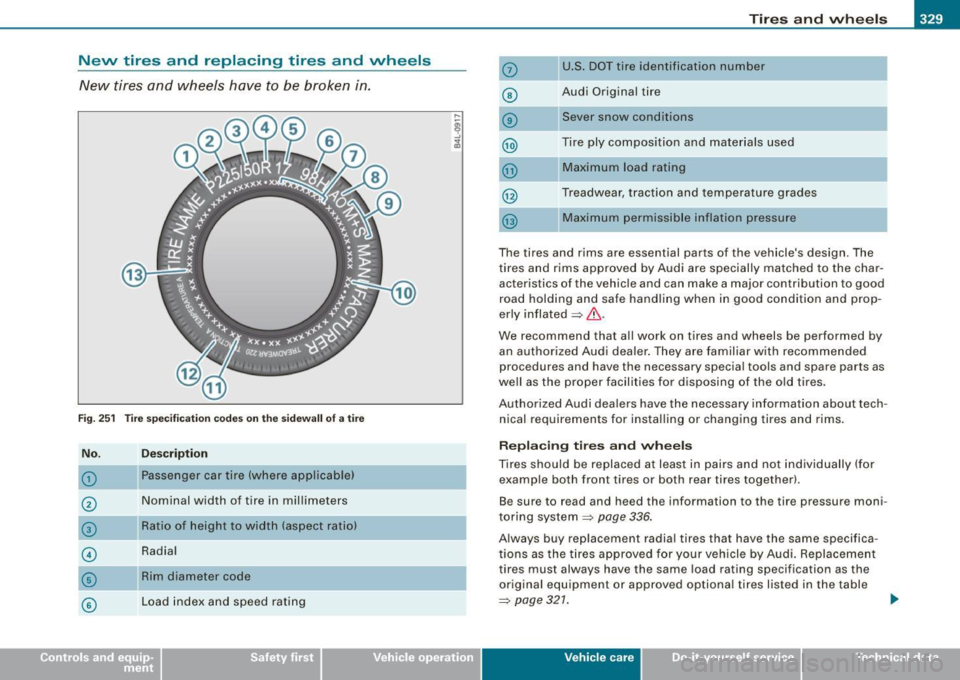
Fig. 251 Tire specification codes on the sidewall of a tire
No.
G)
@
©
©
©
©
Description
Passenger car tire (where applicable)
Nominal width of tire in millimeters
Ratio of height to width (aspect ratio)
Radial
Rim diameter code
Load index and speed rating
0
©
U.S. DOT tire identificat ion number
Audi Original tire
Sever snow condit ions
Tire ply composition and materials used
@ Maximum load rating
@ Treadwear, traction and temperature grades
@ Maximum permissible inflation pressure
The tires and rims are essential parts of the vehicle's design . The
tires and rims approved by Audi are specially matched to the char
acteristics of the vehicle and can make a major contribution to good
road holding and safe handling when in good condition and prop
erly inflated
=> & .
We recommend that all work on tires and wheels be performed by
an authorized Audi dealer. They are familiar with recommended
procedures and have the necessary special tools and spare parts as
well as the proper facilities for disposing of the old tires.
Authorized Audi dealers have the necessary information about tech
nical requirements for installing or changing tires and rims.
Replacing tires and wheels
Tires should be replaced at least in pairs and not individually (for
example both front tires or both rear tires together).
Be sure to read and heed the information to the tire pressure moni
toring system
=> page 336.
Always buy replacement radial tires that have the same specifica
tions as the tires approved for your vehicle by Audi. Replacement
tires must always have the same load rating specification as the
original equipment or approved optional tires listed in the table
=> page 327. ~
Vehic le care I I irechnical data
Page 333 of 398

Tires and wheels -________________ w-.
•
ture. For exam ple , t he numbers 2 208 mean that the tire was
pr od uce d in the 22nd w eek o f 20 08 . T he ot her num bers a re
marketing cod es that may or may not b e used by the tire manufac
tu rer. This inf or ma tion is use d to conta ct consum ers if a tir e defec t
requires a recall.
Audi Original tire
Ti res with the identification "AO" or "R O" hav e been specia lly
m atc h ed wi th you r A ud i. We re comm end u sing on ly these tire s
becaus e they meet the highest standards re garding safety and
dri ving c haracter istic s when used correctly . You r aut horized Audi
d ealer w ill glad ly prov ide you with mor e information .
Tire ply composition and materials used
The number of p li e s indicates the numb er of layers of rubber -coat ed
fabric i n the tir e . In genera l, the grea te r the number of pl ies, th e
mo re we ig ht a t ire can suppo rt. T ire ma nufactu rers also must ind i
cate the materia ls in the tire, which include steel, ny lon, polyester,
and oth ers .
Maximum Load Rating
This numb er ind icat es the maximum load in kil ograms and pou nds
th at ca n be ca rried by t he tire.
Tire qual ity grading for treadvvear , traction , and
temperature resistance
T read wear , traction and temperature grades::::;, page 332.
Maximum Permissible Inflation Pressure
This number is the greatest amount of air pressure that should ever
be put in the t ir e u nder nor mal d riving co nd it ion s.
& WARNING
• Using incorrect or unmatched tires and / or wheels or improper
tire and wheel combinations can lead to loss of control , collision
and serious personal injury .
& WARNING (continued )
• Always use tires, rims and wheel bolts that meet the specifica
tions of original factory -installed tires or other combinations that
have been spec ifically approved by the veh icle manufacturer .
• Tires age even if they are not being used and can fail suddenly,
especially at high speeds . Tires that are more than 6 years old can
only be used in an emergency and then with special care and at
lower speeds .
• Never mount used tires on your vehicle if you are not sure of
their "previous history." Old used tires may have been damaged
even though the damage cannot be seen that can lead to sudden
tire failure and loss of vehicle control.
• All four wheels must be fitted with radial tires of the same type ,
size (rolling circumference ) and the same tread pattern. Driving
with different tires reduces vehicle handling and can lead to a loss of control.
• If the spare tire is not the same as the tires that are mounted
on the vehicle - for example with winter tires - only use the spare
tire for a short period of time and drive with extra care . Refit the
normal road wheel as soon as safely possible.
• Never drive faster than the maximum speed for which the tires
on your vehicle are rated because tires that are driven faster than
their rated speed can fail suddenly.
• Overloading tires cause heat build -up, sudden tire failure ,
includ ing a blowout and sudden deflation and loss of control.
• Temperature grades apply to tires that are properly inflated and
not over or underinflated .
• For technical reasons it is not always possible to use wheels
from other vehicles -in some cases not even wheels from the
same vehicle model.
• If you install wheel trim discs on the vehicle wheels , make sure
that the air flow to the brakes is not blocked. Reduced airflow to
the brakes can them to overheat , increasing stopping distances
and causing a collision.
~
Vehicle care I t •