2009 AUDI S3 instrument panel
[x] Cancel search: instrument panelPage 216 of 324

___ C_ le_ a _ n_i_n ~g _ a_ n_ d __ p_r _o _t _e _c_ t_ i_o _n ___________________________________________ _
In the case of general soiling of the upho lstery and cover material,
we recommend hiring a s pecialis t tha t has the equ ip m ent to c lean
the seat covers and other fabric surfaces by shampooing and spray
e xtraction .
& WARNING
Always read and heed all WARNINGS and the information
~ page 206 .
[ i ] Tip s
Open Ve lcro fasteners on your clothing can damage the seat cover.
Please make sure that Velc ro fas tene rs a re c losed. •
Plastic parts and instrument panel
- Always use a clean c lo th moiste ned in clear wa ter.
A lways use a c lean cloth moistened in clear water to clean these
areas. For persistent d irt use a n Aud i approved
solvent -free plastic
cleaner/protectant .
& WARNING
Solvents can change the properties of some plastics and make it
harder for the airbag to deploy.
• Never clean the instrument panel or the surface of A irbag
modules with cleaning produ cts that contain solvents.
• Product s containing solvents will make the surface of this part
porous .
• Serious injuries can re sult if plastic parts come loose when the
airbag is deployed .
• Always read and heed all WARNINGS and the information
~ page 206.
0 Note
Cleaning agents co ntaini ng so lvents wil l attack t he ma ter ial and can
change the way it behaves .•
Ap plies t o ve hicles : w ith na tural leat her
Natural leather
Aud i makes great eff orts to maintain the pro per ties,
n atu ra l look and feel of in ter ior leather.
General
We offer many different types of leather on our vehicles. Most are different types o f nappa leather, which has a smooth surface and
comes in various co lors.
The intens ity of the color de termi nes the vis ual c h aracteris tics and
appearance. If the surface of the leather has a typica l natural look ,
t hen t he leather is a nap pa lea ther tha t has been left in a re lati ve ly
natural condition. This leather offers particu lar ly good comfor t and
breathes well. Fine veins, closed grains, insect bites, skin folds, and
subt le variations in color remain visib le. These character istics
demonstrate that the material is natura l.
N at ura l n ap pa leather is not covere d by a col or fin is h. It is the refor e
more sensitive to soiling and wear, which is something you need to
co nside r if chi ld ren, a nim als o r othe r factors m ight prove to be
particularly hard on the leather.
By contrast, leather types that are covered by a colored finish layer
ar e mo re du rable. T his has a positive ef fect on the leather's resis
tance to wear and soiling in daily use. On the other hand, the typical
cha ract erist ics of natura l leather are barely or n ot appa ren t.
However, th is does not mean that the leather itself is of inferior
quali ty.
Care and handling
Becaus e of th e exclusive nat ure of the ty pes o f lea ther tha t Audi
uses and their un ique properties (such as sens itivity to oi ls, grease, ..,_
Page 226 of 324

___ C_h_ e_ c_k _in --== g'-- a_n _d_ f_il _li _n ..:::g:::..- ___________________________________________ _
Checking and filling
Engine hood
Releasing the engine hood
The engine hood is released from inside the vehicle.
-Open the driver's door .
Fig. 167 Driver's side
footwell: engine hood
release lever
-Pull the release lever on the left under the instrument
panel
~ fig. 167 in direction of the arrow.
The hood pops up slightly under spring pressure. •
Opening the engine hood
Fig. 168 Engine hood
release lever
Before opening the engine hood, make sure that the wind
shield wipers are folded flat against the windshield. Other
wise, they could damage the paint on the hood.
Pull the release lever~ fig. 168 in the direction indicated
by the arrow. This release the hook under the hood.
- Open the hood all the way.
& WARNING
Hot engine coolant can burn you!
• To reduce the risk of being burned, never open the hood if you
see or hear steam or coolant escaping from the engine compart
ment. Wait until no steam or coolant can be seen or heard before
carefully opening the hood. •
Page 282 of 324

1111...__F_ u_ s_ e_s _ a_n _ d_ b_ u_lb _ s _______________________________________________ _
Fuses and bulbs
Fuses
Replacing a fuse
A problem in the electrical system may be caused by a
blown fuse.
Fig . 199 End face of
instrument panel:
removing cover plate
to access fuses
Fig .
200 Left side of
engine compartment :
fuse cover
Fuse cover on the left end face of the instrument
panel
- Switch off the ignition and the electrical component
affected. - Carefully pry the fuse cover off the instrument panel
using the ignition key or a screwdriver~ fig. 199.
- Check the fuse listing on the next pages to find out which fuse belongs to the component which has failed
~ page 281, "Fuse Locatio n, Instrument Panel left".
- Remove the blown fuse with the plastic clip provided.
The clip is located on the holder in the fuse box.
- Replace a blown fuse (recognizable by the melted metal
strip inside) w ith a fuse of the same amperage .
- Firmly snap the cover back onto the instrument panel
face.
Fuse cover in engine compartment
- Switch the ignition and the affected consumer off.
- Unlatch the fuse cover, push the two slides forward
~ fig. 200.
- Find out which fuse belongs to the equipment which
stopped working~ page 283, "Fuse location, left side of
engine compartment".
- Remove the plastic from its reta iner in the fuse box cover
(left face end of the instrument panel), place it on the
fuse in question and pull it out.
- If the fuse is burned out (recognizable by melted strips of
metal), replace it with a new fuse of the same rating.
- Replace the fuse cover.
- Push the two slides to the rear~ fig. 200. Install the fuse
cover carefully to prevent water from entering.
~
Page 283 of 324

_________________________________________________ F_ u_ s_ e_s _ a_n _d_ b_ u _ lb_ s _ __._
The various electrical circuits are protected by fuses. The fuses are
clustered in a centralized unit. The unit is located behind the face
panel at the end of the instrument panel. The crank for operating
the sunroof in case of a power failure is a lso stored behind the face
panel
~ page 49.
Two spare fuses and a sticker identifying the fuses are located on
the inside of the fuse box cover.
You are well advised to keep a supply of spare fuses in your vehicle .
Fuses with the proper ampere ratings are available at your autho
rized Audi dealer.
& WARNING
Never replace a fuse with one that has a higher amperage rating.
• A fuse with a too high amperage could damage the electrical
part and cause a fire .
0 Note
• On no accoun t should fuses be repaired (e.g . patched up with tin
foil or wire) as this may cause serious damage elsewhere in the elec
trical circuit or cause fire.
• If a fuse blows repeatedly, do not keep replacing it. Instead, have
the cause for the repeated short circuit or overload tracked and
fixed. •
Fuse Location , Instrument Panel left
Fus es which can be replaced.
Fig . 201 Fuse carrier
behind the instrument
panel end face, cover
removed
Note that the following table is accurate at the time of going to
press and is subject to change. In the event of discrepancies , the
label on the inside of the cover always takes precedence .
The power seats are protected by circuit breakers, which automati
cally reset after a few seconds after the overload has been reme -
died. .._
Vehicle care Do-it-yourself service irechnical data
Page 286 of 324

IIJII Fuses and bulbs i,.__....;,___;:,,;_,;,,.:_;__;;:_.:.:..:..=-=;____ ______________________ _
No. UEquipment Amps I No. Equipment Amps
F6 Steering wheel electronics, instrument cluster
5 F28
Not used
F7 Transmission control module 30 Fuse assignment in the left-side instrument
F29 50
F8 Navigation system, radio system 15/25 panel (special equipment)
Navigation system, digital radio, cell phone, TV F30 Power supply relay terminal
15 50
F9 equipment 5
F10 Engine control module, main relay 5/10 Variation
(2) with 54 Plug-in Fuses
F11 Not used No. Equipment
Amps
Control module for CAN data transfer (gateway) 5 F1
Vehicle
electrical system control unit (right)
30
F13 Engine control module 15/25 F2
ESP valves, Anti
-lock brake system (ABS) valves
20/30
F14 Ignition coils 20 F3 Not used
F15 Tank diagnosis, oxygen sensor 5/10 F4
Battery voltage
5
F16 Vehicle electrical system control unit (right) 30 F5 Horn
15
F17 Horn
15 F6 Engine components, fuel pump 15
F18 Audio amplifier 30 F7
Not used
F19 Front windshield wiper system 30 F8
Not used
F20 Water return
-flow pump, volume regulator valve F9 Engine components
10
F21 Oxygen sensor, vacuum pump 15 F10
Fuel tank control, mass air flow sensor
10
F22 Clutch pedal switch, brake light switch 5 F11 Oxygen sensors, in front of catalytic converter 10
F23 Engine relays, engine components
5/10/15 F12 Oxygen sensors, behind catalytic converter
10
F24 Engine components, water return-flow pump 10 F13 Automatic transmission
15
F25 Pump (ESP/ABS), ABS valve 30/40 F14 Not used
F26 Vehicle electrical system control unit (left)
30 F15 Water return-flow pump
10
F27 Secondary air pump 40 F16 Volume control valve
20
F17 Steering wheel electronics, instrument cluster
5
F18 Audio amplifier 30
F19 Navigation system, radio system 15/25
Page 287 of 324
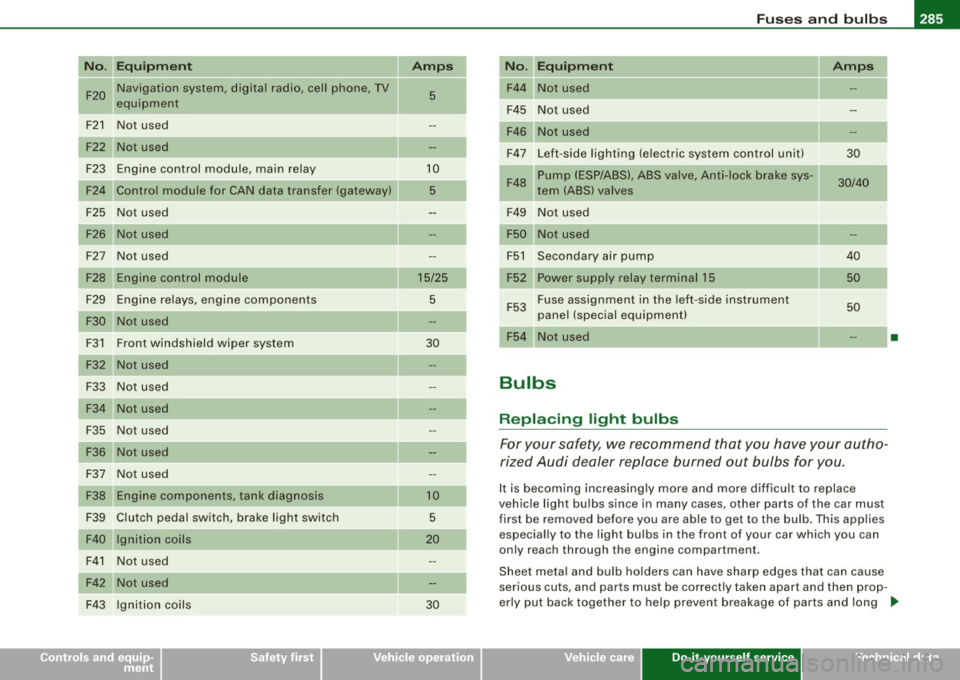
_________________________________________________ F_ u_ s_ e_s _ a_n _ d_ b_ u_lb _ s __ ffllll
N "E .
o . qu1pm ent Amps I No. Equ ipment Amps
F20 Navigation system, digital radio, cell phone, TV
5 F44 Not used
equipm ent
F45 Not used
-
F21 Not used F46 Not used
Not used F47 Left-side lighting (electric system control unit)
30
F23 Engine control module, main re lay 10
Pump (ESP/ABS), ABS valve, Anti-lock brake sys-
F48 30/40
F24 Control module for CAN data transfer (gateway) 5 tern (ABS) valves
F25 Not used F49
Not used
Not us ed Not used
F27 Not used F51 Secondary air pump 40
Engine control module 15/25 F52 Power supply relay terminal 15 50
F29 Engine relays, eng ine components 5
F53 Fuse assign
ment in the left -side instrument
50
F30 Not used panel (special equipment)
F3 1 F
ront windshield wiper system
30
F54 Not use d •
F32 Not us ed
F33 Not used
Bulbs
F3 4 Not used
F35 Not used
Replacing light bulbs
F36 Not used F or your safety, we recommend that you have your autho -
rized Audi dealer replace burned out bulbs for you.
Not used
F37
F38 Eng ine components, ta nk diag nosis 10 It is becom ing increasingly more and more difficult to replace
vehic le light bu lbs since in many cases, other parts of the car must
F39 Clutch pedal switch, brake light switch 5 first be removed before you are able to get to the bulb . This applies
F40 Ignition coils 20 especia lly to the light bu lbs i n the front of your car which you can
only reach through the engine compartment .
F41 Not used
F42 Not used Sheet meta
l and bulb holders can have sharp edges t hat ca n cause
serious cuts, and parts must be correctly taken apart and then prop -
F43 Ignit ion coils 30 erly put back together
to he lp prevent breakage of parts and long
...
• Do-it -yourself service
Page 312 of 324

___ A_l.:,. p _h_ a_ b_e _t _ic _ a_l _in _ d_e _x ____________________________________________ _
Cargo net .... .... ...... .. ... ..... ... 85
Catalytic converter . . . . . . . . . . . . . . . . . . 198
Center armrest . . . . . . . . . . . . . . . . . . . . . . 81
Centigrade Switching between Centigrade and Fahrenheit ..................... 103
Central locking panoramic sliding sunroof closing .. . 49
Certification . . . . . . . . . . . . . . . . . . . 268, 307
Changing a flat tire ...... .... ....... 272
Changing engine oi l .. .... .... .... ... 231
Chassis Undercoating . . . . . . . . . . . . . . . . . . . . 213
See also Audi magnetic ride
Checking 115
Engine coolant level .. .... .... .... 233
Checking tire pressure ...... ........ . 250
Child restraint
Danger of using child restraints in the
front seat . . . . . . . . . . . . . . . . . . . . . . 149
Child restraints What types of child restraint anchors are available? ... .... .... ......... . 182
Where can I get additional information
about child restraints? ... .... .... 183
Child safety ...... ... .... .... ... 169, 174
Additional information .... .... .... 186
Booster seats . . . . . . . . . . . . . . . . . . . . 177
Convertible child safety seats . . . . . . 175
Convertible locking retractor . . . . . . . 179
Important safety instructions for using child safety seats .. ......... .... 172 Important things to know when driving
with children ................... 169
Infant seats ..................... 174
Installing a child restraint using the
LATCH system . . . . . . . . . . . . . . . . . . 185
Lower anchorages . . . . . . . . . . . . . . . . 184
Mounting and releasing the anchorage
hook .... .... ... ........ .... ... 186
Older children and safety belts . .... 178
Safety belts and ol dler children .... . 178
Tether anchors .... .... .... ... ... 186
Tether strap .... ... .... .... .... .. 187
Which restraint system should my o lder
child wear? .. .... .... .... ...... 178
Child safety lock ..................... 44
child safety seat LATCH system . .... .... .... .... .. 185
Child safety seats ... ........... ..... 174
Convertible locking retractor . ...... 179
How do I properly install a child safety
seat in my vehicle? .. ...... .... .. 172
Installing .... ...... ... .... .... .. 179
Safety instructions . . . . . . . . . . . . . . . 172
Cleaning Alcantara (synthetic suede) . .... ... 216
Engine compartment ... .... ...... 217
Fabrics and fabric coverings ..... .. 213
Instrument panel .. ... .. .... .... .. 214
Interior .. .... .... ..... .... .... .. 213
Leather .. .... ... .......... ...... 215
Plastic and vinyl ................. 210
Plastic parts ............... ... ... 214
Safety belts .. .... .... ... ..... ... 217 Trim
strips .... ........ .. . .. .. .. . 209
trim strips .. .... .... ... .... .... .. 210
Cleaning and protection ............. 206
Climate controls .. ........ .... .... ... 98
Air distribution .... .... ... .... ... 103
Air outlets ... .. .... .... .... ...... 104
Air recirculation ... ...... ... ...... 103
Air recirculation mode (manual) ... . 102
AUTO (standard setting) .. .... ... .. 101
Automatic air recirculation ........ 102
Controls . ........... .. .... .... .. 100
Defrosting/defogging .. ........ ... 101
Description .... ........ ....... .... 98
Fan ........ ... .. .... .... .... ... 103
Key-coded setting ..... ... . ....... 105
Recommended settings .... .... .... 98
Setting the temperature .... .... ... 101
Switching between Fahrenheit and
Centigrade ... .... .... ... .... ... 103
Switching the air conditioning on and off 101
Using the climate control economically . .
104
Warm and cold ... .... .... .... ... . 98
Clock . .... .... ............... ........ 9
Coat hooks . . . . . . . . . . . . . . . . . . . . . . . . . . 97
Co ld tire inflation pressure . ..... ... .. 247
Coming -home -function .. ...... ... ... . 56
Compartments in the door trims ... ... . 96
Compass mirror .. .... ....... .... .... 72
Compliance ........................ 307
Consumer Information .......... . 135, 303
Contacting NHTSA ... .... .... .... ... 135
Page 316 of 324

___ A_l.:,. p _h_ a_ b_e _t _ic _ a_l _in _ d_e _x ____________________________________________ _
I
Ignition key 108
Ignition lock ...... ...... .... ...... . 108
Ignition lock posit ions ............... 108
Immobilizer .. .... .... ....... .... .... 10
Important things to do before driving . . 127
Im properly worn safety belts . . . . . . . . . 145
Indicator light
Airbag system . . . . . . . . . . . . . . . 158 , 159
Audi magnetic ride ................ 12
PASSENGER AIR BAG OFF ......... 159
Indicator lights ........... ...... ... 8, 11
Red symbols in the center display . .. 28
Ye llow symbols in the center display . 29
lnfantseats . ........... .... .... .... 174
How do I properly install an infant seat in
my vehicle? .................... 174
Safety instructions ............... 174
Inside rear view mirror .... ... .... ..... 69
Inspection interval ................... 20
Installing child safety seats Safety belts . . . . . . . . . . . . . . . . . . . . . 179
Instrument pane l
I llum ination ........ ... .. .... .... . 57
Instrument pane l and controls .......... 8
Instruments and controls General illustration ........... .... .. 7
Interior light
Rear ................. ........ ... 61
Interior lights ....... ........... .... . 60
Ambient lighting .................. 61
Luggage compartment ............. 62
J
Jack and tools ...................... 270
Jump start location Jump starting (6 -cyl. engine) ....... 290
Jump starting 4-cylinder engine ...... .... .... ... 289
6 -cylinder -engine .... .... ... .. ... 290
Jumper cables .... .... .... .... .... .. 289
Jump -starting 287
K
Key ......... ............ .... ... .... 35
Battery replacement . . . . . . . . . . . . . . . 37
Coded settings .................. 105
Convenience opening and closing of
windows .......... ...... .... ... 47
Key replacement . . . . . . . . . . . . . . . . . . 35
Master key . . . . . . . . . . . . . . . . . . . . . . . 35
Valet key . . . . . . . . . . . . . . . . . . . . . . . . . 35
Key-coded settings Climate controls ...... .... ..... .. 105
Kick-down Automatic transmission 122
L
LATCH 184
Description .......... .......... .. 184
Installing a child restraint ...... ... 185
Location . . . . . . . . . . . . . . . . . . . . . . . . 184
Mounting and releasing the anchorage
hook ...... ............... ..... 186 Launch
Control Program ...... .... ... 122
Leather ...... .... .... .... ...... ... . 214
Cleaning ..................... ... 215
Leaving-home-function .... ... .... .... 56
Lifting jack ... .... .... .... ... .... ... 276
Lifting points ... .. .... .... .... .... .. 295
Lifting/raising the vehicle . ... ... .... . 295
Light sensor package
Automatic headlight control ........ 53
Light/rain sensor defective .. ...... .... 34
Lights Bi-Xenon headlights ....... .... .... 58
Coming-home/ leaving-home-function 56
Emergency flasher .... ........ .... 58
Front fog lights ................... 56
Headlights .... .... ....... .... .... 52
High beam ..... .. .... .... ..... 52, 59
High beam warning/indicator light .. . 14
Instrument panel illumination . ...... 57
Side marker lights ...... ........... 52
Turn signals . ...... .... ...... ... .. 59
Loading the luggage compartment .... 133
Loading the roof rack . ............ .... 9 1
Locking Manual back-up .. ............. .... 44
Power locking switch ...... .... .... 41
Rear lid ..... ...... .... ........... 42
Remote control ................... 39
Using the fold -out key ............. 40
Lower anchorage locator button ...... 184
Lower universal anchorage bars (Canada) ...
184
Lower universal anchorages (Canada) .. 184