Page 23 of 78
INSTRUMENT AND CONTROL FUNCTIONS
3-8
3
EAU12950
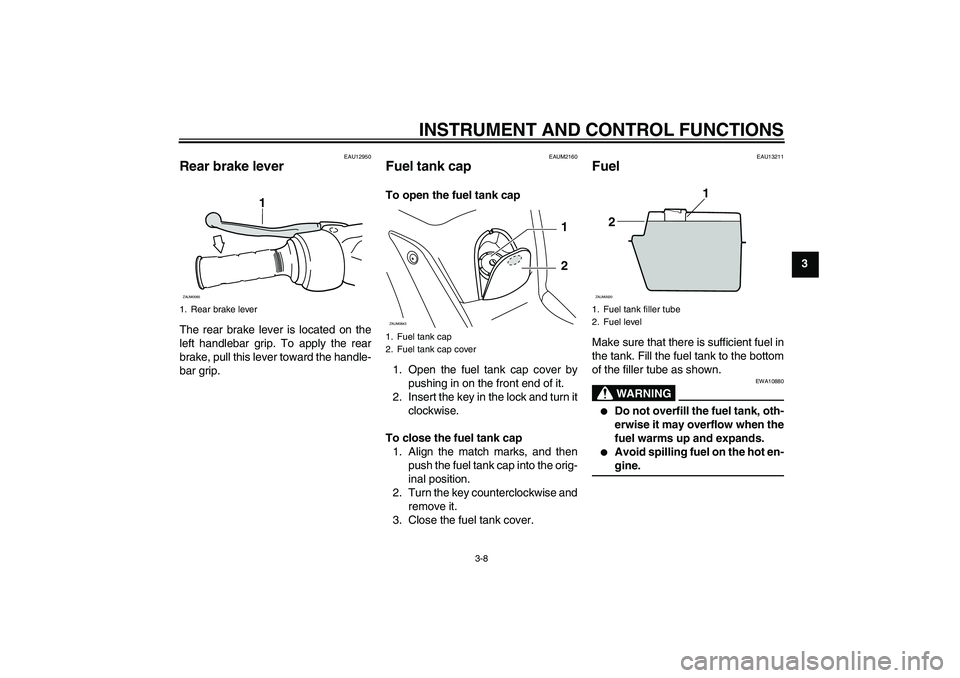
Rear brake lever The rear brake lever is located on the
left handlebar grip. To apply the rear
brake, pull this lever toward the handle-
bar grip.
EAUM2160
Fuel tank cap To open the fuel tank cap
1. Open the fuel tank cap cover by
pushing in on the front end of it.
2. Insert the key in the lock and turn it
clockwise.
To close the fuel tank cap
1. Align the match marks, and then
push the fuel tank cap into the orig-
inal position.
2. Turn the key counterclockwise and
remove it.
3. Close the fuel tank cover.
EAU13211
Fuel Make sure that there is sufficient fuel in
the tank. Fill the fuel tank to the bottom
of the filler tube as shown.
WARNING
EWA10880
�
Do not overfill the fuel tank, oth-
erwise it may overflow when the
fuel warms up and expands.
�
Avoid spilling fuel on the hot en-gine.
1. Rear brake lever
1
ZAUM0085
1. Fuel tank cap
2. Fuel tank cap coverZAUM0643
1
2
1. Fuel tank filler tube
2. Fuel level
1
2
ZAUM0020
Page 24 of 78
INSTRUMENT AND CONTROL FUNCTIONS
3-9
3
CAUTION:
ECA10070
Immediately wipe off spilled fuel
with a clean, dry, soft cloth, since
fuel may deteriorate painted surfac-es or plastic parts.
EAU13320
CAUTION:
ECA11400
Use only unleaded gasoline. The use
of leaded gasoline will cause severe
damage to internal engine parts,
such as the valves and piston rings,as well as to the exhaust system.
Your Yamaha engine has been de-
signed to use regular unleaded gaso-
line with a research octane number of
91 or higher. If knocking (or pinging) oc-
curs, use a gasoline of a different brandor premium unleaded fuel. Use of un-
leaded fuel will extend spark plug life
and reduce maintenance costs.
EAU13441
Catalytic converter This vehicle is equipped with catalytic
converters in the exhaust system.
WARNING
EWA10860
The exhaust system is hot after op-
eration. Make sure that the exhaust
system has cooled down before do-ing any maintenance work.CAUTION:
ECA10700
The following precautions must be
observed to prevent a fire hazard or
other damages.�
Use only unleaded gasoline.
The use of leaded gasoline will
cause unrepairable damage to
the catalytic converter.
�
Never park the vehicle near pos-
sible fire hazards such as grass
or other materials that easily
burn.
�
Do not allow the engine to idletoo long.
Recommended fuel:
REGULAR UNLEADED GASOLINE
ONLY
Fuel tank capacity:
10.5 L (2.77 US gal) (2.31 Imp.gal)
Fuel reserve amount:
2.7 L (0.72 US gal) (0.60 Imp.gal)
Page 26 of 78
INSTRUMENT AND CONTROL FUNCTIONS
3-11
3To lock the storage compartment
Insert the key in the lock and turn it 1/4
turn counterclockwise, and then re-
move the key.
WARNING
EWA10961
�
Do not exceed the load limit of 1
kg (2.2 lb) for the storage com-
partment.
�
Do not exceed the maximum
load of 185 kg (408 lb) for the ve-hicle.
EAUM1191
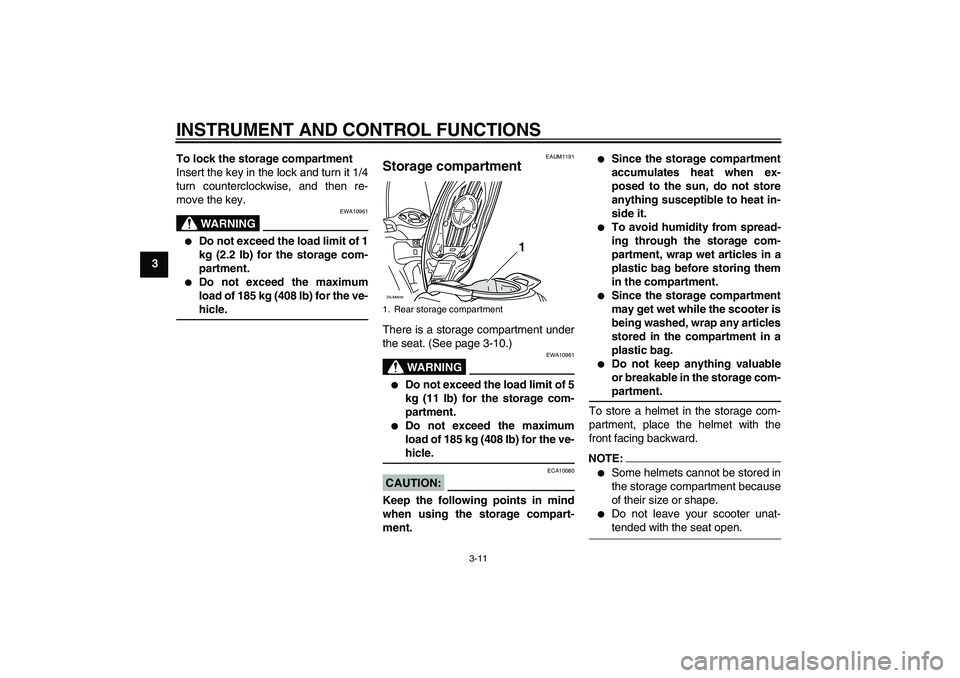
Storage compartment There is a storage compartment under
the seat. (See page 3-10.)
WARNING
EWA10961
�
Do not exceed the load limit of 5
kg (11 lb) for the storage com-
partment.
�
Do not exceed the maximum
load of 185 kg (408 lb) for the ve-hicle.
CAUTION:
ECA10080
Keep the following points in mind
when using the storage compart-
ment.
�
Since the storage compartment
accumulates heat when ex-
posed to the sun, do not store
anything susceptible to heat in-
side it.
�
To avoid humidity from spread-
ing through the storage com-
partment, wrap wet articles in a
plastic bag before storing them
in the compartment.
�
Since the storage compartment
may get wet while the scooter is
being washed, wrap any articles
stored in the compartment in a
plastic bag.
�
Do not keep anything valuable
or breakable in the storage com-partment.
To store a helmet in the storage com-
partment, place the helmet with the
front facing backward.
NOTE:�
Some helmets cannot be stored in
the storage compartment because
of their size or shape.
�
Do not leave your scooter unat-tended with the seat open.
1. Rear storage compartmentZAUM0646
1
Page 27 of 78
INSTRUMENT AND CONTROL FUNCTIONS
3-12
3
EAU14880
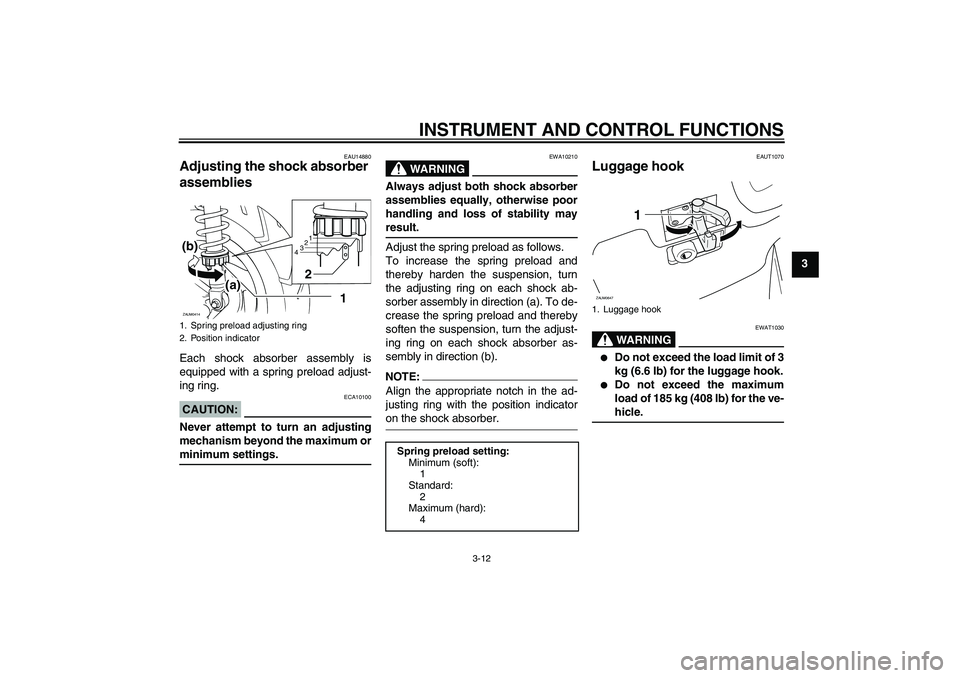
Adjusting the shock absorber
assemblies Each shock absorber assembly is
equipped with a spring preload adjust-
ing ring.CAUTION:
ECA10100
Never attempt to turn an adjusting
mechanism beyond the maximum orminimum settings.
WARNING
EWA10210
Always adjust both shock absorber
assemblies equally, otherwise poor
handling and loss of stability mayresult.
Adjust the spring preload as follows.
To increase the spring preload and
thereby harden the suspension, turn
the adjusting ring on each shock ab-
sorber assembly in direction (a). To de-
crease the spring preload and thereby
soften the suspension, turn the adjust-
ing ring on each shock absorber as-
sembly in direction (b).NOTE:Align the appropriate notch in the ad-
justing ring with the position indicatoron the shock absorber.
EAUT1070
Luggage hook
WARNING
EWAT1030
�
Do not exceed the load limit of 3
kg (6.6 lb) for the luggage hook.
�
Do not exceed the maximum
load of 185 kg (408 lb) for the ve-hicle.
1. Spring preload adjusting ring
2. Position indicator
1
2
3
4
1
2
(b)
(a)
ZAUM0414
Spring preload setting:
Minimum (soft):
1
Standard:
2
Maximum (hard):
4
1. Luggage hook
1
ZAUM0647
Page 28 of 78
INSTRUMENT AND CONTROL FUNCTIONS
3-13
3
EAU15301
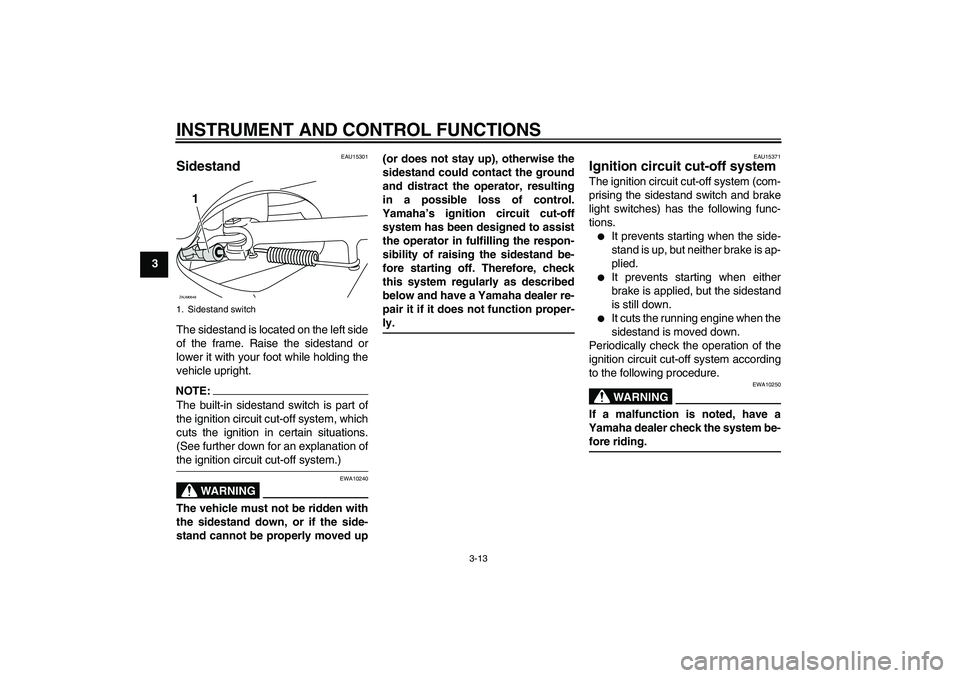
Sidestand The sidestand is located on the left side
of the frame. Raise the sidestand or
lower it with your foot while holding the
vehicle upright.NOTE:The built-in sidestand switch is part of
the ignition circuit cut-off system, which
cuts the ignition in certain situations.
(See further down for an explanation ofthe ignition circuit cut-off system.)
WARNING
EWA10240
The vehicle must not be ridden with
the sidestand down, or if the side-
stand cannot be properly moved up(or does not stay up), otherwise the
sidestand could contact the ground
and distract the operator, resulting
in a possible loss of control.
Yamaha’s ignition circuit cut-off
system has been designed to assist
the operator in fulfilling the respon-
sibility of raising the sidestand be-
fore starting off. Therefore, check
this system regularly as described
below and have a Yamaha dealer re-
pair it if it does not function proper-
ly.
EAU15371
Ignition circuit cut-off system The ignition circuit cut-off system (com-
prising the sidestand switch and brake
light switches) has the following func-
tions.�
It prevents starting when the side-
stand is up, but neither brake is ap-
plied.
�
It prevents starting when either
brake is applied, but the sidestand
is still down.
�
It cuts the running engine when the
sidestand is moved down.
Periodically check the operation of the
ignition circuit cut-off system according
to the following procedure.WARNING
EWA10250
If a malfunction is noted, have a
Yamaha dealer check the system be-fore riding.
1. Sidestand switchZAUM0648
1
Page 30 of 78
PRE-OPERATION CHECKS
4-1
4
EAU15592
The condition of a vehicle is the owner’s responsibility. Vital components can start to deteriorate quickly and unexpectedly,
even if the vehicle remains unused (for example, as a result of exposure to the elements). Any damage, fluid leakage or loss
of tire air pressure could have serious consequences. Therefore, it is very important, in addition to a thorough visual inspec-
tion, to check the following points before each ride.NOTE:Pre-operation checks should be made each time the vehicle is used. Such an inspection can be accomplished in a very shorttime; and the added safety it assures is more than worth the time involved.
WARNING
EWA11150
If any item in the Pre-operation check list is not working properly, have it inspected and repaired before operatingthe vehicle.
Page 33 of 78

OPERATION AND IMPORTANT RIDING POINTS
5-1
5
EAU15980
WARNING
EWA10870
�
Become thoroughly familiar
with all operating controls and
their functions before riding.
Consult a Yamaha dealer re-
garding any control or function
that you do not thoroughly un-
derstand.
�
Never start the engine or oper-
ate it in a closed area for any
length of time. Exhaust fumes
are poisonous, and inhaling
them can cause loss of con-
sciousness and death within a
short time. Always make sure
that there is adequate ventila-
tion.
�
For safety, always start the en-gine with the centerstand down.
EAUM2170
Starting the engine CAUTION:
ECA10250
See page 5-3 for engine break-in in-
structions prior to operating the ve-hicle for the first time.
In order for the ignition circuit cut-off
system to enable starting, the side-
stand must be up.
WARNING
EWA10290
�
Before starting the engine,
check the function of the igni-
tion circuit cut-off system ac-
cording to the procedure
described on page 3-13.
�
Never ride with the sidestanddown.
1. Turn the key to “”.
2. Close the throttle completely.
3. Start the engine by pushing the
start switch while applying the front
or rear brake.
NOTE:If the engine does not start, release the
start switch, wait a few seconds, and
then try again. Each starting attempt
should be as short as possible to pre-
serve the battery. Do not crank the en-
gine more than 10 seconds on any one
attempt. If the engine does not start, trywith the throttle open 1/8 turn.CAUTION:
ECA11040
For maximum engine life, never ac-
celerate hard when the engine iscold!1. Rear brake lever
2. Start switch
3. Front brake lever
123
ZAUM0649
Page 34 of 78

OPERATION AND IMPORTANT RIDING POINTS
5-2
5
EAU16760
Starting off NOTE:Before starting off, allow the engine towarm up.
1. While pulling the rear brake lever
with your left hand and holding the
grab bar with your right hand, push
the scooter off the centerstand.
2. Sit astride the seat, and then ad-
just the rear view mirrors.
3. Switch the turn signal on.
4. Check for oncoming traffic, and
then slowly turn the throttle grip (on
the right) in order to take off.
5. Switch the turn signal off.
EAU16780
Acceleration and deceleration The speed can be adjusted by opening
and closing the throttle. To increase the
speed, turn the throttle grip in direction
(a). To reduce the speed, turn the throt-
tle grip in direction (b).
EAU16792
Braking 1. Close the throttle completely.
2. Apply both front and rear brakes
simultaneously while gradually in-
creasing the pressure.
WARNING
EWA10300
�
Avoid braking hard or suddenly
(especially when leaning over to
one side), otherwise the scooter
may skid or overturn.
�
Railroad crossings, streetcar
rails, iron plates on road con-
struction sites, and manhole
covers become extremely slip-
pery when wet. Therefore, slow
1. Grab bar
1
ZAUM0650
(b)
(a)
ZAUM0199
PUSHOPEN
ZAUM0651