Page 108 of 468
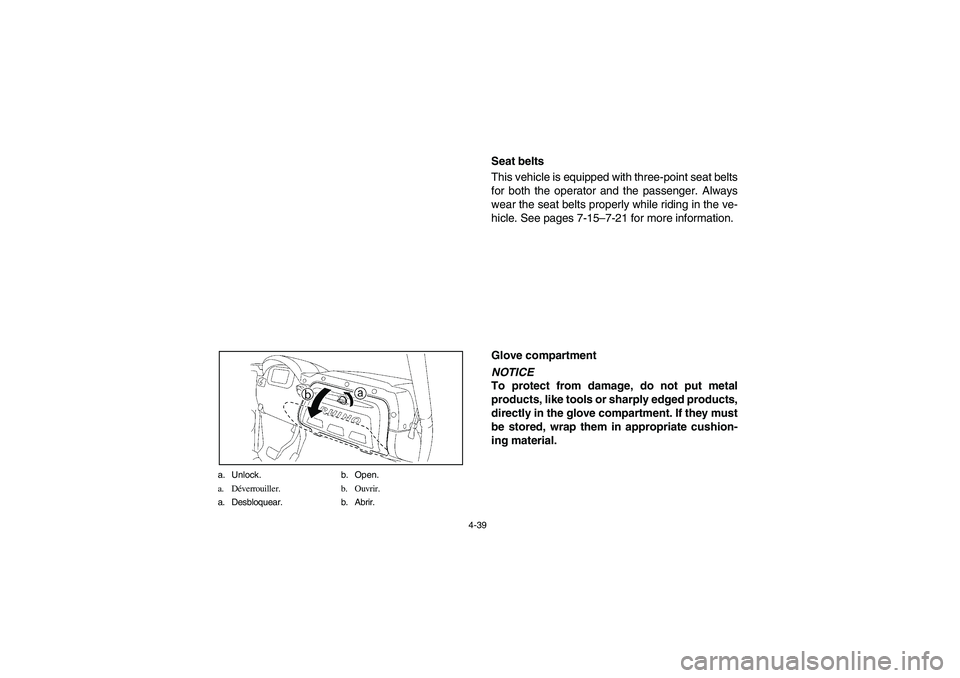
4-39 a. Unlock. b. Open.
a. Déverrouiller. b. Ouvrir.
a. Desbloquear. b. Abrir.
EVU00340
Seat belts
This vehicle is equipped with three-point seat belts
for both the operator and the passenger. Always
wear the seat belts properly while riding in the ve-
hicle. See pages 7-15–7-21 for more information.
EVU01191
Glove compartmentNOTICE
To protect from damage, do not put metal
products, like tools or sharply edged products,
directly in the glove compartment. If they must
be stored, wrap them in appropriate cushion-
ing material.
EE.book Page 39 Monday, October 8, 2007 4:48 PM
Page 114 of 468
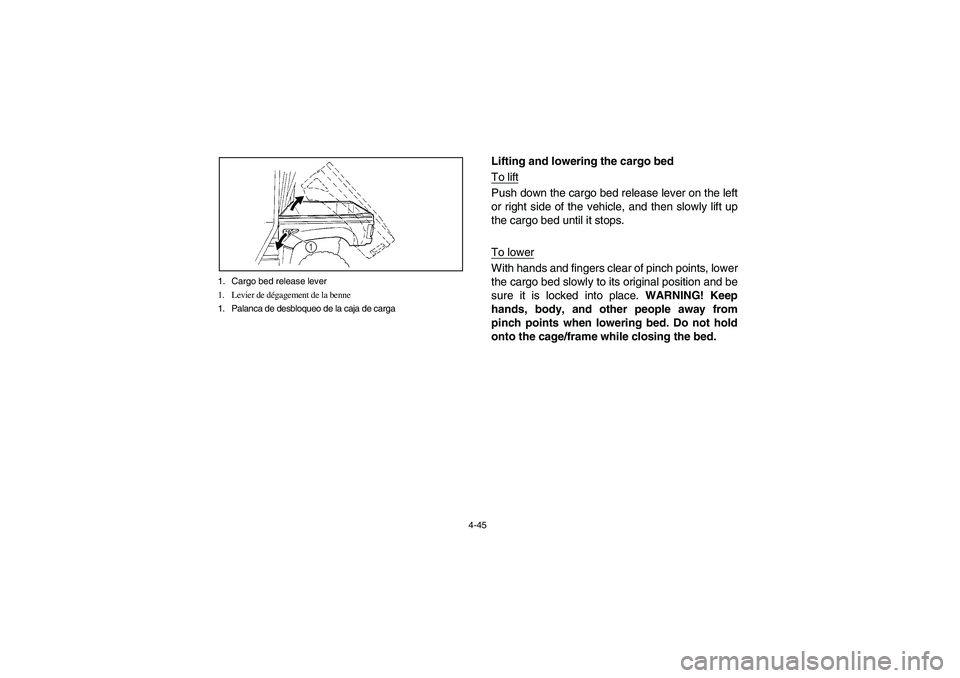
4-45 1. Cargo bed release lever
1. Levier de dégagement de la benne
1. Palanca de desbloqueo de la caja de carga
Lifting and lowering the cargo bed
To liftPush down the cargo bed release lever on the left
or right side of the vehicle, and then slowly lift up
the cargo bed until it stops.
To lowerWith hands and fingers clear of pinch points, lower
the cargo bed slowly to its original position and be
sure it is locked into place. WARNING! Keep
hands, body, and other people away from
pinch points when lowering bed. Do not hold
onto the cage/frame while closing the bed.
EE.book Page 45 Monday, October 8, 2007 4:48 PM
Page 148 of 468
5-25
EVU00450
Accelerator pedal
Check to see that the accelerator pedal operates
correctly. It must operate smoothly and spring
back to the idle position fully when released. Have
a Yamaha dealer repair as necessary for proper
operation.
EVU00460
Seat belts
Make sure that the seat belts are not frayed, torn,
stretched, or damaged. Each seat belt must move
smoothly when pulled out and retract on its own
when released. It must also lock up when quickly
pulled out. The latch plate should click securely
into the buckle and release when the release but-
ton is pushed firmly. Wash off any dirt or mud that
could affect operation. Have a Yamaha dealer re-
pair as necessary for proper operation.
A crash can damage the restraint systems in your
vehicle. A damaged restraint system may not
properly protect the person using it, resulting in se-
rious injury or death in a crash. To help make sure
your restraint systems are working properly after a
crash, have them inspected and any necessary re-
placements made as soon as possible.
EE.book Page 25 Monday, October 8, 2007 4:48 PM
Page 176 of 468
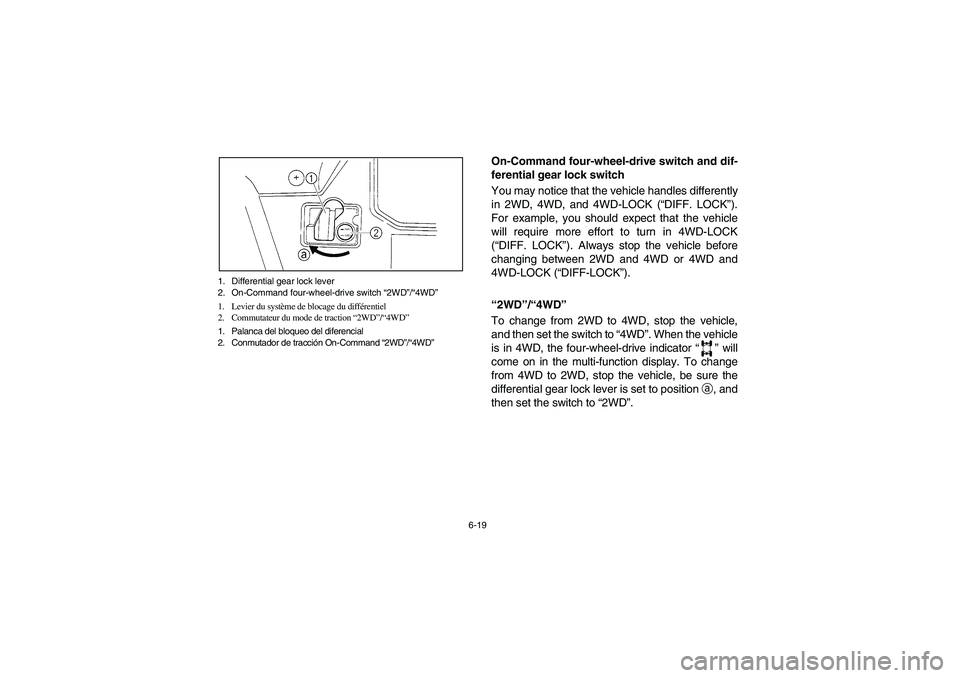
6-19 1. Differential gear lock lever
2. On-Command four-wheel-drive switch “2WD”/“4WD”
1. Levier du système de blocage du différentiel
2. Commutateur du mode de traction “2WD”/“4WD”
1. Palanca del bloqueo del diferencial
2. Conmutador de tracción On-Command “2WD”/“4WD”
5B410009
On-Command four-wheel-drive switch and dif-
ferential gear lock switch
You may notice that the vehicle handles differently
in 2WD, 4WD, and 4WD-LOCK (“DIFF. LOCK”).
For example, you should expect that the vehicle
will require more effort to turn in 4WD-LOCK
(“DIFF. LOCK”). Always stop the vehicle before
changing between 2WD and 4WD or 4WD and
4WD-LOCK (“DIFF-LOCK”).
“2WD”/“4WD”
To change from 2WD to 4WD, stop the vehicle,
and then set the switch to “4WD”. When the vehicle
is in 4WD, the four-wheel-drive indicator “” will
come on in the multi-function display. To change
from 4WD to 2WD, stop the vehicle, be sure the
differential gear lock lever is set to positiona, and
then set the switch to “2WD”.
EE.book Page 19 Monday, October 8, 2007 4:48 PM
Page 177 of 468
6-20
5B410009
Commutateur du mode de traction et commutateur
du système de blocage du différentiel
Le comportement du véhicule diffère en traction “2WD”,
“4WD”, ou “4WD-LOCK” (“DIFF. LOCK”). Ainsi, il
faut par exemple plus de puissance pour effectuer un vi-
rage en “4WD-LOCK” (“DIFF. LOCK”). Il convient de
toujours arrêter le véhicule avant de changer de mode de
traction, donc avant le passage entre les modes “2WD” et
“4WD” et les modes “4WD” et “4WD-LOCK” (“DIFF-
LOCK”).
Modes de traction “2WD”/“4WD”
Pour passer de la traction sur quatre roues à la traction sur
deux roues, arrêter le véhicule, puis régler le commuta-
teur sur “4WD”. Lorsque le véhicule est en mode
“4WD”, l’indicateur de traction sur quatre roues “”
s’affiche à l’écran du bloc de compteurs multifonctions.
Pour passer de la traction sur quatre roues à la traction sur
deux roues, arrêter le véhicule, s’assurer que le levier du
système de blocage du différentiel est à la position a,
puis régler le contacteur sur “2WD”.
5B410009
Conmutador de tracción y de bloqueo del dife-
rencial On-Command
Observará que el vehículo se comporta de forma di-
ferente en 2WD, 4WD y 4WD-LOCK (“DIFF.
LOCK”). Por ejemplo, en 4WD-LOCK (“DIFF.
LOCK”) el vehículo necesitará más esfuerzo para gi-
rar. Detenga siempre el vehículo antes de cambiar
entre 2WD y 4WD o entre 4WD y 4WD-LOCK (“DI-
FF-LOCK”).
“2WD”/“4WD”
Para cambiar de 2WD a 4WD, pare el vehículo y si-
túe el conmutador en “4WD”. Cuando se selecciona
4WD, el indicador de tracción a las cuatro ruedas
“” se ilumina en la pantalla multifunción. Para
cambiar de 4WD a 2WD, pare el vehículo, comprue-
be que la palanca de bloqueo del diferencial se en-
cuentre en la posición a y sitúe el conmutador en
“2WD”.
EE.book Page 20 Monday, October 8, 2007 4:48 PM
Page 178 of 468
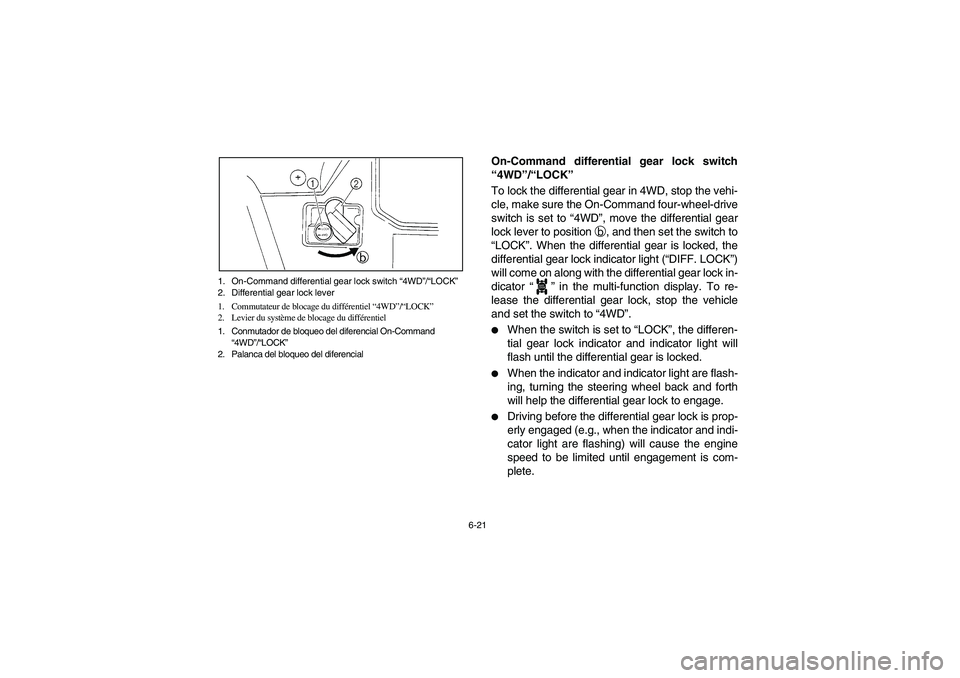
6-21 1. On-Command differential gear lock switch “4WD”/“LOCK”
2. Differential gear lock lever
1. Commutateur de blocage du différentiel “4WD”/“LOCK”
2. Levier du système de blocage du différentiel
1. Conmutador de bloqueo del diferencial On-Command
“4WD”/“LOCK”
2. Palanca del bloqueo del diferencial
On-Command differential gear lock switch
“4WD”/“LOCK”
To lock the differential gear in 4WD, stop the vehi-
cle, make sure the On-Command four-wheel-drive
switch is set to “4WD”, move the differential gear
lock lever to positionb, and then set the switch to
“LOCK”. When the differential gear is locked, the
differential gear lock indicator light (“DIFF. LOCK”)
will come on along with the differential gear lock in-
dicator “” in the multi-function display. To re-
lease the differential gear lock, stop the vehicle
and set the switch to “4WD”.�
When the switch is set to “LOCK”, the differen-
tial gear lock indicator and indicator light will
flash until the differential gear is locked.
�
When the indicator and indicator light are flash-
ing, turning the steering wheel back and forth
will help the differential gear lock to engage.
�
Driving before the differential gear lock is prop-
erly engaged (e.g., when the indicator and indi-
cator light are flashing) will cause the engine
speed to be limited until engagement is com-
plete.
DIFF.
LOCK
EE.book Page 21 Monday, October 8, 2007 4:48 PM
Page 179 of 468
6-22
Commutateur de blocage du différentiel “4WD”/
“LOCK”
Pour bloquer le différentiel en traction sur quatre roues,
arrêter le véhicule, s’assurer que le commutateur du
mode de traction est placé sur “4WD”, placer le levier du
système de blocage du différentiel à la position b, puis
placer le contacteur à la position “LOCK”. Lorsque le
différentiel est bloqué, le témoin de blocage du différen-
tiel (“DIFF. LOCK”) s’allume et l’indicateur de blocage
du différentiel “” s’affiche à l’écran du bloc de comp-
teurs multifonctions. Pour débloquer le différentiel, arrê-
ter le véhicule et placer le commutateur sur “4WD”.�
Lorsque le commutateur est placé sur “LOCK”, l’in-
dicateur et le témoin de blocage du différentiel cli-
gnotent jusqu’à ce que le différentiel se bloque.
�
Lorsque l’indicateur et le témoin clignotent, tourner
le guidon d’un côté à l’autre afin de faciliter le bloca-
ge du différentiel.
�
Si l’on démarre avant que le différentiel soit bloqué
correctement (c.-à-d. tant que l’indicateur et le témoin
clignotent), le régime du moteur restera limité jusqu’à
ce que le différentiel se bloque correctement.
DIFF.
LOCK
Conmutador de bloqueo del diferencial On-Com-
mand “4WD”/“LOCK”
Para bloquear el diferencial con la tracción en 4WD,
pare el vehículo, compruebe que el conmutador de
tracción On-Command se encuentre en “4WD”, des-
place la palanca de bloqueo del diferencial a la posi-
ción b y sitúe el conmutador en “LOCK”. Cuando el
diferencial está bloqueado, el testigo “DIFF.LOCK”
se enciende y el indicador de bloqueo del diferencial
“” se ilumina en la pantalla multifunción. Para
desbloquear el diferencial, pare el vehículo y sitúe el
conmutador en “4WD”.�
Cuando se sitúa el conmutador en la posición
“LOCK”, el indicador y el testigo parpadean hasta
que se bloquea el diferencial.
�
Cuando el indicador y el testigo estén parpa-
deando, gire el volante en uno y otro sentido para
facilitar el acoplamiento del bloqueo del diferen-
cial.
�
Si el vehículo inicia la marcha antes de que el di-
ferencial esté debidamente bloqueado (es decir,
mientras el indicador y el testigo están parpa-
deando), el régimen del motor se limita automáti-
camente hasta que se completa el bloqueo.DIFF.
LOCK
EE.book Page 22 Monday, October 8, 2007 4:48 PM
Page 226 of 468
7-35
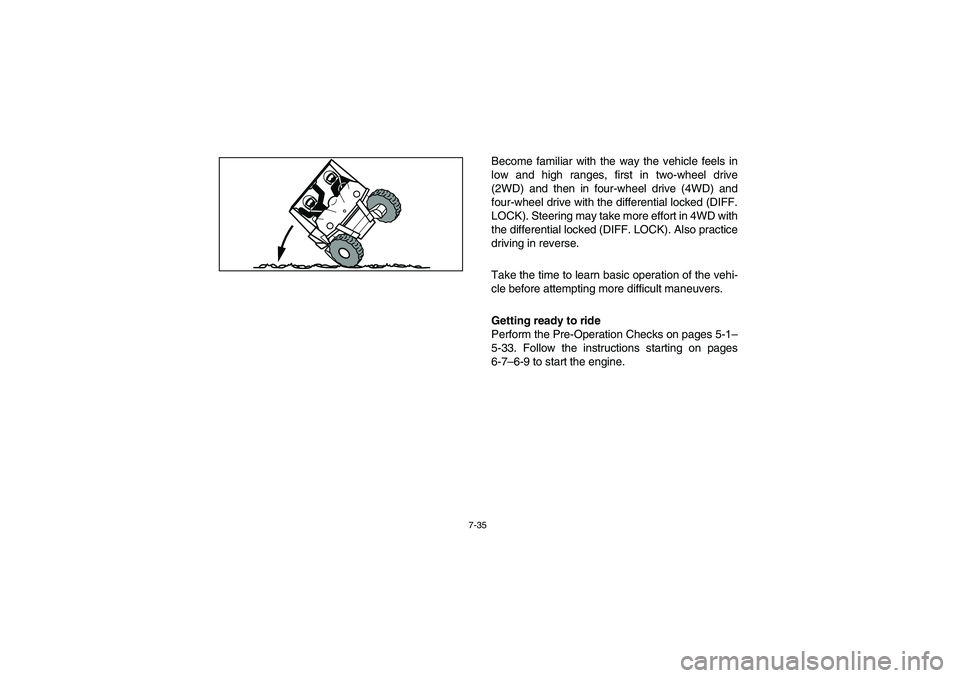
Become familiar with the way the vehicle feels in
low and high ranges, first in two-wheel drive
(2WD) and then in four-wheel drive (4WD) and
four-wheel drive with the differential locked (DIFF.
LOCK). Steering may take more effort in 4WD with
the differential locked (DIFF. LOCK). Also practice
driving in reverse.
Take the time to learn basic operation of the vehi-
cle before attempting more difficult maneuvers.
Getting ready to ride
Perform the Pre-Operation Checks on pages 5-1–
5-33. Follow the instructions starting on pages
6-7–6-9 to start the engine.
EE.book Page 35 Monday, October 8, 2007 4:48 PM