Page 25 of 98

INSTRUMENT AND CONTROL FUNCTIONS
3-9
2
34
5
6
7
8
9 Ambient temperature display
This display shows the ambient tem-
perature from –10 °C to 50 °C in 1 °C
increments. The temperature displayed
may vary from the ambient tempera-
ture. Pushing the “SELECT” button for
at least two seconds switches the am-
bient temperature display to the clock
display.
NOTE:
�
If the ambient temperature falls be-
low –10 °C, a lower temperature
than –10 °C will not be displayed.
�
If the ambient temperature climbs
above 50 °C, a higher temperature
than 50 °C will not be displayed.
�
The accuracy of the temperature
reading may be affected when
riding slowly (approximately under
20 km/h (12.5 mi/h)) or when
stopped at traffic signals, railroad
crossings, etc.
EAU12331
Anti-theft alarm (optional)
This model can be equipped with an
optional anti-theft alarm by a Yamaha
dealer. Contact a Yamaha dealer for
more information.
EAU12347
Handlebar switches
Left
1. Pass switch “PASS”
2. Dimmer switch “/”
3. Turn signal switch “/”
4. Horn switch “”
1
2
3
4
Page 27 of 98
INSTRUMENT AND CONTROL FUNCTIONS
3-11
2
34
5
6
7
8
9
EAU12900
Front brake lever
The front brake lever is located on the
right handlebar grip. To apply the front
brake, pull this lever toward the handle-
bar grip.
EAU12950
Rear brake lever
The rear brake lever is located on the
left handlebar grip. To apply the rear
brake, pull this lever toward the handle-
bar grip.
EAU12962
Rear brake lock lever
This vehicle is equipped with a rear
brake lock lever to prevent the rear
wheel from moving while stopped at
traffic signals, railroad crossings, etc.
To lock the rear wheel
Push the rear brake lock lever to the left
until it snaps into place.
To unlock the rear wheel
Push the rear brake lock lever back to
the original position.
NOTE:
�
Be sure to check that the rear
wheel does not move when the
1. Front brake lever
1
1. Rear brake lever1
1. Rear brake lock lever
1
Page 28 of 98

INSTRUMENT AND CONTROL FUNCTIONS
3-12
1
2
3
4
5
6
7
8
9
rear brake lock lever is applied.
�
To provide secure locking of the
rear wheel, apply the rear brake le-
ver first before moving the rear
brake lock lever to the left.
WARNING
EWA12361
Never move the rear brake lock lever
to the left while the vehicle is mov-
ing, otherwise loss of control or an
accident may result. Make sure that
the vehicle is stopped before mov-
ing the rear brake lock lever to the
left.
EAU12991
ABS (for ABS models)
The Yamaha ABS (Anti-lock Brake
System) features a dual electronic con-
trol system, which acts on the front and
rear brakes independently. The ABS
securely controls wheel lockup during
emergency braking on changing road
surfaces and under various weather
conditions, thereby maximizing tire ad-
hesion and performance while provid-
ing a smooth braking action. The ABS
is monitored by an ECU (Electronic
Control Unit), which will have recourse
to manual braking if a malfunction oc-
curs.
WARNING
EWA10090
�
The ABS performs best on long
braking distances.
�
On certain (rough or gravel)
roads, the braking distance may
be longer with than without the
ABS. Therefore, always keep a
sufficient distance to the vehi-
cle ahead to match the riding
speed.
NOTE:
�
When the ABS is activated, the
brakes are operated in the usual
way. A pulsating action may be felt
at the brake levers, but this does
not indicate a malfunction.
�
This ABS has a test mode which
allows the owner to experience the
pulsating at the brake levers when
the ABS is operating. However,
special tools are required, so
please consult your Yamaha deal-
er when performing this test.
Page 29 of 98
INSTRUMENT AND CONTROL FUNCTIONS
3-13
2
34
5
6
7
8
9
EAU13162
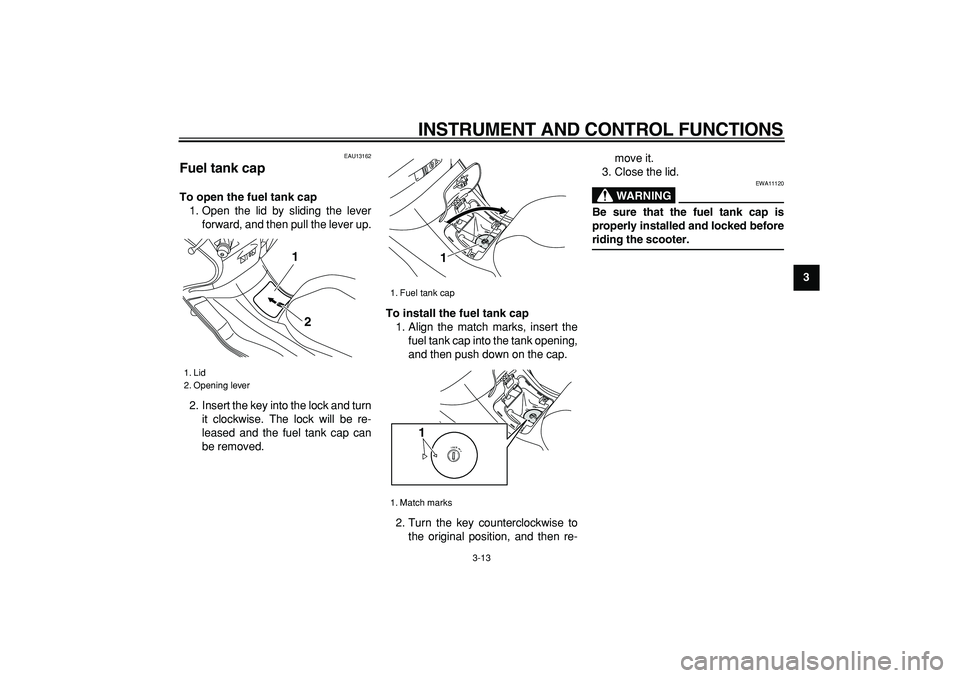
Fuel tank cap
To open the fuel tank cap
1. Open the lid by sliding the lever
forward, and then pull the lever up.
2. Insert the key into the lock and turn
it clockwise. The lock will be re-
leased and the fuel tank cap can
be removed.
To install the fuel tank cap
1. Align the match marks, insert the
fuel tank cap into the tank opening,
and then push down on the cap.
2. Turn the key counterclockwise to
the original position, and then re-move it.
3. Close the lid.
WARNING
EWA11120
Be sure that the fuel tank cap is
properly installed and locked before
riding the scooter.
1. Lid
2. Opening lever
2 1
1. Fuel tank cap
1. Match marks
1
1
Page 31 of 98
INSTRUMENT AND CONTROL FUNCTIONS
3-15
2
34
5
6
7
8
9
EAU34140
Seats
Rider seat
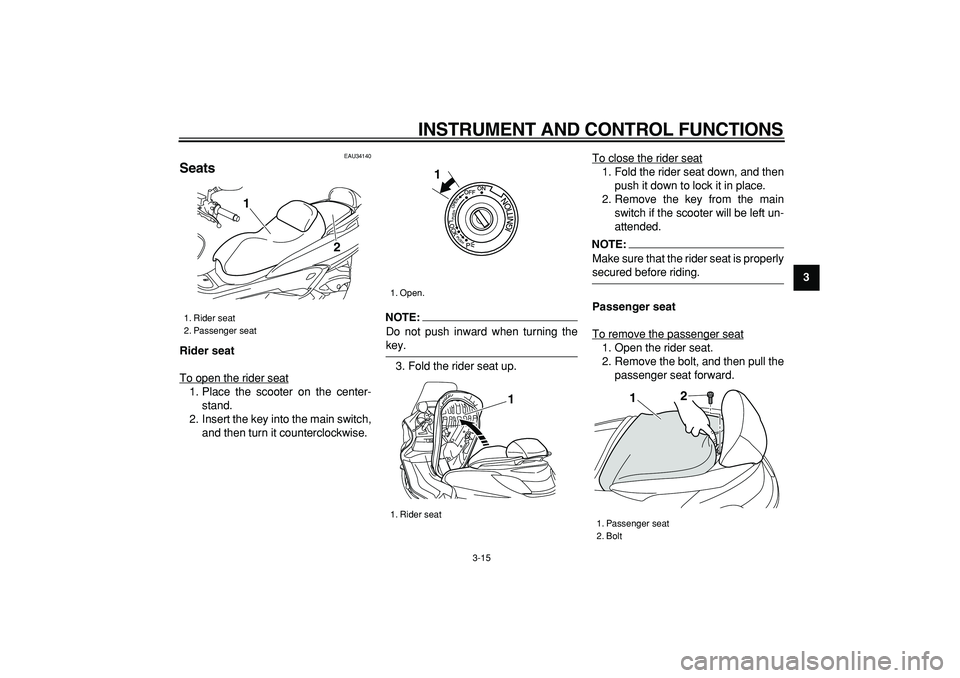
To open the rider seat
1. Place the scooter on the center-
stand.
2. Insert the key into the main switch,
and then turn it counterclockwise.
NOTE:
Do not push inward when turning the
key.
3. Fold the rider seat up.To close the rider seat
1. Fold the rider seat down, and then
push it down to lock it in place.
2. Remove the key from the main
switch if the scooter will be left un-
attended.NOTE:
Make sure that the rider seat is properly
secured before riding.
Passenger seat
To remove the passenger seat
1. Open the rider seat.
2. Remove the bolt, and then pull the
passenger seat forward.
1. Rider seat
2. Passenger seat
2 1
1. Open.
1. Rider seat
1
1
1. Passenger seat
2. Bolt
2
1
Page 33 of 98
INSTRUMENT AND CONTROL FUNCTIONS
3-17
2
34
5
6
7
8
9
EAU14492
Storage compartments
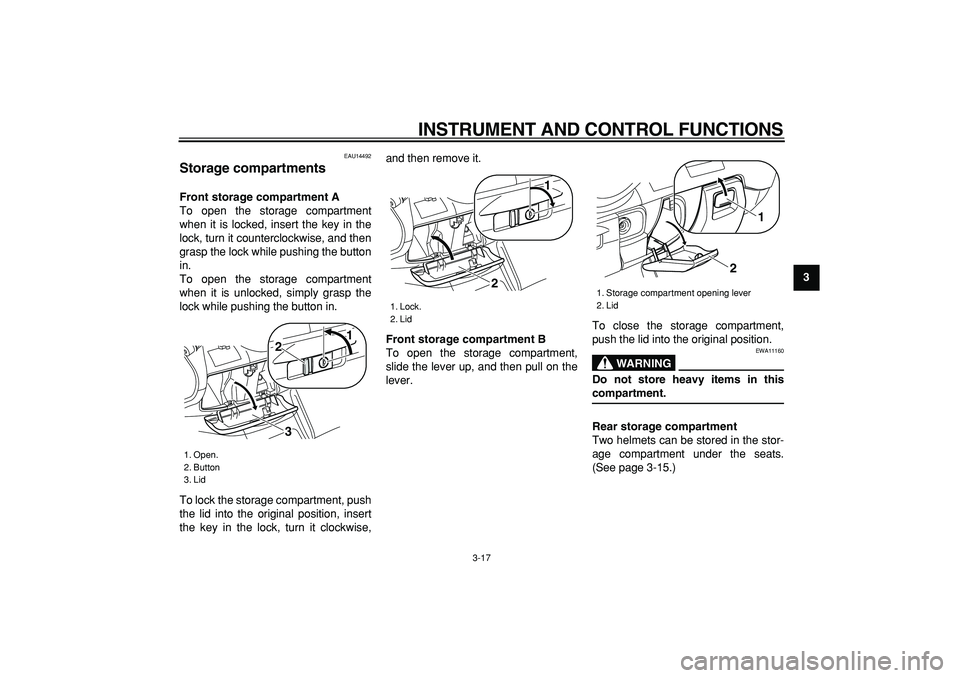
Front storage compartment A
To open the storage compartment
when it is locked, insert the key in the
lock, turn it counterclockwise, and then
grasp the lock while pushing the button
in.
To open the storage compartment
when it is unlocked, simply grasp the
lock while pushing the button in.
To lock the storage compartment, push
the lid into the original position, insert
the key in the lock, turn it clockwise,and then remove it.
Front storage compartment B
To open the storage compartment,
slide the lever up, and then pull on the
lever.To close the storage compartment,
push the lid into the original position.
WARNING
EWA11160
Do not store heavy items in this
compartment.
Rear storage compartment
Two helmets can be stored in the stor-
age compartment under the seats.
(See page 3-15.)
1. Open.
2. Button
3. Lid
23
1
1. Lock.
2. Lid
2
1
1. Storage compartment opening lever
2. Lid
2
1
Page 47 of 98

PERIODIC MAINTENANCE AND MINOR REPAIR
6-3
2
3
4
5
67
8
9
EAU1770A
Periodic maintenance and lubrication chart
NOTE:
�
The annual checks must be performed every year, except if a kilometer-based maintenance, or for the UK, a
mileage-based maintenance, is performed instead.
�
From 50000 km (30000 mi), repeat the maintenance intervals starting from 10000 km (6000 mi).
�
Items marked with an asterisk should be performed by a Yamaha dealer as they require special tools, data and technical
skills.
NO. ITEM CHECK OR MAINTENANCE JOBODOMETER READING
ANNUAL
CHECK 1000 km
(600 mi)10000 km
(6000 mi)20000 km
(12000 mi)30000 km
(18000 mi)40000 km
(24000 mi)
1*
Fuel line
�
Check fuel hoses for cracks or
damage.
√√√√√
2
Spark plug
�
Check condition.
�
Clean and regap.
√√
�
Replace.
√√
3*
Valves
�
Check valve clearance.
�
Adjust.Every 40000 km (24000 mi)
4
Air filter elements
�
Replace.
√√
5
V-belt case air filter
element
�
Clean.
√√√√
6*
Front brake
�
Check operation, fluid level
and vehicle for fluid leakage.
√√√√√√
�
Replace brake pads. Whenever worn to the limit
7*
Rear brake
�
Check operation, fluid level
and vehicle for fluid leakage.
√√√√√√
�
Replace brake pads. Whenever worn to the limit
8
Rear brake lock
�
Check operation.
�
Adjust.
√√√√√√
Page 68 of 98
PERIODIC MAINTENANCE AND MINOR REPAIR
6-24
1
2
3
4
5
6
7
8
9Tire information
This model is equipped with tubeless
tires.
WARNING
EWA10470
�
Have a Yamaha dealer replace
excessively worn tires. Besides
being illegal, operating the vehi-
cle with excessively worn tires
decreases riding stability and
can lead to loss of control.
�
The replacement of all wheel
and brake related parts, includ-
ing the tires, should be left to a
Yamaha dealer, who has the
necessary professional knowl-
edge and experience.
EAU21992
Cast wheels
To maximize the performance, durabil-
ity, and safe operation of your vehicle,
note the following points regarding the
specified wheels.
�
The wheel rims should be checked
for cracks, bends, warpage or
damage before each ride. If any
damage is found, have a Yamaha
dealer replace the wheel. Do not
attempt even the smallest repair to
the wheel. A deformed or cracked
wheel must be replaced.
�
The wheel should be balanced
whenever either the tire or wheel
has been changed or replaced. An
unbalanced wheel can result in
poor performance, adverse han-
dling characteristics, and a short-
ened tire life.
�
Ride at moderate speeds after
changing a tire since the tire sur-
face must first be “broken in” for it
to develop its optimal characteris-
tics.
�
After repairing or replacing the rear
tire, tighten the valve stem nut and
locknut to the specified torques.
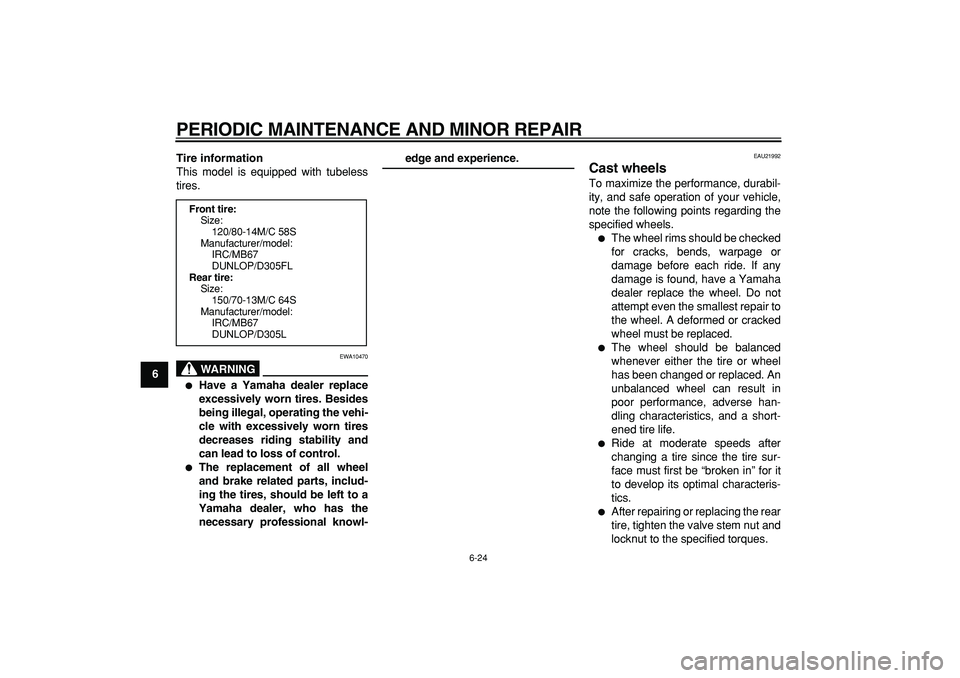
Front tire:
Size:
120/80-14M/C 58S
Manufacturer/model:
IRC/MB67
DUNLOP/D305FL
Rear tire:
Size:
150/70-13M/C 64S
Manufacturer/model:
IRC/MB67
DUNLOP/D305L