2008 VOLVO S60 flat tire
[x] Cancel search: flat tirePage 151 of 230

vehicle's tire information placard or the safety certification label, located on the B-Pillar or the driver's door or on the
inside of the fuel filler door on Canadian models, for the correct tire pressure for your vehicle.
11. Treadwear, Traction, and Temperature grades: See page 168
for more information.
12. Maximum permissible inflation pressure: the greatest amount of air pressure that should ever be put in the tire. This
limit is set by the tire manufacturer.
165 07 Wheels and tires
Glossary of tire terminology
Tire suppliers may have additional markings, notes or warnings such as standard load, radial tubeless, etc.
Tire information placard: A placard showing the OE (Original Equipment) tire sizes, recommended inflation
pressure, and the maximum weight the vehicle can carry.
Tire Identification Number (TIN): A number on the sidewall of each tire providing information about the tire
brand and manufacturing plant, tire size and date of manufacturer.
Inflation pressure: A measure of the amount of air in a tire.
Standard load: A class of P-metric or Metric tires designed to carry a maximum load at 35 psi [37 psi (2.5 bar) for
Metric tires]. Increasing the inflation pressure beyond this pressure will not increase the tires load carrying capability.
Extra load: A class of P-metric or Metric tires designed to carry a heavier maximum load at 41 psi [43 psi (2.9 bar)
for Metric tires]. Increasing the inflation pressure beyond this pressure will not increase the tires load carrying
capability.
kPa: Kilopascal, a metric unit of air pressure.
PSI: Pounds per square inch, a standard unit of air pressure.
B-pillar: The structural member at the side of the vehicle behind the front door.
Bead area of the tire: Area of the tire next to the rim.
Sidewall of the tire: Area between the bead area and the tread.
Tread area of the tire: Area of the perimeter of the tire that contacts the road when mounted on the vehicle.
Rim: The metal support (wheel) for a tire or a tire and tube assembly upon which the tire beads are seated.
Maximum load rating: a figure indicating the maximum load in pounds and kilograms that can be carried by the
tire. This rating is established by the tire manufacturer.
Maximum permissible inflation pressure: the greatest amount of air pressure that should ever be put in the tire.
This limit is set by the tire manufacturer.
Recommended tire inflation pressure: inflation pressure, established by Volvo, which is based on the type of tires
that are mounted on a vehicle at the factory. This inflation pressure is affected by the number of occupants in the
vehicle, the amount of cargo, and the speed at which the vehicle will be driven for a prolonged period. This
information can be found on the tire inflation placard(s) located on the driver's side B-pillar or on the inside of the fuel
filler door on Canadian models, and in the tire inflation table in this chapter.
Cold tires: The tires are considered to be cold when they have the same temperature as the surrounding (ambient)
air. This temperature is normally reached after the vehicle has been parked for at least 3 hours.
166 07 Wheels and tires
Vehicle loading
Properly loading your vehicle will provide maximum return of vehicle design performance.
Before loading your vehicle, familiarize yourself with the following terms for deter-mining your vehicle's weight
ratings, with or without a trailer, from the vehicle's Federal/ Canadian Motor Vehicle Safety Standards
(FMVSS/CMVSS) label, and the vehicle's tire information placard:
ProCarManuals.com
Page 154 of 230

The temperature grade for this tire is established for a tire that is properly inflated and not overloaded. Excessive
speed, under-inflation, or excessive loading, either separately or in combination, can cause heat buildup and tire
failure.
169 07 Wheels and tires
Snow chains, snow tires, studded tires
Snow chains
Snow chains can be used on your Volvo with the following restrictions:
Snow chains should be installed on front wheels only. Use only Volvo approved snow chains.
If accessory, aftermarket or "custom" tires and wheels are installed and are of a size different than the original tires
and wheels, chains in some cases CANNOT be used. Sufficient clearances between chains and brakes, suspension and
body components must be maintained.
Some strap -on type chains will interfere with brake components and therefore CANNOT be used.
All Wheel Drive models: Snow chains should only be installed on the front wheels. Only chains adapted for AWD
models should be used.
Consult your Volvo retailer for additional snow chain information.
CAUTION
Check local regulations regarding the use of snow chains before installing.
Always follow the chain manufacturer's installation instructions carefully. Install chains as tightly as possible and
retighten periodically.
Never exceed the chain manufacturer's specified maximum speed limit. (Under no circumstances should you
exceed 31 mph (50 km/h)).
Avoid bumps, holes or sharp turns when driving with snow chains.
The handling of the vehicle can be adversely affected when driving with chains. Avoid fast or sharp turns as well
as locked wheel braking.
Snow tires, studded tires
1
Tires for winter use:
Owners who live in or regularly commute through areas with sustained periods of snow or icy driving conditions are
strongly advised to fit suitable winter tires to help retain the highest degree of traction.
It is important to install winter tires on all four wheels to help retain traction during cornering, braking, and
accelerating. Failure to do so could reduce traction to an unsafe level or adversely affect handling.
Do not mix tires of different design as this could also negatively affect overall tire road grip.
Winter tires wear more quickly on dry roads in warm weather. They should be removed when the winter driving
season has ended.
Studded tires should be run-in 300-600 miles (500-1000 km) during which the vehicle should be driven as smoothly
as possible to give the studs the opportunity to seat properly in the tires. The tires should have the same rotational
direction throughout their entire lifetime.
1Where permitted
NOTE
ProCarManuals.com
Page 156 of 230
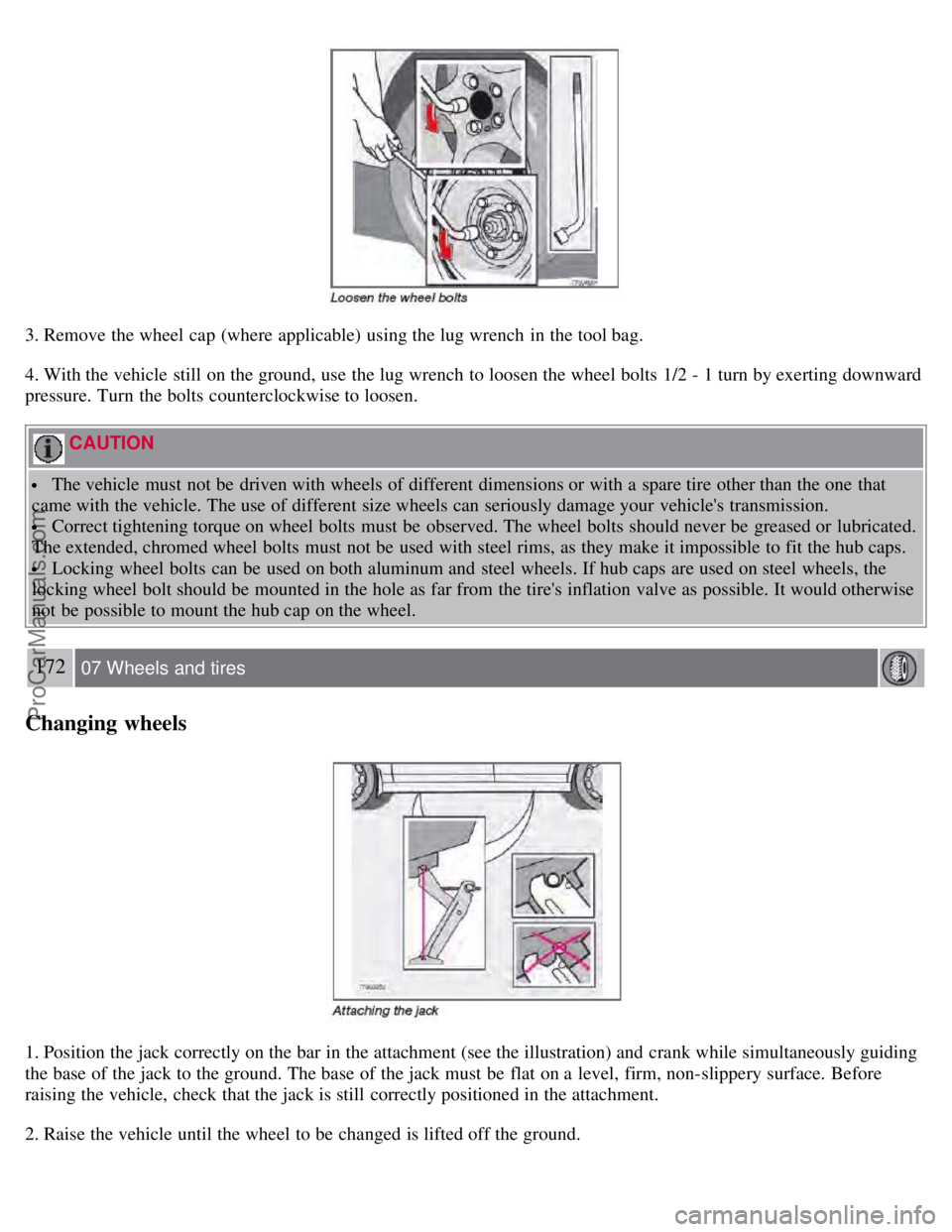
3. Remove the wheel cap (where applicable) using the lug wrench in the tool bag.
4. With the vehicle still on the ground, use the lug wrench to loosen the wheel bolts 1/2 - 1 turn by exerting downward
pressure. Turn the bolts counterclockwise to loosen.
CAUTION
The vehicle must not be driven with wheels of different dimensions or with a spare tire other than the one that
came with the vehicle. The use of different size wheels can seriously damage your vehicle's transmission.
Correct tightening torque on wheel bolts must be observed. The wheel bolts should never be greased or lubricated.
The extended, chromed wheel bolts must not be used with steel rims, as they make it impossible to fit the hub caps.
Locking wheel bolts can be used on both aluminum and steel wheels. If hub caps are used on steel wheels, the
locking wheel bolt should be mounted in the hole as far from the tire's inflation valve as possible. It would otherwise
not be possible to mount the hub cap on the wheel.
172 07 Wheels and tires
Changing wheels
1. Position the jack correctly on the bar in the attachment (see the illustration) and crank while simultaneously guiding
the base of the jack to the ground. The base of the jack must be flat on a level, firm, non-slippery surface. Before
raising the vehicle, check that the jack is still correctly positioned in the attachment.
2. Raise the vehicle until the wheel to be changed is lifted off the ground.
ProCarManuals.com
Page 229 of 230

Spare wheel106
Speedometer48
Stability systems139
Start inhibitor (immobilizer)110
Starting the car127
Steering wheel lock128
Stone chips, touching up181
STOP ENGINE53
Storage compartments99, 100, 101, 102
Studded tires169
Sun visor77
Supplemental Restraint
System (SRS) - warning light49
Suspension251
T
Tachometer48
Temperature control87
Temperature gauge48
Text window - messages52
Three-way catalytic converter250
TIME FOR REGULAR SERVICE53
Tire designations164
Tire economy, improving157
Tire inflation158
Tire inflation pressure table
Canadian models161
US models160
Tire inflation pressure, checking159
Tire Pressure Monitoring System162
indicator light51
Tires
rotation174
Towing - cars with All Wheel Drive142
Towing a trailer144
Towing the car141
Trailer hitch - detachable146
Trailer indicator lamp51
Trailer towing144
Transmission
Geartronic134, 135
Transmission - automatic132
Tread wear indicator156
Trip computer64
Trip odometer48
ProCarManuals.com
Page 230 of 230

Trunk
opening from the inside116
unlocking/locking115
Turn signals60
U
Uniform Tire Quality Grading168
Unlocking the car115
Unlocking the trunk115
Upholstery, cleaning180
V
Valet key110
Valet locking54
Vanity mirror98
Vehicle dimensions244
Vehicle Event Data186
Vehicle Identification Number (VIN)243
Vehicle loading166
VIN (Vehicle Identification Number)243
Volvo and the environment7
Volvo Customer Care Center, contacting1
Volvo Inflatable Curtain26
Volvo On Call Roadside Assistance252
W
Warranties186
Washer fluid reservoir191, 195
Washing the car178
Water, driving through130
Waxing179
Weight distribution130
Weights245
Wheels
changing172
storing156
Whiplash Protection System (WHIPS)28
Windshield washer fluid reservoir195
Windshield wipers61
Winter/Wet driving mode133, 149
Contents | Top of Page
ProCarManuals.com