2008 VOLVO S60 oil type
[x] Cancel search: oil typePage 78 of 230

If your vehicle has been parked in the sun in warm weather, opening the windows and moonroof (option) for several
minutes before driving will help release the warm air from the passenger compartment. When the engine is running,
close the windows and moonroof and use the recirculation function for several minutes to enable the air conditioning
to cool the compartment as quickly as possible.
Windows and optional moonroof
The ECC system will function best if the windows and optional moonroof are closed. If you drive with the moonroof
open, we recommend that you manually adjust the temperature and blower control (the LED in the AUTO switch
should be off).
Acceleration
The air conditioning is momentarily disengaged during full-throttle acceleration.
Climate control maintenance
Special tools and equipment are required to maintain and carry out repairs on the climate system. Work of this type
should only be done by a trained and qualified Volvo service technician.
Refrigerant
Volvo cares about the environment. The air conditioning system in your vehicle contains a CFC-free refrigerant -
R134a (HFC134a). This substance will not deplete the ozone layer. The system contains 1.5 lbs (700 g) R134a and
uses PAG oil.
Climate system blower
The climate system blower will be automatically switched off when the engine is not running (even if the ignition key
is in position I or II) to avoid unnecessary battery drain. To activate the blower, turn the control to the desired setting.
Passenger compartment blower
Approximately 50 minutes after the ignition is turned off, the blower may come on automatically, and run for seven
minutes, to remove condensation in the A/C evaporator.
85 03 Climate
Air distribution
Air distribution
ProCarManuals.com
Page 137 of 230

The attachment brackets for the load carriers are located under the roof molding.
1. Make sure that the load carriers are placed in the right direction. See the mark on the decal under the cover.
2. Press the guide lugs into the holes (1).
3. Carefully lower the opposite side of the load carrier to the roof.
4. Loosen the tightening wheel slightly. Slide the hook on the load carrier attachment into the attachment bracket under
the roof molding.
5. Turn the tightening wheel to secure the load carrier in the attachment bracket.
148 06 Starting and driving
Load carriers (accessory)
6. Repeat this procedure for the other load carrier attachments.
7. Check that the hooks on all four load carrier attachments are securely tightened in the respective attachment brackets
on the roof of the vehicle.
8. Press down the covers.
Check periodically that the load carriers and load are properly secured.
149 06 Starting and driving
Cold weather precautions
If you wish to check your vehicle before the approach of cold weather, the following advice is worth noting:
Make sure that the engine coolant contains 50 percent antifreeze. Any other mixture will reduce freeze protection.
This gives protection against freezing down to - 31°F (-35°C). See section "Coolant". The use of "recycled"
antifreeze is not approved by Volvo. Different types of antifreeze must not be mixed.
Volvo recommends using only genuine Volvo antifreeze in your vehicle's radiator. Your Volvo retailer stocks plenty
of Volvo engine coolant to protect your vehicle during cold weather.
Try to keep the fuel tank well filled - this prevents the formation of condensation in the tank. In addition, in
extremely cold weather conditions it is worthwhile to add fuel line de -icer before refueling.
The viscosity of the engine oil is important. Oil with low viscosity (thinner oil) improves cold-weather starting as
ProCarManuals.com
Page 138 of 230
well as decreasing fuel consumption while the engine is warming up. For winter use, 5W - 30 oil, particularly the
synthetic type1, is recommended. Be sure to use good quality oil but do not use cold-weather oil for hard driving or in
warm weather. See section "Engine oil" for more information.
The load placed on the battery is greater during the winter since the windshield wipers, lighting, etc. are used more
often. Moreover, the capacity of the battery decreases as the temperature drops. In very cold weather, a poorly charged
battery can freeze and be damaged. It is therefore advisable to check the state of charge more frequently and spray an
antirust oil on the battery posts.
Volvo recommends the use of snow tires on all four wheels for winter driving - see section "Wheels and tires."
To prevent the washer fluid reservoir from freezing, add washer solvents containing antifreeze (see page 195 for
the location of the washer fluid reservoir). This is important since dirt is often splashed on the windshield during
winter driving, requiring the frequent use of the washers and wipers. Volvo Washer Solvent should be diluted as
follows:
- Down to 14° F (-10° C): 1 part washer solvent and 4 parts water
- Down to 5° F (-15° C): 1 part washer solvent and 3 parts water
- Down to 0° F (-18° C): 1 part washer solvent and 2 parts water
- Down to -18° F (-28° C): 1 part washer solvent and 1 part water
Use Volvo Teflon Lock Spray in the locks.
1Synthetic oil is not used when the oil is changed at the normal maintenance service intervals.
NOTE
Avoid the use of de -icing sprays as they can cause damage to the locks.
W - Winter/Wet driving mode - enhanced vehicle traction (automatic transmission)
Mode W will only function if the gear selector is in the D position.
Press the button at the base of the gear selector to engage/disengage this driving mode.
An LED in the button will light up to indicate that W is engaged and this will also be displayed in the instrument
panel (see page 48
).
This mode may be selected for starting/moving off on slippery roads.
150 06 Starting and driving
Before a long distance trip
It is always worthwhile to have your vehicle checked by a trained and qualified Volvo service technician before
driving long distances. Your retailer or service technician will also be able to supply you with bulbs, fuses, spark plugs
and wiper blades for your use in the event that problems occur.
As a minimum, the following items should be checked before any long trip:
Check that engine runs smoothly and that fuel consumption is normal.
Check for fuel, oil, and fluid leakage.
Check transmission oil level1.
Check condition of drive belts.
Check state of the battery's charge.
Examine tires carefully (the spare tire as well), and replace those that are worn. Check tire pressures.
The brakes, front wheel alignment, and steering gear should be checked by a trained and qualified Volvo service
technician only.
Check all lights, including high beams.
Reflective warning triangles are legal requirement in some countries.
ProCarManuals.com
Page 143 of 230
covered roads, we recommend suitable winter tires on all four wheels.
When replacing tires, be sure that the new tires are the same size designation, type (radial) and preferably from the
same manufacturer, on all four wheels. Otherwise there is a risk of altering the vehicle's roadholding and handling
characteristics.
Storing wheels and tires
When storing complete wheels (tires mounted on rims), they should be suspended off the floor or placed on their sides
on the floor.
Tires not mounted on rims should be stored on their sides or standing upright, but should not be suspended.
CAUTION
Tires should preferably be stored in a cool, dry, dark place, and should never be stored in close proximity to
solvents, gasoline, oils, etc.
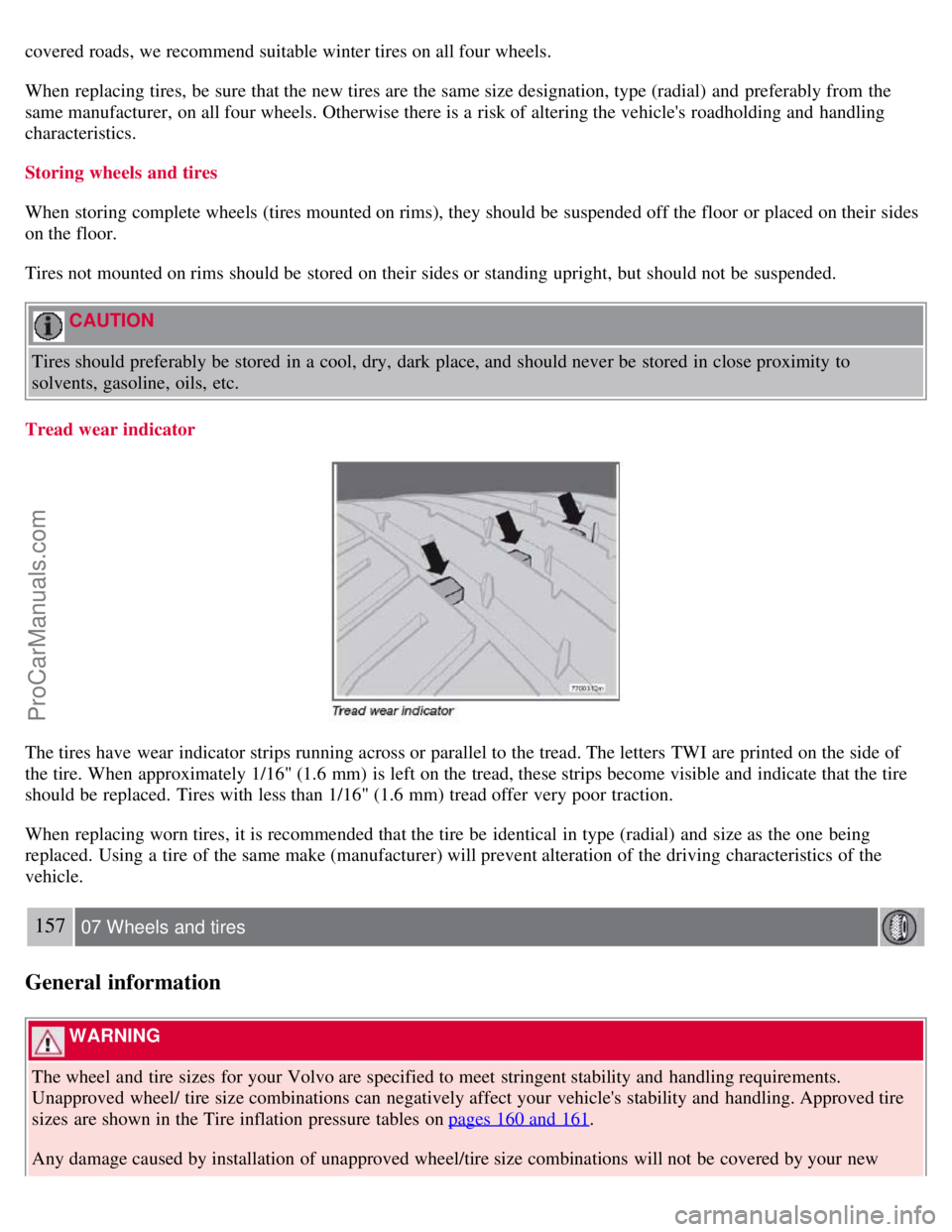
Tread wear indicator
The tires have wear indicator strips running across or parallel to the tread. The letters TWI are printed on the side of
the tire. When approximately 1/16" (1.6 mm) is left on the tread, these strips become visible and indicate that the tire
should be replaced. Tires with less than 1/16" (1.6 mm) tread offer very poor traction.
When replacing worn tires, it is recommended that the tire be identical in type (radial) and size as the one being
replaced. Using a tire of the same make (manufacturer) will prevent alteration of the driving characteristics of the
vehicle.
157 07 Wheels and tires
General information
WARNING
The wheel and tire sizes for your Volvo are specified to meet stringent stability and handling requirements.
Unapproved wheel/ tire size combinations can negatively affect your vehicle's stability and handling. Approved tire
sizes are shown in the Tire inflation pressure tables on pages 160 and 161
.
Any damage caused by installation of unapproved wheel/tire size combinations will not be covered by your new
ProCarManuals.com
Page 170 of 230

The drive belt is equipped with a self -tensioning mechanism and requires no adjustment between changes.
WARNING
The engine must not be running when this check is performed.
Check coolant level
The cooling system must be filled with coolant and not leak to operate at maximum efficiency. Check the coolant level
regularly. The level should be between the "MAX" and "MIN" marks on the expansion tank. The check should be made
with particular thoroughness when the engine is new or when the cooling system has been drained.
Do not remove the filler cap other than for topping up with coolant. Frequent removal may prevent coolant circulation
between the engine and the expansion tank during engine warm up and cooling.
Changing coolant
Normally, the coolant does not need to be changed. If the system must be drained, consult a trained and qualified Volvo
service technician.
NOTE
Do not top off with water only. This reduces the rust-protective and antifreeze qualities of the coolant and has a lower
boiling point. It can also cause damage to the cooling system if it should freeze. Top off with Volvo Genuine
Coolant/Antifreeze only (a 50/50 mix of water and antifreeze)
CAUTION
The cooling system must always be kept filled to the correct level. If it is not kept filled, there can be high local
temperatures in the engine which could result in damage. Different types of antifreeze/coolant may not be mixed.
WARNING
Never remove the radiator cap while the engine is warm. Wait until the vehicle cools.
191 09 Maintenance and servicing
Hood and engine compartment
ProCarManuals.com
Page 173 of 230

The upper section describes the oil's performance level.
The center identifies the oil's viscosity.
The lower section indicates whether the oil has demonstrated energy-conserving properties in a standard test in
comparison to a reference oil.
NOTE
Volvo uses different systems to indicate a low oil level or pressure. Some models have an oil pressure sensor, in which
case a warning symbol (see page 50
) is used to indicate low oil pressure. Other models have an oil level sensor, in
which case the driver is alerted by the warning symbol in the center of the instrument panel and a text in the information
display. Some models use both systems. Contact a trained and qualified Volvo service technician for more information.
Changing engine oil and oil filter
See the previous page for oil specifications and page 246
for oil volumes. Refer to the Warranty and Service Records
Information booklet for information on the oil change intervals.
NOTE
Volvo does not recommend the use of oil additives.
Synthetic oil is not used when the oil is changed at the normal maintenance intervals except at owner request and at
additional charge. Please consult a trained and qualified Volvo service technician.
Checking and adding oil
The oil level should be checked every time the vehicle is refueled. This is especially important during the period up to the
first scheduled maintenance service.
The vehicle should be parked on a level surface when the oil is checked.
If the engine is warm , wait for at least 10- 15 minutes after the engine has been switched off before checking the oil.
Checking the oil
1. Pull out the dipstick and wipe it with a lint-free rag.
2. Reinsert the dipstick, pull it out, and check the oil level.
3. Add oil if necessary. If the level is close to the MIN mark, add approximately 1 US quart (1 liter) of oil.
4. Run the engine until it reaches normal operating temperature.
5. Switch off the engine and wait for at least 10-15 minutes and recheck the oil level. If necessary, add oil until the level
is near the mark.
194 09 Maintenance and servicing
Engine oil
CAUTION
Not checking the oil level regularly can result in serious engine damage if the oil level becomes too low.
Never fill oil above the MAX mark. This could cause an increase in oil consumption.
Not checking the oil level regularly can result in serious engine damage if the oil level becomes too low.
Always add oil of the same type and viscosity as already used.
ProCarManuals.com
Page 175 of 230

Normally, the coolant does not need to be changed. If the system must be drained, consult a trained and qualified Volvo
service technician.
NOTE
Do not top off with water only. This reduces the rust-protective and antifreeze qualities of the coolant and has a lower
boiling point. It can also cause damage to the cooling system if it should freeze. Top off with Volvo Genuine
Coolant/Antifreeze only (a 50/50 mix of water and antifreeze)
CAUTION
The cooling system must always be kept filled to the correct level. If it is not kept filled, there can be high local
temperatures in the engine which could result in damage. Different types of antifreeze/coolant may not be mixed.
Check coolant regularly!
WARNING
Never remove the radiator cap while the engine is warm. Wait until the vehicle cools.
If it is necessary to top up the coolant when the engine is warm, unscrew the expansion tank cap slowly so that the
overpressure dissipates.
196 09 Maintenance and servicing
Fluids
Clutch and brake fluid reservoir
ProCarManuals.com
Page 176 of 230

The clutch and brake fluid should always be above the MIN mark on the side of the reservoir. Check, without removing
the cap, that there is sufficient fluid in the reservoir.
Fluid type: DOT 4+ boiling point >536 °F (280 °C), P/N 9437433.
Replace: Every second year or 30,000 miles (48,000 km). The fluid should be replaced once a year or every 15,000 miles
(24,000 km) when driving under extremely hard conditions (mountain driving, etc.).
Always entrust brake fluid changing to a trained and qualified Volvo service technician.
Power steering fluid reservoir
The fluid level should always be between the ADD and FULL marks.
Fluid type: Volvo synthetic power steering fluid (Pentosin CHF 11S) P/N 1161529 or equivalent.
Replace: No fluid change required.
NOTE
If a problem should occur in the power steering system or if the vehicle has no electrical current and must be towed, it is
still possible to steer the vehicle. However, keep in mind that greater effort will be required to turn the steering wheel.
197 09 Maintenance and servicing
Wiper blades
Windshield wiper blades
ProCarManuals.com