Page 340 of 512
340 3-7. Other interior features
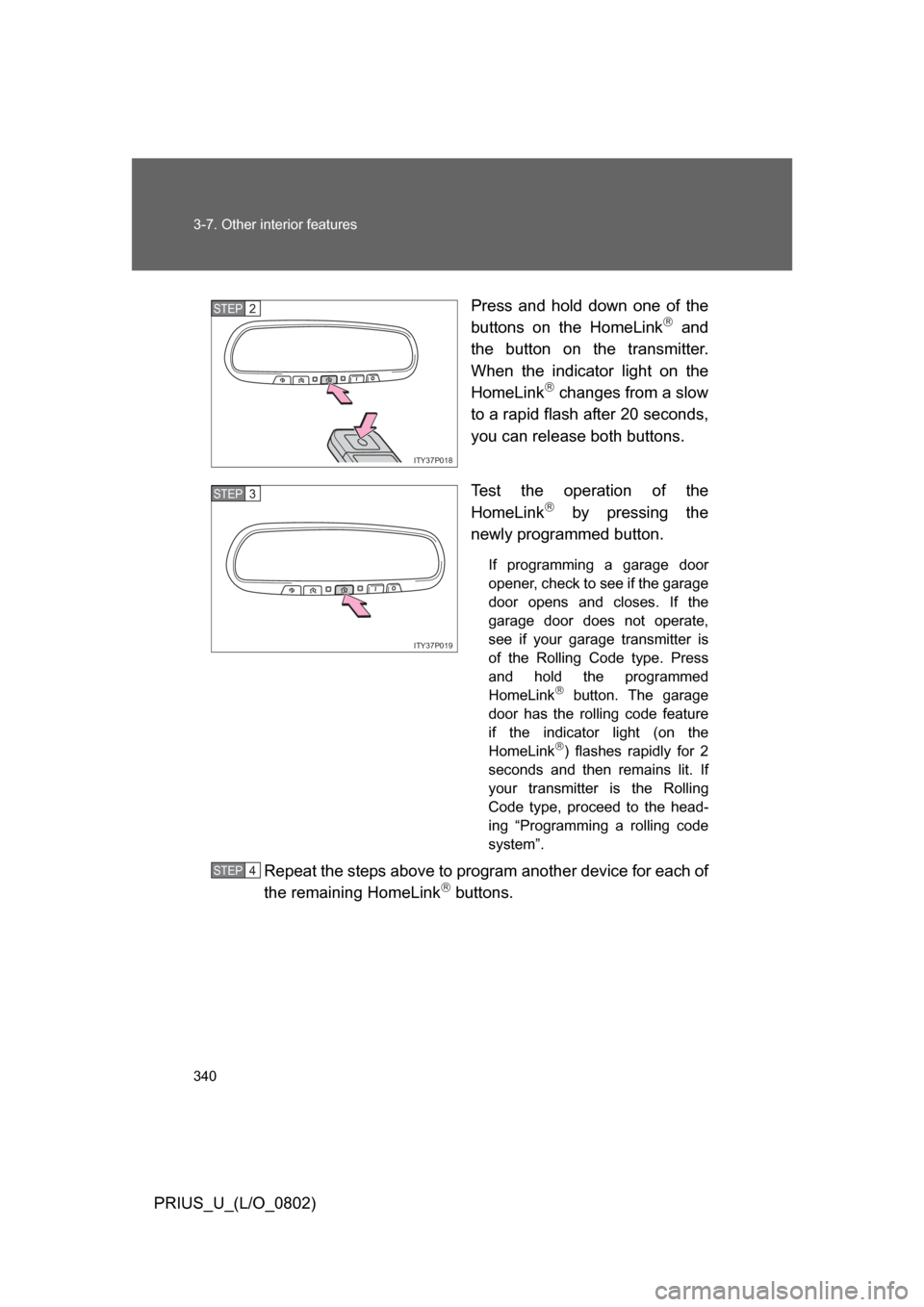
PRIUS_U_(L/O_0802)Press and hold down one of the
buttons on the HomeLink
and
the button on the transmitter.
When the indicator light on the
HomeLink
changes from a slow
to a rapid flash after 20 seconds,
you can release both buttons.
Test the operation of the
HomeLink
by pressing the
newly programmed button.
If programming a garage door
opener, check to see if the garage
door opens and closes. If the
garage door does not operate,
see if your garage transmitter is
of the Rolling Code type. Press
and hold the programmed
HomeLink
button. The garage
door has the rolling code feature
if the indicator light (on the
HomeLink
) flashes rapidly for 2
seconds and then remains lit. If
your transmitter is the Rolling
Code type, proceed to the head-
ing “Programming a rolling code
system”.
Repeat the steps above to program another device for each of
the remaining HomeLink buttons.
ITY37P018
STEP2
ITY37P019
STEP3
STEP4
Page 342 of 512
342 3-7. Other interior features
PRIUS_U_(L/O_0802)Test the operation of the HomeLink
by pressing the newly
programmed button. Check to se e if the gate/device operates
correctly.
Repeat the steps above to program another device for each of
the remaining HomeLink
buttons.
■ Programming other devices
To program other devices such as home security systems, home
door locks or lighting, contact your authorized Toyota dealer for
assistance.
■ Reprogramming a button
The individual HomeLink
buttons cannot be erased but can be
reprogrammed. To reprogram a button, follow the “Basic program-
ming” instructions.
Operating the HomeLink
Press the appropriate HomeLink button. The HomeLink indicator
light on the HomeLink transceiver should turn on.
The HomeLink continues to send a signal for up to 20 seconds as long
as the button is pressed.
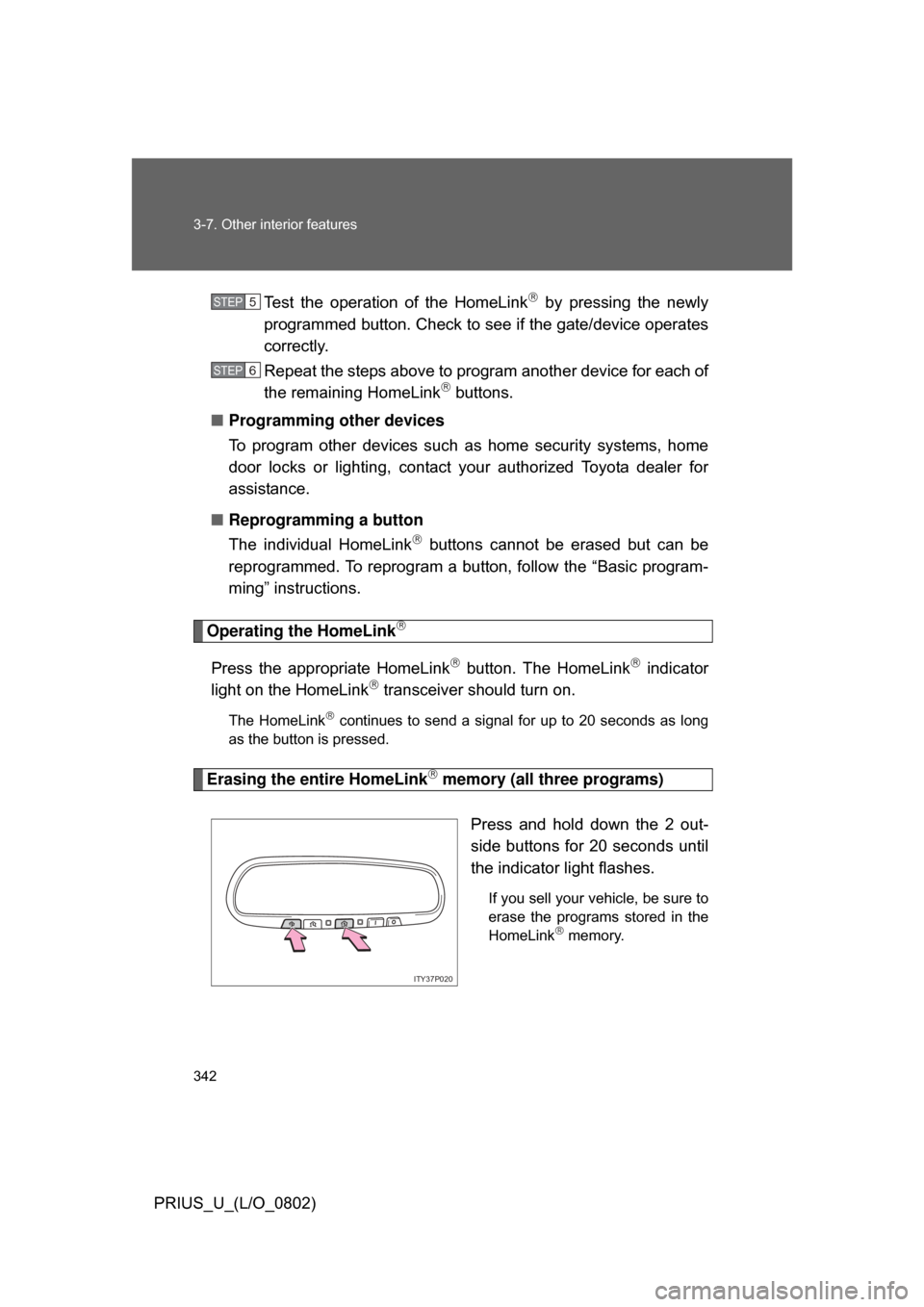
Erasing the entire HomeLink memory (all three programs)
Press and hold down the 2 out-
side buttons for 20 seconds until
the indicator light flashes.
If you sell your vehicle, be sure to
erase the programs stored in the
HomeLink
memory.
STEP5
STEP6
ITY37P020
Page 345 of 512
Maintenance and care4
345
PRIUS_U_(L/O_0802)
4-1. Maintenance and care ............................... 346
Cleaning and protecting the vehicle’s exterior ............ 346
Cleaning and protecting the vehicle’s interior ............. 348
4-2. Maintenance ................... 351 Maintenance requirements .................. 351
General maintenance....... 353
Emission inspection and maintenance (I/M)
programs ........................ 356
4-3. Do-it-yourself maintenance ................. 357
Do-it-yourself service precautions .................... 357
Hood ................................ 361
Positioning a floor jack ..... 362
Engine compartment ........ 364
Tires ................................. 379
Tire inflation pressure ...... 388
Wheels ............................. 392
Air conditioning filter......... 394
Key battery ....................... 396
Checking and replacing fuses .............................. 398
Light bulbs........................ 407
Page 346 of 512
346
PRIUS_U_(L/O_0802)
4-1. Maintenance and care
Cleaning and protecting the vehicle’s exterior
■Automatic car washes
● Fold the mirrors back before washing the vehicle.
● Brushes used in automatic car washes may scratch the vehicle surface
and harm your vehicle’s paint.
■ High pressure automatic car washes
Do not allow the nozzles of the car wash to come within close proximity of
the windows. Before entering an automatic car wash, check that the fuel filler
door is closed.
■ Aluminum wheels
Remove any dirt immediately by using a neutral detergent. Do not use hard
brushes or abrasive cleaners. Do not use strong or harsh chemical cleaners.
Use the same mild detergent and wax as used on the paint.
■ Bumpers and side moldings
Do not scrub with abrasive cleaners.
Perform the following to protect the vehicle and maintain it in prime
condition.
● Working from top to bottom, liber ally apply water to the vehicle
body, wheel wells and underside of the vehicle to remove any
dirt and dust.
Wash the vehicle body using a sponge or soft cloth, such as a cham-
ois.
● For hard-to-remove marks, use car wash soap and rinse thor-
oughly with water.
● Wipe away any water.
● Wax the vehicle when the waterproof coating deteriorates.
If water does not bead on a clean surface, apply wax when
the vehicle body is cool.
Page 349 of 512
349
4-1. Maintenance and care
4
Maintenance and care
PRIUS_U_(L/O_0802)
■
Cleaning the inside of the rear window
Do not use glass cleaner to clean the rear window, as this may cause dam-
age to the rear window defogger heater wires. Use a cloth dampened with
lukewarm water to gently wipe the window clean. Wipe the window in
strokes running parallel to the heater wires.
■ Caring for leather areas
Toyota recommends cleaning the interior of the vehicle at least twice a year
to maintain the quality of the vehicle’s interior.
■ Shampooing the carpets
There are several commercial foaming-type cleaners available. Use a
sponge or brush to apply the foam. Rub in overlapping circles. Do not apply
water. The excellent results are obtained by keeping the carpet as dry as
possible.
■ Seat belts
Clean with mild soap and lukewarm water using a cloth or sponge. Also
check the belts periodically for excessive wear, fraying or cuts.
CAUTION
■Water in the vehicle
● Be careful not to splash or spill liquid on the floor.
● Do not get any of the SRS components or wiring in the vehicle interior wet.
(P. 9 0 )
Electrical malfunction may cause the airbags to deploy or not function
properly, resulting in death or serious injury.
Page 351 of 512
351
4
Maintenance and care
PRIUS_U_(L/O_0802)
4-2. Maintenance
Maintenance requirements
■Repair and replacement
It is recommended that genuine Toyota parts be used for repair to ensure
performance of each system. If non-Toyota parts are used in replacement or
if a repair shop other than a Toyota dealer performs repairs, confirm the war-
ranty coverage.
To ensure safe and economical driv ing, day-to-day care and regular
maintenance is essential. It is the owner’s responsibility to perform
regular checks. Toyota recommen ds the following maintenance.
■General maintenance
Should be performed on a daily basis. This can be done by your-
self or by a Toyota dealer.
■ Scheduled maintenance
Should be performed at specified intervals according to the
maintenance schedule.
For details about maintenance items and schedules, refer to the
“Scheduled Maintenance Guide” or “Owner’s Manual Supplement”.
■Do-it-yourself maintenance
You can perform some maintenance procedures yourself.
Please be aware that do-it-yourself maintenance may affect war-
ranty coverage.
The use of Toyota Repair Manuals are recommended.
For details about warranty coverage, see the separate “Owner’s War-
ranty Information Booklet” or “Owner’s Manual Supplement”.
Page 353 of 512
353
4-2. Maintenance
4
Maintenance and care
PRIUS_U_(L/O_0802)
General maintenance
Engine compartment
Luggage compartment
ItemsCheck points
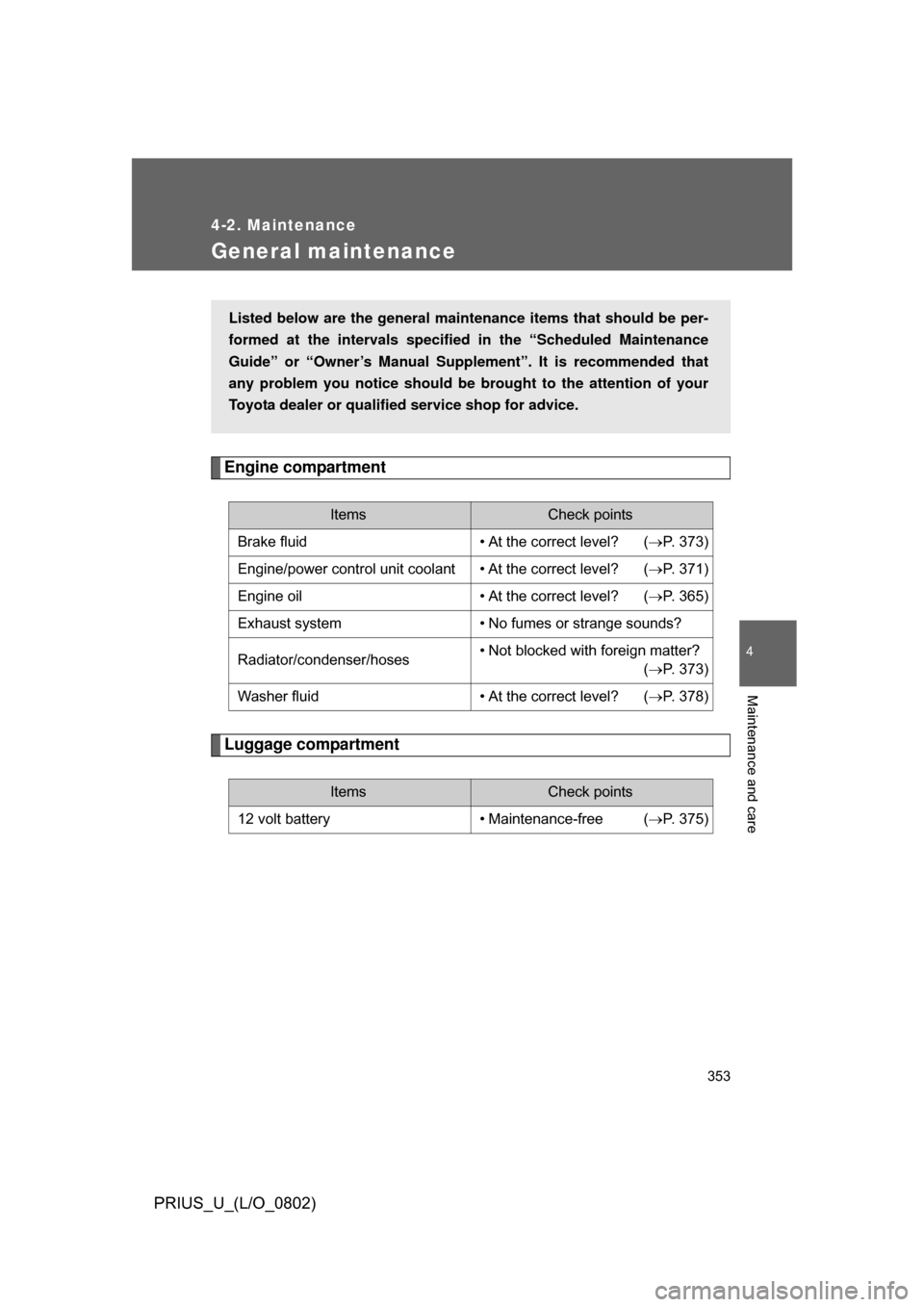
Brake fluid • At the correct level? ( P. 373)
Engine/power control unit coolant • At the correct level? ( P. 371)
Engine oil • At the correct level? ( P. 365)
Exhaust system • No fumes or strange sounds?
Radiator/condenser/hoses • Not blocked with foreign matter?
(P. 373)
Washer fluid • At the correct level? (P. 378)
ItemsCheck points
12 volt battery • Maintenance-free (P. 375)
Listed below are the general maintenance items that should be per-
formed at the intervals specified in the “Scheduled Maintenance
Guide” or “Owner’s Manual Supp lement”. It is recommended that
any problem you notice should be brought to the attention of your
Toyota dealer or qualified service shop for advice.
Page 354 of 512
354 4-2. Maintenance
PRIUS_U_(L/O_0802)
Vehicle interior
ItemsCheck points
Accelerator pedal • Moves smoothly (without uneven pedal
effort or catching)?
Automatic transmission
“Park” mechanism • Can the vehicle be hold securely on an
incline with the shift lever in “P”?
Brake pedal • Moves smoothly?
• Does it have appropriate clearance and
correct amount of free play?
Brakes • Pulls to one side when applied?
• Loss of brake effectiveness?
• Spongy feeling brake pedal?
• Pedal almost touches floor?
Head restraints • Move smoothly and lock securely?
Indicators/buzzers • Function properly?
Lights • Do all the lights come on?
Parking brake • Moves smoothly?
• Can hold the vehicle securely on an
incline?
Seat belts • Does the seat belt system operate
smoothly?
• Are the belts undamaged?
Seats • Do the seat controls operate properly?
Steering wheel • Moves smoothly?
• Has correct free play?
• No strange noises?