Page 232 of 531

234 2−5. Driving information
lNote that when making a turn, the trailer wheels will be closer than
the vehicle wheels to the inside of the turn. Compensate by making
a larger than normal turning radius.
lCrosswinds and rough roads will adversely affect handling of your
vehicle and trailer, causing sway
. Periodically check the rear to
prepare for being passed by large trucks or buses, which may
cause your vehicle and trailer to sway. If swaying occurs, firmly grip
the steering wheel, reduce speed immediately but gradually, and
steer straight ahead. Never increase speed. If you make no
extreme correction with the stee ring or brakes, your vehicle and
trailer will stabilize.
lTake care when passing other vehicles. Passing requires consider−
able distance. After passing a vehi
cle, do not forget the length of
your trailer, and be sure you hav e plenty of room before changing
lanes.
lIn order to maintain engine braking efficiency when driving on a
long steep downgrade, do not use overdrive. Transmission shift
range position must be in “4”, in “S” mode.
lDue to the added load of the trailer, your vehicle’s engine may
overheat on hot days (at temperatur
es over 85°F [30°C] when driv−
ing up a long or steep grade. If the engine coolant temperature
gauge indicates overheating, immediately turn off the air condition−
ing (if in use), pull your vehicle off
the road and stop in a safe spot.
( P. 488)
Page 234 of 531
236 2−5. Driving information
nBefore towing
Check that the following conditions are met:
lThe vehicle’s tires are properly inflated.
lTrailer tires are inflated according to the trailer manufacturer ’s recom−
mendation.
lAll trailer lights work.
lAll lights work each time you connect them.
lThe trailer ball is set up at the proper height for the coupler on the trailer.
lThe vehicle remains level when a loaded or unloaded trailer is hitched.
Do not drive if the vehicle is not level, and check for improper tongue
load, overloading, worn suspension, or other possible causes.
lThe trailer cargo is securely loaded.
lThe rear view mirrors conform to all applicable federal, state/provincial or
local regulations. If they do not, install rear view mirrors appropriate for
towing purposes.
nBreakin schedule
Toyota recommends that you do not use a new vehicle or a vehicle with any
new power train components (engine, transmission, differential, wheel bear−
ings, etc.) to tow a trailer for the first 500 miles (800 km) of driving.
nMaintenance
lIf you tow a trailer, your vehicle will require more frequent maintenance
due to the additional load. (See “Scheduled Maintenance Guide” or
“Owner ’s Manual Supplement”.)
lRetighten the fixing bolts of the towing ball after approximately 600 miles
(1000 km) of trailer towing.
Page 362 of 531
367
4−2. Maintenance
4
Maintenance and care
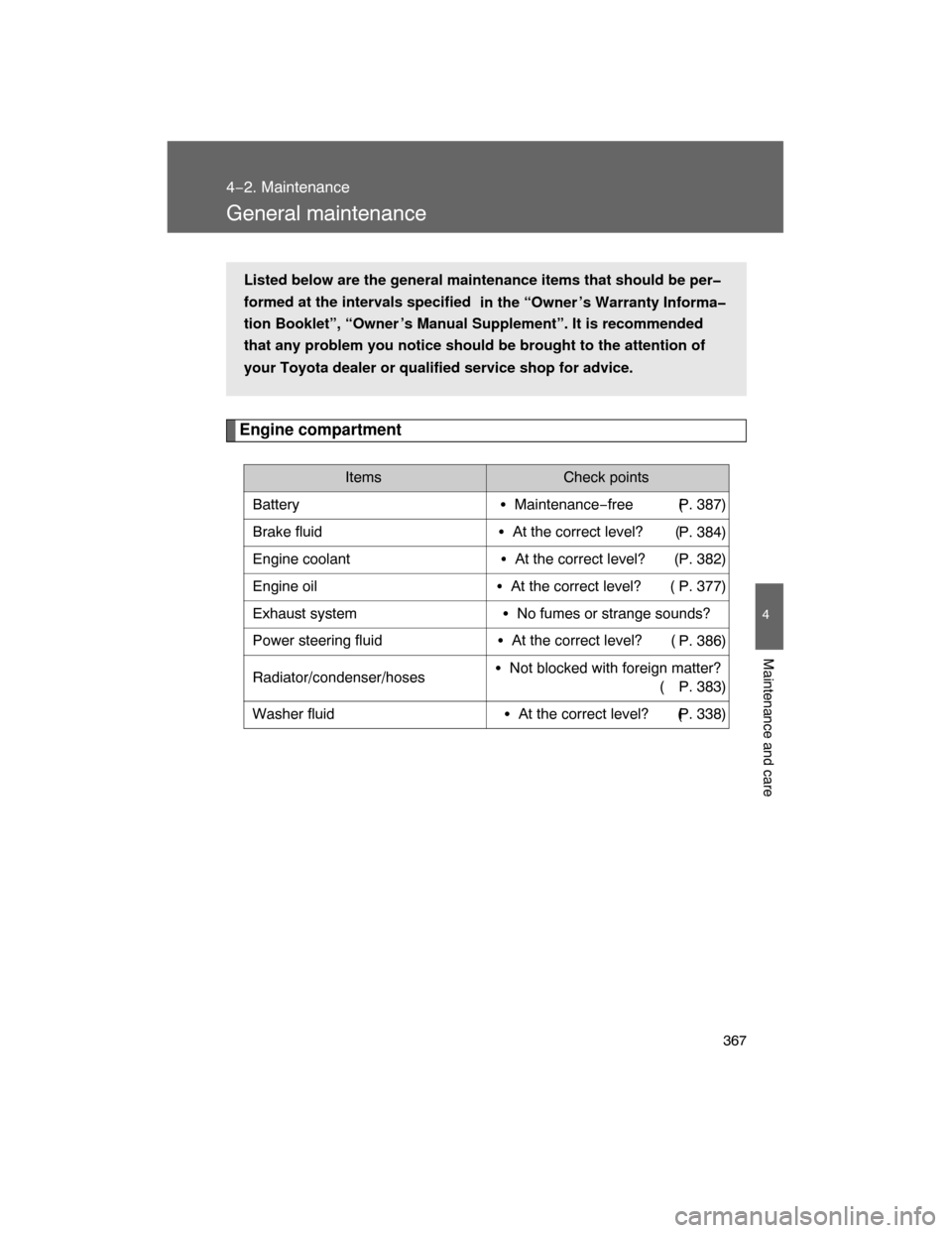
General maintenance
Engine compartment
Items Check points
Battery�Maintenance−free (
P. 387)
Brake fluid�At the correct level? (
P. 384)
Engine coolant�At the correct level? (
P. 382)
Engine oil�At the correct level? (
P. 377)
Exhaust system�No fumes or strange sounds?
Power steering fluid�At the correct level? (
P. 386)
Radiator/condenser/hoses�Not blocked with foreign matter?
( P. 383)
Washer fluid�At the correct level? (
P. 338)
Listed below are the general maintenance items that should be per
formed at the intervals specified
in the “Owner ’s Warranty Informa
tion Booklet”, “Owner ’s Manual Supplement”. It is recommended
that any problem you notice should be brought to the attention of
your Toyota dealer or qualified service shop for advice.
Page 364 of 531
369
4−2. Maintenance
4
Maintenance and care
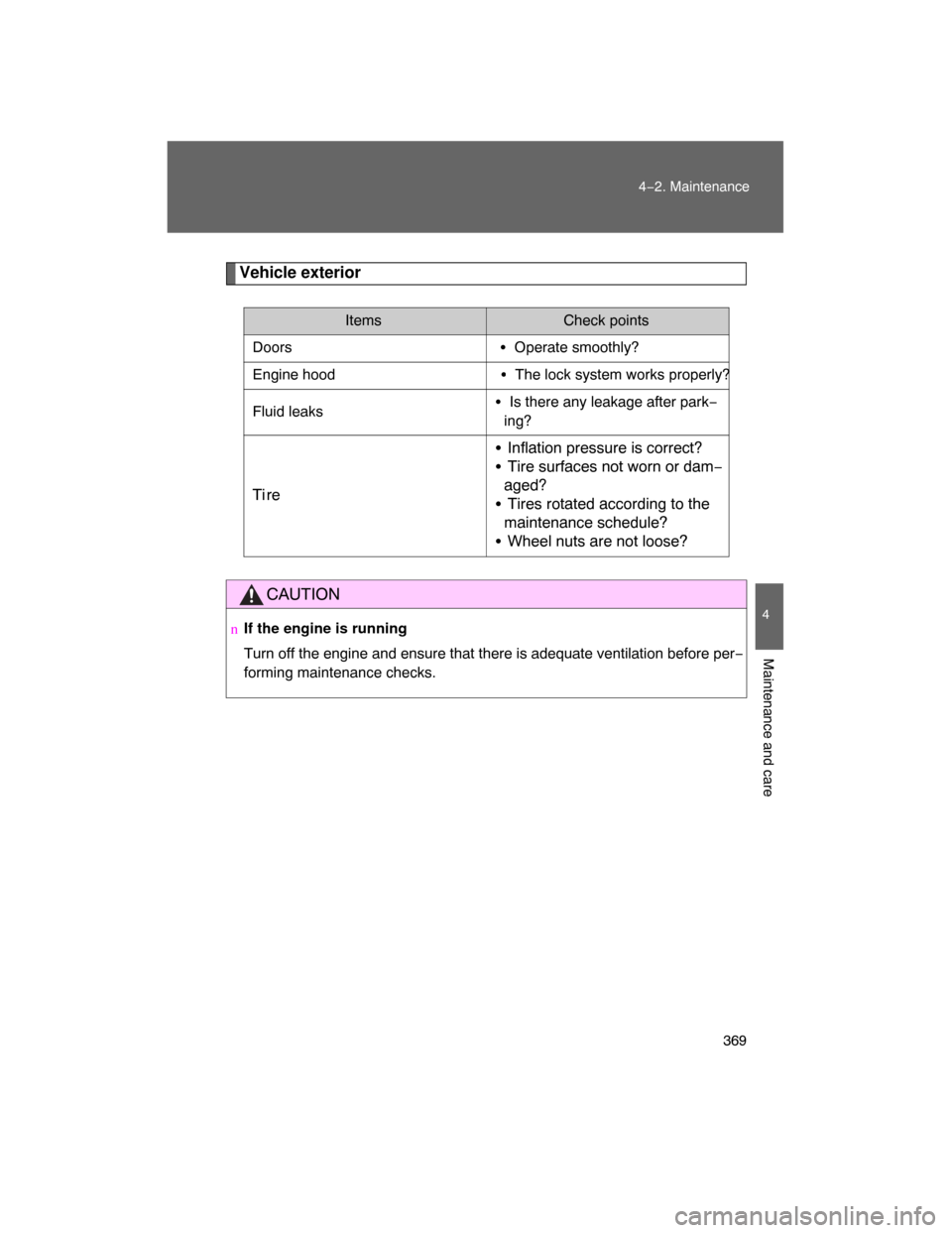
Vehicle exterior
Items Check points
Doors�Operate smoothly?
Engine hood�The lock system works properly?
Fluid leaks�Is there any leakage after park−
ing?
Ti re�Inflation pressure is correct?
�Tire surfaces not worn or dam−
aged?
�Tires rotated according to the
maintenance schedule?
�Wheel nuts are not loose?
CAUTION
nIf the engine is running
Turn off the engine and ensure that there is adequate ventilation before per−
forming maintenance checks.
Page 372 of 531
377
4−3. Do−it−yourself maintenance
4
Maintenance and care
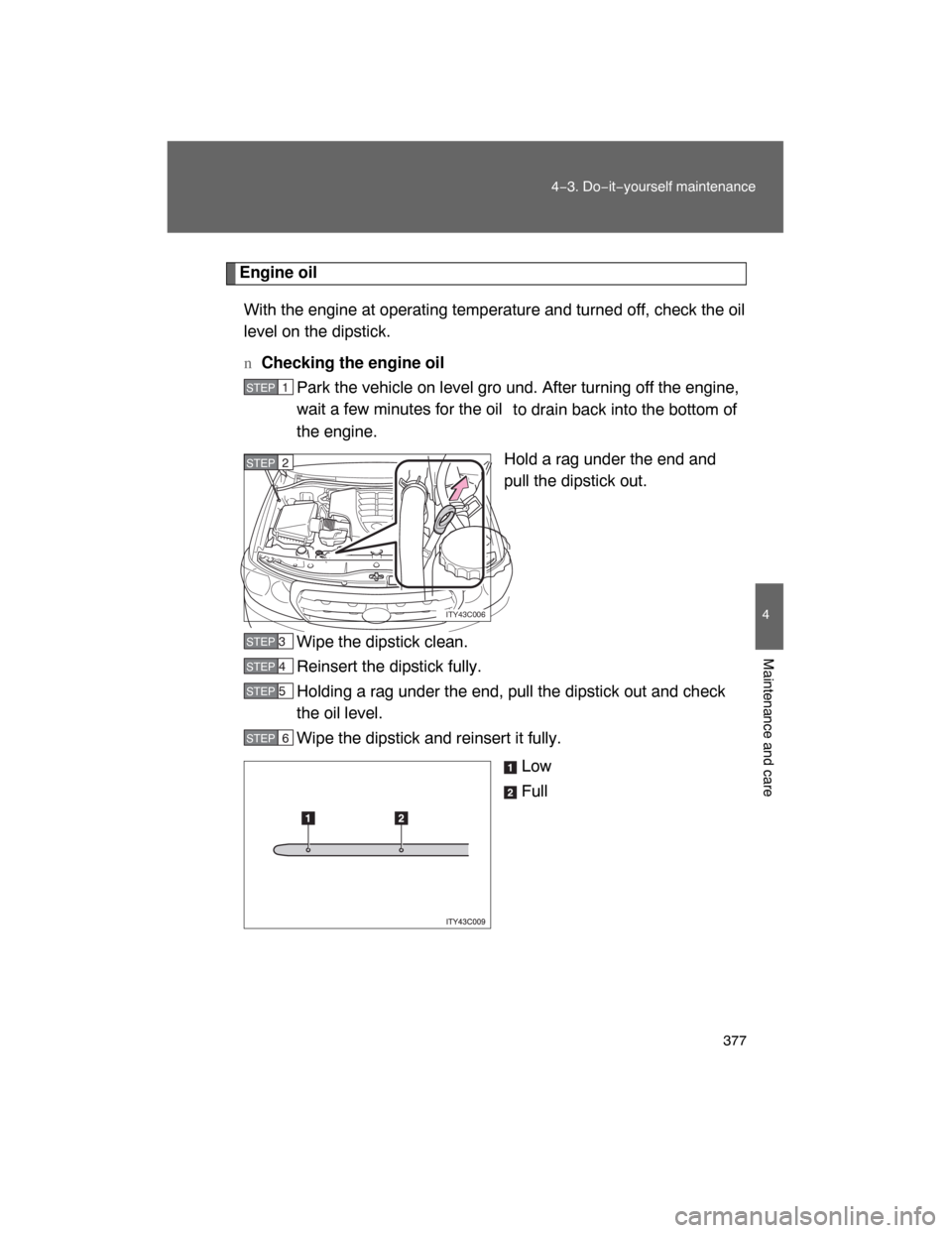
Engine oil
With the engine at operating temperature and turned off, check the oil
level on the dipstick.
nChecking the engine oil
Park the vehicle on level gro und. After turning off the engine,
wait a few minutes for the oil
to drain back into the bottom of
the engine.
Hold a rag under the end and
pull the dipstick out.
Wipe the dipstick clean.
Reinsert the dipstick fully.
Holding a rag under the end, pull the dipstick out and check
the oil level.
Wipe the dipstick and reinsert it fully.
Low
Full
STEP1
ITY43C006
STEP2
STEP 3
STEP 4
STEP 5
STEP6
Page 373 of 531
378 4−3. Do−it−yourself maintenance
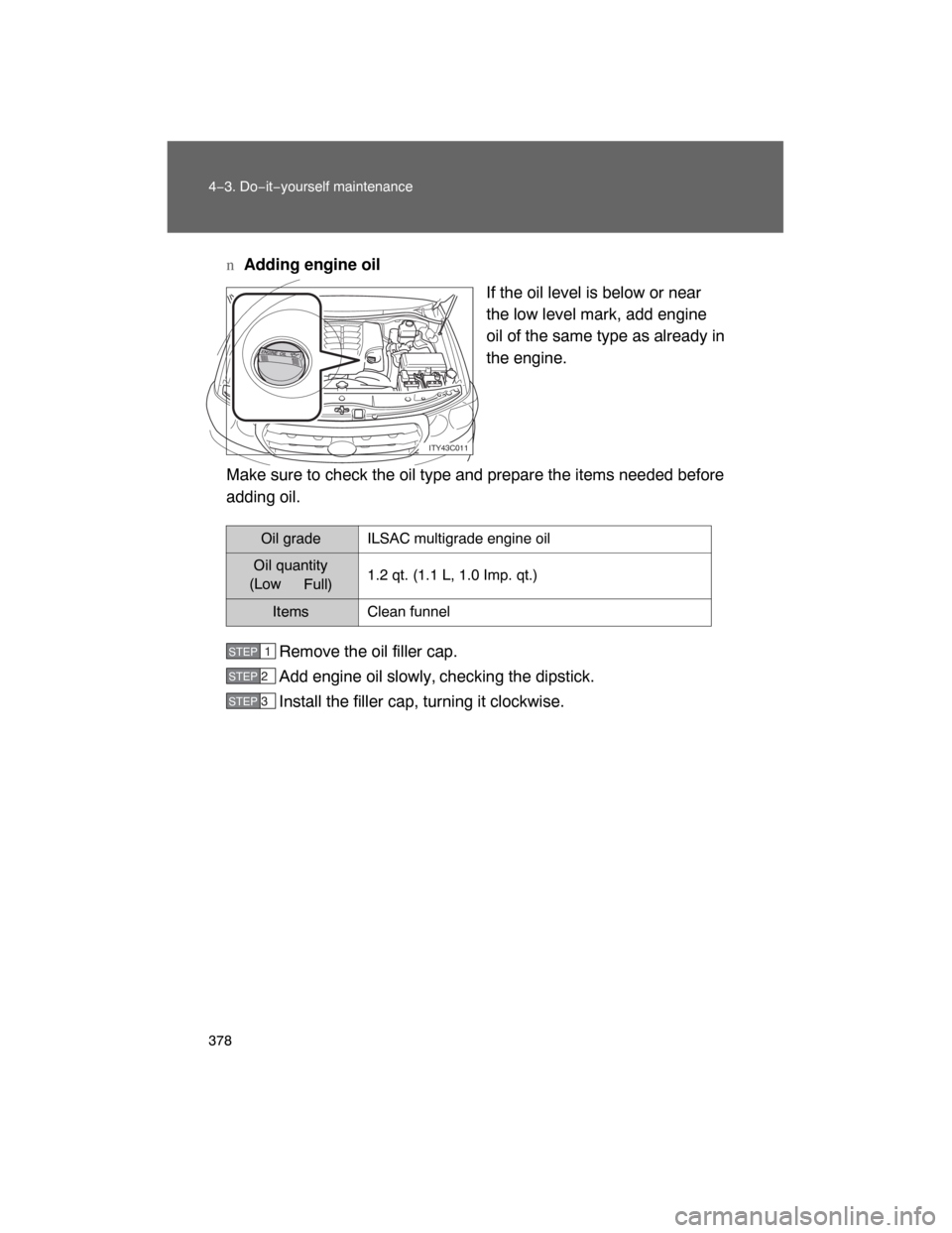
nAdding engine oil
If the oil level is below or near
the low level mark, add engine
oil of the same type as already in
the engine.
Make sure to check the oil type and prepare the items needed before
adding oil.
Remove the oil filler cap.
Add engine oil slowly,
checking the dipstick.
Install the filler cap, turning it clockwise.
ITY43C011
Oil gradeILSAC multigrade engine oil
Oil quantity
(Low
Full)
1.2 qt. (1.1 L, 1.0 Imp. qt.)
Items
Clean funnel
STEP1
STEP 2
STEP 3
Page 376 of 531

381
4−3. Do−it−yourself maintenance
4
Maintenance and care
CAUTION
nUsed engine oil
lUsed engine oil contains potentially harmful contaminants which may
cause skin disorders such as inflammation or skin cancer, so care should
be taken to avoid prolonged and repeated contact. To remove used engine
oil from your skin, wash thoroughly with soap and water.
lDispose of used oil and filters only in a safe and acceptable manner. Do
not dispose of used oil and filters in household trash, in sewers or onto the
ground.
Call your Toyota dealer, service station or auto parts store for information
concerning recycling or disposal.
lDo not leave used engine oil within the reach of children.
NOTICE
nTo prevent serious engine damage
Check the oil level on regular basis.
nWhen replacing the engine oil
lBe careful not to spill engine oil on the vehicle components.
lAvoid overfilling, or the engine could be damaged.
lCheck the oil level on the dipstick every time you refill the vehicle.
l
Be sure the engine oil filler cap is properly retightened.
Page 377 of 531
382 4−3. Do−it−yourself maintenance
Engine coolant
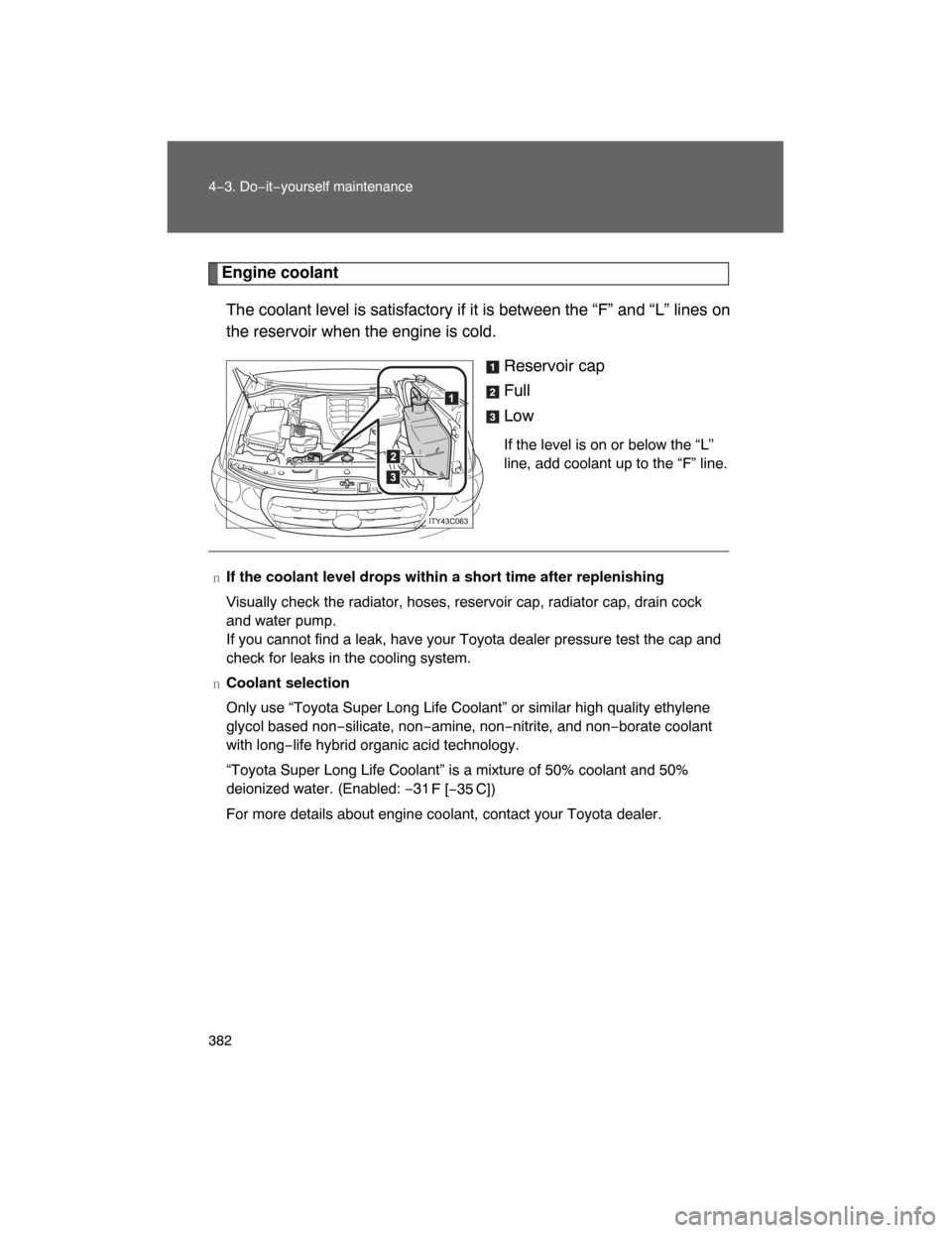
The coolant level is satisfactory if it is between the “F” and “L” lines on
the reservoir when the engine is cold.
Reservoir cap
Full
Low
If the level is on or below the “L”
line, add coolant up to the “F” line.
nIf the coolant level drops within a short time after replenishing
Visually check the radiator, hoses, reservoir cap, radiator cap, drain cock
and water pump.
If you cannot find a leak, have your Toyota dealer pressure test the cap and
check for leaks in the cooling system.
nCoolant selection
Only use “Toyota Super Long Life Coolant” or similar high quality ethylene
glycol based non−silicate, non−amine, non−nitrite, and non−borate coolant
with long−life hybrid organic acid technology.
“Toyota Super Long Life Coolant” is a mixture of 50% coolant and 50%
deionized water. (Enabled: −31
F [−35 C])
For more details about engine coolant, contact your Toyota dealer.