Page 213 of 496

201
�
If non−genuine Toyota wheels are used.
�If tire chains are used.
�If the spare tire is in a location subject
to poor radio wave signal reception.
�If a large metallic object which can
interfere with signal reception is put in
the deck.
If the tire pressure warning light continues
to comes on after blinking for 1 minute
when the engine switch is in �ON" posi-
tion, have the system checked by your
Toyota dealer.
Even if you use genuine wheels, the tire
pressure warning system may not work
properly with some types of tires. For vehicles sold in U.S.A.
This device complies with Part 15 of the
FCC Rules. Operation is subject to the
following two conditions:
(1) This device may not cause harmful
interference, and (2) this device must
accept any interference received, includ-
ing interference that may cause unde-
sired operation.
NOTICE:
This equipment has been tested and
found to comply with the limits for a
Class B digital device, pursuant to Part
15 of the FCC Rules. These limits are
designed to provide reasonable protec-
tion against harmful interference in a
residential installation. This equipment
generates, uses and can radiate radio
frequency energy and, if not installed
and used in accordance with the instruc-
tions, may cause harmful interference to
radio communications. However, there is
no guarantee that interference will not
occur in a particular installation. If this
equipment does cause harmful interfer-
ence to radio or television reception,
which can be determined by turning the
equipment off and on, the user is en-
couraged to try to correct the interfer-
ence by one or more of the following
measures:
Page 408 of 496
396�
Make sure to set the jack prop-
erly in the jack point. Raising
the vehicle with jack improper-
ly positioned will damage the
vehicle or may allow the ve-
hicle to fall off the jack and
cause death or serious injury.
� Never get under the vehicle
when the vehicle is supported
by the jack alone.
� Use the jack only for lifting
your vehicle during wheel
changing.
� Do not raise the vehicle with
someone in the vehicle.
� When raising the vehicle, do
not place any objects on top
of or underneath the jack.
� Raise the vehicle only high
enough to remove and change
the tire.
NOTICE
� Do not continue driving with
a deflated tire. Driving even a
short distance can damage a
tire and wheel beyond repair.
� Vehicles with rear height con-
trol air suspension: When
jacking up or installing the
tire chains, be sure to turn
off the rear height control
and stop the engine. Other-
wise, the vehicle height may
change in the automatic lev-
eling function, resulting in
accident.
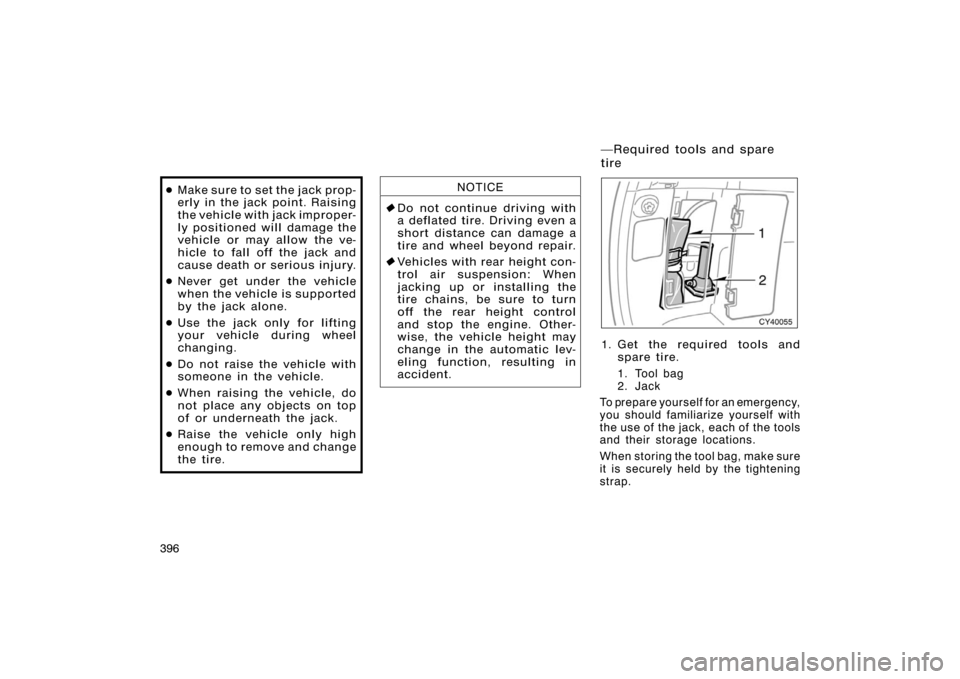
CY40055
1. G et th e req u i red to o l s an d
spare tire.
1. Tool bag
2. Jack
To prepare yourself for an emergency,
you should familiarize yourself with
the use of the jack, each of the tools
and their storage locations.
When storing the tool bag, make sure
it is securely held by the tightening
strap.
�Required tools and spare
tire
Page 456 of 496

444 The tires on your Toyota have built−in
treadwear indicators to help you know
when the tires need replacement.
When the tread depth wears to 1.6
mm (0.06 in.) or less, the indicators
will appear. If you can see the indica-
tors in two or more adjacent grooves,
the tire should be replaced. The lower
the tread, the higher the risk of skid-
ding.
The effectiveness of snow tires is
lost if the tread wears down below
4 mm (0.16 in.).
If you have tire damage such as
cuts, splits, cracks deep enough to
expose the fabric, or bulges indi-
cating internal damage, the tire
should be replaced.
If a tire often goes flat or cannot be
properly repaired due to the size or
location of a cut or other damage, it
should be replaced. If you are not
sure, consult with your Toyota dealer.If air loss occurs while driving, do not
continue driving. Driving even a short
distance can damage a tire beyond
repair.
Any tires which are over 6 years
old must be checked by a qualified
technician even if damage is not
obvious.
Tires deteriorate with age even if they
have never or seldom been used.
This applies also to the spare tire and
tires stored for future use.
REPLACING YOUR TIRES
W h en rep l aci n g a ti re, use a ti re of
the same size and construction,
and the same or greater maximum
load as the originally installed
tires. Also, on four−wheel drive
models, all the tires must be the
same brand and have the same
tread patterns.
Using any other size or type of tire
may seriously affect handling, ride,
speedometer/odometer calibration,
ground clearance, and clearance be-
tween the body and tires or snow
chains.
Check that the maximum load of the
replaced tire is greater than 1/2 of the
Gross Axle Weight Ratings (GAWR)
of either the front axle or the rear
axle, whichever is greater. As for the
maximum load of the tire, see the load
limit at maximum cold tire inflation
pressure mentioned on the sidewall
of the tire, and as
for the Gross Axle
Weight Ratings (GAWR), see the Cer-
tification Label.