2008 SUBARU TRIBECA steering
[x] Cancel search: steeringPage 6 of 409
4
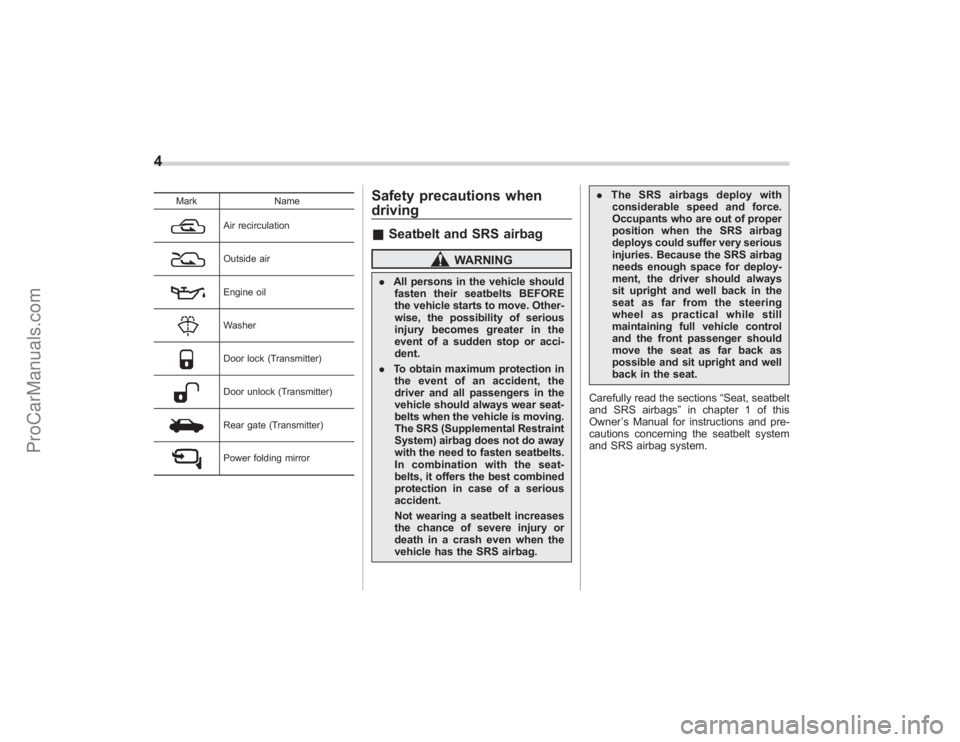
MarkName
Air recirculationOutside airEngine oilWasherDoor lock (Transmitter)Door unlock (Transmitter)Rear gate (Transmitter)Power folding mirror
Safety precautions when
driving&Seatbelt and SRS airbag
WARNING
. All persons in the vehicle should
fasten their seatbelts BEFORE
the vehicle starts to move. Other-
wise, the possibility of serious
injury becomes greater in the
event of a sudden stop or acci-
dent.
. To obtain maximum protection in
the event of an accident, the
driver and all passengers in the
vehicle should always wear seat-
belts when the vehicle is moving.
The SRS (Supplemental Restraint
System) airbag does not do away
with the need to fasten seatbelts.
In combination with the seat-
belts, it offers the best combined
protection in case of a serious
accident.
Not wearing a seatbelt increases
the chance of severe injury or
death in a crash even when the
vehicle has the SRS airbag. .
The SRS airbags deploy with
considerable speed and force.
Occupants who are out of proper
position when the SRS airbag
deploys could suffer very serious
injuries. Because the SRS airbag
needs enough space for deploy-
ment, the driver should always
sit upright and well back in the
seat as far from the steering
wheel as practical while still
maintaining full vehicle control
and the front passenger should
move the seat as far back as
possible and sit upright and well
back in the seat.
Carefully read the sections “Seat, seatbelt
and SRS airbags ”in chapter 1 of this
Owner ’s Manual for instructions and pre-
cautions concerning the seatbelt system
and SRS airbag system.
ProCarManuals.com
Page 17 of 409

&Instrument panel
1) Door locks (page 2-4)
2) Illumination brightness control
(page 3-28)
3) Remote control mirror (page 3-40) Power folding mirror switch (if equipped)
(page 3-41)
4) Windshield wiper deicer (page 3-36)
5) Traction Control system OFF switch (page 7-26)
6) Headlight beam leveler (if equipped) (page 3-29)
7) Light control lever (page 3-26)
8) Combination meter (page 3-5)
9) Wiper control lever (page 3-33)
10) Cruise control (page 7-30)
11) Horn (page 3-42)
12) SRS airbag (page 1-44)
13) Tilt steering (page 3-41)
14) Hood lock release knob (page 11-4)
15) Fuse box (page 11-38)
16) Power windows (page 2-19)
15
– CONTINUED –
ProCarManuals.com
Page 26 of 409
1-2
Seat, seatbelt and SRS airbags
Front seats
WARNING
.Never adjust the seat while driv-
ing to avoid the possibility of
loss of vehicle control and of
personal injury.
. Before adjusting the seat, make
sure the hands and feet of rear
seat passengers or luggage are
clear of the adjusting mechan-
ism.
. Seatbelts provide maximum re-
straint when the occupant sits
well back and upright in the seat.
To reduce the risk of sliding
under the seatbelt in a collision,
the front seatbacks should be
always used in the upright posi-
tion while the vehicle is running.
If the front seatbacks are not
used in the upright position in a
collision, the risk of sliding under
the lap belt and of the lap belt
sliding up over the abdomen will
increase, and both can result in
serious internal injury or death.
. The SRS airbags deploy with
considerable speed and force.
Occupants who are out of proper position when the SRS airbag
deploys could suffer very serious
injuries. Because the SRS airbag
needs enough space for deploy-
ment, the driver should always
sit upright and well back in the
seat as far from the steering
wheel as practical while still
maintaining full vehicle control
and the front passenger should
move the seat as far back as
possible and sit upright and well
back in the seat.
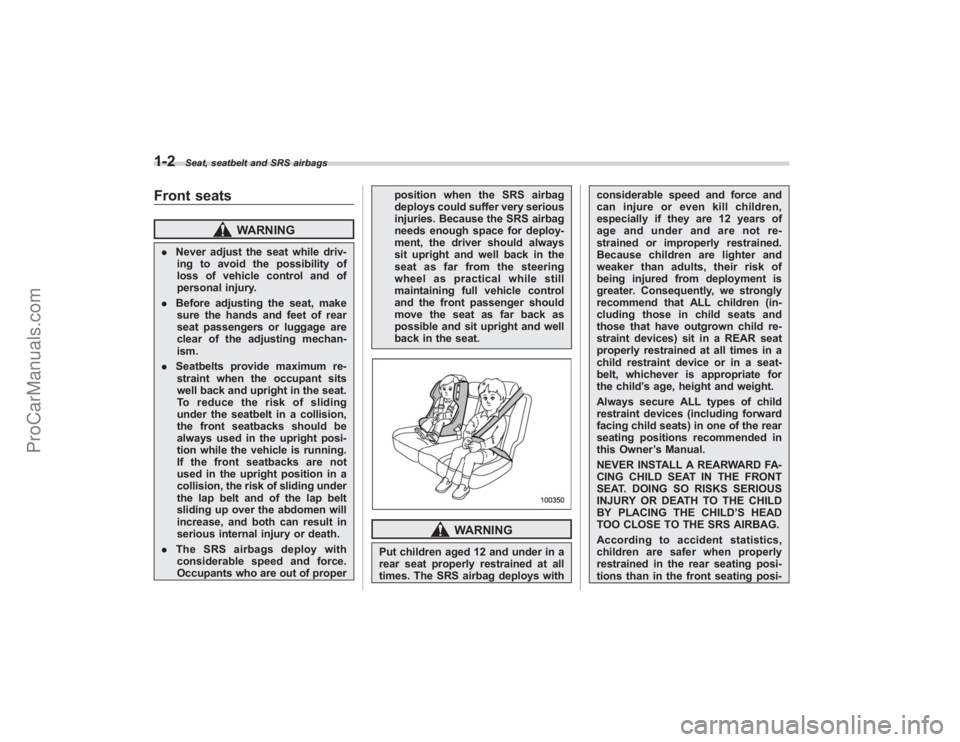
WARNING
Put children aged 12 and under in a
rear seat properly restrained at all
times. The SRS airbag deploys withconsiderable speed and force and
can injure or even kill children,
especially if they are 12 years of
age and under and are not re-
strained or improperly restrained.
Because children are lighter and
weaker than adults, their risk of
being injured from deployment is
greater. Consequently, we strongly
recommend that ALL children (in-
cluding those in child seats and
those that have outgrown child re-
straint devices) sit in a REAR seat
properly restrained at all times in a
child restraint device or in a seat-
belt, whichever is appropriate for
the child
’s age, height and weight.
Always secure ALL types of child
restraint devices (including forward
facing child seats) in one of the rear
seating positions recommended in
this Owner ’s Manual.
NEVER INSTALL A REARWARD FA-
CING CHILD SEAT IN THE FRONT
SEAT. DOING SO RISKS SERIOUS
INJURY OR DEATH TO THE CHILD
BY PLACING THE CHILD ’S HEAD
TOO CLOSE TO THE SRS AIRBAG.
According to accident statistics,
children are safer when properly
restrained in the rear seating posi-
tions than in the front seating posi-
ProCarManuals.com
Page 33 of 409
&Reclining the seatback
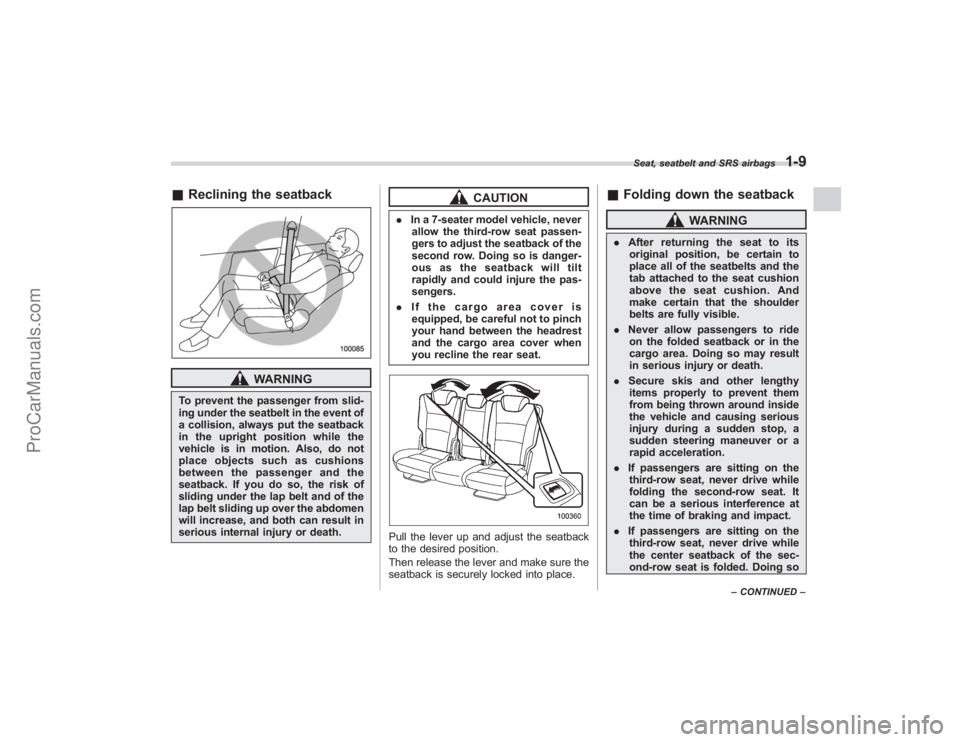
WARNING
To prevent the passenger from slid-
ing under the seatbelt in the event of
a collision, always put the seatback
in the upright position while the
vehicle is in motion. Also, do not
place objects such as cushions
between the passenger and the
seatback. If you do so, the risk of
sliding under the lap belt and of the
lap belt sliding up over the abdomen
will increase, and both can result in
serious internal injury or death.
CAUTION
. In a 7-seater model vehicle, never
allow the third-row seat passen-
gers to adjust the seatback of the
second row. Doing so is danger-
ous as the seatback will tilt
rapidly and could injure the pas-
sengers.
. If the cargo area cover is
equipped, be careful not to pinch
your hand between the headrest
and the cargo area cover when
you recline the rear seat.Pull the lever up and adjust the seatback
to the desired position.
Then release the lever and make sure the
seatback is securely locked into place.
& Folding down the seatback
WARNING
. After returning the seat to its
original position, be certain to
place all of the seatbelts and the
tab attached to the seat cushion
above the seat cushion. And
make certain that the shoulder
belts are fully visible.
. Never allow passengers to ride
on the folded seatback or in the
cargo area. Doing so may result
in serious injury or death.
. Secure skis and other lengthy
items properly to prevent them
from being thrown around inside
the vehicle and causing serious
injury during a sudden stop, a
sudden steering maneuver or a
rapid acceleration.
. If passengers are sitting on the
third-row seat, never drive while
folding the second-row seat. It
can be a serious interference at
the time of braking and impact.
. If passengers are sitting on the
third-row seat, never drive while
the center seatback of the sec-
ond-row seat is folded. Doing so
Seat, seatbelt and SRS airbags
1-9
– CONTINUED –
ProCarManuals.com
Page 38 of 409
1-14
Seat, seatbelt and SRS airbags
&Folding down the seatback
WARNING
. After returning the seat to its
original position, be certain to
place all of the seatbelts and the
tab attached to the seat cushion
above the seat cushion. And
make certain that the shoulder
belts are fully visible.
. Never allow passengers to ride
on the folded seatback or in the
cargo area. Doing so may result
in serious injury or death.
. Secure skis and other lengthy
items properly to prevent them
from being thrown around inside
the vehicle and causing serious
injury during a sudden stop, a
sudden steering maneuver or a
rapid acceleration.
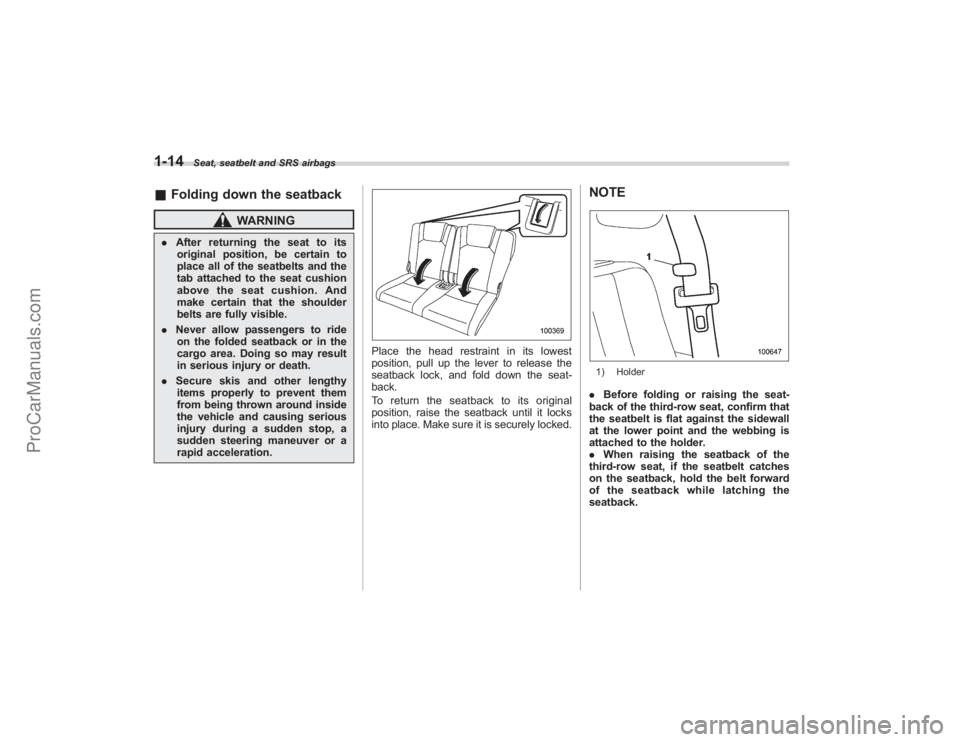
Place the head restraint in its lowest
position, pull up the lever to release the
seatback lock, and fold down the seat-
back.
To return the seatback to its original
position, raise the seatback until it locks
into place. Make sure it is securely locked.
NOTE1) Holder. Before folding or raising the seat-
back of the third-row seat, confirm that
the seatbelt is flat against the sidewall
at the lower point and the webbing is
attached to the holder.
. When raising the seatback of the
third-row seat, if the seatbelt catches
on the seatback, hold the belt forward
of the seatback while latching the
seatback.
ProCarManuals.com
Page 43 of 409
the front seatbacks should be
always used in the upright posi-
tion while the vehicle is running.
If the front seatbacks are not
used in the upright position in a
collision, the risk of sliding under
the lap belt and of the lap belt
sliding up over the abdomen will
increase, and both can result in
serious internal injury or death.
. Do not put cushions or any other
materials between occupants
and seatbacks or seat cushions.
If you do so, the risk of sliding
under the lap belt and of the lap
belt sliding up over the abdomen
will increase, and both can result
in serious internal injury or
death.
WARNING
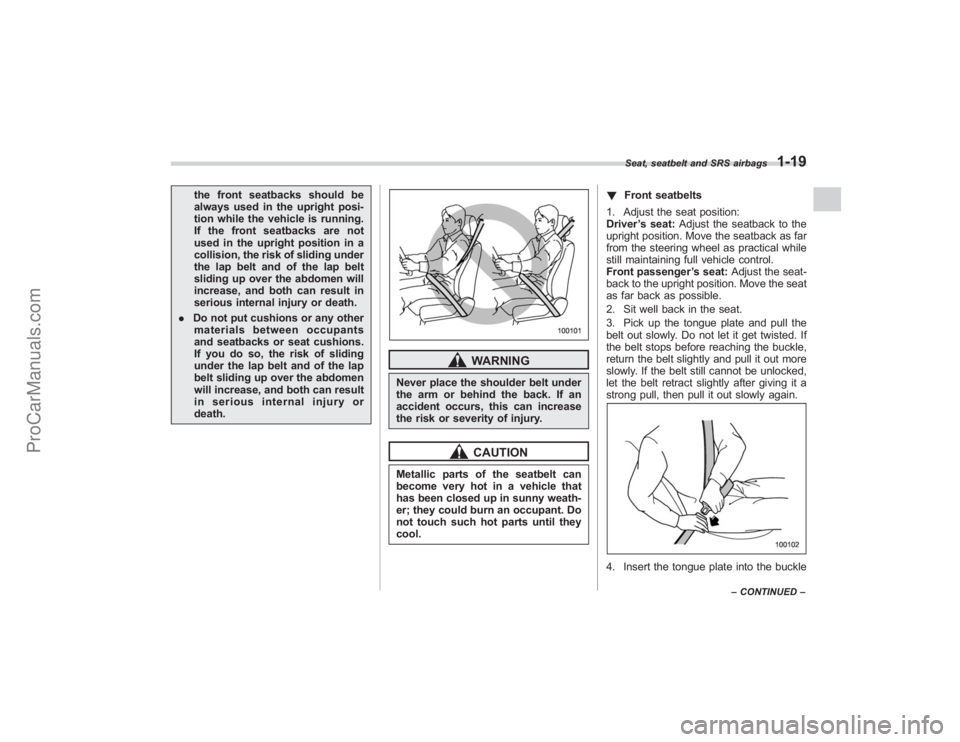
Never place the shoulder belt under
the arm or behind the back. If an
accident occurs, this can increase
the risk or severity of injury.
CAUTION
Metallic parts of the seatbelt can
become very hot in a vehicle that
has been closed up in sunny weath-
er; they could burn an occupant. Do
not touch such hot parts until they
cool. !
Front seatbelts
1. Adjust the seat position:
Driver ’s seat: Adjust the seatback to the
upright position. Move the seatback as far
from the steering wheel as practical while
still maintaining full vehicle control.
Front passenger ’s seat: Adjust the seat-
back to the upright position. Move the seat
as far back as possible.
2. Sit well back in the seat.
3. Pick up the tongue plate and pull the
belt out slowly. Do not let it get twisted. If
the belt stops before reaching the buckle,
return the belt slightly and pull it out more
slowly. If the belt still cannot be unlocked,
let the belt retract slightly after giving it a
strong pull, then pull it out slowly again.
4. Insert the tongue plate into the buckle
Seat, seatbelt and SRS airbags
1-19
– CONTINUED –
ProCarManuals.com
Page 69 of 409
seat as far from the steering
wheel as practical while still
maintaining full vehicle control
and the front passenger should
move the seat as far back as
possible and sit upright and well
back in the seat.
. Do not place any objects over or
near the SRS airbag cover or
between you and the SRS airbag.
If the SRS airbag deploys, those
objects could interfere with its
proper operation and could be
propelled inside the vehicle and
cause injury.
WARNING
. Put children aged 12 and under in
a rear seat properly restrained at
all times. The SRS airbag de-
ploys with considerable speed
and force and can injure or even
kill children, especially if they are
12 years of age and under and
are not restrained or improperly
restrained. Because children are
lighter and weaker than adults,
their risk of being injured from
deployment is greater.
Consequently, we strongly re-
commend that ALL children (in-
cluding those in child seats and
those that have outgrown child
restraint devices) sit in a REAR
seat properly restrained at all
times in a child restraint device
or in a seatbelt, whichever is
appropriate for the child ’s age,
height and weight.
Always secure ALL types of child
restraint devices (including for-
ward facing child seats) in one of
the rear seating positions recom-
mended in this Owner ’s Manual.
According to accident statistics,
children are safer when properly restrained in the rear seating
positions than in the front seat-
ing positions.
For instructions and precautions
concerning the child restraint
system, refer to the
“Child re-
straint systems ”section in this
chapter.
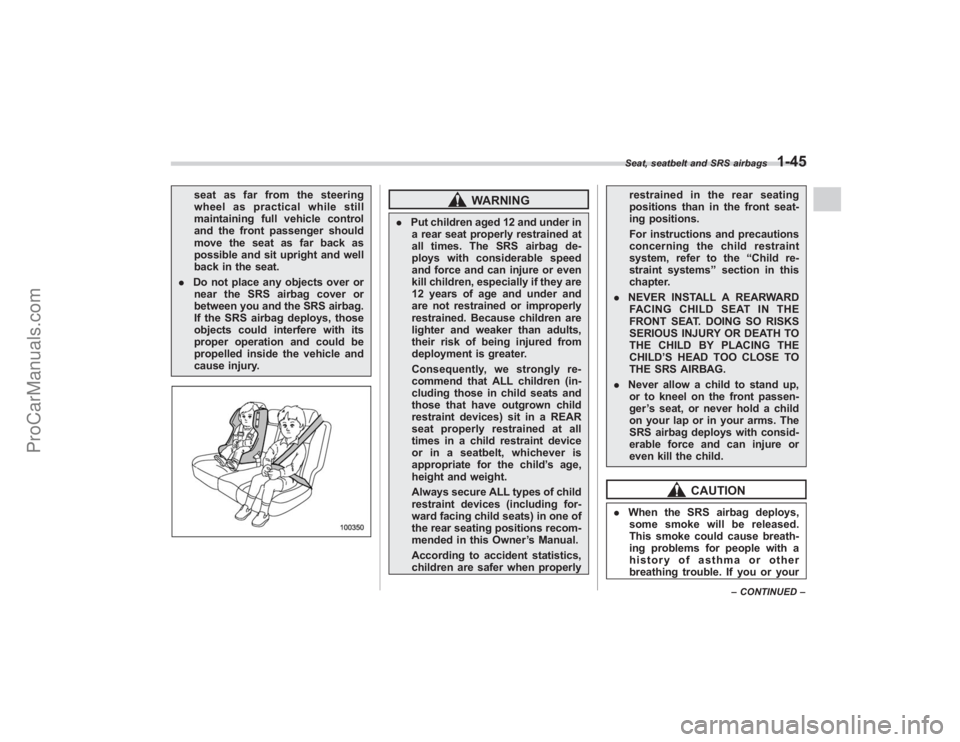
. NEVER INSTALL A REARWARD
FACING CHILD SEAT IN THE
FRONT SEAT. DOING SO RISKS
SERIOUS INJURY OR DEATH TO
THE CHILD BY PLACING THE
CHILD ’S HEAD TOO CLOSE TO
THE SRS AIRBAG.
. Never allow a child to stand up,
or to kneel on the front passen-
ger ’s seat, or never hold a child
on your lap or in your arms. The
SRS airbag deploys with consid-
erable force and can injure or
even kill the child.
CAUTION
. When the SRS airbag deploys,
some smoke will be released.
This smoke could cause breath-
ing problems for people with a
history of asthma or other
breathing trouble. If you or yourSeat, seatbelt and SRS airbags
1-45
– CONTINUED –
ProCarManuals.com
Page 72 of 409
1-48
Seat, seatbelt and SRS airbags
&Subaru advanced frontal air-
bag systemYour vehicle is equipped with a Subaru
advanced frontal airbag system that com-
plies with the new advanced frontal airbag
requirements in the amended Federal
Motor Vehicle Safety Standard (FMVSS)
No. 208.
The Subaru advanced frontal airbag sys-
tem automatically determines the deploy-
ment force of the driver ’s SRS frontal
airbag at the time of deployment as well as
whether or not to activate the front
passenger ’s SRS frontal airbag and, if
activated, the deployment force of the
SRS frontal airbag at the time of deploy-
ment.
Your vehicle has warning labels on the
driver ’s and front passenger ’s sun visors
beginning with the phrase “EVEN WITH
ADVANCED AIR BAGS” and a tag
attached to the glove box lid beginning
with the phrase “Even with Advanced Air
Bags”. Make sure that you carefully read
the instructions on the warning labels and
tag.
Always wear your seatbelt. The Subaru
advanced frontal airbag system is a
supplemental restraint system and must
be used in combination with a seatbelt. All
occupants should wear a seatbelt or be
seated in an appropriate child restraint system.
The driver
’s SRS frontal airbag is stowed
in the center portion of the steering wheel.
The front passenger ’s SRS frontal airbag
is stowed near the top of the dashboard
under an “SRS AIRBAG ”mark.
In a moderate to severe frontal collision,
the driver ’s and front passenger ’s SRS
frontal airbags deploy and supplement the
seatbelts by reducing the impact on the
driver ’s and front passenger ’s head and
chest.
WARNING
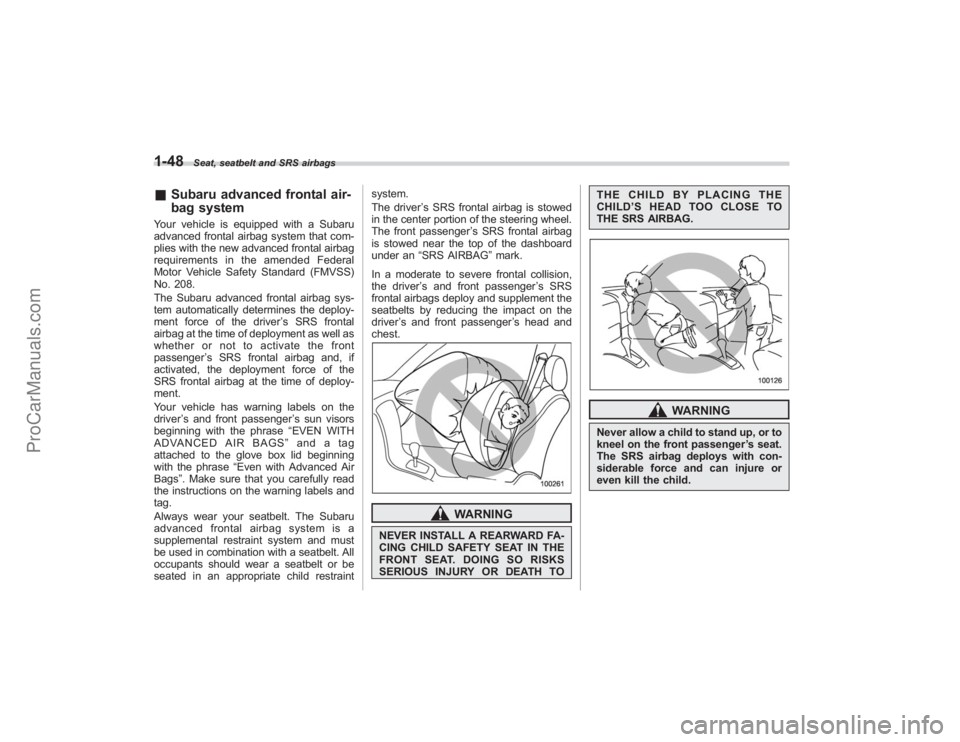
NEVER INSTALL A REARWARD FA-
CING CHILD SAFETY SEAT IN THE
FRONTSEAT.DOINGSORISKS
SERIOUS INJURY OR DEATH TO THE CHILD BY PLACING THE
CHILD’
S HEAD TOO CLOSE TO
THE SRS AIRBAG.
WARNING
Never allow a child to stand up, or to
kneel on the front passenger ’s seat.
The SRS airbag deploys with con-
siderable force and can injure or
even kill the child.
ProCarManuals.com