2008 SUBARU TRIBECA heating
[x] Cancel search: heatingPage 295 of 409

.Backing up with a trailer is difficult and
takes practice. When backing up with a
trailer, never accelerate or steer rapidly.
When turning back, grip the bottom of the
steering wheel with one hand and turn it to
the left for a left turn, and turn it to the right
for a right turn.
. If the ABS warning light illuminates
while the vehicle is in motion, stop towing
the trailer and have repairs performed
immediately by the nearest SUBARU
dealer.
! Driving on grades
. Before going down a steep hill, slow
down and shift into lower gear (if neces-
sary, use 1st gear) in order to utilize the
engine braking effect and prevent over-
heating of your vehicle’ s brakes. Do not
make sudden downshifts.
. When driving uphill in hot weather, the
air conditioner may turn off automatically
to protect the engine from overheating.
. When driving uphill in hot weather, pay
attention to the water temperature gauge
pointer and AT OIL TEMP warning light
since the engine and transmission are
relatively prone to overheating under
these conditions. If the water temperature
gauge pointer approaches the OVER-
HEAT zone or the AT OIL TEMP warning
light illuminates, immediately switch off the air conditioner and stop the vehicle at the
nearest safe place. Refer to the
“Engine
overheating ”section in chapter 9, and
“Warning and indicator lights ”section in
chapter 3.
NOTEThe temperature of engine coolant is
less likely to rise to the OVERHEAT
zone in the “D ” position than in the
manual mode position.
. Avoid using the accelerator pedal to
stay stationary on an uphill slope instead
of using the parking brake or foot brake.
That may cause the transmission fluid to
overheat.
! Parking on a grade
Always block the wheels under both
vehicle and trailer when parking. Apply
the parking brake firmly. You should not
park on a hill or slope. But if parking on a
hill or slope cannot be avoided, you
should take the following steps:
1. Apply the brakes and hold the pedal
down.
2. Have someone place wheel blocks
under both the vehicle and trailer wheels.
3. When the wheel blocks are in place,
release the regular brakes slowly until the
blocks absorb the load.
4. Apply the regular brakes and then apply the parking brake; slowly release
the regular brakes.
5. Shift into
“P”and shut off the engine.
Driving tips
8-27
ProCarManuals.com
Page 297 of 409
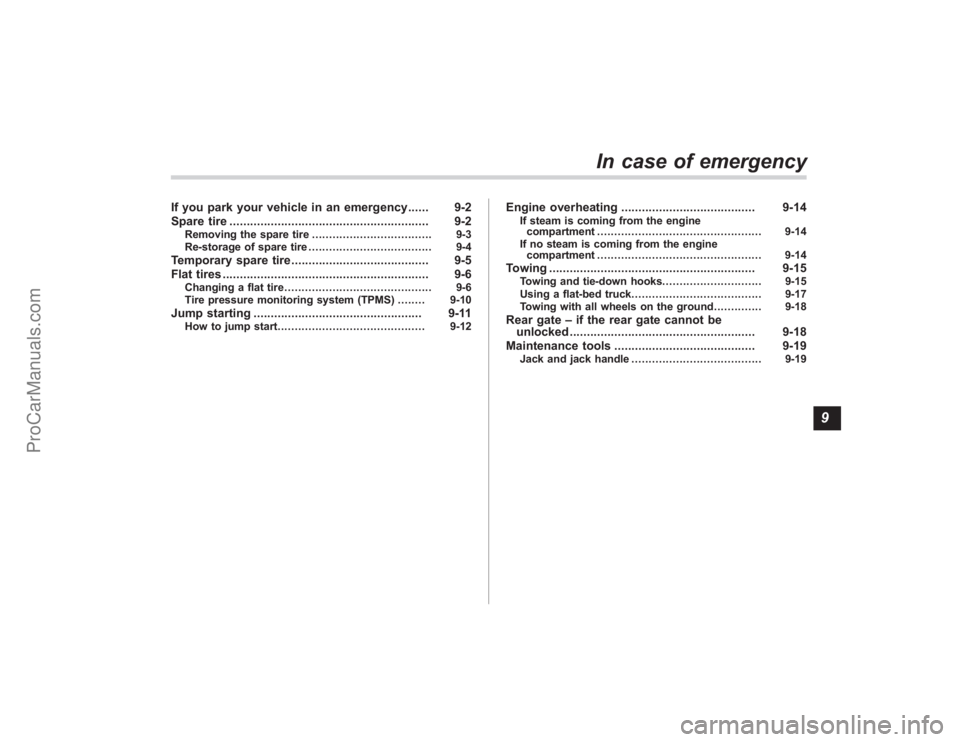
If you park your vehicle in an emergency...... 9-2
Spare tire .......................................................... 9-2
Removing the spare tire ................................... 9-3
Re-storage of spare tire .................................... 9-4
Temporary spare tire........................................ 9-5
Flat tires ............................................................ 9-6
Changing a flat tire ........................................... 9-6
Tire pressure monitoring system (TPMS) ........ 9-10
Jump starting................................................. 9-11
How to jump start ........................................... 9-12
Engine overheating ....................................... 9-14
If steam is coming from the engine
compartment ................................................ 9-14
If no steam is coming from the engine compartment ................................................ 9-14
Towing............................................................ 9-15
Towing and tie-down hooks. ............................ 9-15
Using a flat-bed truck. ..................................... 9-17
Towing with all wheels on the ground .............. 9-18
Rear gate–if the rear gate cannot be
unlocked ...................................................... 9-18
Maintenance tools ......................................... 9-19
Jack and jack handle ...................................... 9-19
In case of emergency
9
ProCarManuals.com
Page 310 of 409

9-14
In case of emergency
5. Start the engine of the vehicle with the
booster battery and run it at moderate
speed. Then start the engine of the vehicle
that has the discharged battery.
6. When finished, carefully disconnect
the cables in exactly the reverse order.
Engine overheating
WARNING
Never attempt to remove the radia-
tor cap until the engine has been
shut off and has fully cooled down.
When the engine is hot, the coolant
is under pressure. Removing the
cap while the engine is still hot
could release a spray of boiling hot
coolant, which could burn you very
seriously.
If the engine overheats, safely pull off the
road and stop the vehicle in a safe place.& If steam is coming from the
engine compartmentTurn off the engine and get everyone
away from the vehicle until it cools down.&If no steam is coming from
the engine compartment1. Keep the engine running at idling
speed.
2. Open the hood to ventilate the engine
compartment.
Confirm that the cooling fan is turning. If
the fan is not turning, immediately turn off the engine and contact your authorized
dealer for repair.
3. After the engine coolant temperature
has dropped, turn off the engine.
If the temperature gauge stays at the
overheated zone, turn off the engine.
4. After the engine has fully cooled down,
check the coolant level in the reserve
tank.
If the coolant level is below the
“LOW ”
mark, add coolant up to the “FULL”mark.
5. If there is no coolant in the reserve
tank, add coolant to the reserve tank.
Then remove the radiator cap and fill the
radiator with coolant.
If you remove the radiator cap from a hot
radiator, first wrap a thick cloth around the
radiator cap, then turn the cap counter-
clockwise slowly without pressing down
until it stops. Release the pressure from
the radiator. After the pressure has been
fully released, remove the cap by pressing
down and turning it.
ProCarManuals.com
Page 333 of 409

Cooling system
WARNING
Never attempt to remove the radia-
tor cap until the engine has been
shut off and has cooled down
completely. Since the coolant is
under pressure, you may suffer
serious burns from a spray of boil-
ing hot coolant when the cap is
removed.
CAUTION
.The cooling system has been
filled at the factory with a high
quality, corrosion-inhibiting,
year-around coolant which pro-
vides protection against freezing
down to −33 8F( −36 8C).
Subaru engines use aluminum
components that require the
anti-corrosive and anti-freeze
properties of Subaru Genuine
Coolant, which is specifically
formulated for the Subaru cool-
ing system. Failure to use Subaru
Genuine Coolant along with
Subaru Cooling System Condi-
tioner at the recommended main- tenance intervals may result in
problems, including, but not lim-
ited to shortened life of engine
components and cooling system
clogging, coolant leaks and en-
gine damage from overheating.
Problems caused by the failure to
use Subaru Genuine Coolant and
Subaru Cooling System Condi-
tioner at recommended intervals
are not covered under the
Subaru Limited Warranty.
While there may be other generic
products that may provide the
required protection, they have
not been tested for compatibility
with Subaru engines and cooling
system components, and there-
fore not recommended.
. Do not splash the engine coolant
over painted parts. The alcohol
contained in the engine coolant
may damage the paint surface.
& Hose and connectionsYour vehicle employs an electric cooling
fan which is thermostatically controlled to
operate when the engine coolant reaches
a specific temperature.
If the radiator cooling fan does not operate even when the engine coolant tempera-
ture gauge exceeds the normal operating
range, the cooling fan circuit may be
defective. Check the fuse and replace it
if necessary. If the fuse is not blown, have
the cooling system checked by your
SUBARU dealer.
If frequent addition of coolant is neces-
sary, there may be a leak in the engine
cooling system. It is recommended that
the cooling system and connections be
checked for leaks, damage, or looseness.
&
Engine coolant! Checking the coolant levelCheck the coolant level at each fuel stop.
1. Check the coolant level on the outside
of the reservoir while the engine is cool.
Maintenance and service
11-11
–CONTINUED –
ProCarManuals.com
Page 400 of 409

14-4
Index
Pets........................................................................\
. 7
Snowy and icy roads ............................................... 8-9
Tips....................................................................... 8-4
Tired or sleepy. .......................................................... 7
E
Electrical system ........................................................ 12-3
Electronic Brake Force Distribution (EBD) system ................................................. 3-17, 7-22
Emergency Locking Retractor (ELR) ............................. 1-17
Engine
Compartment overview ........................................... 11-6
Coolant ............................................................... 11-11
Exhaust gas (Carbon monoxide) ............................ 5, 8-2
Hood .................................................................... 11-4
Oil........................................................................\
11-7
Overheating .......................................................... 9-14
Starting .................................................................. 7-7
Stopping ................................................................ 7-8
Exterior care .............................................................. 10-2
F
Flat tires .................................................................... 9-6
Floor mat .................................................................. 6-12
Fluid level Automatic transmission ........................................ 11-15
Brake ................................................................. 11-20
Power steering .................................................... 11-19
Fog light switch .......................................................... 3-32
Folding mirror switch .................................................. 3-41 Front
Differential gear oil ................................................ 11-17
Fog light .............................................................. 11-45
Seatbelt pretensioners ........................................... 1-27
Seats ..................................................................... 1-2
Turn signal light .................................................... 11-45
Front seats Fore and aft adjustment ........................................... 1-3
Reclining ................................................................ 1-3
Fuel ........................................................................\
... 7-2
Economy hints ........................................................ 8-2
Filler lid and cap ...................................................... 7-3
Gauge .................................................................... 3-8
Requirements ......................................................... 7-2
Fuses ..................................................................... 11-38
Fuses and circuits ..................................................... 12-5
G
GAWR (Gross Axle Weight Rating) .............................. 8-12
Glove box ................................................................... 6-5
GVWR (Gross Vehicle Weight Rating) ... ....................... 8-12
H
Hazard warning flasher .......................................... 3-5, 9-2
Head restraint adjustment ............................................. 1-5
Rear .................................................................... 1-11
Headlight Beam leveler. ........................................................ 3-29
Flasher ................................................................. 3-27
Indicator light ........................................................ 3-21
Headlights ....................................................... 3-26, 11-42
ProCarManuals.com
Page 402 of 409
14-6
Index
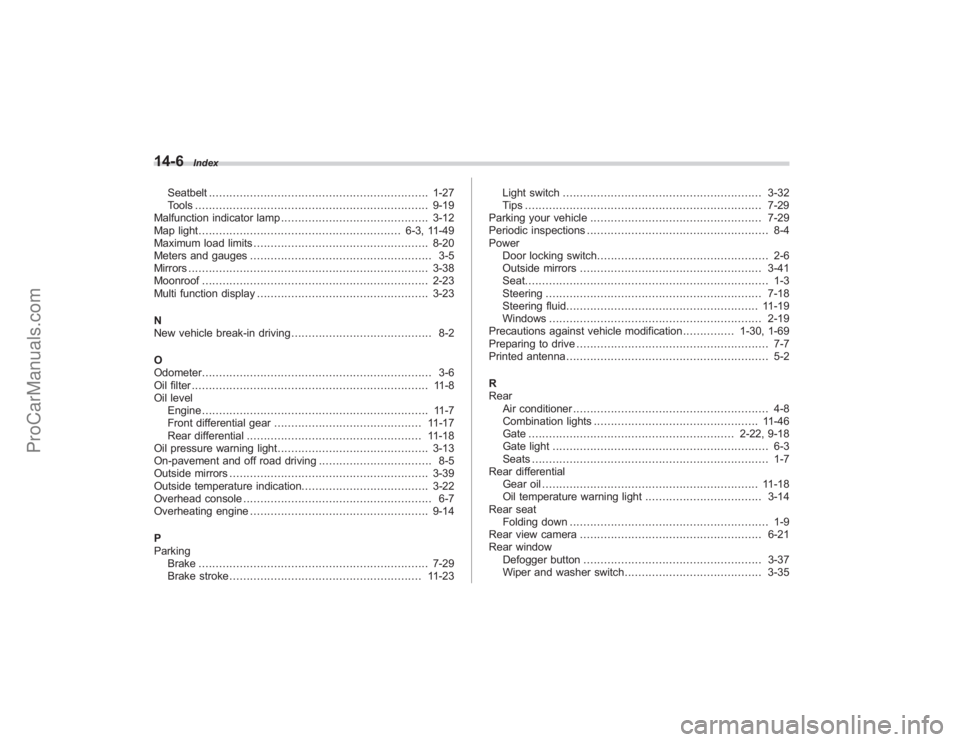
Seatbelt................................................................ 1-27
Tools .................................................................... 9-19
Malfunction indicator lamp ........................................... 3-12
Map light ........................................................... 6-3, 11-49
Maximum load limits ................................................... 8-20
Meters and gauges ..................................................... 3-5
Mirrors ...................................................................... 3-38
Moonroof .................................................................. 2-23
Multi function display .................................................. 3-23
N
New vehicle break-in driving ......................................... 8-2
O
Odometer ................................................................... 3-6
Oil filter ..................................................................... 11-8
Oil level Engine .................................................................. 11-7
Front differential gear ........................................... 11-17
Rear differential ................................................... 11-18
Oil pressure warning light ............................................ 3-13
On-pavement and off road driving ................................. 8-5
Outside mirrors .......................................................... 3-39
Outside temperature indication. .................................... 3-22
Overhead console ....................................................... 6-7
Overheating engine .................................................... 9-14
P
Parking Brake ................................................................... 7-29
Brake stroke ........................................................ 11-23 Light switch
.......................................................... 3-32
Tips ..................................................................... 7-29
Parking your vehicle .................................................. 7-29
Periodic inspections ..................................................... 8-4
Power Door locking switch .................................................. 2-6
Outside mirrors ..................................................... 3-41
Seat ....................................................................... 1-3
Steering ............................................................... 7-18
Steering fluid ........................................................ 11-19
Windows .............................................................. 2-19
Precautions against vehicle modification ............... 1-30, 1-69
Preparing to drive ........................................................ 7-7
Printed antenna ........................................................... 5-2
R
Rear Air conditioner ......................................................... 4-8
Combination lights ................................................ 11-46
Gate ............................................................ 2-22, 9-18
Gate light ............................................................... 6-3
Seats ..................................................................... 1-7
Rear differential Gear oil ............................................................... 11-18
Oil temperature warning light .................................. 3-14
Rear seat Folding down .......................................................... 1-9
Rear view camera ..................................................... 6-21
Rear window Defogger button .................................................... 3-37
Wiper
and washer switch ........................................ 3-35
ProCarManuals.com