Page 383 of 444
increase. Be careful not to mistakenly
release air from a warm tire to reduce itspressure.NOTE .
The air pressure in a tire increases
by approximately 4.3 psi (30 kPa, 0.3 kgf/cm
2) when the tire becomes warm.
. The tires are considered cold when
the vehicle has been parked for at least
three hours or has been driven less
than one mile (1.6 km).
WARNING
Do not let air out of warm tires to
adjust pressure. Doing so will result
in low tire pressure.
Incorrect tire pressures detract from con-
trollability and ride comfort, and they
cause the tires to wear abnormally. .
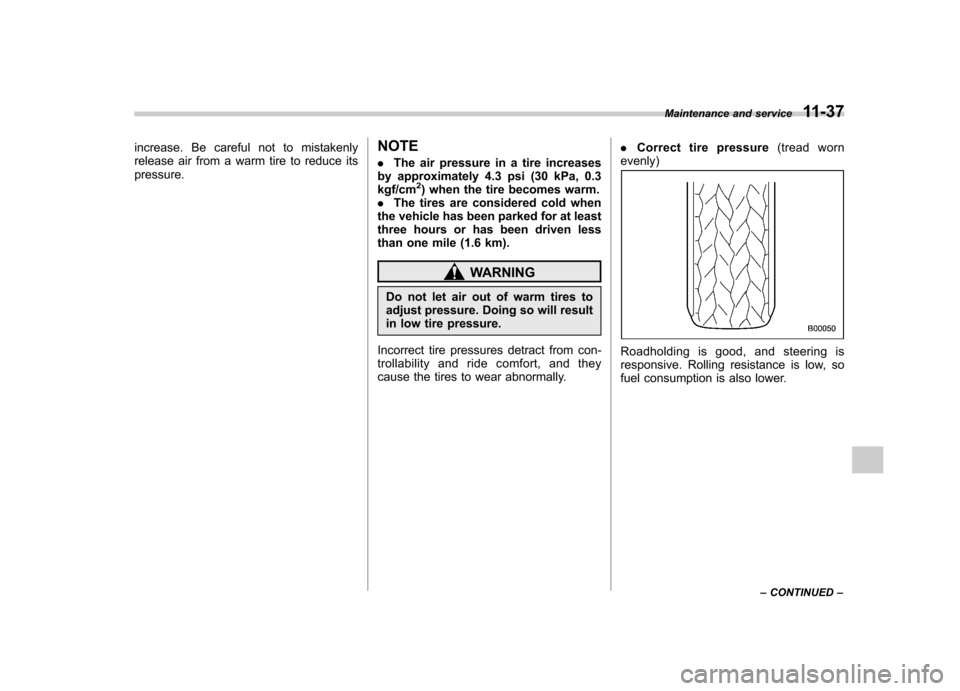
Correct tire pressure (tread worn
evenly)
Roadholding is good, and steering is
responsive. Rolling resistance is low, so
fuel consumption is also lower. Maintenance and service
11-37
– CONTINUED –
Page 395 of 444
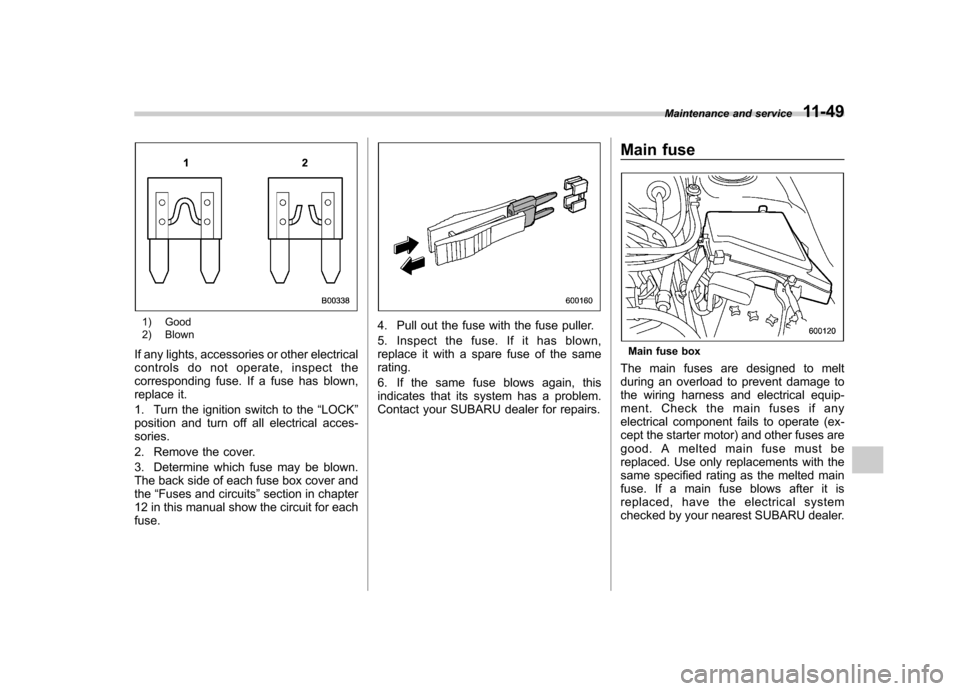
1) Good
2) Blown
If any lights, accessories or other electrical
controls do not operate, inspect the
corresponding fuse. If a fuse has blown,
replace it.
1. Turn the ignition switch to the “LOCK ”
position and turn off all electrical acces- sories.
2. Remove the cover.
3. Determine which fuse may be blown.
The back side of each fuse box cover andthe “Fuses and circuits ”section in chapter
12 in this manual show the circuit for eachfuse.4. Pull out the fuse with the fuse puller.
5. Inspect the fuse. If it has blown,
replace it with a spare fuse of the samerating.
6. If the same fuse blows again, this
indicates that its system has a problem.
Contact your SUBARU dealer for repairs. Main fuse
Main fuse box
The main fuses are designed to melt
during an overload to prevent damage to
the wiring harness and electrical equip-
ment. Check the main fuses if any
electrical component fails to operate (ex-
cept the starter motor) and other fuses are
good. A melted main fuse must be
replaced. Use only replacements with the
same specified rating as the melted main
fuse. If a main fuse blows after it is
replaced, have the electrical system
checked by your nearest SUBARU dealer. Maintenance and service
11-49
Page 430 of 444
cified government test surfaces of
asphalt and concrete. A tire marked
C may have poor traction perfor- mance.
WARNING
The traction grade assigned to
this tire is based on straight-
ahead braking traction tests,
and does not include accel-
eration, cornering, hydroplan-
ing, or peak traction charac-teristics.
& Temperature A, B, C
The temperature grades are A (the
highest), B, and C, representing thetire ’s resistance to the generation of
heat and its ability to dissipate heat
when tested under controlled con-
ditions on a specified indoor labora-
tory test wheel. Sustained high
temperature can cause the material
of the tire to degenerate and reduce
tire life, and excessive temperature
can lead to sudden tire failure. The grade C corresponds to a level of
performance which all passenger
car tires must meet under the
Federal Motor Vehicle Safety Stan-
dards No. 109. Grades B and A
represent higher levels of perfor-
mance on the laboratory test wheel
than the minimum required by law.
WARNING
The temperature grade for this
tire is established for a tire
that is properly inflated and
not overloaded. Excessive
speed, underinflation, or ex-
cessive loading, either sepa-
rately or in combination, can
cause heat buildup and possi-
ble tire failure. Reporting safety defects (USA)
If you believe that your vehicle has
a defect which could cause a
crash or could cause injury or
death, you should immediately in-
form the National Highway Traffic
Safety Administration (NHTSA) in
addition to notifying Subaru of
America, Inc.
If NHTSA receives similar com-
plaints, it may open an investiga-
tion, and if it finds that a safety
defect exists in a group of vehi-
cles, it may order a recall and
remedy campaign. However,
NHTSA cannot become involved
in individual problems between
you, your dealer, or Subaru of
America, Inc. To contact NHTSA,
you may call the Vehicle Safety
Hotline toll-free at 1-888-327-4236
(TTY: 1-800-424-9153); go to
http://www.safercar.gov; or write
to: Administrator, NHTSA, 400
Seventh Street, SW., Washington,
Consumer information and Reporting safety defects
13-13
– CONTINUED –
Page 443 of 444

GAS STATION REFERENCE
& Fuel:
! 2.5-liter non-turbo models
Use only unleaded gasoline with an octane rating of 87 AKI or
higher. ! 2.5-liter turbo models
Use premium unleaded gasoline with an octane rating of 91 AKI
or higher. For temporary purposes if premium unleaded
gasoline is not available, you may use regular unleaded
gasoline with an octane rating of 87 AKI or higher. For optimum
engine performance and driveability, it is required that you use
premium grade unleaded gasoline. ! 3.0-liter models
Use unleaded gasoline with an octane rating of 91 AKI or
higher. Regular unleaded gasoline with an octane rating of 87
AKI or higher may be used. However for optimum engine
performance and driveability, it is recommended that you use
91 AKI or higher grade unleaded gasoline. You may experience
reduced output, poor accelerator response, and reduced fuel
economy when using gasoline with an octane rating lower than
91 AKI, depending on your driving habits and conditions. If you
experience any of these conditions while using a lower octane
rated fuel, you may want to return to using 91 AKI octane rated
fuel as soon as possible. Additionally, if your vehicle knocks
heavily or persistently, or if you are driving with heavy loads
such as when towing a trailer, the use of 91 AKI or higher grade
unleaded gasoline is required. &
Fuel octane rating
This octane rating is the average of the Research Octane and
Motor Octane numbers and is commonly referred to as the Anti
Knock Index (AKI). Refer to “Fuel ”section in this manual.
& Fuel capacity:
16.9 US gal (64 liters, 14.1 Imp gal) & Engine oil:
Use only API classification SM with the words “ENERGY
CONSERVING ”or ILSAC GF-4, which can be identified with
the ILSAC certification mark (Starburst mark).& Engine oil capacity:
2.5-liter models: 4.2 US qt (4.0 liters, 3.5 Imp qt)
3.0-liter models: 5.8 US qt (5.5 liters, 4.8 Imp qt)