2008 SKODA SUPERB battery
[x] Cancel search: batteryPage 208 of 272

Inspecting and Replenishing209
Using the systemSafetyDriving TipsGeneral MaintenanceBreakdown assistanceTechnical Data
WARNING
•Never open the bonnet if you see that steam or coolant is flowing out of
the engine compartment - risk of scaldi ng! Wait long enough until the steam
or coolant has stopped escaping.
•For safety reasons, the bonnet must always be properly closed when
driving. One should therefore check that the lock has in fact engaged prop-
erly after closing the bonnet.
•Stop your vehicle immediately while driv ing if you notice that the lock is
not properly engaged and close the bonne t properly - risk of an accident!
Caution
Ensure that the arms of the windscreen wipers are correctly in place against the
windscreen before opening the bonnet otherwise damage could occur to the
paintwork.
Working in the engine compartment
Particular care is required when carrying out any work in the engine
compartment!
There is a risk of injuries, scalding, accidents and fire when working in the
engine compartment, e.g. inspecting and replenishing oil and other fluids. For
this reason, it is essential to comply with the warning instructions stated
below and with the general applicable rules of safety. The engine compart-
ment of your car is a hazardous area ⇒ .
WARNING
•Never open the bonnet if you see that steam or coolant is flowing out of
the engine compartment - risk of scaldi ng! Wait long enough until the steam
or coolant has stopped escaping.
•Switch off the engine and pull out the ignition key.
•Apply the handbrake firmly.
•If your vehicle is fitted with a ma nual gearbox, move the gearshift lever
into Neutral, or if it is fitted with automatic gearbox, move the selector lever
into position P.
•Allow the engine to cool down.
•Keep children clear of the engine compartment.
•Never spill oil and other fluids over the hot engine. Such fluids (e.g. the
antifreeze contained in the coolant) may ignite!
•Avoid short circuits in the electrical system - particularly on the battery.
•Never place your hand into the radiator fan as long as the engine is still
warm. The fan might suddenly start running!
•Never open the cap of the coolant expa nsion bottle as long as the engine
is still warm. The cooling system is pressurized!
•Cover over the cap of the coolant expansion reservoir with a large cloth
when opening it as protection for your face, hands and arms from hot steam
or hot coolant.
•Do not let objects, such as e.g cleaning cloth or tools lie in the engine
compartment.
•If you wish to work under the vehicle, you must secure the vehicle from
rolling away and support it with suitable supporting blocks: the car jack is
not sufficient for this - risk of injury!
•In cases where it be necessary to carry out inspection work when the
engine is running there is an additional risk from rotating parts (e.g. the V-
ribbed belt, alternator, radiator fan) and from the high-voltage ignition
system. Please observe in addition the following.
−Never touch the electrical cabl es of the ignition system.
− Absolutely avoid any jewellery, loose items of clothing or long hair
from getting into the rotating parts of the engine - Hazard! Therefore
remove any jewellery beforehand, tie up your hair and wear tight fitting
clothing.
•Please also comply with the warnin g instructions stated below when
carrying out any essential work on the fuel system or on the electrical
system.
WARNING (continued)
NKO B6 20.book Page 209 Wednesday, March 26, 2008 3:15 PM
Page 209 of 272

Inspecting and Replenishing
210
− Always separate the car batter y from the electrical system.
− Do not smoke.
− Never carry out any work close to naked flames.
− Always keep a working fire extinguisher at hand.
Caution
When replenishing fluids in the engine, always ensure that the fluids are on no
account mixed up. This may result in major operating problems and also vehicle
damage!
Overview of the engine compartment
The main inspection points
Fig. 187 Diesel engine 1.9 litre/77 kW
Coolant expansion bottle . . . . . . . . . . . . . . . . . . . . . . . . . . . . . . . . . . .
Windshield washer fluid reservoir . . . . . . . . . . . . . . . . . . . . . . . . . . .
Engine oil filler opening . . . . . . . . . . . . . . . . . . . . . . . . . . . . . . . . . . . . .
Engine oil dipstick . . . . . . . . . . . . . . . . . . . . . . . . . . . . . . . . . . . . . . . . . .
Brake fluid reservoir . . . . . . . . . . . . . . . . . . . . . . . . . . . . . . . . . . . . . . . .
Battery (below a cover) . . . . . . . . . . . . . . . . . . . . . . . . . . . . . . . . . . . . .
Note
The location of the inspection points in the engine compartment of petrol and
diesel engines is practically identical.
Engine oil
Engine oil specifications
The grade of engine oil should be selected in accordance with
precise specifications.
The engine of your vehicle has been factor y-filled with a high-grade oil which you
can use throughout the year - except in extreme climatic regions.
You can mix various oils together with each other when refilling with oil. This does
not, however, apply for models with flexible service intervals (QG1).
Engine oils are, of course, undergoing co ntinuous further development. Thus the
information stated in this Owner's Manual is only correct at the time of publication.
Škoda Service Partners are informed by Škoda Auto a.s. about current changes. This
why you should always have engine oil changed by your Škoda Service Partner.
The specifications (VW standards) stated in the following must be indicated sepa-
rately or together with other specifications on the bottle.
WARNING (continued)A1214A2220
A3212
A4211
A5215
A6216
NKO B6 20.book Page 210 Wednesday, March 26, 2008 3:15 PM
Page 215 of 272

Inspecting and Replenishing
216
There may be an indication of a leak in th e brake system, however, if the fluid level
drops significantly within a short time or if it drops below the “MIN” marking. A situ-
ation where the brake fluid level is too low is indicated by the warning light
lighting up in the instrument cluster ⇒page 34. In this case stop immediately and
do not drive any further! Obta in professional assistance.
WARNING
•Read and observe the warning notes ⇒page 209 before working in the
engine compartment.
•If the fluid level has dropped below the MIN marking, do not drive any
further - risk of accident! Contact a Škoda dealer to obtain professional
assistance.
Replacing brake fluid
Brake fluid absorbs moisture. This causes the fluid to absorb moisture from the
surrounding air over a period of time. Excessive water in the brake fluid may be the
cause of corrosion in the brake system. Th e water content also lowers the boiling
point of the brake fluid. This is why brake fluid must be replaced every two
years.
One may only use new genuine brake fluid from Škoda Auto a.s. The specification
for the brake fluid is “FMVSS 116 DOT 4”.
We recommend that you have the brake fluid replaced by a Škoda Service Partner
as part of an Inspection Service.
WARNING
•Using old brake fluid can result in seve re stress on the brakes because of
the formation of vapour bubbles in the brake system. This greatly impairs
the braking efficiency and thus also the safety of your vehicle.
•Brake fluid is toxic! It must therefore be kept safely in closed original
containers and well aw ay from children and unauthorized persons.
Caution
Brake fluid damages the paintwork of the vehicle.
For the sake of the environment
In view of the problems involved with prop er disposal of brake fluid, the special
tools and the professional knowledge required, you should have the brake fluid
replaced by a Škoda Service Partner.
Battery
Working on the battery
Fig. 191 Engine compart-
ment: The battery
NKO B6 20.book Page 216 Wednesday, March 26, 2008 3:15 PM
Page 216 of 272

Inspecting and Replenishing217
Using the systemSafetyDriving TipsGeneral MaintenanceBreakdown assistanceTechnical Data
The battery is located in a plastic ho using in the engine compartment or
in the left side of the luggage compartment.
Battery in the engine compartment
– Press the interlock on the side of the battery cover ⇒page 216,
fig. 191 , fold the battery cover out and pull it out.
– The installation of the battery cover takes place in the reverse order.
Battery in the luggage compartment
– You can open the compartment with the symbol
by turning the
securing pins e. g with a coin or usin g a flat screwdriver in direction of
arrow ⇒fig. 192 .
Removal and installation of the battery is not recommended since it can, under
certain circumstances, lead to major damage. Contact a specialist garage.
There is a risk of injuries, scalding, acci dents and burns when carrying out any work
on the battery and on the electrical system. For this reason, it is essential to comply
with the warning instructions ⇒ stated below and with the general applicable
rules of safety.
WARNING
•The battery acid is strongly corrosive and must, therefore, be handled
with the greatest of care. Always we ar protective gloves, eye and skin
protection when handling batteries. Corrosive fumes in the air irritate the
air passages and lead to conjunctivitis and inflammation of the air passages
in the lungs. Battery acid corrodes de ntal enamel and creates deep wounds
after contact with the skin which take a long time to heal. Repeated contact
with diluted acids causes skin diseases (inflammations, ulcers, slin cracks).
Acids coming into contact with water are diluted accompanied by significant
development of heat.
•Do not tilt the battery otherwise battery electrolyte may flow out of the
battery vent openings. Protect the eyes with safety glasses or a shield! There
is the danger of suffering blindness! If any battery electrolyte gets into your
eye, rinse out your eye immediately with clear water for several minutes.
Contact a doctor without delay.
•Splashes of acid on your skin or clothes should be neutralised as soon as
possible using soap suds and then rinsed with plenty of water. Contact a
doctor immediately if you swallow battery electrolyte.
•Keep batteries out of the reach of children.
•Hydrogen is released when you char ge a battery and a highly explosive
gas mixture is produced. An explosion can be caused through sparkling over
during unclamping or loosening of the cable plug while the ignition is on.
•Bridging of the poles will create a short circuit (e.g. through metal
objects, cables). Possible consequences of a short circuit: Melting of lead
struts, explosion and burning of the battery, jets of acid spurting out.
•It is prohibited to work with a naked flame and light, to smoke or to carry
out any activities which produce sparks. Avoid creating sparks when
working with cables and electrical device s. Strong sparking represents a risk
of injury.
•Before carrying out any work on the electrical system, switch off the
engine, the ignition as well as all electrical components and disconnect the
negative cable (-) on the battery. If you wish to replace a bulb it is sufficient
to switch off the appropriate light.
Fig. 192 Luggage compart-
ment: Battery behind the
cover
NKO B6 20.book Page 217 Wednesday, March 26, 2008 3:15 PM
Page 217 of 272

Inspecting and Replenishing
218
•Never charge a frozen or thawed battery - risk of explosion and caustic
burns! Replace a frozen battery.
•Never use a battery which is damaged - risk of explosion! Immediately
replace a damaged battery.
Caution
•You must only disconnect the battery if the ignition is switched off, otherwise
the electrical system (electronic components) of the vehicle may be damaged.
When disconnecting the battery from the electrical system of the vehicle, first
disconnect the negati ve terminal (-) of the battery. Then disconnect the positive
terminal (+).
•When reconnecting the battery, first connec t the positive terminal (+) and only
then the negative terminal (-) of the battery. You must on no account connect the
cables wrongly - risk of a cable fire.
•Ensure that battery acid does not come into contact with the vehicle body
otherwise damage could occur to the paintwork.
•Do not place the battery in direct dayl ight in order to protect the battery
housing from the effects of ultra-violet light.
For the sake of the environment
A removed battery is a special type of waste which is harmful to the environment -
contact your specialist garage regarding disposing of the battery.
Note
Please also refer to the guidelines ⇒page 220, also after connecting the battery.
Battery with a charge level indicator, the so-called magic eye
There is a so-called magic eye ⇒fig. 193 located on the top of the battery. The
“magic eye” changes its colour in line with the charge state of and electrolyte level
in the battery.
Air bubbles can influence the colour of the “magic eye”. For this reason carefully
knock on the “magic eye” before carrying out the check.
•Green colour - the battery is adequately charged.
•Dark colour - the battery has to be charged
•Colourless or yellow colour - have th e battery checked by a Škoda dealer.
Batteries, which are more than 5 years old, must be replaced. We recommend you
have the electrolyte level inspected and adjusted to the correct level or the battery
replaced if necessary by a Škoda Service Partner.
Caution
If the vehicle has not been driven for more than 3 to 4 weeks, the battery will
discharge because certain electrical comp onents consume electricity (e.g. control
units) also in idle state. You can prevent the discharging of the battery by discon-
necting the negative terminal or charging the battery constantly with a very low
charging current. Please also refer to the notes when working on the battery
⇒ page 216, “Working on the battery”.
WARNING (continued)
Fig. 193 Battery with a
charge level indicator
NKO B6 20.book Page 218 Wednesday, March 26, 2008 3:15 PM
Page 218 of 272

Inspecting and Replenishing219
Using the systemSafetyDriving TipsGeneral MaintenanceBreakdown assistanceTechnical Data
Inspecting the electrolyte level
The battery is practically maintenance-free under normal oper ating conditions.
We do, however, recommend that you have the electrolyte level inspected from
time to time by a Škoda Service Partner when outside temperatures are high or
when driving on long trips. You shou ld also check the electrolyte level ⇒page 219
each time the battery is charged.
The battery acid level will also be chec ked as part of the Inspection Service.
Operation in winter
The battery has to provide greater amounts of electricity during the winter. It also
has only part of the initial power output at low temperatures that it has at normal
temperatures.
A discharged battery may already freez e at temperatures just below 0°C.
We therefore recommend that you have the battery checked by a Škoda dealer
before the start of the winter, and recharged if necessary.
WARNING
Never charge a frozen or thawed battery - risk of explosion and caustic
burns. Replace a frozen battery.
Charging the battery
A properly charged battery is essential for reliably starting the
engine.
–Read the warning notes ⇒ in “Working on the battery” on
page 216 and ⇒.
– Switch the ignition and all electrical components off.
– Only for “quick-charging”: Disconnect both battery cables (first of all
“negative”, then “positive”). – Carefully attach the terminal clamps of the charger to the battery
terminals (red = “positive”, black = “negative”).
– You can now plug the mains cable of the charger into the power socket
and switch on the charger.
– When charging is completed: switch the charger off and unplug the mains cable from the power socket.
– Only then should you disconnect the terminal clamps of the charger.
– Reconnect the cables to the battery (first of all “positive”, then “nega- tive”).
It is not normally necessary to disconnect the cables of the battery if you recharge
the battery using low amperages (as for example from a mini-charger). Please also
refer to the instructions from the charger manufacturer.
A charging current of 0.1 of the total battery capacity (or lower) is that which should
be used until full charging is achieved.
It is, however, necess ary to disconnect both cables be fore charging the battery with
high amperages, so-called “ quick-charging”.
“Quick-charging” a battery is dangerous ⇒ in “Working on the battery” on
page 216. It requires a special charger an d appropriate knowledge. We therefore
recommend that you have your battery qu ick-charged only by your Škoda Service
Par tner.
A discharged battery may already freeze at temperatures just below 0°C ⇒. We
recommend that you no longer use a ba ttery which has thawed out because the
casing of the battery may be cracked through the formation of ice and this would
allow battery electrolyte to flow out.
The vent plugs of the battery should not be opened for charging.
WARNING
Never charge a frozen or thawed battery - risk of explosion and caustic
burns. Replace a frozen battery.
NKO B6 20.book Page 219 Wednesday, March 26, 2008 3:15 PM
Page 219 of 272
Inspecting and Replenishing
220
Disconnecting and reconnecting the battery
On disconnecting and reconnecting the battery the following functions are initially
deactivated or are no longer able to operate fault-free.
We recommend having the vehicle checked by a Škoda Service Partner to ensure
full functionality of all electrical systems.
Replacing the battery
You should only replace a battery with a new battery of the same capacity, voltage
(12 V), amperage and of the same size. Škoda Service Partners have a range of suit-
able batteries available.
We recommend that you only have an old battery disposed of by your Škoda dealer
since it does require special disposal.
For the sake of the environment
Batteries contain poisonous substances such as sulphuric acid and lead. They must
be disposed of in accordance with local environmental protection regulations and
on no account as domestic waste.
Windshield washer system
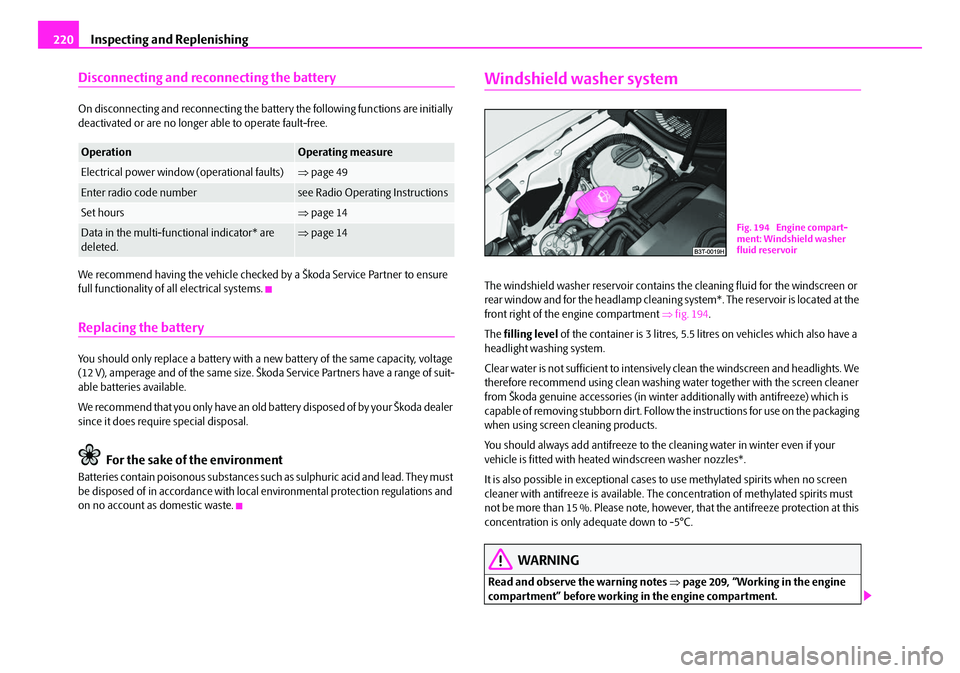
The windshield washer reserv oir contains the cleaning fluid for the windscreen or
rear window and for the headlamp cleaning system*. The reservoir is located at the
front right of the engine compartment ⇒fig. 194 .
The filling level of the container is 3 litres, 5.5 li tres on vehicles which also have a
headlight washing system.
Clear water is not sufficient to intensivel y clean the windscreen and headlights. We
therefore recommend using clean washing water together with the screen cleaner
from Škoda genuine accessorie s (in winter additionally with antifreeze) which is
capable of removing stubborn dirt. Follow the instructions for use on the packaging
when using screen cleaning products.
You should always add antifreeze to the cleaning water in winter even if your
vehicle is fitted with heated windscreen washer nozzles*.
It is also possible in exceptional cases to use methylated spirits when no screen
cleaner with antifreeze is available. The concentration of methylated spirits must
not be more than 15 %. Please note, however, that the antifreeze protection at this
concentration is only adequate down to -5°C.
WARNING
Read and observe the warning notes ⇒page 209, “Working in the engine
compartment” before working in the engine compartment.
OperationOperating measure
Electrical power window (operational faults)⇒ page 49
Enter radio code numbersee Radio Operating Instructions
Set hours⇒page 14
Data in the multi-functional indicator* are
deleted.⇒page 14Fig. 194 Engine compart-
ment: Windshield washer
fluid reservoir
NKO B6 20.book Page 220 Wednesday, March 26, 2008 3:15 PM
Page 235 of 272

Breakdown assistance
236
– Reinstall the full wheel trim/wheel cap after removing the adapter or place the cap onto the safety wheel bolt.
– Have the tightening torque checked w i t h a t o rq u e w re n c h a s s o o n a s
possible. Steel and light alloy wheels must be tightened to a tightening
torque of 120 Nm.
The safety wheel bolts on vehicles fitted with them (one safety wheel bolt per
wheel) can only be loosened or tigh ten up by using the adapter provided.
It is meaningful to note the code numbe r hammered into the rear side of the
adapter or the rear side of the safety wheel bolts. You can obtain a replacement
adapter from a Škoda Service Partner, if necessary, by quoting this number.
We recommend that you always carry the adapter for the wheel bolts with you in
the vehicle. It should be st owed in the vehicle tool kit.
Caution
Damage can occur to the adapter and safety wheel bolt if the safety wheel bolt is
tightened up too much.
Note
The set of safety wheel bolts can be obtained from a Škoda Service Partner.
Jump-starting
Initial steps
You can use the battery of another vehicl e for jump-starting yours if the engine
does not start because the battery on your vehicle is flat. You will require jump-start
cables for this purpose.
Both batteries must have a rated voltage of 12 V. The capacity (Ah) of the battery
supplying the power must not be significa ntly less than the capacity of the
discharged battery in your vehicle. Jump-start cables
Only use jump-start cables which have an
adequately large cross-section and insu-
lated terminal clamps. Please pay attent ion to the manufacturer's instructions.
Positive cable - colour coding in the majority of cases red.
Negative cable - colour coding in the majority of cases black.
WARNING
•A discharged battery may already freeze at temperatures just below 0°C.
In case of frozen battery carry out no jump-starting - risk of explosion!
•Please pay attention to the warning instructions relating to working in
the engine compartment ⇒page 209, “Working in the engine compart-
ment”.
Note
•There must not be any contact between the two vehicles otherwise current may
flow as soon as the negative terminals are connected.
•The discharged battery must be properly connected to the system of the
vehicle.
•Switch off any mobile phone, pay attent ion to the instructions for use of the
mobile phone in such a situation.
•We recommend purchasing jump-start cabl es from Škoda Service Partners as a
Škoda original accessory or from retailers who sell branded batteries.
NKO B6 20.book Page 236 Wednesday, March 26, 2008 3:15 PM