2008 SKODA SUPERB lights
[x] Cancel search: lightsPage 199 of 272

Taking care of your vehicle and cleaning the vehicle
200
Plastic parts
External plastic parts are cleaned by normal washing. Plastic parts and synthetic
leather can also be treated with special solvent-free plastic cleaning agents if a
damp cloth is not sufficient. Paint care pr oducts are not suitable for plastic parts.
Caution
Solvent-free cleaners attack the material and can damage it.
Windows
Only use a plastic ice scraper for removing snow and ice from the windows and
mirrors. You should not move the ice scraper forward and backward but in one
direction on the window which you are clea ning in order to avoid any damage to
the surface of the glass.
You can best remove residues of rubber, oil, grease, wax or silicone by using a
special window cleaner or a special silicone remover.
You should also clean the windows regularly from the inside.
Do not use window leathers which you have used to polish the vehicle body to dry
off the windows. Residues of preservati ves in the window leather can dirty the
window and reduce visibility.
Do not affix any stickers over the inside of the rear window to avoid damage to the
heating elements of the rear window heater .
We recommend using a preservative from Škoda genuine accessories offered by
your Škoda dealer.
Caution
Never remove snow or ice from the glass parts with warm or hot water - risk of
formation of cracks in the glass!
The headlight lenses
Please do not use any aggres sive cleaning or chemical solvent pr oducts - risk of
damage to the plastic lenses Please use soap and clean warm water.
Caution
Never wipe the headlights dry and do not use any sharp objects for cleaning the
plastic lenses, this may result in damage to the protective paintwork and conse-
quently in formation of cracks on the head light lenses, e.g through effect of chem-
ical products.
Door and window seals
The rubber seals on the doors, boot lid, bonnet and windows remain supple and
last longer if you treat them from time to time with a rubber care product (e.g. with
a spray with silicone-free oil). You also avoid premature wear of the seals and
prevent leakages in this way. It is also easier to open the doors. Rubber seals which
are well cared for also do not stick together in cold winter weather.
Locks
We recommend that you use the spray from Škoda original accessories with
regreasing and anticorrosive effect for de-icing locks.
Note
When washing your vehicle, ensure that as little water as possible gets into the
locks.
NKO B6 20.book Page 200 Wednesday, March 26, 2008 3:15 PM
Page 219 of 272
Inspecting and Replenishing
220
Disconnecting and reconnecting the battery
On disconnecting and reconnecting the battery the following functions are initially
deactivated or are no longer able to operate fault-free.
We recommend having the vehicle checked by a Škoda Service Partner to ensure
full functionality of all electrical systems.
Replacing the battery
You should only replace a battery with a new battery of the same capacity, voltage
(12 V), amperage and of the same size. Škoda Service Partners have a range of suit-
able batteries available.
We recommend that you only have an old battery disposed of by your Škoda dealer
since it does require special disposal.
For the sake of the environment
Batteries contain poisonous substances such as sulphuric acid and lead. They must
be disposed of in accordance with local environmental protection regulations and
on no account as domestic waste.
Windshield washer system
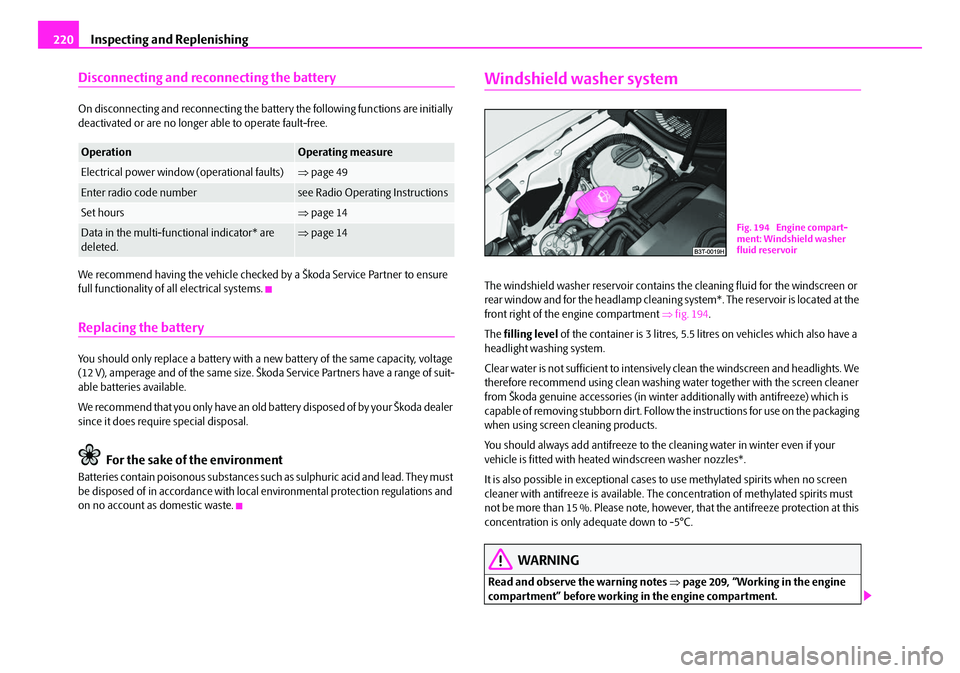
The windshield washer reserv oir contains the cleaning fluid for the windscreen or
rear window and for the headlamp cleaning system*. The reservoir is located at the
front right of the engine compartment ⇒fig. 194 .
The filling level of the container is 3 litres, 5.5 li tres on vehicles which also have a
headlight washing system.
Clear water is not sufficient to intensivel y clean the windscreen and headlights. We
therefore recommend using clean washing water together with the screen cleaner
from Škoda genuine accessorie s (in winter additionally with antifreeze) which is
capable of removing stubborn dirt. Follow the instructions for use on the packaging
when using screen cleaning products.
You should always add antifreeze to the cleaning water in winter even if your
vehicle is fitted with heated windscreen washer nozzles*.
It is also possible in exceptional cases to use methylated spirits when no screen
cleaner with antifreeze is available. The concentration of methylated spirits must
not be more than 15 %. Please note, however, that the antifreeze protection at this
concentration is only adequate down to -5°C.
WARNING
Read and observe the warning notes ⇒page 209, “Working in the engine
compartment” before working in the engine compartment.
OperationOperating measure
Electrical power window (operational faults)⇒ page 49
Enter radio code numbersee Radio Operating Instructions
Set hours⇒page 14
Data in the multi-functional indicator* are
deleted.⇒page 14Fig. 194 Engine compart-
ment: Windshield washer
fluid reservoir
NKO B6 20.book Page 220 Wednesday, March 26, 2008 3:15 PM
Page 220 of 272

Inspecting and Replenishing221
Using the systemSafetyDriving TipsGeneral MaintenanceBreakdown assistanceTechnical Data
Caution
•On no account should you add radiator antifreeze or other additives to the
windscreen washer fluid.
•If the vehicle is fitted with headligh t cleaning system, you should only add
cleaning products which do not attack the polycarbonate coating of the headlights
to the windscreen washer fluid. Please co ntact your Škoda Service Partner, who will
tell you which cleaning agent you can use.
NKO B6 20.book Page 221 Wednesday, March 26, 2008 3:15 PM
Page 230 of 272

Breakdown assistance231
Using the systemSafetyDriving TipsGeneral MaintenanceBreakdown assistanceTechnical Data
Spare wheel
The spare wheel lies in a well under the floor covering of the luggage compartment
and is fixed in place using special screws ⇒fig. 201 .
Before removing the spare wheel, you must take out the box with the vehicle tool
kit box ⇒page 230, fig. 200 .
One should check the inflation pressure in the spare wheel (at best when generally
checking the tyre air pressures - see sign on the fuel filler flap ⇒page 222) to
ensure that the spare wheel is always ready to use.
Temporary spare wheel
A warning label displayed on the rim of the temporary spare wheel indicates that
your vehicle is equipped with a temporary spare wheel.
Please observe the following notes when driving with a temporary spare wheel:
•After fitting on the wheel, the warning stic ker must not be concealed (e.g. by the
wheel trim).
•Do not drive with this spare wheel at more than 80 km/h - risk of accident. Avoid
accelerating at full throttle, sharp braking and fast cornering.
•The inflation pressure for this spare wheel is identical to the inflation pressure
of the standard tyres. The temporary spare wheel R 18 must have an inflation pres-
sure of 420 kPa (4.2 bar)!
•Use this spare wheel only to reach the nearest specialist garage as it is not
intended for continuous use.
•No other summer or winter tyres must be mounted on the rim of the spare
wheel R 18.
Changing a wheel
Preliminary work
The following steps should be carried out before actually changing the
wheel.
– If it is necessary to change a wheel, park the vehicle as far away as possible from the traffic flow. The place you choose should be level.
–Have all the occupants get out. While changing a wheel, the occu-
pants of the vehicle should not stan d on the road (e.g. behind a crash
barrier).
– Apply the handbrake firmly.
–Engage 1st gear or if your vehicle is fitted with an automatic gearbox,
position the selector lever into position P.
– If a trailer is coupled, uncouple it.
– Take the vehicle tool kit ⇒ page 230 and the spare wheel
⇒ page 231 out of the luggage compartment.
WARNING
•If you find yourself in flowing traffic switch on the hazard warning lights
system and place the warning triangle on the side of the road at the
prescribed distance from your vehicle while observing all national legal
provisions. In this way you are protecting not only yourself but also other
road users.
Fig. 201 Luggage compart-
ment: Spare wheel
NKO B6 20.book Page 231 Wednesday, March 26, 2008 3:15 PM
Page 237 of 272

Breakdown assistance
238
– Release the clutch particularly gent ly when starting off or depress the
accelerator particularly gently if yo ur vehicle is fitted with an auto-
matic gearbox.
Driver of the towed vehicle
– Switch the ignition on so that the steering wheel is not blocked and you can also operate the turn signal lights, the headlight flasher, the
windscreen wipers and wi ndscreen washer system.
– Take the vehicle out of gear or move the selector lever into position N
if your vehicle is fitted with an automatic gearbox.
– Note that the brake servo unit and power steering only operate if the engine is running. You will require si gnificantly greater physical force
to depress the brake pedal and to steer the vehicle if the engine is not
running.
– Ensure that the tow rope is always kept taught.
Tow rope or tow bar
A tow bar is safest way of towing a vehicle and also minimizes any shocks. You can
use a tow rope only if a suitable tow bar is not available.
The tow rope must be elastic to protect the vehicle. Thus one should only use
plastic fibre rope or a rope made out of a similarly elastic material.
Only attach the tow rope to the towing eyes provided for this purpose ⇒page 238
and ⇒page 239.
Driving style
Towing another vehicle requires a certain amount of practice. Both drivers should
be familiar with the particular points about towing a vehicle. Unskilled drivers
should not attempt to tow in another vehicle or to be towed in.
One should be constantly vigilant not to allow impermissibly high towing forces or
jerky loadings. There is always a risk of excessive stresses and damage resulting at
the points to which you attach the tow ro pe or tow bar when you attempt to tow a
vehicle which is not standing on a paved road.
Caution
If the gearbox of your vehicle no longer contains any oil because of a defect, your
vehicle must only be towed in with the driven wheels raised clear of the ground, or
on a special vehicle transporter or trailer.
Note
•Please comply with any legal requirements particularly regarding the switched
on signal systems, when towing in or tow-starting another vehicle.
•The tow rope must not be twisted as it may in certain circumstances result in the
front towing eye being unscrewed out of your vehicle.
Front towing eye
The towing eye is stored in the box for the vehicle tool kit.
Fig. 208 Front bumper:
Protective grille
NKO B6 20.book Page 238 Wednesday, March 26, 2008 3:15 PM
Page 244 of 272

Fuses and light bulbs245
Using the systemSafetyDriving TipsGeneral MaintenanceBreakdown assistanceTechnical Data
Fuse assignment in the dash panel
Certain electrical components are only standard on certain vehicle model versions
or only suppliable as optional equipment for certain models.
No.Power consumerAmperes
1Diagnostic socket, engine cont rol unit, relay EKP, control
unit for EKP7,5
2Control unit for ABS, ESP, swit ch for tyre inflation pres-
sure-control system, brake sensor5
3Switch and control unit for airbag5
4WIV, parking light, dimming rear mirror, pressure sensor,
telephone preinstallation5
5Control unit for headlamp beam adjustment and head-
light swivel, control unit for parking aid5
6Instrument cluster, control unit for electromechanical
power steering, Haldex5
7Valve heating, air mass meter10
Fig. 216 Schematic repre-
sentation of the fuse carrier
in the dash panel
8Control unit for trailer detection5
9Relay for auxiliary heating5
10Adaptive left main headlight10
11Adaptive right main headlight10
12Central locking system of the front doors10
13Diagnostic socket, light switch, rain sensor, clock7,5
14Central locking system and bonnet lid15
15Central control unit - interior lights7,5
16The air conditioning system7,5
17Central locking system of the rear doors10
18Not assigned
19Not assigned
20ABS, ESP, Uphill-Start off-Assist5
21Not assigned
22Air blower for Climatronic40
23Front power window30
24Selector lever lock5
25Rear window heater
relay for auxiliary heating and ventilation25
30
26Power socket in the luggage compartment25
27Fuel pump relay,
Fuel pump relay, control unit for fuel pump, injection
valves15
20
28Not assigned
29Not assigned
30Not assigned
No.Power consumerAmperes
NKO B6 20.book Page 245 Wednesday, March 26, 2008 3:15 PM
Page 245 of 272

Fuses and light bulbs
246
Electrically adjustable seats are protected by automatic circuit breakers, which
switch on again automatically after a few seconds after the overload has been
eliminated.
Bulbs
Changing bulbs
The relevant lamp must always be switch ed off before a light bulb is replaced.
Defect light bulbs should only be replaced with light bulbs of the same type. The
designation is located on the li ght socket or the glass bulb.
Changing certain bulbs is not something wh ich you can do yourself, but requires to
be done by a specialist. Other parts of the vehicle must be removed in order to
change the light bulbs. This applies, in particular, to bulbs which can only be
reached from the engine compartment.
We therefore recommend that you have any bulbs changed by a Škoda Service
Partner or, in exceptional cases, by ca lling on other professional assistance.
Please note that the engine compartment is a hazardous area ⇒page 209,
“Working in the engine compartment”.
We recommend that you carry the set of light bulbs with you which was delivered
in your vehicle. Replacement light bulbs
17) are available at specialist garages.
The set of light bulbs can be stowed in the locable box in the spare wheel.
Fitted with a xenon headlight
Change of light bulbs on Xenon lights (low beam lights, parking lights and main
beam lights) should be undertaken by a specialist garage.
Overview of bulbs
31Not assigned
32Rear power window30
33Electric sliding/tilting roof25
34Alarm, spare horn5
35front and rear lighter25
36Headlight cleaning system20
37Front seat heating20
38Heated rear seats20
39Not assigned
40Fan air-conditioning system, relay for auxiliary heating
and ventilation40
41Not assigned
42Light switch5
43To w i n g d e v i c e15
44To w i n g d e v i c e20
45To w i n g d e v i c e15
46Heated windscreen washer nozzles, relay for auxiliary
heating and ventilation, switch for seat heating5
47Not assigned
48Not assigned
49Not assigned
No.Power consumerAmperes
17)Replacement light bulbs are, on the other hand, part of the basic equipping of the vehicle in
some countries.
NKO B6 20.book Page 246 Wednesday, March 26, 2008 3:15 PM
Page 246 of 272

Fuses and light bulbs247
Using the systemSafetyDriving TipsGeneral MaintenanceBreakdown assistanceTechnical Data
WARNING
•Bulbs H7 and H3 are pressurised and may burst when changing the bulb
- risk of injury!
•It is recommended to wear gloves and eye protection when changing a
light bulb.
•Gas discharge bulbs* (xenon bulbs) op erate with a high voltage, profes-
sional knowledge is required - danger to life!
Caution
Do not take hold of the glass bulb with naked fingers (even the smallest amount of
dirt reduces the working life of the light bu lb). Use a clean cloth, serviette or some-
thing similar.
Note
This Owner's Manual only describes the replacement of bulbs where it is assumed
that no major complications wi ll arise. Other light bulbs should be changed by your
specialist garage.
Front headlight
Positions of the light bulbs in the front headlight ⇒fig. 217 .
Front headlightHalogen headlightXenon headlight
Low beam H7D1S
Main beamH3D1S, H3
Parking lightsW5W
Tu r n s i g n a l sPY 24W
Fog lightsH8
Rear light unitBulb
Reversing lightW16W
Tu r n s i g n a l sPY21W
Light bulb for the brake lights and tail
lightsW16W
Parking lightsW5W
Fog lightsP21W
OthersBulb
Licence plate lightC5W
front interior lightingW5W
3. Brake lightLED
Rear interior lightingW5W
Storage compartment light - front pas-
senger sideC3W
Footwell lightW5W
Luggage compartment lightW5W
Door warning lightW5W
Lighting for vanity mirrorC5W
Entry lightW5W
Fig. 217 Front headlight:
Installing the light bulbs
NKO B6 20.book Page 247 Wednesday, March 26, 2008 3:15 PM