2008 SKODA OCTAVIA change wheel
[x] Cancel search: change wheelPage 158 of 304

Communication157
Using the systemSafetyDriving TipsGeneral MaintenanceBreakdown assistanceTechnical Data
Operate telephone in the information display*
If you select the menu point Te l e p h o n e on the information display with the aid of
the handwheel , you can change to the following menus:
„Phone book
„Dial number
„Call register
„Voice mailbox
„Messages
„Bluetooth
„Settings
„Back
Phone book
In the menu point Phone book is the list of the loaded contacts from the telephone
memory and the SIM card of the mobile phone. In the phone phonebook there are
1000 free memory locations available.
Dial number
In the menu point Dial number, you can write any telephone number. Select in
sequence the desired digits with the ai d of the handwheel and confirm it by
pressing the handwheel. Yo u can select the numbers 0 - 9, the symbols *, # and the
functions Delete, Call, Cancel . Call register
In the menu point
Call register, you can select the following menu points:
„Missed calls
„Received calls
„Last calls
„Delete lists
Voice mailbox
In the menu point Voice mailbox there is a list of messages from the missed calls.
Messages
In the menu point Messages there is a list of received text messages.
Bluetooth
In the menu Bluetooth you can select the following menu points:
„User - the overview of the stored users
„New user - Search for users who are in the reception range
„Visibility - Switching on the visibility of the telephone unit for other devices
„Extras
„Headset
„Modem
„Phone name - the possibility to change the name of the telephone unit (pre-
set SKODA-rSAP)
Settings
In the menu Settings you can select the following menu points:
„Phone book
„Update
„Select memory
„SIM & phone (SIM & Mobile phone)
„SIM card
„Mobile phone
Fig. 165 Information
display: Menu telephone
A4
20A5Facelift.book Page 157 Saturday, September 6, 2008 2:13 PM
Page 178 of 304

Airbag system177
Using the systemSafetyDriving TipsGeneral MaintenanceBreakdown assistanceTechnical Data
Important safety information regarding the front airbag system
Correct use of the airbag system considerably reduces the risk of
injury!
WARNING
•Never transport children on the front seat of a vehicle without using a
proper restraint system. If airbags are deployed in the event of an accident,
the child might suffer severe or even fatal injuries!
•For the driver and front passenger it is important to maintain a distance
of at least 25 cm from the steering wheel or dash panel ⇒fig. 180 . Not main-
taining this minimum distance will mean that the airbag system will not be
able to properly protect you - hazard! The front seats and the head restraints
must always also be correctly adjusted to match the body size of the occu-
pant.
•It is essential to always switch off ⇒page 181, “Deactivating an airbag”
the front passenger airbag when attach ing a child safety seat on the front
passenger seat where the child is seated with its back facing in direction of
travel (in some countries also when the ch ild is facing the direction of travel).
If this is not done, there is a risk of the child suffering severe or even fatal
injuries if the front passenger airbag is deployed. In certain countries
national legal provisions also requir e that the side or head passenger
airbags be deactivated. When transporting a child on the front passenger seat, please comply with the appropriate national regulations regarding the
use of child safety seats.
•There must not by any further persons, animals or objects positioned
between the front seated occupants and the deployment area of the airbag.
•The steering wheel and the surface of the airbag module in the dash
panel on the passenger side must not be stuck onto, covered or modified in
any other way. These parts should only be cleaned with a dry cloth or a cloth
moistened with water. No objects such as cup holders, mobile phone
mounts, etc. may be attached to the covers of the airbag modules or be
located within the immediate area.
•No modifications of any kind may be made to parts of the airbag system.
Any work on the airbag system includ ing installing and removing system
components because of other repair work (e.g. removing the steering
wheel) must only be carried out by a specialist garage.
•Never carry out changes on the front bumper or on the body.
•Never place any objects on the surface of the front passenger airbag in
the dash panel.
Fig. 180 Safe distance to
steering wheel
WARNING (continued)
20A5Facelift.book Page 177 Saturday, September 6, 2008 2:13 PM
Page 195 of 304

Intelligent Technology
194
•when driving with snow chains
•when driving in deep snow or on a loose surface
•when it is necessary to rock a ca r free when it has become stuck.
then you should switch on the ESP again.
WARNING
It is also not possible for the ESP to overcome the physical limits of the
vehicle. Even if a vehicle fitted with ESP you should still always adapt your
style of driving to the condition of the road surface and the traffic situation.
This particularly applies when driving on slippery and wet roads. The
increased safety offered must not tempt you to take greater risks than other-
wise - risk of an accident!
Note
•All four wheels must be fitted with the same tyres in order to achieve problem-
free operation of the ESP. Differing rolling circumferences of the tyres can lead to an
undesirable reduction in the engine output.
•Changes to vehicle (e.g. on engine, on the brakes, on chassis or other assign-
ment of tyres and wheels) can influence the function of the ESP ⇒page 243,
“Accessories, changes and replacement of parts”.
Electronic Differential Lock (EDS)*
The electronic differential lock pr events an individual wheel from
slipping.
Models fitted with ESP are equipped with electronic differential lock (EDL).
General
The EDL makes it much easier, and sometimes at all possible, to start off, accelerate
and climb a steep hill when the conditio ns of the road surface are unfavourable. Operating principle
The EDL is activated automatically, that is without any action on the part of the
driver. It monitors the speeds of the driven wheels with the aid of the ABS sensors.
Should only
one drive wheel begin spinning on a slippery surface there will be an
appreciable difference in the speed of the driven wheels. The EDL function brakes
the slipping wheel and the differential transmits a greater driving force to the other
driven wheel. This control proces s is also accompanied by noises.
Overheating of the brakes
The EDL switches off automatically if unusually severe stresses exist in order to
avoid excessive heat generation in the disc brake on the wheel which is being
braked. The vehicle can continue to be driven and has the same characteristics as a
vehicle not fitted with EDL.
The EDL switches on again automatically as soon as the brake has cooled down.
WARNING
•Depress the accelerator carefully when accelerating on uniformly slip-
pery road surfaces, such as ice and snow. The driven wheels might still spin
despite the EDL and affect the stability of the vehicle - risk of an accident!
•You should always adapt your style of driving to the condition of road
surface and to the traffic situation even when your vehicle is fitted with EDL.
The increased safety offered must not tempt you to take greater risks than
otherwise - risk of an accident!
Note
•If the ABS or ESP warning light comes on, this may also indicate a fault in the
EDL. Please have the car inspected as soon as possible by a specialist garage.
•Changes to vehicle (e.g. on engine, on the brakes, on chassis or other assign-
ment of tyres and wheels) can in fluence the function of the EDL ⇒page 243,
“Accessories, changes and replacement of parts”.
20A5Facelift.book Page 194 Saturday, September 6, 2008 2:13 PM
Page 196 of 304
Intelligent Technology195
Using the systemSafetyDriving TipsGeneral MaintenanceBreakdown assistanceTechnical Data
Traction control system (TCS)
The traction control system prevents the driven wheels from spinning
when accelerating.
General
The TCS makes it much easier, and sometimes at all possible, to start off, accelerate
and climb a steep hill when the conditio ns of the road surface are unfavourable.
Operating principle
The TCS switches on automatically when th e engine is started and then conducts a
self-test. The system monitors the speeds of the driven wheels with the aid of the
ABS sensors. If the wheels are spinning, the force transmitted to the road surface is
automatically adapted by redu cing the engine speed. This occurs at all speeds.
The TCS operates in combination with the ABS ⇒page 197, “Antilock brake system
(ABS)”. The TCS will not function if a fault exists in the ABS system.
The TCS warning light lights up in the instrument cluster when there is a fault on the
TCS
⇒ page 37.
Switching off
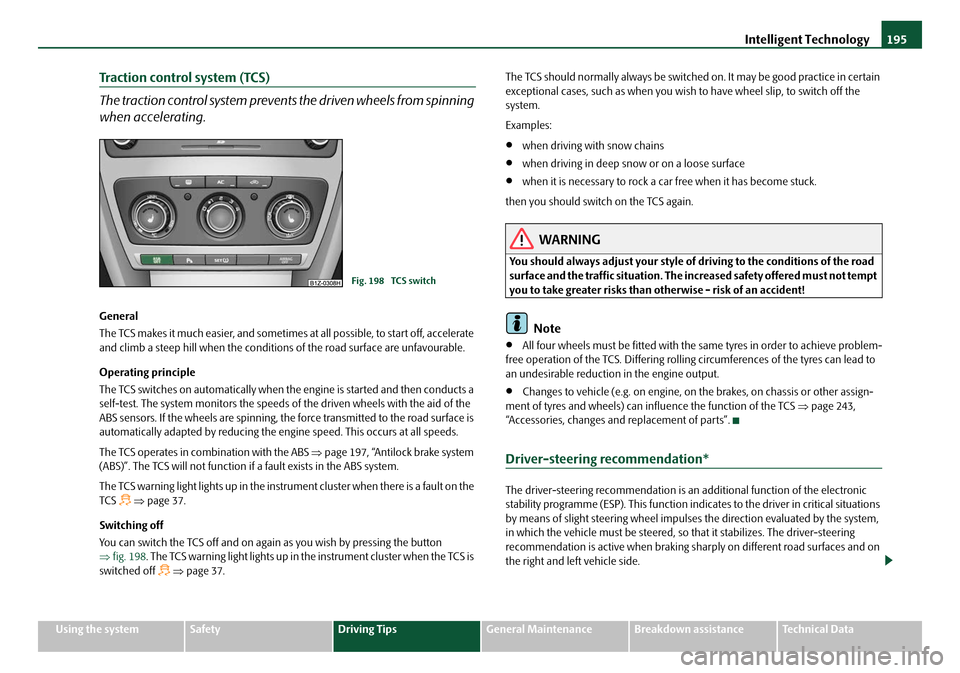
You can switch the TCS off and on again as you wish by pressing the button
⇒ fig. 198 . The TCS warning light lights up in the instrument cluster when the TCS is
switched off
⇒ page 37. The TCS should normally always be switched on. It may be good practice in certain
exceptional cases, such as when you wish
to have wheel slip, to switch off the
system.
Examples:
•when driving with snow chains
•when driving in deep snow or on a loose surface
•when it is necessary to rock a car free when it has become stuck.
then you should switch on the TCS again.
WARNING
You should always adjust your style of driving to the conditions of the road
surface and the traffic situation. The increased safety offered must not tempt
you to take greater risks than otherwise - risk of an accident!
Note
•All four wheels must be fitted with the same tyres in order to achieve problem-
free operation of the TCS. Differing rolling circumferences of the tyres can lead to
an undesirable reduction in the engine output.
•Changes to vehicle (e.g. on engine, on the brakes, on chassis or other assign-
ment of tyres and wheels) can in fluence the function of the TCS ⇒page 243,
“Accessories, changes and replacement of parts”.
Driver-steering recommendation*
The driver-steering recommendation is an additional function of the electronic
stability programme (ESP). This function indicates to the driver in critical situations
by means of slight steering wheel impulses the direction evaluated by the system,
in which the vehicle must be steered, so that it stabilizes. The driver-steering
recommendation is active when braking shar ply on different road surfaces and on
the right and left vehicle side.
Fig. 198 TCS switch
20A5Facelift.book Page 195 Saturday, September 6, 2008 2:13 PM
Page 198 of 304

Intelligent Technology197
Using the systemSafetyDriving TipsGeneral MaintenanceBreakdown assistanceTechnical Data
vehicle and reduces the strain on the brakes
. Any additional braking should be done
intermittently, no t continuously.
Note
The hazard warning light system is switched on automatically in case of an emer-
gency braking at speeds greater than 60 km /h. The hazard warning light system is
switched off automatically after a ccelerating or driving off again.
Brake booster
The brake booster boosts the pressure which you generate with the brake pedal.
The necessary pressure is only gene rated when the engine is running.
WARNING
•Never switch off the engine before the vehicle is stationary.
•The brake booster only operates when the engine is running. Greater
physical effort for braking is required when engine is switched off. Because
if you do not stop as normal, this can cause an accident and severe injuries.
Antilock brake system (ABS)
ABS prevents the wheels locking when braking.
General
The ABS contributes significan tly to enhancing the active safety of your vehicle.
Compared to a car not fitted with the ABS brake system, you are able to retain
optimal steering ability even during a fu ll brake application on a slippery road
surface because the wheels do not lock up.
You must not expect, however, that the br aking distance will be shorter under all
circumstances as a result of the ABS. Th e braking distance for example on gravel
and fresh snow, when you should anyway be driving slowly and cautiously, will be
longer. Operating principle
The brake pressure will be reduced on a wheel which is rotating at a speed which is
too low for the speed of the vehicle and tend
ing to lock. This control cycle is notice-
able from a pulsating movement of the brake pedal which is accompanied by
noises. This is consciously intended to provide the driver with the information that
the wheels are tending to lock (ABS control range). You must always keep the brake
pedal depressed to enable the ABS to optima lly control the brake application in this
braking range. Never interrupt the application of the brakes!
WARNING
•The ABS can also not overcome the physic al limits of your vehicle. Please
do not forget this, particularly when driv ing on icy or wet road surfaces. If the
ABS is operating within the control ra nge, adapt your speed immediately to
the conditions of the road surface and the traffic situation. The increased
safety offered by the ABS must not tempt you to take greater risks than
otherwise - risk of an accident!
•The normal braking system is still fully functional if there is an ABS fault.
Visit a specialist garage as quickly as po ssible and adjust your style of driving
to take account of the ABS fault in the meantime since you will not know how
great the damage is.
Note
•A warning light comes on if a fault occurs in the ABS system ⇒ page 38.
•Changes to vehicle (e.g. on engine, on the brakes, on chassis or other assign-
ment of tyres and wheels) can in fluence the function of the ABS ⇒ page 243,
“Accessories, changes and replacement of parts”.
Brake Assist*
During a severe brake application (e.g. if a hazard exists), the Brake Assist increases
the braking force and thus makes it possible to rapidly produce the pressure
required in the brake system.
20A5Facelift.book Page 197 Saturday, September 6, 2008 2:13 PM
Page 200 of 304

Intelligent Technology199
Using the systemSafetyDriving TipsGeneral MaintenanceBreakdown assistanceTechnical Data
Tyre inflation pressure-control system*
The tyre inflation pressure-control system compares with the aid of the ABS sensors
the speed and also the rolling circumference of the individual wheels. If the rolling
circumference of a wheel is changed, the warning light
lights up in the instru-
ment cluster ⇒page 38 and an audible signal sound s. The rolling circumference of
the tyre can change if:
•the tyre inflation pressure is too low,
•the structure of the tyre is damaged,
•the vehicle is loaded on one side,
•the wheels of an axle are loaded heavily (e.g. when towing a trailer or when
driving uphill or downhill),
•snow chains are mounted,
•the temporary spare wheel is mounted,
•one wheel per axle was changed.
Basic setting of tyre inflation pressure-control system
After changing the tyre inflation pressures or after changing one or several wheels,
a basic setting of the system must be carried out as follows.
•Inflate all tyres to the specified inflation pressure ⇒page 237.
•Switch on the ignition.
•Press button ⇒fig. 199 for more than 2 seconds. While pressing the
button, the warning light lights up. At the same time the memory of the system
is erased and the new calibration is star ted, which is confirmed with an audible
signal and then the warning light
goes out.
•If the warning light does not go out after the basic setting, there is a fault in
the system. Have the vehicle inspected by your nearest specialist garage.
Warning light
lights up
If the tyre inflation pressure of at least on e wheel is insufficiently inflated in compar-
ison to the stored basic value, the warning light
⇒ lights up.
Warning light
flashes
If the warning light flashes, there is a system fault. Have the vehicle inspected by
your nearest specialist garage.
WARNING
•When the warning light lights up, immediately reduce the speed and
avoid sudden steering and brake mano euvres. Please stop the vehicle
without delay at the nearest possible stop and inspect the tyres and their
inflation pressures.
•The driver is responsible for the correct tyre inflation pressures. For this
reason, the tyre inflation pressures must be checked regularly.
•Under certain circumstances (e.g. sporty style of driving, wintry or
unpaved roads) the warning light can be delayed or does not light up at
all.
•The tyre inflation pressure-control system does not take away the
responsability from the driver for the correct tyre inflation pressure.
Note
The tyre inflation pressure-control system:
•does not replace the regular tyre inflatio n pressure control, because the system
cannot detect an even pressure loss,
Fig. 199 Button for setting
the tyre inflation pressure
control value
20A5Facelift.book Page 199 Saturday, September 6, 2008 2:13 PM
Page 240 of 304

Wheels and Tyres239
Using the systemSafetyDriving TipsGeneral MaintenanceBreakdown assistanceTechnical Data
WARNING
•You must have your tyres replaced with new ones at the latest when the
wear indicators have been worn do wn. The legally permissible minimum
tread depth should be observed.
•Worn tyres do not provide the necessary adhesion to the road surface at
high speeds on wet roads. One could experience “aquaplaning” (uncon-
trolled movements of the vehicle - “swimming” on a wet road surface).
Changing wheels around
If significantly greater wear is present on the front tyres, we recommend changing
the front wheels around with the rear wheels as shown in the diagram ⇒fig. 220 .
You will then obtain approximately the same life for all the tyres.
It may be advantageous to swap the tyre s over “crosswise” when certain types of
wear characteristic ar ise on the running surface of the tyres (but not in the case of
unidirectional tyres). Škoda Service Pa rtners can provide you with details.
We recommend that you change the wheels around every 10 000 km in order to
achieve even wear on all wheels and to obtain optimal tyre life.
New tyres and wheels
Tyres and wheel rims are important design elements. One should therefore use the
tyres and wheel rims which have been released for use by Škoda Auto. They are
exactly matched to the vehicl e type and therefore contribu te significantly to good
road holding and safe driving characteristics ⇒.
Only fit radial tyres of the same type on all 4 wheels, size (rolling circumference)
and, if possible, the same tread pattern on one axle.
The Škoda Service Partners have access to the most current information about
which tyres we have released for use on your vehicle.
We recommend that you have any work rela ting to tyres or wheels carried out by
your Škoda Service Partner . Your dealer has all of th e necessary special tools and
replacement parts available plus the required specialist knowledge and is also in a
position to properly dispose of the old tyres. A large number of Škoda Service Part-
ners also have an attractive range of tyres and wheels available.
The tyre/wheel combinations which are appr oved for your vehicle are indicated in
your vehicle documents. Approval and lice nsing may differ according to the legis-
lation prevailing in individual countries.
Proper knowledge of the tyre data makes it easier for you to select the correct type
of tyre. Tyres do, for example, have the following inscription on their walls:
195 / 65 R 15 91 T
What this means is:
The following speed restrictions apply to tyres.
Fig. 220 Changing wheels
around
195Tyre wid th i n m m
65Height/width ratio in %
RCode letter for the type of tyre - R adial
15Diameter of wheel in inches
91Load index
TSpeed symbol
20A5Facelift.book Page 239 Saturday, September 6, 2008 2:13 PM
Page 244 of 304

Accessories, changes and replacement of parts243
Using the systemSafetyDriving TipsGeneral MaintenanceBreakdown assistanceTechnical Data
Accessories, changes and replacement of parts
Accessories and replacement parts
Škoda vehicles have been built according to the latest discoveries in safety engi-
neering. Thus one should no t change the condition in which the vehicle was deliv-
ered from the manufacturer without some thought.
The following guidelines should be observed when a vehicle is to be retrofitted with
accessories, have technical ch anges made to it or a par t has to be replaced at some
time in the future.
•Advise should always be obtained from a Škoda Service Partner before buying
any accessories and before making any technical changes ⇒.
•This is particularly the case when acce ssories are bought in a foreign country.
•Škoda Genuine Accessories which have b een released for use and Skoda orig-
inal parts can be obtained from Škoda Se rvice Partners. They will install them
professionally and correctly.
•All Škoda original accessories which are listed in the catalogue of original acces-
sories such as tilting roofs, spoile rs, wheel rims etc. are homologized.
•Radios, aerials and other electrical access ories should only be installed by an
authorised workshop.
•The guidelines issued by Škoda Auto a.s. must be observed when making tech-
nical changes.
•This is to ensure that no technical damage occurs to the vehicle, that travelling
and operating safety are maintained and that the chnages are permissible. Škoda
Service Partners undertake this work professionally or refer it to an specialist
company in special cases.
Any damage which is done caused by technical changes made without
consulting a Skoda a.s. dealer is excluded from the guarantee.
WARNING
•We advise you, in your own interest, to only use Škoda Genuine Accesso-
ries and Škoda original parts which have been expressly approved for use on your Škoda. Reliability, safety and su
itabiliity have been established for
these Škoda original parts.
•We cannot guarantee suitability of installation into your vehicle of other
products despite keeping a constant ey e on market developments (also not
in the case where there is an attestation or permission can be produced).
Technical changes
Interference on the electronic components and their software can lead to opera-
tional faults. This interference can also impair not directly affected systems because
of the networking of the electronic co mponents. This means that the operating
safety of your vehicle can be considerably jeopardized, a greater wear of vehicle
parts can occur and finally the vehi cle registration documents expire.
We trust that you will understand that yo ur Škoda Service Partner cannot be liable
for damage resulting from unprofessional work.
We therefore recommend that you have a ll work carried out with Škoda original
parts at your authorised Škoda Service Partners.
WARNING
Work or modifications on your vehicle, which have been carried out unpro-
fessionally, can cause operational faults - risk of accident!
WARNING (continued)
20A5Facelift.book Page 243 Saturday, September 6, 2008 2:13 PM