2008 SKODA OCTAVIA Time
[x] Cancel search: TimePage 196 of 304
Intelligent Technology195
Using the systemSafetyDriving TipsGeneral MaintenanceBreakdown assistanceTechnical Data
Traction control system (TCS)
The traction control system prevents the driven wheels from spinning
when accelerating.
General
The TCS makes it much easier, and sometimes at all possible, to start off, accelerate
and climb a steep hill when the conditio ns of the road surface are unfavourable.
Operating principle
The TCS switches on automatically when th e engine is started and then conducts a
self-test. The system monitors the speeds of the driven wheels with the aid of the
ABS sensors. If the wheels are spinning, the force transmitted to the road surface is
automatically adapted by redu cing the engine speed. This occurs at all speeds.
The TCS operates in combination with the ABS ⇒page 197, “Antilock brake system
(ABS)”. The TCS will not function if a fault exists in the ABS system.
The TCS warning light lights up in the instrument cluster when there is a fault on the
TCS
⇒ page 37.
Switching off
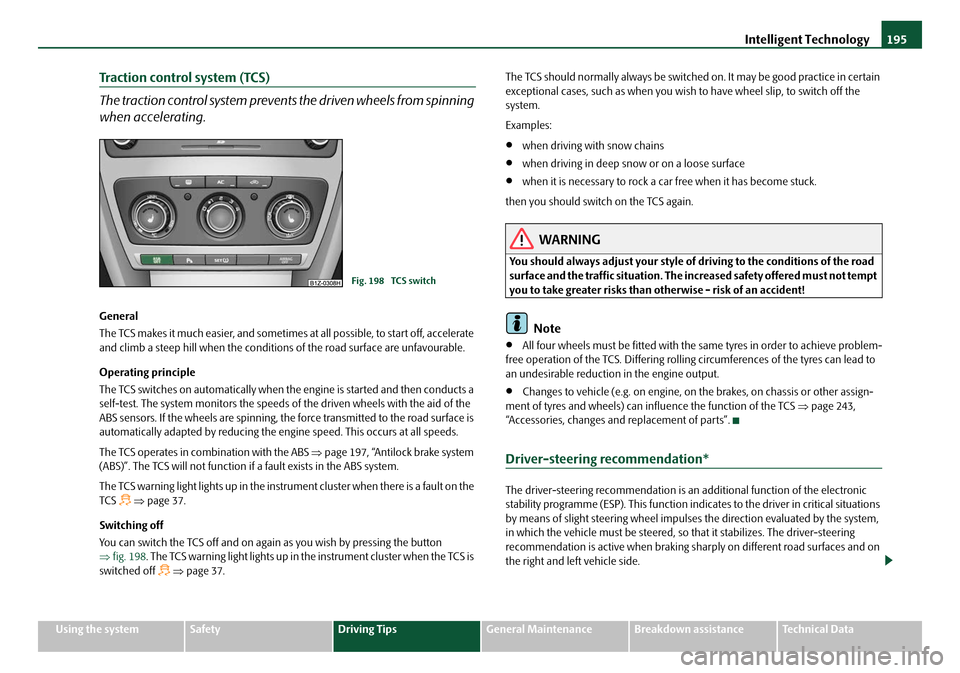
You can switch the TCS off and on again as you wish by pressing the button
⇒ fig. 198 . The TCS warning light lights up in the instrument cluster when the TCS is
switched off
⇒ page 37. The TCS should normally always be switched on. It may be good practice in certain
exceptional cases, such as when you wish
to have wheel slip, to switch off the
system.
Examples:
•when driving with snow chains
•when driving in deep snow or on a loose surface
•when it is necessary to rock a car free when it has become stuck.
then you should switch on the TCS again.
WARNING
You should always adjust your style of driving to the conditions of the road
surface and the traffic situation. The increased safety offered must not tempt
you to take greater risks than otherwise - risk of an accident!
Note
•All four wheels must be fitted with the same tyres in order to achieve problem-
free operation of the TCS. Differing rolling circumferences of the tyres can lead to
an undesirable reduction in the engine output.
•Changes to vehicle (e.g. on engine, on the brakes, on chassis or other assign-
ment of tyres and wheels) can in fluence the function of the TCS ⇒page 243,
“Accessories, changes and replacement of parts”.
Driver-steering recommendation*
The driver-steering recommendation is an additional function of the electronic
stability programme (ESP). This function indicates to the driver in critical situations
by means of slight steering wheel impulses the direction evaluated by the system,
in which the vehicle must be steered, so that it stabilizes. The driver-steering
recommendation is active when braking shar ply on different road surfaces and on
the right and left vehicle side.
Fig. 198 TCS switch
20A5Facelift.book Page 195 Saturday, September 6, 2008 2:13 PM
Page 197 of 304

Intelligent Technology
196
WARNING
Even with this additional function the vehicle cannot be steered automati-
cally! The driver is furthermore fully reponsible for the steering of the
vehicle!
Brakes
What has a negative effect on braking efficiency?
Wear-and-tear
Wear-and-tear to the brake pads is greatly dependent on the operating conditions
of the vehicle and your style of driving. Particularly if you drive a great deal in towns
and over short distances or if you adopt a sporty style of driving, it may be neces-
sary to have the thickness of the brake pads inspected at a specialist garage
between the service inspections.
Wet roads or road salt
There may be a certain delay before the brakes take full effect under certain condi-
tions such as when driving through water, during heavy rain showers or after the
vehicle has been washed in an automatic vehicle wash, since the brake discs and
brake pads may be moist or even have a coating of ice on them in winter. You
should dry the brakes as soon as possib le (by applying and releasing the brakes
several times, if the road conditions and the traffic situation allows it).
There also may be a certain delay before the full braking efficiency is available when
driving on roads which have been treated wi th road salt if you have not used the
brakes for some considerable time beforeha nd. The layer of salt on the brake discs
and brake pads must first be rubb ed off when you apply the brakes.
Corrosion
Corrosion on the brake discs and dirt on th e bake pads occur if the vehicle has been
parked for a long period and if you do not make much use of the braking system.
We recommend cleaning the brake discs by firmly applying the brakes at a fairly
high speed if you do not make much use of the braking system or if surface corro-
sion is present ⇒. Faults in the brake surface
If you notice that the braking distance
has suddenly become longer and that the
brake pedal can be depressed further, it is possible that a brake circuit of the dual-
circuit brake system has failed. Drive, in such cases, to the nearest specialist garage
without delay in order to have the problem rectified. Drive at a reduced speed while
on your way to the dealer and adapt your style of driving to the higher brake pedal
pressure required.
Low brake fluid level
An insufficient level of brake fluid may result in problems in the brake system. The
level of the brake fluid is monitored electronically ⇒page 40, “Brake system ”.
WARNING
•Only apply the brakes for the purpos e of drying and cleaning the brake
discs if the traffic conditions permit this. Do not place any other road users
in jeopardy.
•When retrospectively mounting a front spoiler, solid wheel hubs etc. one
must ensure that the air supply to the front wheel brakes is not reduced
otherwise the braking system could run too hot.
•Allow for the fact that new brake pads do not achieve their full braking
efficiency until approximately 200 kilo metres. New brake pads must be first
“run in” before they develop their optimal friction force. You can, however,
compensate for this slightly reduced braking force by increasing the pres-
sure on the brake pedal. This guidelin e also applies to any new brake pads
installed at a future date.
Caution
•Never allow the brakes to ru b by applying slight pressure if you do not wish to
brake the vehicle. This causes the brakes to overheat and can also result in a longer
braking distance and excessive wear.
•Before negotiating a steep downhill sect ion, please reduce your speed, shift
down into the next lower gear (manual ge arbox) or select a lower driving stage
(automatic gearbox). This enables you to make full use of the braking power of the
20A5Facelift.book Page 196 Saturday, September 6, 2008 2:13 PM
Page 198 of 304

Intelligent Technology197
Using the systemSafetyDriving TipsGeneral MaintenanceBreakdown assistanceTechnical Data
vehicle and reduces the strain on the brakes
. Any additional braking should be done
intermittently, no t continuously.
Note
The hazard warning light system is switched on automatically in case of an emer-
gency braking at speeds greater than 60 km /h. The hazard warning light system is
switched off automatically after a ccelerating or driving off again.
Brake booster
The brake booster boosts the pressure which you generate with the brake pedal.
The necessary pressure is only gene rated when the engine is running.
WARNING
•Never switch off the engine before the vehicle is stationary.
•The brake booster only operates when the engine is running. Greater
physical effort for braking is required when engine is switched off. Because
if you do not stop as normal, this can cause an accident and severe injuries.
Antilock brake system (ABS)
ABS prevents the wheels locking when braking.
General
The ABS contributes significan tly to enhancing the active safety of your vehicle.
Compared to a car not fitted with the ABS brake system, you are able to retain
optimal steering ability even during a fu ll brake application on a slippery road
surface because the wheels do not lock up.
You must not expect, however, that the br aking distance will be shorter under all
circumstances as a result of the ABS. Th e braking distance for example on gravel
and fresh snow, when you should anyway be driving slowly and cautiously, will be
longer. Operating principle
The brake pressure will be reduced on a wheel which is rotating at a speed which is
too low for the speed of the vehicle and tend
ing to lock. This control cycle is notice-
able from a pulsating movement of the brake pedal which is accompanied by
noises. This is consciously intended to provide the driver with the information that
the wheels are tending to lock (ABS control range). You must always keep the brake
pedal depressed to enable the ABS to optima lly control the brake application in this
braking range. Never interrupt the application of the brakes!
WARNING
•The ABS can also not overcome the physic al limits of your vehicle. Please
do not forget this, particularly when driv ing on icy or wet road surfaces. If the
ABS is operating within the control ra nge, adapt your speed immediately to
the conditions of the road surface and the traffic situation. The increased
safety offered by the ABS must not tempt you to take greater risks than
otherwise - risk of an accident!
•The normal braking system is still fully functional if there is an ABS fault.
Visit a specialist garage as quickly as po ssible and adjust your style of driving
to take account of the ABS fault in the meantime since you will not know how
great the damage is.
Note
•A warning light comes on if a fault occurs in the ABS system ⇒ page 38.
•Changes to vehicle (e.g. on engine, on the brakes, on chassis or other assign-
ment of tyres and wheels) can in fluence the function of the ABS ⇒ page 243,
“Accessories, changes and replacement of parts”.
Brake Assist*
During a severe brake application (e.g. if a hazard exists), the Brake Assist increases
the braking force and thus makes it possible to rapidly produce the pressure
required in the brake system.
20A5Facelift.book Page 197 Saturday, September 6, 2008 2:13 PM
Page 199 of 304

Intelligent Technology
198
The majority of drivers do apply the brakes in good time in dangerous situations,
but do not depress the brake pedal with su fficient pressure. Consequently, it is not
possible for the car to achieve its maxi mum deceleration and the car covers a
greater distance than necessary.
The Brake Assist is activated by the very quick operation of the brake pedal. In such
cases, a much greater braking pressure ex ists than during a normal brake applica-
tion. This makes it possible, even with a relatively low resistance of the brake pedal,
to produce an adequate pressure in the brake system in the shortest possible time,
which is required for maximum deceleration of the car. You must apply the brake
pedal firmly and hold it in this position in order to achieve the shortest possible
braking distance.
The Brake Assist is able to help you achieve a shorter braking distance in emergency
situations by rapidly producing the pressure required in the brake system. It fully
exploits the attributes of the ABS. After you release the brake pedal, the function of
the Brake Assist is automatically switched off and the brakes operate in the normal
way.
The Brake Assist is part of the ESP system. If a fault occurs in the ESP, the Brake Assist
function is also not available. Further information on the ESP ⇒page 193.
WARNING
•The Brake Assist is also not able to overcome the physical limits of your
car in terms of the braking distance required.
•Adapt your speed to the conditions of the road surface and to the traffic
situation.
•The increased safety offered by the Brake Assist must not tempt you to
take a greater safety risk than otherwise.
Uphill-Start off-Assist*
The uphill-start off-assist makes it much easier to start off on steep hills. The system
assists a start off by holding the brake pr essure produced by the brake pedal actu-
ation for approx. 2 seconds after releasing the brake pedal. The driver can therefore
move his foot from the brake pedal to the accelerator pedal and start off on the slope, without having to actuate the hand
brake. The brake pressure drops gradually
the more you operate the accelerator pedal. If the vehicle does not start off within
2 seconds, it starts to roll back.
The uphill-start off-assist is active in the ev ent of a 5% slope, if the vehicle door is
closed. It is alwa ys active on slopes when in forward or reverse start off. When
driving downhill, it is inactive.
Electromechanical power steering
The power steering enables you to steer the vehicle with less physical force.
With the electromechanical power steering, the steering assist is automatically
adapted to the speed and to the steering angle.
It is still possible to fully steer the vehicle if the power steering fails or if the engine
is not running (vehicle being towed in). The only difference is that greater physical
effort is required.
If there is a fault in the power steering, the warning light
or lights up in the
instrument cluster ⇒page 35.
WARNING
Contact your specialist garage if the power steering is defective.
20A5Facelift.book Page 198 Saturday, September 6, 2008 2:13 PM
Page 200 of 304

Intelligent Technology199
Using the systemSafetyDriving TipsGeneral MaintenanceBreakdown assistanceTechnical Data
Tyre inflation pressure-control system*
The tyre inflation pressure-control system compares with the aid of the ABS sensors
the speed and also the rolling circumference of the individual wheels. If the rolling
circumference of a wheel is changed, the warning light
lights up in the instru-
ment cluster ⇒page 38 and an audible signal sound s. The rolling circumference of
the tyre can change if:
•the tyre inflation pressure is too low,
•the structure of the tyre is damaged,
•the vehicle is loaded on one side,
•the wheels of an axle are loaded heavily (e.g. when towing a trailer or when
driving uphill or downhill),
•snow chains are mounted,
•the temporary spare wheel is mounted,
•one wheel per axle was changed.
Basic setting of tyre inflation pressure-control system
After changing the tyre inflation pressures or after changing one or several wheels,
a basic setting of the system must be carried out as follows.
•Inflate all tyres to the specified inflation pressure ⇒page 237.
•Switch on the ignition.
•Press button ⇒fig. 199 for more than 2 seconds. While pressing the
button, the warning light lights up. At the same time the memory of the system
is erased and the new calibration is star ted, which is confirmed with an audible
signal and then the warning light
goes out.
•If the warning light does not go out after the basic setting, there is a fault in
the system. Have the vehicle inspected by your nearest specialist garage.
Warning light
lights up
If the tyre inflation pressure of at least on e wheel is insufficiently inflated in compar-
ison to the stored basic value, the warning light
⇒ lights up.
Warning light
flashes
If the warning light flashes, there is a system fault. Have the vehicle inspected by
your nearest specialist garage.
WARNING
•When the warning light lights up, immediately reduce the speed and
avoid sudden steering and brake mano euvres. Please stop the vehicle
without delay at the nearest possible stop and inspect the tyres and their
inflation pressures.
•The driver is responsible for the correct tyre inflation pressures. For this
reason, the tyre inflation pressures must be checked regularly.
•Under certain circumstances (e.g. sporty style of driving, wintry or
unpaved roads) the warning light can be delayed or does not light up at
all.
•The tyre inflation pressure-control system does not take away the
responsability from the driver for the correct tyre inflation pressure.
Note
The tyre inflation pressure-control system:
•does not replace the regular tyre inflatio n pressure control, because the system
cannot detect an even pressure loss,
Fig. 199 Button for setting
the tyre inflation pressure
control value
20A5Facelift.book Page 199 Saturday, September 6, 2008 2:13 PM
Page 203 of 304

Driving and the Environment
202
Catalytic converter
Proper operation of the emission co ntrol system (catalytic converter)
is of major significance for drivin g your vehicle in an environmen-
tally conscious way.
Please refer to the following guidelines:
– For vehicles with petrol engine only refuel with unleaded petrol
⇒ page 219, “Grades of petrol”.
– Never run the fuel tank completely empty.
– Do not switch off the ignition while you are driving the vehicle.
– Do not pour too much oil into the engine ⇒page 228, “Replenishing
engine oil”.
– Do not tow-start the vehicle over a distance of more than 50 metres
⇒ page 253, “Tow-starting and towing vehicle”.
If you drive your vehi cle in a country in which unleade d petrol is not available, you
must have the catalytic converter replaced later when driving the vehicle into a
country in which use of a cata lytic converter is mandatory.
WARNING
•In view of the high temperatures which may be produced in the catalytic
converter, one should always park a vehicle in such a way that the catalytic
converter cannot come into contact with easily flammable materials below
the vehicle - a risk of fire!
•Never use additional underbody protection or corrosion-protection
agents for the exhaust pipes, catalyti c converters or heat shields. Such
substances might ignite when driving - risk of fire!
Caution
•Vehicles fitted with catalytic converter should neve r be allowed to let the fuel
tank to run completely empty. An irregular fuel supply can result in poor ignition or misfiring. Unburnt fuel may get into the exhaust system and damage the catalytic
converter.
•Filling the tank even only once with le
aded petrol will result in the catalytic
converter being destroyed.
•If you detect misfiring, a drop in perf ormance or irregular engine running when
driving, reduce your speed immediately and have the vehicle inspected by the
nearest specialist garage. The symptoms described may be caused by a fault in the
ignition system. Unburnt fuel may get in to the exhaust system and damage the
catalytic converter.
For the sake of the environment
Even if the exhaust system is operating properly, a sulphur-like exhaust odour may
be produced under certain operating condit ions of the engine. This depends on the
sulphur content of the fuel. It is often su fficient to refuel with unleaded premium-
grade petrol of a different brand or at a different filling station.
Driving in an economical and environmentally
conscious manner
General
Your personal style of driving is a major factor.
Your fuel consumption, any pollution of the environmental and the wear-and-tear
to the engine, brakes and tyres, depend essentially on three factors:
•your personal style of driving,
•the conditions under which your vehicle is operated,
•technical aspects.
You can easily improve your fuel economy by 10 - 15 percent by driving in an
economical way with foresight. This section is intended to provide you with a
number of tips on how to protect the en vironment and at the same time save
money.
20A5Facelift.book Page 202 Saturday, September 6, 2008 2:13 PM
Page 205 of 304

Driving and the Environment
204
Avoiding full throttle
Driving more slowly means saving fuel.
Sensitive use of the accelera tor will not only significantly reduce fuel consumption
but also positively influence environmen tal pollution and wear of your vehicle.
You should avoid fully exploi ting the top speed of your vehicle wherever possible.
Fuel consumption, pollutant emissions and vehicle noises increase disproportion-
ally at high speeds.
The ⇒fig. 202 shows the ratio of fuel consumption to the speed of your vehicle.
You will cut your fuel consumption by half if you only make use three-quarters of
the possible top speed of your vehicle.
Reducing idling
Idling also costs fuel.
It is worthwhile switching off the engine in a traffic jam or when waiting at a level
crossing or at traffic lights with a length y red phase. Even after just 30 - 40 seconds
you will have saved more fuel than that is needed when you start the engine up
again.
If an engine is only idling it takes much longer for it to reach its normal operating
temperature. Wear-and-tear and pollutant em issions, though, are particularly high in the warming-up phase. This is why you
should drive off right after starting the
engine. Do avoid high engine revolutions at this time, however.
Regular servicing
A poorly tuned engine consumes an unnecessarily high amount of
fuel.
Having your vehicle serviced regularly at a specialist garge enables you to satisfy
one of the requirements for economical moto ring even before you set off on your
journey. Keeping your vehicle properly servic ed not only has a positive effect on the
safety of your vehicle and maintaining its value, but also saves on fuel.
A poorly tuned engine can result in a fuel consumption which is 10% higher than
normal.
The foreseen maintenance work should be undertaken exactly according to the
Service schedule by a specialist garage.
Also check the oil level after refueling. Oil consumption is dependent to a consid-
erable extent on the load and speed of the engine. Oil consumption could be as
high as 0.5 litres/1 000 km depending on your style of driving.
It is quite normal that a new engine ha s a higher oil consumption at first, and
reaches its lowest level only after a certain running in time. It is therefore not
possible to correctly assess the oil cons umption of a new vehicle until after you
have driven about 5 000 km.
For the sake of the environment
•You can achieve additional improvements in your fuel economy by using high-
lubricity oils.
•Check the ground below your car at regula r intervals to detect any leakages in
good time. Please have your vehicle inspected by a specialist garge if you find any
stains caused by oil or other fluids on the floor.
Fig. 202 Fuel consumption
in litres/100 km. and speed in
km/h.
20A5Facelift.book Page 204 Saturday, September 6, 2008 2:13 PM
Page 206 of 304

Driving and the Environment205
Using the systemSafetyDriving TipsGeneral MaintenanceBreakdown assistanceTechnical Data
Avoid driving short distances
Short distances result in an above-average high fuel consumption.
– Avoid driving a distance of no more than 4 km if the engine is cold.
The engine and catalytic converter mu st first have reached their optimal operating
temperature in order to effectively reduce fu el consumption and pollutant emis-
sions.
The cold engine vehicle consumes approx. 15 - 20 litres/100 km of fuel immediately
after starting. Fuel co nsumption drops to 10 litres/100 km after just 1 kilometre. The
engine reaches its operating temperat ure (outside temperature and engine
dependent) only after about 4 to 10 kilometres and the fuel consumption then
stabilizes. You should therefore avoid driving short distances whenever possible.
An important factor in this connection is also the ambient temperature. The
⇒ fig. 203 shows the different fuel consumptions for the same distance, on the one
hand at +20°C and on the other hand at -10°C. Your vehicle has a higher fuel
consumption in winter than in summer.
Checking tyre inflation pressures
Tyres which are correctly inflated save fuel.
Always ensure that your tyres are inflated to the correct pressure at all times. The
rolling resistance will be increased if the tyre filling pressure is too low. This will not only increase fuel consumption but also
tyre wear and the driving behaviour will
worsen.
Always check the inflation pressure of the tyres when cold.
Do not drive with winter tyres all year round for this costs about 10 % more fuel.
Winter tyres are also louder.
No unnecessary ballast
Transporting ballast costs fuel.
The fact that every kilogram of extra weight increases your fuel consumption
means that it is worth taking a look in the luggage compartment to avoid trans-
porting any unnecessary ballast.
It is particularly in town traffic, when one is accelerating quite often, that the vehicle
weight will have a significant effect upon the fuel consumption. A rule of thumb
here is that an increase in weight of 100 kilograms will cause an increase in fuel
consumption of about 1 litre/100 kilometres.
You may frequently also leave a roof rack fitted on just out of convenience,
although you no longer need it. The incr eased aerodynamic drag of your vehicle
causes it to use about 10% more fuel th an normal at a speed of 100 - 120 km/h,
even when you are not carr ying a load on the roof.
Saving electricity
Generating electricity costs fuel.
– Switch off electrical components as soon as you no longer need them.
When the engine is running, the alternator generates and supplies electrical power.
The greater the load on the alternator as a result of having a large number of elec-
trical components switched on, the more fuel will be consumed for operating the
alternator.
Fig. 203 Fuel consumption
in litres/100 km at different
temperatures
20A5Facelift.book Page 205 Saturday, September 6, 2008 2:13 PM