2008 SKODA FABIA maintenance
[x] Cancel search: maintenancePage 72 of 252

Seats and Stowage71
Using the systemSafetyDriving TipsGeneral MaintenanceBreakdown assistanceTechnical Data
– Release the fixtures at the ends of the cross member by slightly
pulling up the securing screws . The fixtures open when they are
not already opened.
– Position the cross member with the fixed (not pulled out) part onto
the right (in direction of travel) lashing eye and then the pull out part
onto the left lashing eye.
– Press the fixtures on both sides of the cross member until they lock
in place and tighten the securing screws .
– Check the attachment of the cross member by pulling it.
WARNING
When transporting the bicycles in the luggage compartment, ensure the safety of the passengers transported.
Install bicycle carrier
– Position the approved bicycle carrier on the middle of the cross
member, after pulling up the screw push the frame side rail (alu-
part) towards the cross member and screw the screw into the nut
⇒fig. 79.
– Slacken the screw and take it out of the moveable part of the
fixture; position the moveable part of the carrier, depending on
bicycle size, into one of the possible positions, so that it does not
come in contact with the boot lid. We recommend to place the move-
able part of the fixture in such a position that the holes are visible
between the screw and the moveable part.
– Insert the screw into the desired position and tighten.
Put bicycle into the bicycle carrier
– Remove the front wheel before putting the bicycle into the vehicle.
AB
AC
AA
AB
AC
Fig. 79 Install bicycle carrier
AA
AA
AB
AA
AB
Fig. 80 Put in the bicycle
Fig. 81 Fastening the front wheel
NKO A05F 20.book Page 71 Wednesday, April 2, 2008 1:02 PM
Page 74 of 252
Seats and Stowage73
Using the systemSafetyDriving TipsGeneral MaintenanceBreakdown assistanceTechnical Data
– When transporting two bicycles tension the strap ⇒fig. 82 between
the saddle rods, by pushing the bicycles apart.
– Hang the carabines at the ends of the strap into the lashing eyes
behind the rear seats.
– Pull the strap through the tensioning clasp, first of all on the one side
and then on the other side.
– If it is necessary, the position of the bicycles in the vehicle can be addi-
tionally rectified.
WARNING
•When transporting passengers and objects, which require the seats to be folded forwards, ensure the safety of the passengers being transported.
•Place the bicycles in the bicycle carrier in such a position that no collision between the steering arm and the rear window can occur.
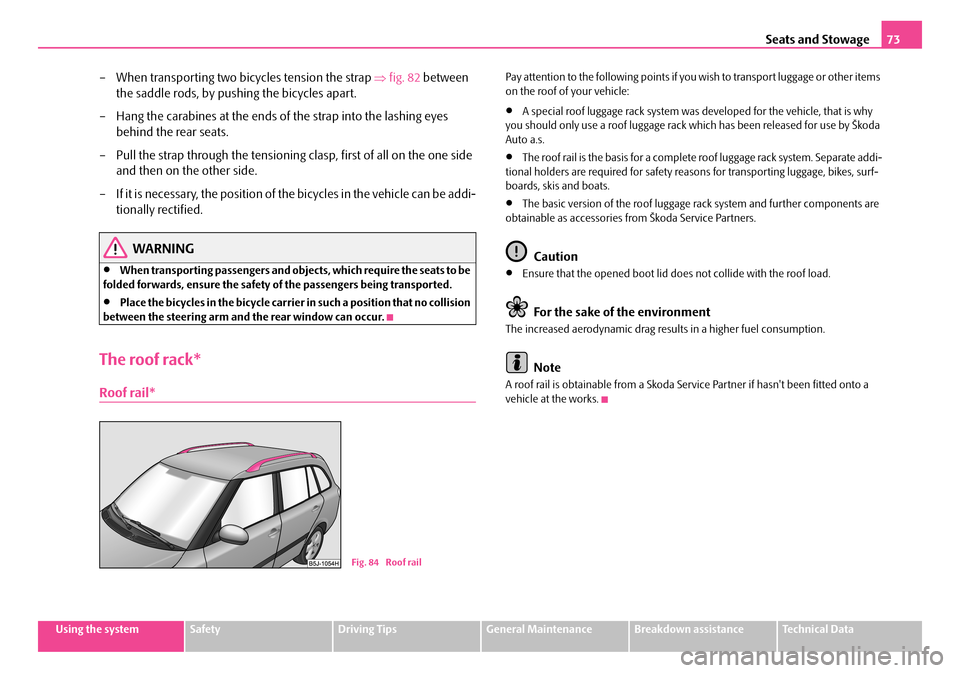
The roof rack*
Roof rail*
Pay attention to the following points if you wish to transport luggage or other items on the roof of your vehicle:
•A special roof luggage rack system was developed for the vehicle, that is why you should only use a roof luggage rack which has been released for use by Škoda Auto a.s.
•The roof rail is the basis for a complete roof luggage rack system. Separate addi-tional holders are required for safety reasons for transporting luggage, bikes, surf-boards, skis and boats.
•The basic version of the roof luggage rack system and further components are obtainable as accessories from Škoda Service Partners.
Caution
•Ensure that the opened boot lid does not collide with the roof load.
For the sake of the environment
The increased aerodynamic drag results in a higher fuel consumption.
Note
A roof rail is obtainable from a Skoda Service Partner if hasn't been fitted onto a vehicle at the works.
Fig. 84 Roof rail
NKO A05F 20.book Page 73 Wednesday, April 2, 2008 1:02 PM
Page 76 of 252

Seats and Stowage75
Using the systemSafetyDriving TipsGeneral MaintenanceBreakdown assistanceTechnical Data
•Do not use any cups or beakers which are made of brittle material (e.g. glass, porcelain). You might be injured by them in the event of an accident.
Caution
Do not open the beverages in the cup holder while driving. There is a risk of spilling e.g. when braking and therefore the electrical components or the seat upholstery can be damaged.
Rear cup holder*
You can place one cup or beverage can into the recess ⇒fig. 87.
WARNING
•Do not place any hot beverages into the cup holder. If the vehicle moves, the hot beverages may spill - risk of scalding!
•Do not use any cups or beakers which are made of brittle material (e.g. glass, porcelain). You might be injured by them in the event of an accident.
Caution
Do not open the beverages in the cup holder while driving. There is a risk of spilling e.g. when braking and therefore the electrical components or the seat upholstery can be damaged.
Note holder
The note holder is designed e.g. for attaching a car park ticket in parking areas.
The attached note has to always be removed before starting off in order not to restrict the driver's vision.
WARNING (continued)
Fig. 87 Centre console: Cup holder
Fig. 88 Windscreen: Note holder
NKO A05F 20.book Page 75 Wednesday, April 2, 2008 1:02 PM
Page 78 of 252

Seats and Stowage77
Using the systemSafetyDriving TipsGeneral MaintenanceBreakdown assistanceTechnical Data
WARNING
•Take care when using the cigarette lighter! Not paying proper attention or incorrect use the cigarette lighter in an uncontrolled manner may result in burns.
•The cigarette lighter and the power socket also operates when the igni-tion is switched off or the ignition key withdrawn. This is why you should never leave children unattended in the vehicle!
Caution
Always use matching plugs to avoid damaging the power socket.
Note
Connecting electrical components when the engine is not running will drain the battery of the vehicle - risk of battery draining!
Power socket in the luggage compartment
– Open the cover of the power socket ⇒fig. 92.
– Connect the plug of the electrical appliance to the socket.
You can only use the power socket for the connection of approved electrical acces-sories with a power uptake up to 180 watts. The vehicle battery will be discharged in the process if the engine is stationary.
The same remarks apply here as for ⇒page 76.
Further information ⇒page 200, “Accessories, changes and replacement of parts”.
Storage compartments
Overview
You will find the following storage facilities in your vehicle:
WARNING
•Please do not place anything on top of the dash panel. Such objects might slide or fall down when driving (when accelerating or cornering) and may distract you from concentrating on the traffic situation - risk of acci-dent!
Fig. 92 Luggage compart-ment: Power socket
Storage compartments on the front passenger side*⇒page 78
Storage compartment on the driver's side⇒page 79
Stowage compartment for spectacles*⇒page 79
Stowage compartment in centre console⇒page 79
Storage compartment in the front seat*⇒page 79
Front seat armrest with stowage compartment*⇒page 80
Storage compartment in the front doors⇒page 80
Storage compartments in the luggage compartment⇒page 81
Flexible storage compartment*⇒page 81
Clothes hooks*⇒page 82
NKO A05F 20.book Page 77 Wednesday, April 2, 2008 1:02 PM
Page 80 of 252

Seats and Stowage79
Using the systemSafetyDriving TipsGeneral MaintenanceBreakdown assistanceTechnical Data
Storage compartment on the driver's side
Unlockable compartment below the steering wheel on the left.
Stowage compartment for spectacles*
– Press on the lid of the stowage compartment, the stowage compart-
ment opens downwards ⇒fig. 96.
WARNING
The storage compartment must always be closed when driving for safety reasons - risk of head injury.
Stowage compartment in centre console
Unlocable compartment in the centre console.
Storage compartment in the front seat*
Fig. 95 Dash panel: Storage compartment on the driver's side
Fig. 96 Detail of the head-liner: Stowage compartment for spectacles
Fig. 97 Centre console: Storage compartment
Fig. 98 Front seat: Storage compartment
NKO A05F 20.book Page 79 Wednesday, April 2, 2008 1:02 PM
Page 82 of 252

Seats and Stowage81
Using the systemSafetyDriving TipsGeneral MaintenanceBreakdown assistanceTechnical Data
WARNING
Use the area ⇒fig. 101 of the storage compartment only for storing objects which do not project so that the effectiveness of the side airbag is not impaired.
Removeable storage compartments in the luggage
compartment*
A removeable storage compartment*⇒fig. 102 is located on both sides in the side trim panel of the luggage compartment.
The removeable storage compartments* are intended for storing small objects of up to 2.5 kg in weight.
Flexible storage compartment*
A flexible storage compartment is located on the right side of the luggage
compartment. The flexible storage compartment is foreseen for storing
small objects of up to 8 kg. in weight.
Removing
– Take hold of the flexible storage compartment at both upper corners.
– Press the upper corners to the inside and release the storage compart-
ment by pulling upwards.
– Remove by pulling towards you.
Installing
– Insert both ends of the flexible storage compartment into the open-
ings of the right side trim panel of the luggage compartment and push
it downwards until it locks.
Note
If the variable loading floor* is installed ⇒page 66 in the luggage compartment, no flexible storage compartment can be installed.
AA
Fig. 102 Removeable storage compartments
Fig. 103 Flexible storage compartment
NKO A05F 20.book Page 81 Wednesday, April 2, 2008 1:02 PM
Page 84 of 252

Heating and air conditioning system83
Using the systemSafetyDriving TipsGeneral MaintenanceBreakdown assistanceTechnical Data
Heating and air conditioning system
Heating
Using the system
The heating system delivers air into the interior of the vehicle and
warms it as required.
Setting temperature
– Turn the control dial ⇒fig. 105 to the right in order to increase the
temperature.
– Turn the control dial to the left in order to increase the tempera-
ture.
Controlling blower
– Turn the blower switch into one of the positions, 1 to 4, in order to
switch the blower on.
– Turn the blower switch into position 0 in order to switch the blower
off.
– Pressing button causes the recirculating air system ⇒ to be
switched on.
Control for air distribution
– You can adjust the direction of the air flow using air distribution regu-
lator ⇒page 85.
The air inlet in front of the windscreen must be free of ice, snow or leaves in order to ensure that the heating and ventilation systems operate properly.
All controls apart from the control dial can be set to any desired intermediate position.
The heating effect is dependent upon the coolant temperature, thus full heat output only occurs when the engine has reached its operating temperature.
The blower should aways be on to prevent the windows from misting up.
WARNING
You should not leave recirculated air mode on over a longer period of time, as “stale” air may result in fatigue in the driver and occupants, divert your attention and also cause the windows to mist up. The risk of having an acci-dent increases. Switch recirculated air mode off as soon as the windows begin misting up.
Note
•If the air distribution is positioned towards the windows, the total amount of air is used to defrost the windows and thus no air will be fed to the footwell. This can lead to restriction of the heating comfort.
•The used air streams out through the air removal openings in the luggage compartment.
•Have the air conditioning system cleaned by a specialist workshop.
Fig. 105 Heating: Control elements
AA
AA
AB
AB
A1
AC
AB
NKO A05F 20.book Page 83 Wednesday, April 2, 2008 1:02 PM
Page 86 of 252

Heating and air conditioning system85
Using the systemSafetyDriving TipsGeneral MaintenanceBreakdown assistanceTechnical Data
WARNING
You should not leave recirculated air mode on over a longer period of time, as “stale” air may result in fatigue in the driver and occupants, divert your attention and also cause the windows to mist up. The risk of having an acci-dent increases. Switch recirculated air mode off as soon as the windows begin misting up.
Air outlet vents
Fig. 106 Air outlet vents
Open air outlet vents
– Turn the rotary knob into the upper position.
Close air outlet vents
– Turn the rotary knob into the lower position.
Redirecting air flow
– The horizontal as well as the vertical direction of the air flow is set with
the handle in the middle of the air outlet vents.
You can set the air supply to the individual vents with the air distribution control ⇒page 83, fig. 105. Air outlet vents 3 and 4 can also be opened or closed individ-ually.
Unwarmed or cooled air will flow out of the opened air outlet vents according to the setting of the control dial ⇒page 83, fig. 105 and according to atmospheric conditions.
Climatic (semi-automatic air conditioning system)*
Description
Climatic is a combined cooling and heating system with electronic
control of the convenience temperature in the vehicle interior. It
makes it possible to optimally control the air temperature at any
season of the year.
Description of the Climatic
It is important for your safety and for your driving comfort that the Climatic is oper-ating properly.
The air conditioning system operates when switch ⇒page 86, fig. 107 is pressed and the following conditions are met:
•engine running,
•outside temperature above +2°C and
•blower switch switched on (positions 1 to 4).
If the cooling system is switched on, the temperature and air humidity drops in the vehicle. The wellbeing of the occupants of the car is enhanced as a result of this particularly at high outside temperatures and a high air humidity. The system prevents the windows misting up during the cold season of the year.
The heating effect is dependent upon the coolant temperature, thus full heat output only occurs when the engine has reached its operating temperature.
It is possible to briefly activate recirculated air mode in order to enhance the cooling effect ⇒.
AC
AA
ACAE
NKO A05F 20.book Page 85 Wednesday, April 2, 2008 1:02 PM