2008 SKODA FABIA battery
[x] Cancel search: batteryPage 78 of 252

Seats and Stowage77
Using the systemSafetyDriving TipsGeneral MaintenanceBreakdown assistanceTechnical Data
WARNING
•Take care when using the cigarette lighter! Not paying proper attention or incorrect use the cigarette lighter in an uncontrolled manner may result in burns.
•The cigarette lighter and the power socket also operates when the igni-tion is switched off or the ignition key withdrawn. This is why you should never leave children unattended in the vehicle!
Caution
Always use matching plugs to avoid damaging the power socket.
Note
Connecting electrical components when the engine is not running will drain the battery of the vehicle - risk of battery draining!
Power socket in the luggage compartment
– Open the cover of the power socket ⇒fig. 92.
– Connect the plug of the electrical appliance to the socket.
You can only use the power socket for the connection of approved electrical acces-sories with a power uptake up to 180 watts. The vehicle battery will be discharged in the process if the engine is stationary.
The same remarks apply here as for ⇒page 76.
Further information ⇒page 200, “Accessories, changes and replacement of parts”.
Storage compartments
Overview
You will find the following storage facilities in your vehicle:
WARNING
•Please do not place anything on top of the dash panel. Such objects might slide or fall down when driving (when accelerating or cornering) and may distract you from concentrating on the traffic situation - risk of acci-dent!
Fig. 92 Luggage compart-ment: Power socket
Storage compartments on the front passenger side*⇒page 78
Storage compartment on the driver's side⇒page 79
Stowage compartment for spectacles*⇒page 79
Stowage compartment in centre console⇒page 79
Storage compartment in the front seat*⇒page 79
Front seat armrest with stowage compartment*⇒page 80
Storage compartment in the front doors⇒page 80
Storage compartments in the luggage compartment⇒page 81
Flexible storage compartment*⇒page 81
Clothes hooks*⇒page 82
NKO A05F 20.book Page 77 Wednesday, April 2, 2008 1:02 PM
Page 96 of 252
Starting-off and Driving95
Using the systemSafetyDriving TipsGeneral MaintenanceBreakdown assistanceTechnical Data
Ignition lock
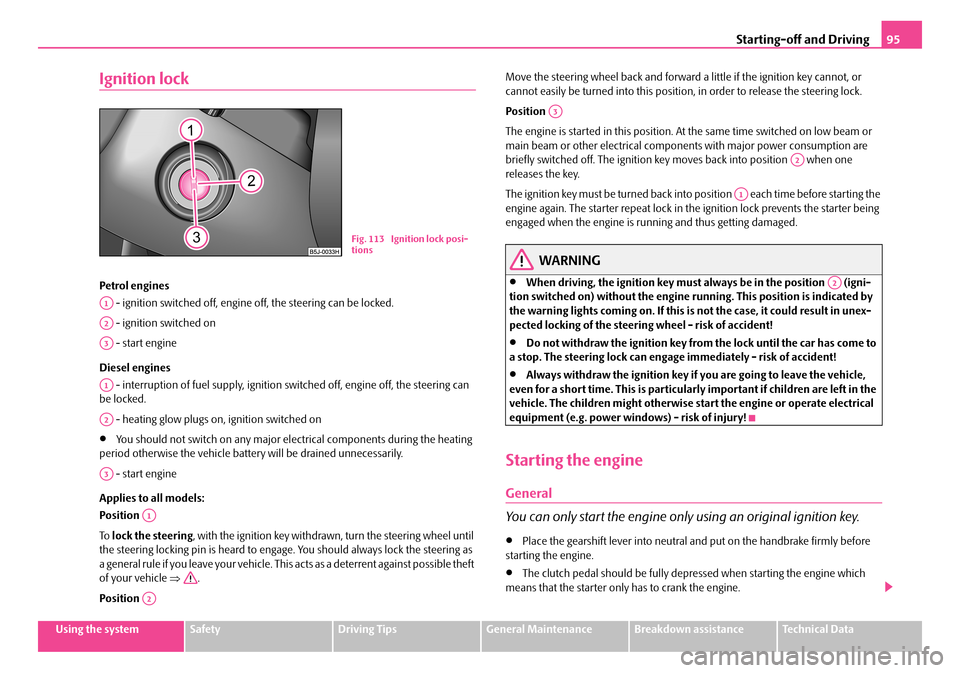
Petrol engines
- ignition switched off, engine off, the steering can be locked.
- ignition switched on
- start engine
Diesel engines
- interruption of fuel supply, ignition switched off, engine off, the steering can be locked.
- heating glow plugs on, ignition switched on
•You should not switch on any major electrical components during the heating period otherwise the vehicle battery will be drained unnecessarily.
- start engine
Applies to all models:
Position
To lock the steering, with the ignition key withdrawn, turn the steering wheel until the steering locking pin is heard to engage. You should always lock the steering as a general rule if you leave your vehicle. This acts as a deterrent against possible theft of your vehicle ⇒.
Position
Move the steering wheel back and forward a little if the ignition key cannot, or cannot easily be turned into this position, in order to release the steering lock.
Position
The engine is started in this position. At the same time switched on low beam or main beam or other electrical components with major power consumption are briefly switched off. The ignition key moves back into position when one releases the key.
The ignition key must be turned back into position each time before starting the engine again. The starter repeat lock in the ignition lock prevents the starter being engaged when the engine is running and thus getting damaged.
WARNING
•When driving, the ignition key must always be in the position (igni-tion switched on) without the engine running. This position is indicated by the warning lights coming on. If this is not the case, it could result in unex-pected locking of the steering wheel - risk of accident!
•Do not withdraw the ignition key from the lock until the car has come to a stop. The steering lock can engage immediately - risk of accident!
•Always withdraw the ignition key if you are going to leave the vehicle, even for a short time. This is particularly important if children are left in the vehicle. The children might otherwise start the engine or operate electrical equipment (e.g. power windows) - risk of injury!
Starting the engine
General
You can only start the engine only using an original ignition key.
•Place the gearshift lever into neutral and put on the handbrake firmly before starting the engine.
•The clutch pedal should be fully depressed when starting the engine which means that the starter only has to crank the engine.
Fig. 113 Ignition lock posi-tions
A1
A2
A3
A1
A2
A3
A1
A2
A3
A2
A1
A2
NKO A05F 20.book Page 95 Wednesday, April 2, 2008 1:02 PM
Page 97 of 252

Starting-off and Driving96
•Let go of the key as soon as the engine starts otherwise there may be damage to the starter.
The engine running noises may louder at first be louder for a short time after starting the cold engine until oil pressure can be built up in the hydraulic valve clearance compensation. This is quite normal and is not an operating problem.
If the engine does not start ...
You can use the battery of another vehicle as a jump-start aid ⇒page 208.
It is only possible to tow-start vehicles fitted with a manual gearbox. The tow-starting distance must not be more than 50 metres ⇒page 211.
WARNING
•Never run the engine in non ventilated or enclosed areas. The exhaust gases of the engine contain besides the odorless and colourless carbon monoxide a poisonous gas - hazard! Carbon monoxide can cause uncon-sciousness and death.
•Never leave your vehicle unattended with the engine running.
Caution
•The starter may only be operated (ignition key position ), if the engine is not running. If the starter is immediately operated after switching off the engine, the starter or the engine can be damaged.
•Avoid high engine revolutions, full throttle and high engine loads as long as the engine has not yet reached its normal operating temperature - risk of damaging the engine!
•Vehicles which are fitted with an exhaust gas catalytic converter should not be tow-started over a distance of more than 50 metres.
For the sake of the environment
Never warm up the engine when the vehicle is standing. Drive off right away. When driving the engine reaches its operating temperature more rapidly and the pollutant emissions are lower.
Petrol engines
These engines are fitted with a starter system which selects the correct fuel/air mixture for every external air temperature.
•Do not operate accelerator before and when starting engine.
•Interrupt the attempt at starting after 10 seconds if the engine does not start right awayand wait for about 30 seconds before repeating the attempt.
•It is possible that the fuse on the electrical fuel pump is defect if the engine still does not start. Check the fuse and replace it if necessary ⇒page 213.
•If the engine does not start, contact the nearest specialist garage to obtain professional assistance.
It may be necessary, if the engine is very hot, to slightly depress the accelerator after the engine has started.
Diesel engines
Glow plug system
Diesel engines are equipped with a glow plug system, the preglow period being controlled automatically in line with the coolant temperature and outside temper-ature.
The preglow indicator light comes on after the ignition has been switched on.
You should not switch on any major electrical components during the heating period otherwise the vehicle battery will be drained unnecessarily.
•You should start the engine immediately after the glow plug warning light has gone out.
•The glow plug warning light will come on for about one second if the engine is at a normal operating temperature or if the outside temperature is above +5°C. This means that you can start the engine right away.
•Interrupt the attempt at starting after 10 seconds if the engine does not start right awayand wait for about 30 seconds before repeating the attempt.
•It is possible that the fuse on the diesel preglow system is defect if the engine still does not start. Check the fuse and replace it if necessary ⇒page 213.
A3
NKO A05F 20.book Page 96 Wednesday, April 2, 2008 1:02 PM
Page 107 of 252

Automatic gearbox106
Shifting down gears
– One-touch back of the selector lever (in the Tiptronic position) .
It is possible to switch over to manual both when the car is stationary and also when driving.
When you accelerate, the gearbox shifts up automatically in gears 1, 2, 3, 4 and 5 into the next higher gear just before the maximum permissible engine speed is reached.
If you select a lower gear, the automatic gearbox does not shift down until there is no risk of the engine overrevving.
If you operate the kickdown function, the gearbox shifts into a lower gear in line with the vehicle speed and engine speed.
Emergency programme
An emergency programme exists in the event of a fault in the system.
The gearbox operates in a corresponding emergency programme if there are func-tional faults in the gearbox electronics. This is indicated by all of the segments in the display lighting up or going out.
It is possible to continue to move the selector lever into all the positions. In the positions D and S the gearbox remains engaged in the 3rd gear. It is also possible to continue to engage reverse gear in the position R.
The manual shift programme (Tiptronic) is switched off in the emergency mode.
If the gearbox has switched over to emergency mode, drive to the nearest specialist garage in order to have the fault rectified.
Tow-starting and towing vehicle
Tow-starting a vehicle
It is not possible to tow-start or push-start vehicles fitted with automatic gearbox.
you can use jump-start cables connected to the battery of another vehicle for starting your car if the vehicle battery is flat ⇒page 208.
Towing a vehicle
Please pay attention to the following information if it comes necessary to tow-in your car ⇒page 209.A-
NKO A05F 20.book Page 106 Wednesday, April 2, 2008 1:02 PM
Page 111 of 252

Communication110
Caution
Taking the mobile phone out of the adapter during the call can lead to interruption of the connection. When taking out the mobile phone, the connection to the factory-fitted antenna is interrupted, this reduces the quality of the transmitting and receiving signal. This might result additionally in harmful radiation from the mobile phone in the interior of the vehicle and the charging of the telephone battery is interrupted.
Note
•Please also refer to the additional instructions ⇒page 117, “Mobile phones and two-way radio systems”.
•Please contact your Škoda Service Partner if there are any points which are not clear.
•The voice control of the telephone is only possible for adapters with PTT button. Suitable adapters are available at a Škoda Service Partner.
Inserting the mobile phone and adapter
Only one telephone mount is factory-fitted. An adapter for the mobile
phone can be purchased from Škoda original accessories.
Inserting the mobile phone and adapter
– First of all push the adapter in the direction of arrow ⇒fig. 125 up to
the stop into the mount. Press the adapter slightly downwards, until it
locks securely into position.
– Insert the mobile phone into the adapter (as specified in manufac-
turer's instructions).
Removing the mobile phone and adapter
– Press simultaneouly the side locks of the mount and remove the
mobile phone and adapter ⇒fig. 125.
This enables you to make full use of the advantages of a normal carphone (“hands-free system” using a microphone integrated in the vehicle, optimal transmission of signals using an external aerial etc.). The battery of the mobile phone is also constantly charged.
Mobile phone operation
If you select the menu PHONE in the information display and the phone is not in the adapter, INSERT PHONE is shown on the display.
After inserting the phone in the adapter, the system begins to load the phone book from the phone and the SIM card into the information display.
Fig. 125 Universal prepara-tion for the mobile phone
Fig. 126 Multi-functional module: control buttons
NKO A05F 20.book Page 110 Wednesday, April 2, 2008 1:02 PM
Page 118 of 252

Communication117
Using the systemSafetyDriving TipsGeneral MaintenanceBreakdown assistanceTechnical Data
Establishing the Bluetooth connection
After switching on the ignition, the Bluetooth connection is automatically estab-lished for the already adapted mobile phone 4). You can hear an increasing tone sequence from the loudspeakers of the vehicle.
Disconnecting the Bluetooth connection
After withdrawing the ignition key, the Bluetooth connection is disonnected. You can hear an increasing tone sequence from the loudspeakers of the vehicle.
WARNING
•Pay attention primarily to the traffic situation! As the driver you are fully responsible for road safety. Use the telephone system only to such an extent, so that you are in full control of your vehicle at any time - risk of accident!
•In the event of air transport, the Bluetooth function of the handsfree-system must be switched off by a specialist garage.
Caution
Taking the mobile phone out of the adapter during the call can lead to interruption of the connection. When taking out the mobile phone, the connection to the factory-fitted antenna is interrupted, this reduces the quality of the transmitting and receiving signal. This might result additionally in harmful radiation from the mobile phone in the interior of the vehicle and the charging of the telephone battery is interrupted.
Note
•Not valid for all mobile phones which enable a communication via Bluetooth.
•Please operate your mobile phone exclusively with a suitable adapter, in order to keep a low radiation in the vehicle.
•Inserting the mobile phone into the adapter ensures an optimal sending and receiving power and offers at the same time the advantage of the battery charging.
•If you insert the mobile telephone into the adapter, the connection is estab-lished via the interface in the adapter set and the Bluetooth connection is discon-
nected. You can hear an increasing tone sequence from the loudspeakers of the vehicle.
•Note that the range of the Bluetooth connection to the handsfree-system is limited to the vehicle interior. The range is dependent on local factors, e.g. obstacles between the devices and interferences with other devices. If your mobile phone is e.g. in a jacket pocket, this can lead to difficulties when establishing the Bluetooth connection with the handsfree-system or the data transfer.
•If you have set the Portuguese language in the information display, it is used automatically for the mobile phone operation, as this is the language, which was entered during coding of the handsfree-system.
•On certain mobile phones with operating system, it is necessary to install on the mobile phone an application of the mobile phone manufacturer, which enables the take-over of the phone phonebook via Bluetooth.
Mobile phones and two-way radio systems
We recommend that you have the installation of a mobile phone and two-way radio system in a vehicle carried out by a Škoda Service Partner.
Škoda Auto a.s. permits the operation of mobile phones and two-way radio systems with a professionally installed external aerial and a maximum transmission power of up to 10 watts.
Our Škoda Service Partners are also happy to inform you about the possibilities available for installing and operating mobile telephones and radio transmitters which have an output greater than 10 watts. The Škoda Service Partners can provide you with details about the technical possibilities for retrofitting of mobile tele-phones and radio transmitters.
Operation of mobile phones or two-way radio systems may interfere with func-tioning of the electronic systems of your vehicle. The reasons for this may be:
•no external aerial,
•external aerial incorrectly installed,
•transmission power greater than 10 watts.
NKO A05F 20.book Page 117 Wednesday, April 2, 2008 1:02 PM
Page 157 of 252

Intelligent Technology156
pedal firmly and hold it in this position in order to achieve the shortest possible braking distance.
The Brake Assist is able to help you achieve a shorter braking distance in emergency situations by rapidly producing the pressure required in the brake system. It fully exploits the attributes of the ABS. After you release the brake pedal, the function of the Brake Assist is automatically switched off and the brakes operate in the normal way.
The Brake Assist is part of the ESP system. If a fault occurs in the ESP, the Brake Assist function is also not available. Further information on the ESP ⇒page 151.
WARNING
•The Brake Assist is also not able to overcome the physical limits of your car in terms of the braking distance required.
•Adapt your speed to the conditions of the road surface and to the traffic situation.
•The increased safety offered by the Brake Assist must not tempt you to take a greater safety risk than otherwise.
Electrohydraulic power steering
The power steering enables you to steer the vehicle with less physical force.
The steering characteristics can be changed by a specialist garage.
You will place great stresses on the power steering system if the steering is turned to full lock when the vehicle is stationary. Turning the steering to full lock in such a situation will be accompanied by noises.
It is still possible to fully steer the vehicle if the power steering fails or if the engine is not running (vehicle being towed in). The only difference is that greater physical effort is required.
It is possible that the hydraulic pump of the power steering will not run due to the low vehicle network voltage if the battery has gone flat and the engine must started with the help off jump leads. This condition will be indicated by lighting up of the warning light.
The power steering operates again if the battery is charged to a specific range when engine is running. It also operates again, if the engine can be started with its own battery.
Caution
Do not leave the steering at full lock for more than 15 seconds when the engine is running - risk of damaging the power steering!
Note
Have the steering inspected as soon as possible by a specialist garage if there is a leak or fault in the system.
Tyre inflation pressure-control system*
The tyre inflation pressure-control system compares with the aid of the ABS sensors the speed and also the rolling circumference of the individual wheels. If the infla-tion pressure and therefore the rolling circumference of a wheel has changed signif-icantly, the warning light lights up in the dash panel ⇒page 26. The tyre inflation pressure-control system functions late or too sensitively if:
•the structure of the tyre is damaged,
•the vehicle is loaded to one side or with a load on the roof,
Fig. 160 Button for setting the tyre inflation pressure control value
NKO A05F 20.book Page 156 Wednesday, April 2, 2008 1:02 PM
Page 182 of 252

Inspecting and Replenishing181
Using the systemSafetyDriving TipsGeneral MaintenanceBreakdown assistanceTechnical Data
– Grip the bonnet and lift it up.
– Take the bonnet support out of its holder and set it in the opening
designed for it ⇒page 180, fig. 169.
Closing the bonnet
– Lift the bonnet slightly and unhook the bonnet support. Press the
bonnet support into the holder designed to hold it.
– Allow the bonnet to drop from a height of about 30 cm into the lock -
bonnet do not press down on it!
WARNING
•Never open the bonnet if you see that steam or coolant is flowing out of the engine compartment - risk of scalding! Wait long enough until the steam or coolant has stopped escaping.
•For safety reasons, the bonnet must always be properly closed when driving. One should therefore check that the lock has in fact engaged prop-erly after closing the bonnet.
•Stop your vehicle immediately while driving if you notice that the lock is not properly engaged and close the bonnet properly - risk of an accident!
Caution
•Before opening the bonnet, ensure that the arms of the windscreen wipers are correctly in place against the windscreen. Otherwise, there is a risk of damage to the paintwork.
Working in the engine compartment
Particular care is required when carrying out any work in the engine
compartment!
There is a risk of injuries, scalding, accidents and fire when working in the engine compartment, e.g. inspecting and replenishing oil and other fluids. For
this reason, it is essential to comply with the warning instructions stated below and with the general applicable rules of safety. The engine compart-ment of your car is a hazardous area ⇒.
WARNING
•Never open the bonnet if you see that steam or coolant is flowing out of the engine compartment - risk of scalding! Wait long enough until the steam or coolant has stopped escaping.
•Switch off the engine and pull out the ignition key.
•Apply the handbrake firmly.
•If your vehicle is fitted with a manual gearbox, move the gearshift lever into Neutral, or if it is fitted with automatic gearbox, move the selector lever into position P.
•Allow the engine to cool down.
•Keep children clear of the engine compartment.
•Do not touch any hot engine parts - risk of burns!
•Never spill oil and other fluids over the hot engine. Such fluids (e.g. the antifreeze contained in the wash liquid) may ignite!
•Avoid short circuits in the electrical system - particularly on the battery.
•Never place your hand into the radiator fan as long as the engine is still warm. The fan might suddenly start running!
•Never open the cap of the coolant expansion bottle as long as the engine is still warm. The cooling system is pressurized!
•Cover over the cap of the coolant expansion reservoir with a large cloth when opening it as protection for your face, hands and arms from hot steam or hot coolant.
•Do not let objects, such as e.g cleaning cloth or tools lie in the engine compartment.
•If you wish to work under the vehicle, you must secure the vehicle from rolling away and support it with suitable supporting blocks: the car jack is not sufficient for this - risk of injury!
•In cases where it be necessary to carry out inspection work when the engine is running there is an additional risk from rotating parts (e.g. the V-
NKO A05F 20.book Page 181 Wednesday, April 2, 2008 1:02 PM