2008 SKODA FABIA light
[x] Cancel search: lightPage 112 of 252
Communication111
Using the systemSafetyDriving TipsGeneral MaintenanceBreakdown assistanceTechnical Data
When inserting the mobile phone the next time only perform an update of the rele-vant phone book. The updating takes a few minutes, first of all the last read phone-book appears on the information display. Newly stored telephone numbers are only shown after the updating has ended.
The telephone numbers are loaded from the mobile phone depending on the memory date, beginning with the oldest entry. If the number of telephone numbers exceed 1 500, the newly stored telephone numbers are not loaded from the mobile phone. If several telephone numbers in the phonebook are under one name, all the telephone numbers with the same name are loaded separately.
If a telephone event (e.g. incoming or outgoing call, dialogue of the voice control) occurs during the updating procedure, the updating is interrupted. After the tele-phone event has ended, the updating starts anew.
The following is shown one after the other on the display:
PLEASE WAIT
LOADING... LAST CALLS
LOADING... ACCEPTED CALLS
LOADING... MISSED CALLS
LOADING... PHONE BOOK
After loading is completed, phone book, last calls, accepted calls, missed calls and memory appear in the display.
Using the system
•You can scroll through the telephone memory for individual names or menus by slowly turning the thumbwheel ⇒page 110, fig. 126.
•You can scroll through from A to Z or from Z to A within the telephone memory by slowly turning the thumbwheel downwards or upwards.
•You can always return to one level higher in the menu of the information display by pressing the button at the top for a lengthy period.
•The selected menu is displayed by briefly pressing the button .
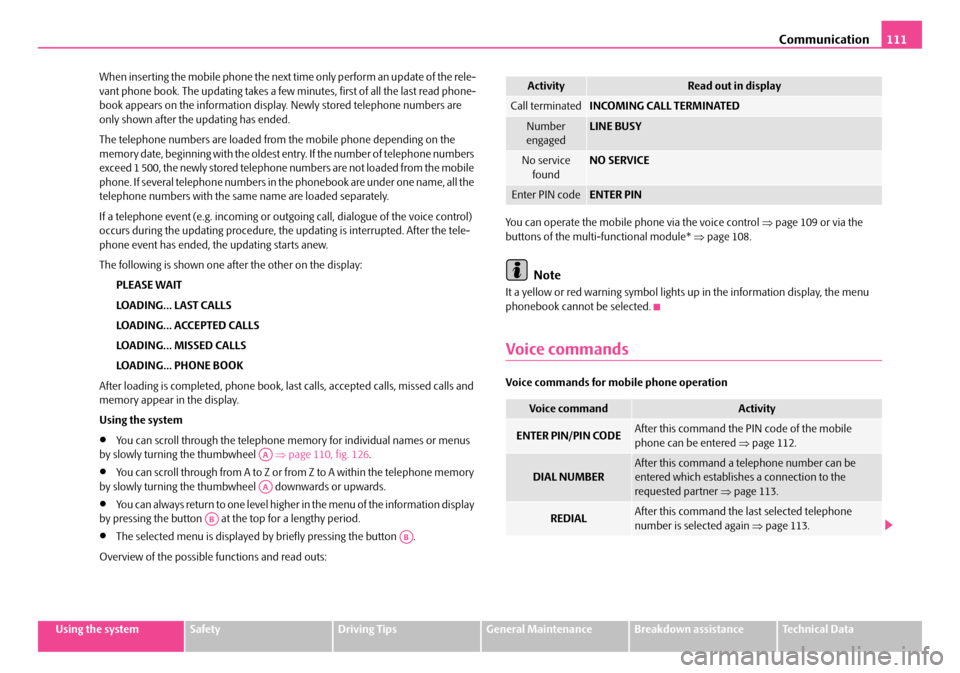
Overview of the possible functions and read outs:
You can operate the mobile phone via the voice control ⇒page 109 or via the buttons of the multi-functional module* ⇒page 108.
Note
It a yellow or red warning symbol lights up in the information display, the menu phonebook cannot be selected.
Voice commands
Voice commands for mobile phone operation
AA
AA
AB
AB
ActivityRead out in display
Call terminatedINCOMING CALL TERMINATED
Number engagedLINE BUSY
No service foundNO SERVICE
Enter PIN codeENTER PIN
Voice commandActivity
ENTER PIN/PIN CODEAfter this command the PIN code of the mobile phone can be entered ⇒page 112.
DIAL NUMBERAfter this command a telephone number can be entered which establishes a connection to the requested partner ⇒page 113.
REDIALAfter this command the last selected telephone number is selected again ⇒page 113.
NKO A05F 20.book Page 111 Wednesday, April 2, 2008 1:02 PM
Page 120 of 252

Communication119
Using the systemSafetyDriving TipsGeneral MaintenanceBreakdown assistanceTechnical Data
Loading a CD to one definite position
– Touch button . The LEDs in the buttons light up at the memory
spaces, which are already assigned and flash in the case of free
memory spaces.
– Touch the desired button and guide the CD into the CD-case .
Ejecting a CD
– Touch the button , in order to eject a CD. For assigned memory
spaces, now the LEDs light up in the buttons .
– Touch the corresponding button . The CD is ejected.
Ejecting all CDs
– Hold the button pressed for more than 2 seconds, in order to eject
the CDs. All CDs in the CD-changer are ejected consecutively.
Note
•Always guide the CD into the CD-case with the printed side pointing upwards.
•Never push the CD with force into the CD-case as the insertion is performed automatically.
•After loading a CD into the CD-changer, you must wait until the LED of the corresponding button lights up. Then the CD-case is free to load the next CD.
•If you have selected a position, on which a CD is already located, this CD will be ejected. Take out the ejected CD and load the desired CD.
•The magazine can take up to six standard CDs (diameter 12 cm). Please do not use 8 cm “single CDs”!
•In order to avoid malfunctions of the changer, please never use a CD protective foil or stabilizer (obtainable on the market as CD-accessory).
•Described in this Owner's Manual are only the steps required for the operation of the CD-changer.
•You will find further information for this setting menu in the Radio Owner's Manual.
Tips for operating the CD-changer
Please pay attention to the following notes for operating the CD-changer.
•Only clean CDs without scratches and damages should be used, in order to guarantee a proper, high-quality CD-playback.
•Affix no labels to the CDs.
•Always store non-used CDs in the original folding box.
•Never expose CDs to direct sun rays.
•Use a soft, non-fluffy cloth to clean the CDs. Wipe the CD straight-lined from the middle to the outside. Strong dirt must be eliminated with usual CD-cleaner.
•Please never use liquids such as gasoline, paint thinner or disk cleaner, other-wise the surface of the CD could get damaged.
Precaution measures for laser equipment
Laser equipment is classified according to DIN IEC 76 (CO) 6/VDE 0837 in the safety categories 1 - 4.
The Škoda CD-changer corresponds to the safety category 1.
The laser used for equipment of category 1 is to such an extent energy-poor and/or shielded that there is no risk of danger when used in accordance with the regula-tion.
WARNING
Please concentrate fully at all times on your driving!
ACAD
ADAB
AA
AD
AD
AA
AB
ADAB
NKO A05F 20.book Page 119 Wednesday, April 2, 2008 1:02 PM
Page 123 of 252

Passive Safety122
Before setting off
The driver is always fully responsible for his occupants and for the
operating safety of the vehicle.
For your own safety and the safety of the people travelling with you, please pay attention to the following points before setting off.
•Ensure that the lighting and the turn signal system are functioning properly.
•Inspect the tyre inflation pressure.
•Ensure that all the windows offer a good visibility to the outside.
•Safely attach the items of luggage ⇒page 61, “Loading the luggage compart-ment”.
•Ensure that no objects can obstruct the pedal.
•Adjust the mirror, the front seat and the head restraint to match your body size.
•Point out to your occupants that the head restraints must be adjusted to match their body size.
•Protect the children in suitable child seats with correctly fastened seat belts ⇒page 142, “Transporting children safely”.
•Adopt the correct seated position. Also inform your occupants to adopt the correct seated position.
•Fasten the seat belt correctly. Also inform your occupants to properly fasten the seat belts ⇒page 128, “How are seat belts correctly fastened?”.
What influences the driving safety?
The driving safety is primarily determined by the style of driving and
the personal behaviour of all the occupants.
The driver is fully responsible for himself and his occupants. If your driving safety is effected, you place yourself and the oncoming traffic at risk. Please refer to the following guidelines.
•Do not get distracted from concentrating on the traffic situation, e.g. by your occupants or mobile phone calls.
•Never drive when your driving ability is impaired, e.g. through medication, alcohol, drugs.
•Keep to the traffic regulations and the permissible speed limit.
•Adjust the driving speed at all times to the road condition as well as to the traffic and weather conditions.
•Take regular breaks on long journeys - at the latest every two hours.
Correct seated position
Correct seated position for the driver
Correct seated position for the driver is important for safe and
relaxed driving.
Fig. 128 The correct distance of the driver from the steering wheel
NKO A05F 20.book Page 122 Wednesday, April 2, 2008 1:02 PM
Page 124 of 252

Passive Safety123
Using the systemSafetyDriving TipsGeneral MaintenanceBreakdown assistanceTechnical Data
For your own safety and to reduce the risk of injury in the event of an accident, we recommend the following setting.
•Adjust the steering wheel so that the distance between the steering wheel and your chest is at least 25 cm ⇒page 122, fig. 128.
•Position the driver seat in the forward/back direction so that you are able to press the pedals with your legs at a slight angle .
•Adjust the backrest so that you are able to reach the highest point of the steering wheel with your arms at a slight angle.
•Adjust the head restraint so that the top edge of the head restraint is at the same level as the upper part of your head ⇒fig. 129.
•Fasten the seat belt correctly ⇒page 128, “How are seat belts correctly fastened?”.
Driver seat adjustment ⇒page 56, “Adjusting the front seats”.
WARNING
•The front seats and the head restraints must always be adjusted to match the body size of the seat occupant as well as the seat belts must always be correctly fastened in order to provide an optimal protection for you and your occupants.
•The driver must maintain a distance of at least 25 cm to the steering wheel ⇒page 122, fig. 128. Not maintaining this minimum distance will
mean that the airbag system will not be able to properly protect you - hazard!
•When driving, hold the steering wheel with both hands firmly on the outer edge in the 9 o'clock and 3 o'clock position. Never hold the steering wheel firmly in the 12 o'clock position or in another way (e.g. in the middle of the steering wheel or at the inner steering wheel edge). In such cases, injuries to the arms, the hands and the head can occur when the driver airbag is deployed.
•Ensure that there are no objects in the footwell as any objects may get behind the pedals during a driving or braking manoeuvre. You would then no longer be able to operate the clutch, to brake or accelerate.
Correct seated position for the front passenger
The front passenger must maintain a distance of at least 25 cm from
the dash panel so that the airbag offers the greatest possible safety
when an airbag is deployed.
For the safety of the front passenger and to reduce the risk of injury in the event of an accident, we recommend the following setting.
•Adjust the front passenger seat as far as possible to the rear.
•Adjust the head restraint so that the top edge of the head restraint is at the same level as the upper part of your head ⇒fig. 129.
•Fasten the seat belt correctly ⇒page 128, “How are seat belts correctly fastened?”.
In exceptional cases the front passenger airbag can be deactivated ⇒page 139, “Deactivating an airbag”.
Adjusting the passenger seat ⇒page 56, “Adjusting the front seats”.
WARNING
•The front seats and the head restraints must always be adjusted to match the body size of the seat occupant as well as the seat belts must always be
Fig. 129 The correct head restraint adjustment for the driver
WARNING (continued)
NKO A05F 20.book Page 123 Wednesday, April 2, 2008 1:02 PM
Page 133 of 252

Airbag system132
Airbag system
Description of the airbag system
General information on the airbag system
The front airbag system is complementary to the three-point seat belts and offers additional protection in the head and chest area of the driver and passenger in the event of a frontal collision.
In the event of a side collision, the side airbags reduce the risk of injury to the occu-pants to the part of their body facing the side of the accident.
The airbag system is only functional after the ignition has been switched on.
The operational readiness of the airbag system is monitored electronically. The airbag warning light comes on for a few seconds each time the ignition is switched on.
The airbag system (according to vehicle equipment) essentially consists of:
•an electronic control unit,
•the front airbags for the driver and front passenger ⇒page 133,
•the side airbags ⇒page 136,
•Head airbags ⇒page 138,
•an airbag warning light in the instrument cluster ⇒page 28,
•a front passenger airbag switch* ⇒page 140,
•an indicator light for a switched off front seat passenger airbag* in the middle of the dash panel ⇒page 140.
A fault in the airbag system exists if:
•the airbag indicator light does not light up when the ignition is switched on,
•the airbag indicator light does not go out after about 3 seconds after the ignition is switched on,
•the airbag indicator light goes out and comes on again after the ignition is switched on,
•the airbag indicator light comes on or flickers when driving,
•an airbag indicator light showing a switched-off front passenger airbag* in the middle of the dash panel flashes.
WARNING
•To enable the occupants of a car to be protected with the greatest possible effect when the airbag is deployed, the front seats must be ⇒page 122, “Correct seated position” correctly adjusted to match the body size of the occupant.
•If you do not fasten the seat belts when driving, lean too far forward or adopt an incorrect seated position, you are exposing yourself to increased risk of injury in the event of an accident.
•Have the airbag system checked immediately by a specialist garage if a fault exists. Otherwise, there is a risk of the airbag not being activated in the event of an accident.
•No modifications of any kind may be made to parts of the airbag system.
•It is prohibited to manipulate individual parts of the airbag system as this might result in the airbag being deployed.
•The protective function of the airbag system is sufficient for only one accident. The airbag system must then be replaced if the airbag has been deployed.
•The airbag system needs no maintenance during its working life.
•If you sell your car, please hand over the complete vehicle documenta-tion to the new owener. Please note that the documents relating to the possibility of deactivating the front passenger airbag are also part of the vehicle documents!
•If the vehicle or individual parts of the airbag system are scrapped, it is essential to observe the relevant safety precautions. Škoda Service Partners are familiar with these regulations.
•When disposing of vehicle or parts of the airbag system, it is important to comply with the national legal requirements.
NKO A05F 20.book Page 132 Wednesday, April 2, 2008 1:02 PM
Page 134 of 252

Airbag system133
Using the systemSafetyDriving TipsGeneral MaintenanceBreakdown assistanceTechnical Data
When are the airbags deployed?
The airbag system is designed in such a way that the driver and the front passenger airbag* are deployed in the event of a frontal collision of major severity.
In the case of a violent side crash, the side airbag* in the front seat and the head airbag* on the side of the car at which the collision occurs are deployed.
It is also possible under certain special accident situations that the front as well as the side airbags and head airbags* are deployed.
The airbags are not deployed in the case of minor frontal and side collisions, in the case of rear-end collisions and vehicle rollover.
Deployment factors
It is not possible to state globally which deployment conditions apply to the airbag system in every situation as the circumstances which exist in the case of accidents vary greatly. An important role in this case, for example, is played by factors such as the type of object against which the vehicle impacts (hard, soft), the angle of impact, the vehicle speed etc.
A decisive factor for the deployment of the airbags is the deceleration which occurs during a collision. The control unit analyses the nature of the collision and activates the relevant restraint system. If the vehicle deceleration which occurs and is meas-ured during the collision remains below the prescribed reference values specified in the control unit, the airbags are not deployed although the vehicle may well suffer severe damage to the bodywork as a consequence of the accident.
The airbags are not deployed if:
•ignition off,
•a minor frontal collision,
•a minor side collision,
•a rear-end collision,
•rollover.
Caution
The dash panel must be replaced after the front passenger airbag has been deployed.
Note
•A grey white or red, non harmful gas is released when airbag is inflated. This is perfectly normal and is not an indication of a fire in the vehicle.
•In the event of an accident in which the airbags are deployed:
−The interior lighting comes on (if the switch for the interior light is in the door contact position),
−The hazard warning light is switched on,
−All the doors are unlocked.
Front airbags
Description of the front airbags
The airbag system is not a substitute for the seat belt!
Fig. 137 Driver airbag in the steering wheel
NKO A05F 20.book Page 133 Wednesday, April 2, 2008 1:02 PM
Page 138 of 252

Airbag system137
Using the systemSafetyDriving TipsGeneral MaintenanceBreakdown assistanceTechnical Data
Important safety information on the side airbag
Correct use of the airbag system considerably reduces the risk of
injury!
WARNING
•It is essential to always switch off ⇒page 139, “Deactivating an airbag” the front passenger airbag when attaching a child safety seat on the front passenger seat where the child is seated with its back facing in direction of travel (in some countries also when the child is facing the direction of travel). If this is not done, there is a risk of the child suffering severe or even fatal injuries if the front passenger airbag is deployed. In certain countries national legal provisions also require that the side passenger airbags be deactivated. When transporting a child on the front passenger seat, please comply with the appropriate national regulations regarding the use of child safety seats.
•Your head should never be positioned in the deployment area of the side airbag. You might suffer severe injuries in the event of an accident. This applies in particular to children who are transported without using a suit-able child safety seat ⇒page 144, “Child safety and side airbag*”.
•If children adopt an incorrect seated position when travelling, they may be exposed to an increased risk of injury in the event of an accident. This can result in serious injuries ⇒page 142, “What you should know about trans-porting children!”.
•There must not be any further persons, animals as well as objects posi-tioned between the occupants and the deployment area of the airbag. There must also be no accessories such as cup holders, attached to the doors to enable the side airbags to activate properly.
•Only hang light items of clothing on the clothes hooks to the vehicle. Never leave any heavy or sharp-edged objects in the pockets of the items of clothing.
•Ensure that there are no excessive forces, such as violent knocks, kicks etc., impact on the backrests of the seats otherwise the system may be damaged. The side airbags would not be deployed in such a case!
•Any seat or protective covers which you fit to the driver or front passenger seats must only be of the type expressly authorized by Škoda Auto. In view of the fact that the airbag inflates out of the backrest of the seat, use of non-approved seat or protective covers would considerably impair the protective function of the side airbag.
•Any damage to the original seat covers in the area of the side airbag module must be repaired without delay by your specialist garage.
•The airbag modules in the front seats must not display any damage, cracks or deep scratches. It is not permissible to use force in order to open the modules.
•Any work on the side airbag system including removing and installing system components because of other repair work (e.g. removing seats) must only be carried out by a specialist garage.
WARNING (continued)
NKO A05F 20.book Page 137 Wednesday, April 2, 2008 1:02 PM
Page 140 of 252

Airbag system139
Using the systemSafetyDriving TipsGeneral MaintenanceBreakdown assistanceTechnical Data
The airbags inflate in fractions of a second and at a high speed in order to be able to offer that additional protection in the event of an accident. A grey white, non harmful gas is released when airbag is inflated. This is perfectly normal and is not an indication of a fire in the vehicle.
Important safety information on the head airbag
Correct use of the airbag system considerably reduces the risk of
injury!
WARNING
•It is essential to always switch off ⇒page 139 the front passenger airbag when attaching a child safety seat on the front passenger seat where the child is seated with its back facing in direction of travel (in some countries also when the child is facing the direction of travel). If this is not done, there is a risk of the child suffering severe or even fatal injuries if the front passenger airbag is deployed. In certain countries national legal provisions also require that the side or head passenger airbags be deactivated. When transporting a child on the front passenger seat, please comply with the appropriate national regulations regarding the use of child safety seats.
•There must not be any objects in the deployment area of the head airbags which might prevent the airbags from inflating properly.
•Only hang light items of clothing on the clothes hooks to the vehicle. Never leave any heavy or sharp-edged objects in the pockets of the items of clothing. In addition, it is not permitted to use clothes hangers for hanging up items of clothing.
•There must not be any other persons (e.g. children) or animals between the car occupant and the deployment area of the head airbag. In addition, none of the occupants should lean their head out of the window when driving, or extend their arms and hands out of the window.
•The sun visors must not be swivelled to the side windows into the deployment area of the head airbags if any objects, such as ball-point pens etc. are attached to them. This might result in injuries to the occupants if the head airbag is deployed.
•Installing impermissible accessories in the area of the head airbags may considerably impair the protection offered by the head airbag in the event of it being deployed. When the deployed head airbag is inflated, parts of the accessories fitted may in certain circumstances be thrown into the interior of the car and cause injuries to the occupants ⇒page 200.
•Any work on the head airbag system including installing and removing system components because of other repair work (e.g. removing headliner) must only be carried out by a specialist garage.
Deactivating an airbag
Deactivating airbags
If any airbags have been deactivated, switch them on again as soon
as possible so that they are able to again provide their proper protec-
tion.
There is the technical means installed within your vehicle to switch off the front, side* or head airbag* (take out of commission).
This is why you should have the deactivation of the airbags carried out by a specialist garage.
On vehicles equipped with the switch for deactivation of the airbags, you can deac-tivate the front passenger airbag or passenger side airbag by means of this switch ⇒page 140.
Deactivation of airbags is envisaged only for particular instances, such as if:
•you must in exceptional cases use a child seat on the front passenger seat where the child has its back to the direction of travel of the vehicle (in some coun-tries this must be in the direction of travel due to other legal regulations applying) ⇒page 142, “Important safety information regarding the use of child safety seats”
•you are not able to maintain the distance of at least 25 cm between middle of steering wheel and chest, despite the driver seat being correctly adjusted,
WARNING (continued)
NKO A05F 20.book Page 139 Wednesday, April 2, 2008 1:02 PM