2008 Seat Exeo service
[x] Cancel search: servicePage 235 of 303

Wheels and tyres233
Safety First
Operating instructions
Practical tips
Te c h n i c a l D a t a
•
Avoid driving over obstacles (for example kerbs) or potholes.
•
If one or more tyres is being driven in emergency conditions, the driving
quality of the vehicle is impaired and there is a risk of accident.Note
•
The anti-puncture tyres do not “deflate” on losing pressure because they
are supported on the reinforced sides. Therefore defects in the tyre can not be
detected with a visual inspection.
•
Snow chains must not be used on front tyres used in emergency
conditions.
New tyres and wheels
New tyres and wheels have to be run-in.The tyres and wheel rims are an essential part of the vehicle's design. The
tyres and rims approved by SEAT are specially matched to the characteristics
of the vehicle and make a major contribution to good road holding and safe
handling ⇒.
Tyres should be replaced at least in pairs and not individually (i.e. both front
tyres or both rear tyres together). A knowledge of tyre designations makes it
easier to choose the correct tyres. Radial tyres have the tyre designations
marked on the sidewall, for example: 195/65 R15 91T
This contains the following information:
195 Tyre width in mm
65 Height/width ratio in %
R Tyre construction: Radial 15 Rim diameter in inches
91 Load rating code
T Speed rating
The tyres could also have the following information:
•
A direction of rotation symbol
•
“Reinforced” denotes heavy-duty tyres.
The manufacturing date is also indicate d on the tyre sidewall (possibly only
on the inner side of the wheel).
“DOT ... 1103...” means, for example, that the tyre was produced in the 11th
week of 2003.
We recommend that work on tyres and wh eels is carried out by an Authorised
Service Centre. They are familiar with the procedure and have the necessary
special tools and spare parts as well as the proper facilities for disposing of
the old tyres.
Any Authorised Service Centre has full information on the technical require-
ments when installing or changing tyres, wheels or wheel trims.
WARNING
•
We recommend that you use only wh eels and tyres which have been
approved by SEAT for your model. Failure to do so could impair vehicle
handling. Risk of accident.
•
Avoid running the vehicle on tyres th at are more than six years old. If
you have no alternative, you should drive slowly and with extra care at all
times.
•
Never use old tyres or those with an unknown “history of use”.
•
If wheel trims are retrofitted, you must ensure that the flow of air to the
brakes is not restricted. This could cause them to overheat.
•
All four wheels must be fitted with radial tyres of the same type, size
(rolling circumference) and the same tread pattern.
WARNING (continued)
Exeo_EN.book Seite 233 Freitag, 17. Oktober 2008 11:24 11
Page 237 of 303
Wheels and tyres235
Safety First
Operating instructions
Practical tips
Te c h n i c a l D a t a
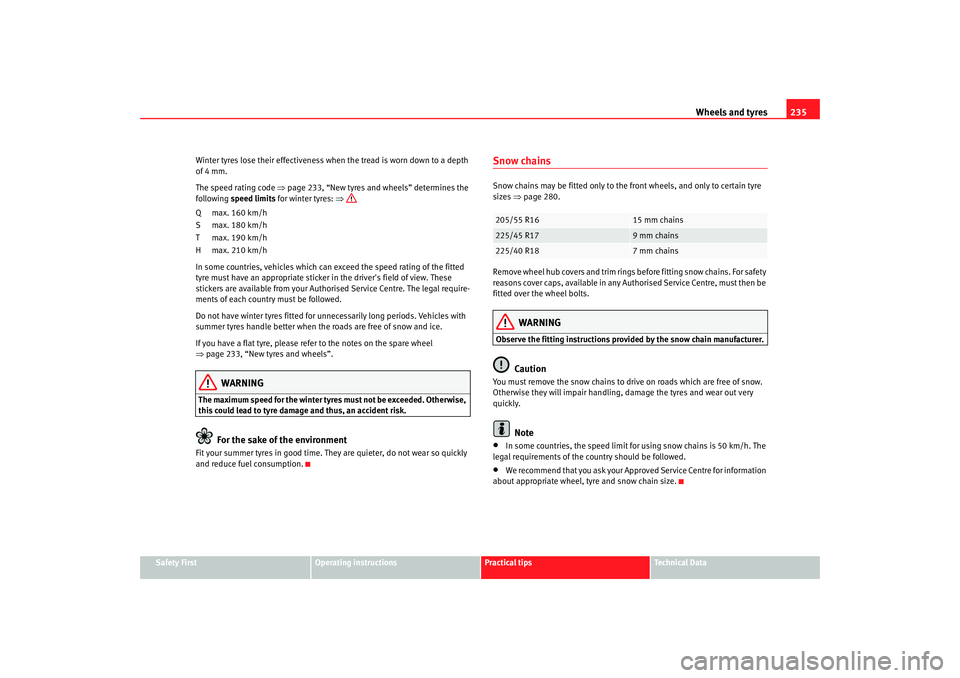
Winter tyres lose their effectiveness when the tread is worn down to a depth
of 4 mm.
The speed rating code
⇒page 233, “New tyres and wheels” determines the
following speed limits for winter tyres: ⇒
Q max. 160 km/h
S max. 180 km/h
T max. 190 km/h
H max. 210 km/h
In some countries, vehicles which can exceed the speed rating of the fitted
tyre must have an appropriate sticker in the driver's field of view. These
stickers are available from your Authorised Service Centre. The legal require-
ments of each country must be followed.
Do not have winter tyres fitted for u nnecessarily long periods. Vehicles with
summer tyres handle better when the roads are free of snow and ice.
If you have a flat tyre, please refer to the notes on the spare wheel
⇒ page 233, “New tyres and wheels”.
WARNING
The maximum speed for the winter tyre s must not be exceeded. Otherwise,
this could lead to tyre damage and thus, an accident risk.
For the sake of the environment
Fit your summer tyres in good time. They are quieter, do not wear so quickly
and reduce fuel consumption.
Snow chainsSnow chains may be fitted only to the front wheels, and only to certain tyre
sizes ⇒page 280.
Remove wheel hub covers and trim rings before fitting snow chains. For safety
reasons cover caps, available in any Authorised Service Centre, must then be
fitted over the wheel bolts.
WARNING
Observe the fitting instructions provided by the snow chain manufacturer.
Caution
You must remove the snow chains to drive on roads which are free of snow.
Otherwise they will impair handling, damage the tyres and wear out very
quickly.
Note
•
In some countries, the speed limit for using snow chains is 50 km/h. The
legal requirements of the country should be followed.
•
We recommend that you ask your Appr oved Service Centre for information
about appropriate wheel, tyre and snow chain size.205/55 R16
15 mm chains
225/45 R17
9 mm chains
225/40 R18
7 mm chains
Exeo_EN.book Seite 235 Freitag, 17. Oktober 2008 11:24 11
Page 245 of 303

If and when243
Safety First
Operating instructions
Practical tips
Te c h n i c a l D a t a
– Insert the adapter onto the wheel bolt and push it on as far as it
will go ⇒page 242, fig. 182 .
– Fit the box spanner as far as it will go over the adapter.
– Loosen or tighten the wheel bolt as appropriate.Error code
The code number of the anti-t heft wheel bolt is stamped onto the front part of
the adaptor.
The code number should be noted and kept in a safe place, as it is only by
using the code number that a duplicat e adaptor can be obtained from an
Authorised Service Centre.Tyres with directional tread pattern
Tyres with directional tread pattern must be fitted so that they
rotate in the correct direction.A directional tread pattern can be identified by arrows on the sidewall that
point in the direction of rotation. Always note the direction of rotation indi-
cated when fitting the wheel. This is important so that these tyres can give
maximum grip and avoid excessive noise, tread wear and aquaplaning.
If, in an emergency, you have to fit th e spare wheel so it rotates in the wrong
direction, you must drive extremely care fully. The tyre will not give optimum
performance. This is particularly important when driving on wet roads.
To benefit from the advantages of tyres with this type of tread pattern, the
defective tyre should be replaced as soon as possible so that all tyres again
rotate in the correct direction.
Tyre repair* (Tyre-Mobility-System)General information and safety notes
Repaired tyres are only suitable for temporary use over a
short period.Your vehicle is equipped with a tyre repair kit: the Tyre Mobility System.
In the event of a puncture you will find the TMS, which consists of a sealing
compound and a compressor, located under the floor panel in the luggage
compartment.
The Tyre Mobility System will reliably seal tyres damaged by foreign bodies,
provided that the cuts or punctu res are no larger than approx. 4 mm in diam-
eter.
It is not necessary to remove the foreign body from the tyre.
Fig. 183 The Tyre
Mobility System is not
suitable for repairing this
type of damage to tyres.
Exeo_EN.book Seite 243 Freitag, 17. Oktober 2008 11:24 11
Page 246 of 303

If and when
244The sealing compound must not be used in the following cases:•
On cuts and punctures larger than 4 mm ⇒page 243, fig. 183
•
if the wheel rim has been damaged
•
if you have been driving with very low pressure or a completely flat tyre
How to use the TMS (tyre mobility system) is described in the section
Repairing a tyre ⇒ page 245 and in the instructions supplied with the tyre
sealant can.
The TMS (tyre mobility system) can be used at outside temperatures down to
-20 °C.
WARNING
After repairing a tyre please note the following points:•
Do not drive faster than 80 km/h.
•
Avoid heavy acceleration, hard braking and fast cornering.
•
Vehicle handling could be impaired.
•
Tyres which have been sealed using the Tyre Mobility System are only
suitable for temporary use over a short period.
•
After using the tyre sealant the tyre pressure monitoring system* may
malfunction. Therefore, please drive carefully to the next available quali-
fied workshop.
•
The Tyre Mobility System must NOT be used,
− on cuts and punctures larger than 4 mm
− if the wheel rim has been damaged
− if you have been driving with very low pressure or a completely flat
tyre
•
Seek professional assistance if the repair of a tyre puncture is not
possible with the sealing compound.
•
Do not allow the sealant to come into contact with your eyes, skin or
clothing.
•
If you do come into contact with the sealant immediately rinse the eyes
or skin affected with clean water.
•
Change clothing immediately if it becomes soiled with the tyre sealant.
•
Make sure you do not breathe in the fumes!
•
If any of the tyre sealant is accidentally ingested, immediately rinse the
mouth thoroughly and drink lots of water.
−Do not induce vomiting. Seek medical assistance if needed.
•
If any allergic reactions should occur get medical help immediately.
•
Keep the sealant away from children.For the sake of the environment
Used bottles of sealing compound can be returned to the Technical Service
for disposal.
Note
•
If sealant should leak out, leave it to dry. When it has dried, you can pull
it off like a piece of foil.
•
Observe the expiry date stated on the sealing compound can. Have the
sealing compound exchanged by a qualified workshop.
A1
A2
A3
WARNING (continued)
Exeo_EN.book Seite 244 Freitag, 17. Oktober 2008 11:24 11
Page 283 of 303

General notes on the technical data 281
Safety First
Operating instructions
Practical tips
Te c h n i c a l D a t a
Snow chains
Snow chains may be fitted only to the
front wheels.
Consult the chapter “wheels” of this manual.
Wheel bolts
After the wheels have been changed, the tightening torque of the wheel bolts
should be checked as soon as possible with a torque wrench ⇒. The tight-
ening torque for steel and alloy wheels is 120 Nm.
WARNING
•
Check the tyre pressure at least once per month. Checking tyre pressure
value is very important. If the tyre pre ssure is too high or too low, there is
an increased danger of accidents, particularly at high speeds.
•
If the torque of the wheel bolts is to o low, they could loosen while the
vehicle is in motion. Risk of accident! If the tightening torque is too high,
the wheel bolts and threads can be damaged.Note
We recommend that you ask your Authorised Service Centre for information
about appropriate wheel, tyre and snow chain size.
Exeo_EN.book Seite 281 Freitag, 17. Oktober 2008 11:24 11
Page 284 of 303

Technical Data
282Te c h n i c a l D a t aChecking fluid levelsFrom time to time, the levels of the different fluids in the
vehicle must be checked. Never fill with incorrect fluids,
otherwise serious damage to the engine may be caused.Fig. 228 Diagram for the location of the various elements
Vehicle battery
Engine oil filler cap
Brake fluid reservoir
Engine oil dipstick.
Coolant expansion tank
Windscreen washer fluid container
Hydraulic fluid reservoir for power steering
The checking and refilling of service fluids are carried out on the components
mentioned above. These operat ions are described in the ⇒page 213.
Overview
Further explanations, instructions and restrictions on the technical data are
contained as of ⇒page 277.Note
The layout of parts may vary depending on the engine.A1A2A3A4A5A6A7
Exeo_EN.book Seite 282 Freitag, 17. Oktober 2008 11:24 11
Page 299 of 303
Index297
side airbags . . . . . . . . . . . . . . . . . . . . . . . . . . 40
Using child seats . . . . . . . . . . . . . . . . . . . . . . 46
Using seat belts . . . . . . . . . . . . . . . . . . . . . . . 21
Seals . . . . . . . . . . . . . . . . . . . . . . . . . . . . . . . . . . 201
Seat adjustment Lumbar support . . . . . . . . . . . . . . . . . . . . . . 133
Seat belt position Pregnant women . . . . . . . . . . . . . . . . . . . . . . 24
Seat belts . . . . . . . . . . . . . . . . . . . . . . . . . . . . 23
Seat belt release . . . . . . . . . . . . . . . . . . . . . . . . . 25
Seat belt warning lamp . . . . . . . . . . . . . . . . . . . . 18
Seat belts . . . . . . . . . . . . . . . . . . . . . . . . . . . . . . . 18 adjustment . . . . . . . . . . . . . . . . . . . . . . . . . . . 22
Height adjustment . . . . . . . . . . . . . . . . . . . . . 25
Incorrectly fastened . . . . . . . . . . . . . . . . . . . . 26
Not worn . . . . . . . . . . . . . . . . . . . . . . . . . . . . . 20
Safety notes . . . . . . . . . . . . . . . . . . . . . . . . . . 21
Warning lamp . . . . . . . . . . . . . . . . . . . . . . 18, 68
Seat belts cleaning . . . . . . . . . . . . . . . . . . . . . . 205
Seat belts protection . . . . . . . . . . . . . . . . . . . . . . 21
Seat heating . . . . . . . . . . . . . . . . . . . . . . . . . . . . 161
Seats . . . . . . . . . . . . . . . . . . . . . . . . . . . . . . . . . . . 18 Electric adjustment . . . . . . . . . . . . . . . . . . . 132
Electric backrest adjustment . . . . . . . . . . . 133
Manual adjustment . . . . . . . . . . . . . . . . . . . 130
Manual backrest angle adjustment . . . . . . 131
Moving the seat forwards and backwards . 130
Seat height adjustment . . . . . . . . . . . . . . . . 130
Self-directing headlights . . . . . . . . . . . . . . . . . . 118 faulty . . . . . . . . . . . . . . . . . . . . . . . . . . . . . . . . 80
Service indicator . . . . . . . . . . . . . . . . . . . . . . . . . 74 Servotronic . . . . . . . . . . . . . . . . . . . . . . . . . . . . . 180
Shoes . . . . . . . . . . . . . . . . . . . . . . . . . . . . . . . . . . 15
Side airbags . . . . . . . . . . . . . . . . . . . . . . . . . . . . . 38
Description . . . . . . . . . . . . . . . . . . . . . . . . . . . 38
Function . . . . . . . . . . . . . . . . . . . . . . . . . . . . . 39
Safety notes . . . . . . . . . . . . . . . . . . . . . . . . . . 40
Side lights . . . . . . . . . . . . . . . . . . . . . . . . . . . . . 112
Sitting position Driver . . . . . . . . . . . . . . . . . . . . . . . . . . . . . . . 10
Front passenger . . . . . . . . . . . . . . . . . . . . . . . 11
Incorrect sitting position . . . . . . . . . . . . . . . . 14
Passengers . . . . . . . . . . . . . . . . . . . . . . . . . . . 12
Sitting position, occupants . . . . . . . . . . . . . . . . . 10
Ski bag . . . . . . . . . . . . . . . . . . . . . . . . . . . . . . . . 143
Snow chains . . . . . . . . . . . . . . . . . . . . . . . 235, 281
Solar-powered blower/solar roof . . . . . . . . . . . 161
Spare keys . . . . . . . . . . . . . . . . . . . . . . . . . . . . . . 93
Spare parts . . . . . . . . . . . . . . . . . . . . . . . . . . . . . 206
Spare wheel Steel rim . . . . . . . . . . . . . . . . . . . . . . . . . . . . 237
Speed warning . . . . . . . . . . . . . . . . . . . . . . . . 80, 81
Speed warning function . . . . . . . . . . . . . . . . . . . 81
Speedometer . . . . . . . . . . . . . . . . . . . . . . . . . . . . 63
Steam jets . . . . . . . . . . . . . . . . . . . . . . . . . . . . . 199
Steering Locking . . . . . . . . . . . . . . . . . . . . . . . . . . . . . 163
Manual steering wheel adjustment . . . . . . 162
Steering wheel controls . . . . . . . . . . . . . . . . . . . 90
Stopping the engine . . . . . . . . . . . . . . . . . . . . . 165 Sun roof
Opening . . . . . . . . . . . . . . . . . . . . . . . . . . . . 109
Sun roof / deflector . . . . . . . . . . . . . . . . . . . . . . 108
Sun visors . . . . . . . . . . . . . . . . . . . . . . . . . . . . . 123
Sunroof . . . . . . . . . . . . . . . . . . . . . . . . . . . . . . . . 110 Automatic close function . . . . . . . . . . . . . . 110
Closing . . . . . . . . . . . . . . . . . . . . . . . . . . . . . 109
Manual operation . . . . . . . . . . . . . . . . . . . . 111
Override function . . . . . . . . . . . . . . . . . . . . . 110
Supplementary heating . . . . . . . . . . . . . . . . . . 161
Switches in the driver's door Electric windows . . . . . . . . . . . . . . . . . . . . . 106
Symbols Red symbols in central display . . . . . . . . . . . 76
Yellow symbols in central display . . . . . . . . 78
TTailgateCentral locking system . . . . . . . . . . . . . . . . 100
Light . . . . . . . . . . . . . . . . . . . . . . . . . . . . . . . 122
TCS Funcionamiento . . . . . . . . . . . . . . . . . . . . . . 178
Technical modification s . . . . . . . . . . . . . . . . . . 206
The danger of not using the seat belt . . . . . . . . 20
The environment Heated rear window . . . . . . . . . . . . . . . . . . 123
Leaks . . . . . . . . . . . . . . . . . . . . . . . . . . . . . . 213
Roof carriers . . . . . . . . . . . . . . . . . . . . . . . . . 145
Warming up the engine . . . . . . . . . . . . . . . . 164
Tightening torque of wheel bo lts . . . . . . . . . . . 281
Exeo_EN.book Seite 297 Freitag, 17. Oktober 2008 11:24 11
Page 300 of 303

Index
298Tools . . . . . . . . . . . . . . . . . . . . . . . . . . . . . . . . . . 236
Tow starting
Comments . . . . . . . . . . . . . . . . . . . . . . . . . . 274
Towing . . . . . . . . . . . . . . . . . . . . . . . . . . . . 186, 274 Accessories . . . . . . . . . . . . . . . . . . . . . . . . . 188
Notes on towing . . . . . . . . . . . . . . . . . 186, 187
Removable towing bracket . . . . . . . . . . . . . 189
Technical requirements . . . . . . . . . . . . . . . 186
Towing a trailer . . . . . . . . . . . . . . . . . . . . . . . . . 280
Towing bracket, fitting . . . . . . . . . . . . . . . . . . . 195
Towing eye . . . . . . . . . . . . . . . . . . . . . . . . . . . . . 274
Towing eyes . . . . . . . . . . . . . . . . . . . . . . . . . . . . 275
Tow-starting . . . . . . . . . . . . . . . . . . . . . . . . . . . . 274
Traction control system How the system works . . . . . . . . . . . . . . . . 178
Trailer weights . . . . . . . . . . . . . . . . . . . . . . . . . . 280
Trip recorder . . . . . . . . . . . . . . . . . . . . . . . . . . . . 63
Type plate . . . . . . . . . . . . . . . . . . . . . . . . . . . . . 278
Tyre Mobility System . . . . . . . . . . . . . . . . . . . . . 243
Tyre mobility system . . . . . . . . . . . . . . . . . . . . . 237
Tyre pressure . . . . . . . . . . . . . . . . . . . . 66, 89, 227 Loss . . . . . . . . . . . . . . . . . . . . . . . . . . . . . . . 229
Tyre pressure monitoring . . . . . . . . . . . . . . . . . 228
Tyre pressure monitoring system . . . . . . . . . . . . 88
Tyre pressures . . . . . . . . . . . . . . . . . . . . . . . . . . 280
Tyre repair kit Tyre Mobility System . . . . . . . . . . . . . . . . . . 243
Tyres and wheels Dimensions . . . . . . . . . . . . . . . . . . . . . . . . . 233
Tyres service life . . . . . . . . . . . . . . . . . . . . . . . . 230 Tyres tread depth . . . . . . . . . . . . . . . . . . . . . . . 231
Tyres with directional tread pattern . . . . . . . . . 227
UUnderbody maintenance . . . . . . . . . . . . . . . . . 202VVehicle data . . . . . . . . . . . . . . . . . . . . . . . . . . . . 278
Vehicle identification data . . . . . . . . . . . . . . . . 278
Vehicle identification number . . . . . . . . . . . . . 278
Vehicle Maintenance
Exterior . . . . . . . . . . . . . . . . . . . . . . . . . . . . . 198
Vehicle modifications . . . . . . . . . . . . . . . . . . . . 206
Vehicle paintwork Products for vehicle maintenance . . . . . . . 197
Waxing . . . . . . . . . . . . . . . . . . . . . . . . . . . . . 199
Vehicle washing . . . . . . . . . . . . . . . . . . . . . . . . 198
Ventilation slits . . . . . . . . . . . . . . . . . . . . . . . . . . 17WWarning lamp . . . . . . . . . . . . . . . . . . . . . . . . . . . 29 Alternator . . . . . . . . . . . . . . . . . . . . . . . . . . . . 69
Warning lamps Airbag . . . . . . . . . . . . . . . . . . . . . . . . . . . . . . 66
Anti-lock brake system . . . . . . . . . . . . . . . . . 67
Electronic differential lock . . . . . . . . . . . . . . 67
Electronic stabilisation programme . . . . . . . 68
Engine management (EPC) . . . . . . . . . . . . . . 69
Exhaust emission control system . . . . . . . . 66 Handbrake . . . . . . . . . . . . . . . . . . . . . . . . . . . 70
Red symbols in central display . . . . . . . . . . 76
Seat belt warning lamp . . . . . . . . . . . . . . . . . 68
Yellow symbols in central display . . . . . . . . 78
Warning lamps - overview . . . . . . . . . . . . . . . . . 65
Washer fluid level . . . . . . . . . . . . . . . . . . . . . . . . 80
Washing by hand . . . . . . . . . . . . . . . . . . . . . . . 198
Washing with high pressure cleaners . . . . . . . 199
Wear indicators . . . . . . . . . . . . . . . . . . . . . . . . . 231
Wheel bolts . . . . . . . . . . . . . . . . . . . . . . . . . . . . 281 Torque . . . . . . . . . . . . . . . . . . . . . . . . . . . . . 234
Wheels . . . . . . . . . . . . . . . . . . . . . . . . . . . . 227, 280 Changing a wheel . . . . . . . . . . . . . . . . . . . . 238
Why assume the correct sitting position? . . . . . 28
Why should head restraints be correctly adjusted? 13
Why wear seat belts? . . . . . . . . . . . . . . . . . . 19, 28
Why wear seatbelts? . . . . . . . . . . . . . . . . . . . . . . 18
Windows Defrosting . . . . . . . . . . . . . . . . . . . . . . . . . . 156
Windscreen washer system . . . . . . . . . . . . . . . 220
Windscreen wiper blades Cleaning . . . . . . . . . . . . . . . . . . . . . . . . . . . . 201
Windscreen wipers . . . . . . . . . . . . . . . . . . . . . . 125 Changing blades . . . . . . . . . . . . . . . . . . . . . 221
Rain sensor . . . . . . . . . . . . . . . . . . . . . . . . . 125
Washer jets . . . . . . . . . . . . . . . . . . . . . . . . . 125
Winter Battery . . . . . . . . . . . . . . . . . . . . . . . . . . . . . 223
Winter conditions Defrost function . . . . . . . . . . . . . . . . . . . . . 156
Exeo_EN.book Seite 298 Freitag, 17. Oktober 2008 11:24 11