2008 SAAB 9-5 DIRECT
[x] Cancel search: DIRECTPage 122 of 288

122 Interior equipment and trunkCompass The compass is integrated in the rearview
mirror. The compass bearing is displayed in
the top right-hand corner of the mirror and is
updated every other second. The compass
displays the car’s direction of travel: N, NE,
E, etc.
Switch the compass display on and off by
pressing button 5 for 3 seconds.
Changing zones
The earth’s magnetic fields vary depending
on one’s position on the globe. If you drive
your car from one magnetic zone to another
the compass setting will need to be changed
to ensure a correct bearing.
1 Study the illustrations to determine the
correct zone.
2 Press and hold button 5 until "ZONE" is
shown in the display on the mirror
(6 seconds). The zone number setting
now is also shown.
3 Press button 5 repeatedly to change the
zone number. There are 15 zones from
which to choose. Once the correct zone
is selected, release the button and wait
4 seconds. The compass will now
display the bearing.Calibration
Calibration is performed automatically
during travel. If an accessory, such as a
mobile phone, is fitted and it can be
assumed that the compass is affected, the
compass may need to be calibrated manu-
ally.
1 Press and hold button 5 until "CAL" and
the compass bearing are displayed
(approx. 9 seconds).
2 Drive in circles (max. 5 mph/8 km/h) or
drive as normal until "CAL" is no longer
displayed.
Compass zones in US Compass zones in Canada
95_US_M08.book Page 122 Friday, May 11, 2007 1:06 PM
ProCarManuals.com
Page 126 of 288

126 Interior equipment and trunkPower Outlet3
33 3You can use the electrical socket to charge
a mobile phone, for example.
Glove compartment The glove compartment can be cooled by
the air conditioning (ACC) system. Cold air
can be directed to the glove compartment
for keeping drinks cool, etc.
Slide the cover to open/close the air inlet. Storage facilitiesAdditional storage facilities are provided
(see next page).
WARNING
The maximum combined load for the two
power outlets is 240 W (20 A).
WARNING
The glove compartment must be closed
while travelling. An open glove compart-
ment door could cause leg injuries in the
event of a crash.
IB1286
Sliding cover in glove compartment to
admit cold air
95_US_M08.book Page 126 Friday, May 11, 2007 1:06 PM
ProCarManuals.com
Page 137 of 288
137 Interior equipment and trunk
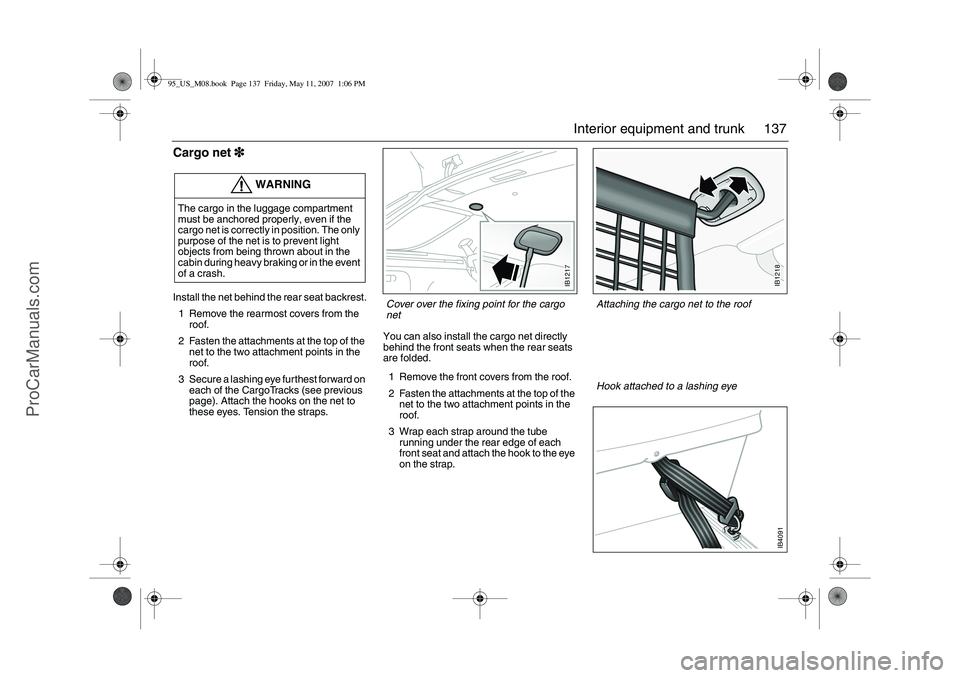
Cargo net3
33 3Install the net behind the rear seat backrest.
1 Remove the rearmost covers from the
roof.
2 Fasten the attachments at the top of the
net to the two attachment points in the
roof.
3 Secure a lashing eye furthest forward on
each of the CargoTracks (see previous
page). Attach the hooks on the net to
these eyes. Tension the straps.You can also install the cargo net directly
behind the front seats when the rear seats
are folded.
1 Remove the front covers from the roof.
2 Fasten the attachments at the top of the
net to the two attachment points in the
roof.
3 Wrap each strap around the tube
running under the rear edge of each
front seat and attach the hook to the eye
on the strap.
WARNING
The cargo in the luggage compartment
must be anchored properly, even if the
cargo net is correctly in position. The only
purpose of the net is to prevent light
objects from being thrown about in the
cabin during heavy braking or in the event
of a crash.
IB1217
Cover over the fixing point for the cargo
net
IB1218
Attaching the cargo net to the roof
IB4091
Hook attached to a lashing eye
95_US_M08.book Page 137 Friday, May 11, 2007 1:06 PM
ProCarManuals.com
Page 145 of 288

145 Starting and driving
Important considerations with
catalytic convertersThe catalytic converter is an emission-con-
trol device incorporated in the car’s exhaust
system. It consists of a metal canister with a
honeycomb insert, the cells of which have
walls coated in a catalytic layer (mixture of
precious metals).
To ensure that the catalytic converter con-
tinues to function properly, and also to avoid
damage to the converter and its associated
components, the following points must be
observed:
Have the car serviced regularly in accor-
dance with the service program. The fuel
and ignition systems are particularly
important in this context.
Always be alert to any misfiring of the
engine (not running on all cylinders) and
any loss of power or performance. At the
first sign of a malfunction, reduce speed
and take the car to a workshop as soon as
possible. We recommend that you
contact an authorized Saab dealer. If the engine fails to start (in very cold
weather or if the battery is flat), the car can
be push started (manual gearbox only) or
started using jumper cables to a donor
battery. However, as soon as you have
started the engine, it is important that it
runs on all cylinders. If it is misfiring, allow
it to idle for up to five minutes to give it time
to settle and run smoothly. If, after this
time, the engine still fails to run properly,
turn off the engine and get in touch with a
workshop for advice. We recommend that
you contact an authorized Saab dealer. Never park the car on dry grass or other
combustible material. The catalytic
converter gets very hot and could there-
fore start a fire.
Never drive off if the engine is misfiring.
If you jump start the car when the engine
is already up to normal temperature, the
engine must start to run on all cylinders.
Stop jump-starting if the engine fails to
start immediately.
Failure to follow these directions could
result in the catalytic converter and associ-
ated components being damaged, and
could represent a breach of the warranty
conditions.
NOTEUse only unleaded gasoline. Leaded gas-
oline is detrimental to the catalyst and
oxygen sensor and will seriously impair
the function of the catalytic converter.
NOTEIf the car runs out of fuel, it is possible for
air to get into the fuel system. If this
happens, the catalytic converter may
overheat and be damaged.
IB3879
12
2
3
3
Oxygen-sensor-controlled
injection system1 Engine control module
2 Oxygen sensor (lambda probe)
3 Catalytic converters
95_US_M08.book Page 145 Friday, May 11, 2007 1:06 PM
ProCarManuals.com
Page 161 of 288

161 Starting and driving
ABS brakes
ABS (antilock braking system) modulates
the brake pressure to the respective
wheels. Wheel sensors detect if a wheel is
about to lock, and the control module
reduces the pressure to that wheel and then
increases it once more until the tendency is
detected again.
The brake system is equipped with an Elec-
tronic Brake-force Distribution device
(EBD), which distributes the brake pressure
between the front and rear wheels, in such
a way as to achieve optimum braking perfor-
mance irrespective of the car’s speed and
load.
WARNING
It is prudent to try your brakes from
time to time, especially when driving in
heavy rain, through water collected on
the road, in snow, on a wet road sur-
face or in salty slush. In such condi-
tions, the brakes may take longer than
normal to take effect. To rectify this,
touch the brake pedal periodically to
dry the brakes out.
The same applies after the car has
been washed or when the weather is
very humid.
Avoid parking the car with wet brakes.
Before parking, and if the traffic condi-
tions allow, brake quite heavily so that
the brake discs and pads warm up and
dry.
The brakes are power assisted and it
should be kept in mind that the servo
unit only provides the power assis-
tance when the engine is running.
The brake pressure required when the
engine is off,(e.g. when the car is
being towed) is roughly four times the
normal pedal force required. The
pedal also feels hard and unre-
sponsive.
WARNING
The additional safety afforded by the
ABS system is not designed to allow
drivers to drive faster but to make
normal driving safer.
To stop as quickly as possible, without
loss of directional stability, whether
the road surface is dry, wet or slippery,
press the brake pedal down hard-
without letting up (do not pump the
pedal), declutching simulta-
neously, and steer the car to safety.
95_US_M08.book Page 161 Friday, May 11, 2007 1:06 PM
ProCarManuals.com
Page 163 of 288

163 Starting and driving
Electronic Stability
Program (ESP
®)
The system employs both the antilock brak-
ing system (ABS) and the traction control
system (TCS). It is a system that helps the
driver to stabilize the car in unusual circum-
stances that would otherwise be more diffi-
cult to handle.
How the ESP
® system works
The system can help to prevent the car from
skidding by braking one or several wheels
independently of the driver. The engine
output is then also reduced to prevent the
driving wheels from spinning. The car has
sensors that measure wheel speed, yaw
acceleration, lateral acceleration, steering
wheel position and braking pressure. The
values provided by these sensors are used
to calculate the actual direction of the car. If
this direction does not agree with that
intended by the driver, calculated from the
steering wheel position, the ESP
® is
engaged.
The ESP
® system improves the driver’s
chances of retaining control over the car in
critical situations.
To ensure that the system works as
designed, the dimensions of all four tires
must be the same.
WARNING
When driving normally, the ESP
® system
will help to improve the stability of the car.
This does not mean that car can be driven
faster. The same care and prudence as
normally applied should be displayed on
cornering and when driving on slippery
roads.
IB1841
Increased stability with ESP
®.
The system applies the brakes to the
wheels as shown in order to reduce the
likelihood of the car skidding
95_US_M08.book Page 163 Friday, May 11, 2007 1:06 PM
ProCarManuals.com
Page 173 of 288

173 Starting and driving
If winter tires are fitted, the same type must
be fitted on all wheels. Your Saab dealer will
be pleased to advise you on the best tires for
your car.
Remember that tires age. It may therefore
be necessary to change them before they
reach the legal wear limit, as they gradually
lose their friction properties.
The best response if the car gets into a
front-wheel skid is to freewheel (manual
gearbox only), i.e. disengage the clutch (so
that the wheels are neither driven or
retarded by the engine.
If the car has automatic transmission, ease
up on the accelerator and steer carefully in
the desired direction.
In a rear-wheel skid, steer in the same direc-
tion that the rear of the car is moving.
Tire chains3
33 3If you want to fit tire chains (where legally
permitted) they should only be fitted to the
tires recommended under ”Specifications”
(see page 268).
Consult your Saab dealer for details of
approved tire chains.
Driving in hot weatherAlways check the coolant level before start-
ing a journey. When the engine is cold, the
coolant shall lie on or just above the
KALT/COLD mark on the expansion tank..
At the end of a journey, if the engine has
worked hard, allow it to idle for two or three
minutes before switching it off.
If the needle on the temperature gauge
enters the red zone:
1 Bring the car to a standstill but leave the
engine running. Do not remove the cap
on the expansion tank even if the tank is
empty. If the needle on the temperature
gauge continues to rise while the engine
is idling, switch off the engine.
WARNING
Do not exceed 30 mph (50 km/h)
when tire chains are fitted.
Tire chains can reduce the directional
stability of the car.
Tire chains must not be used on the
rear wheels. NOTECheck the links frequently for wear.
Check that the chains do not contact
the wheel-arch liner at full lock.
See section ”Specifications”,
page 268, for information on allowable
wheel dimensions for the fitting of tire
chains.
95_US_M08.book Page 173 Friday, May 11, 2007 1:06 PM
ProCarManuals.com
Page 205 of 288

205 Car care and technical informationHeadlight bulb for high beam (Halogen)On cars equipped with Xenon lamps the Halogen lamps are used
only for high beam flasher if the daytime running lights are deacti-
vated and the headlight switch is in the off position (otherwise Xenon
lamp is utilized):
1 Remove the cover from the back of the lamp unit. To improve
accessibility to the right-hand side, hold back the induction air
hose. To improve accessibility to the left-hand side, remove the
battery cover. Release the two clips along the long sides of the
cover.
2 Hold the connector and move the bulb up and down slightly while
pulling it out.
3 Detach the connector from the bulb.
4 Fit the new bulb in the connector without touching the lens with
fingers.
5 Align and fit the bulb in its guide in the reflector by moving it up
and down slightly while pushing it forward.
6Fit the cover.
IB3894
IB3895
The three covers of the headlight.
The left-hand cover is for the direction indicator. Replacement of
this bulb should be carried out by a workshop. We recommend
that you contact an authorized Saab workshop.
95_US_M08.book Page 205 Friday, May 11, 2007 1:06 PM
ProCarManuals.com