Page 109 of 538

Seat and seat belts
2-63
2
Front passenger’s airbag ON-OFF switch
E00410100070
The front passenger’s airbag
ON-OFF switch can be used to
disable the front passenger’s ai
rbag. If you have a rearward
facing child restraint system that cannot be fitted to any seat other than the front passenger seat, be sure to turn OFF thefront passenger’s airbag ON-OFF switch before using it. (Refer to “To turn an airbag off” on page 2-64.) The front passenger’s airbag ON-OFF switch is located in theglove box.
Front passenger’s airbag OFF indication lamp
E00411500026
The front passenger’s airbag of
f indicator is located in the
instrument panel. The indicator normally illuminates when the ignition switch is turned to the “ON” position, and goes off a few seconds later.When the front passenger’s airb
ag ON-OFF switch is turned
OFF, the indicator will stay on to show that the passenger front airbag is not operational.When the front passenger’s airb
ag ON-OFF switch is turned
ON, the indicator goes off to show that the front passenger’s airbag is operational.
BK-BK2008E1ENUK.en-uk-Section5.fm Page
63 Wednesday, January 9, 2008 4:28 PM
Page 110 of 538

2-64 Seat and seat belts
2
To turn an airbag off
E00410600075
WARNING
!●
Do not fit any accessory
that makes the indicator
impossible to see, and do
not cover the indicator
with a sticker. You would no
t be able to verify the
status of the passenger airbag system.
WARNING
!●
To reduce risk of serious or fatal injury:• Always remove the key from the ignition switch before operating an ai
rbag ON-OFF switch. Fail-
ure to do so could advers
ely affect the airbag per-
formance. • Wait at least 60 seconds
to operate the airbag ON-
OFF switch after turning
the ignition switch from
the “ON” position to the “LOCK” position. The SRS airbag system is designed to retainenough voltage to deploy the airbag. • Always remove the key from an airbag ON-OFF switch after operati
ng that switch. Failure to do so
could lead to improper posi
tion of the airbag ON-
OFF switch. • Do not turn OFF the front passenger’s airbag ON-OFF switch except when
a rearward facing child
restraint system is fitt
ed to the front passenger
seat.• If the indicator does not illuminate when the front passenger’s airbag ON-OFF
switch is turned OFF,
do not fit a rearward facing child restraint systemto the front passenger seat. We recommend you to have the system inspected by a MITSUBISHI MOTORS Authorized
Service Point.
• If the indicator remains
on when the front passen-
ger’s airbag ON-OFF switch is turned ON, do not allow anyone to sit on the front passenger seat. Werecommend you to have th
e system inspected by a
MITSUBISHI MOTORS
Authorized Service
Point.
BK-BK2008E1ENUK.en-uk-Section5.fm Page
64 Wednesday, January 9, 2008 4:28 PM
Page 111 of 538

Seat and seat belts
2-65
2
To turn an airbag off, follow these steps: 1. Insert the key into the airbag ON-OFF switch, and turn it
to the “OFF” position.
2. Remove the key from the key opening of that airbag ON-
OFF switch.
3. Insert the key into the ignition switch, and turn the igni-
tion to the “ON” position. The front passenger’s airbagOFF indication lamp will stay on.
The front passenger’s airbag is
now deactivated and will not
deploy until switched on again.
Driver’s and passenger’s front airbag system
E00407400372
The driver’s airbag is located
under the padded cover in the
middle of the steering wheel. Th
e front passenger’s airbag is
contained in the instrument panel above the glove box. The driver’s airbag inflates at
two different rates according to
the severity of the impact. The front passenger’s airbag de
ploys at the same time as the
driver’s airbag, even if the passe
nger seat is not occupied, and
inflates at two different rates
according to the severity of the
impact.
BK-BK2008E1ENUK.en-uk-Section5.fm Page
65 Wednesday, January 9, 2008 4:28 PM
Page 112 of 538

2-66 Seat and seat belts
2
Deployment of front airbags
E00407500067
The front airbags ARE DESIGNED TO DEPLOY when...The front airbags are designed
to deploy when the vehicle suf-
fers a moderate to severe frontal impact. A typical condition is shown in the illustration.
The front airbags will deploy if the severity of impact is above the designed threshold level, co
mparable to an approximately
25 km/h
(15 mph)
collision when impacting straight into a solid
wall that does not move or deform. If the severity of the impactis below the above threshold level, the front airbags may not deploy. However, this threshold speed will be considerably higher if the vehicle strikes an
object that absorbs the impact
by either deforming or moving (for example, another stationary vehicle, pole or a guard rail). Because frontal collisions can
easily move you out of position,
it is important to always properl
y wear your seat belts. Your
seat belts will help you to keep
a safe distance from the steer-
ing wheel and instrument panel during the initial stages of air-bag deployment. The initial stage of airbag inflation is the most forceful one and can possibly ca
use serious or fatal injuries.
Moreover, the seat belts in
your vehicle are your primary
means of protection in a col
lision. The SRS (Supplemental
Restraint System) airbags are de
signed to provide additional
protection. Therefore, for your sa
fety and the safety of all occu-
pants, be sure to always properly wear your seat belts.
1- Head-on collision with a solid wall at speed of approxi-
mately 25 km/h (15 mph) or higher
2- Moderate to severe frontal impact within the shaded area
between the arrows
BK-BK2008E1ENUK.en-uk-Section5.fm Page
66 Wednesday, January 9, 2008 4:28 PM
Page 113 of 538
Seat and seat belts
2-67
2
The front airbags MAY NOT DEPLOY when...With certain types of frontal collisions, the vehicle’s body structure is designed to absorb the shock to help protect the occupants from harm. (The vehicle body’s front area may deform significantly as it abso
rbs the impact.) Under such cir-
cumstances, the front airbags
may not deploy irrespective of
the deformation and damage to the vehicle body. Examples of some typical conditions are shown in the illustra-tion. Because the front airbags do not
protect the occupant in all
types of frontal collisions, be sure to always properly wear your seat belts.
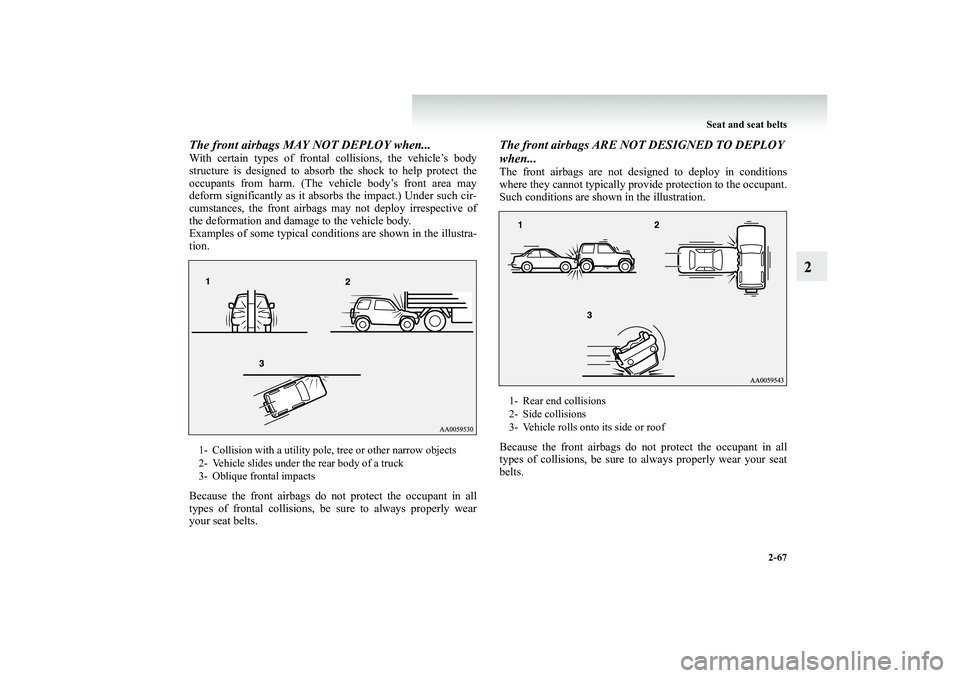
The front airbags ARE NOT
DESIGNED TO DEPLOY
when...The front airbags are not designed to deploy in conditions where they cannot typically provide protection to the occupant. Such conditions are shown in the illustration. Because the front airbags do not
protect the occupant in all
types of collisions, be sure to always properly wear your seatbelts.
1- Collision with a utility pole, tree or other narrow objects 2- Vehicle slides under the rear body of a truck 3- Oblique frontal impacts
1- Rear end collisions 2- Side collisions3- Vehicle rolls onto its side or roof
BK-BK2008E1ENUK.en-uk-Section5.fm Page
67 Wednesday, January 9, 2008 4:28 PM
Page 114 of 538

2-68 Seat and seat belts
2
The front airbags MAY DEPLOY when...The front airbags may deploy if the bottom of the vehicle suf- fers a moderate to severe impact (undercarriage damage). Examples of some typical cond
itions are shown in the illustra-
tion. Because the front airbags may de
ploy in certain types of unex-
pected impacts as shown in the
illustration, an
d because these
impacts can easily move you out of position, it is important to always properly wear your seat
belts. Your seat belts will help
you to keep a safe distance from
the steering wh
eel and instru-
ment panel during the initial stages of airbag deployment. The initial stage of airbag inflation
is the most for
ceful one and can
possibly cause serious or fatal injuries if you contact it at this stage.1- Collision with an elevated median/island or kerb 2- Vehicle travels over a deep hole/pothole 3- Vehicle drives down a steep slope and hits the ground
WARNING
!●
Do not attach anything to
the steering wheel padded
cover, such as trim materi
al, badges, etc. It might
strike and injure an occupa
nt if the airbag inflates.
●
Do not set anything on, or attach anything to, the instrument panel above the glove box. It mightstrike and injure an occupa
nt if the airbag inflates.
WARNING
!●
Do not attach accessories to, or put them in front of, the windscreen. These object
s could restrict the air-
bag inflation, or strike and
injure an occupant if the
airbag inflates.
BK-BK2008E1ENUK.en-uk-Section5.fm Page
68 Wednesday, January 9, 2008 4:28 PM
Page 115 of 538
Seat and seat belts
2-69
2
Side airbag system*
E00407600198
The side airbags (A)
are contained in the
driver and front pas-
senger seatbacks. The side airbag is designed to
inflate only on th
e side of the
vehicle that is impacted, even
with no passenger in the front
seat.
●
Do not put packages, pets
or other objects between
the airbags and the driver or front passenger. It could affect airbag perfor
mance, or could cause
injury when the
airbag inflates.
●
Right after the airbag infl
ation, several airbag sys-
tem components will be ho
t. Do not touch them; you
could be burned.
●
The airbag system is designed to work only once. Once the airbags have depl
oyed, they will not work
again. They must promptly
be replaced, and we rec-
ommend you to have the entire airbag system inspected by a MITSUBIS
HI MOTORS Authorized
Service Point.WARNING
!
BK-BK2008E1ENUK.en-uk-Section5.fm Page
69 Wednesday, January 9, 2008 4:28 PM
Page 116 of 538
2-70 Seat and seat belts
2
The label shown here is attached to the seatbacks with a side airbag.
Curtain airbag system*
E00409100243
The curtain airbags are contained in the front pillars and roofside rail. The curtain
airbag is designed to
inflate only on the
side of the vehicle that is imp
acted, even with
no passenger in
the front seat or rear (3-door
models)/second (5-door models)
seat.
BK-BK2008E1ENUK.en-uk-Section5.fm Page
70 Wednesday, January 9, 2008 4:28 PM

