Page 108 of 450
2-60 Seat and seat belts
2
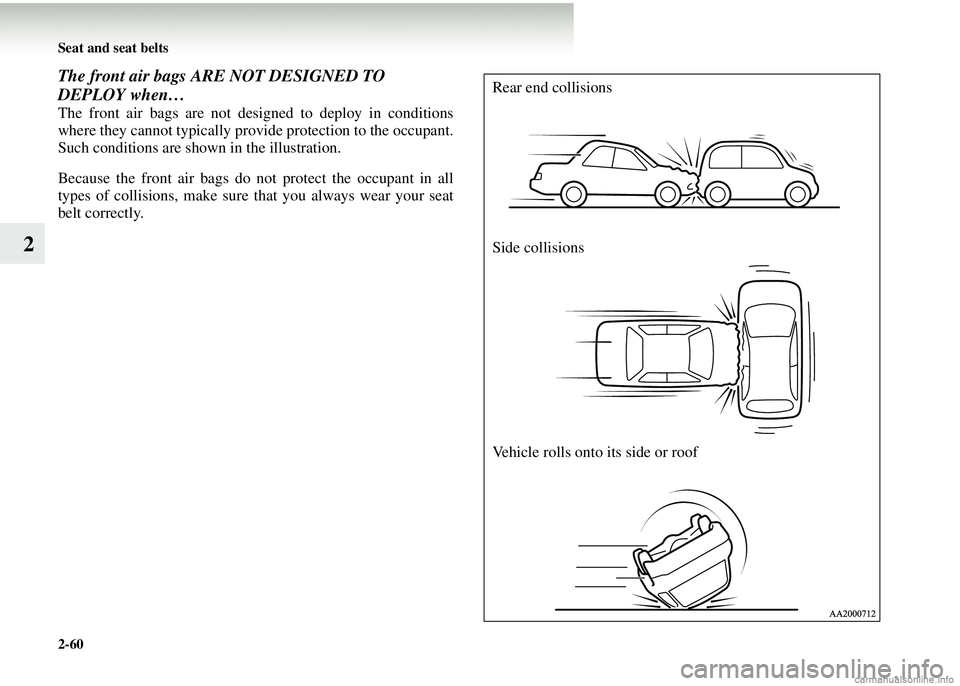
The front air bags ARE NOT DESIGNED TO
DEPLOY when…
The front air bags are not designed to deploy in conditions
where they cannot typically provide protection to the occupant.
Such conditions are shown in the illustration.
Because the front air bags do not protect the occupant in all
types of collisions, make sure that you always wear your seat
belt correctly.
Side collisions
Vehicle rolls onto its side or roof Rear end collisions
Page 109 of 450
Seat and seat belts2-61
2
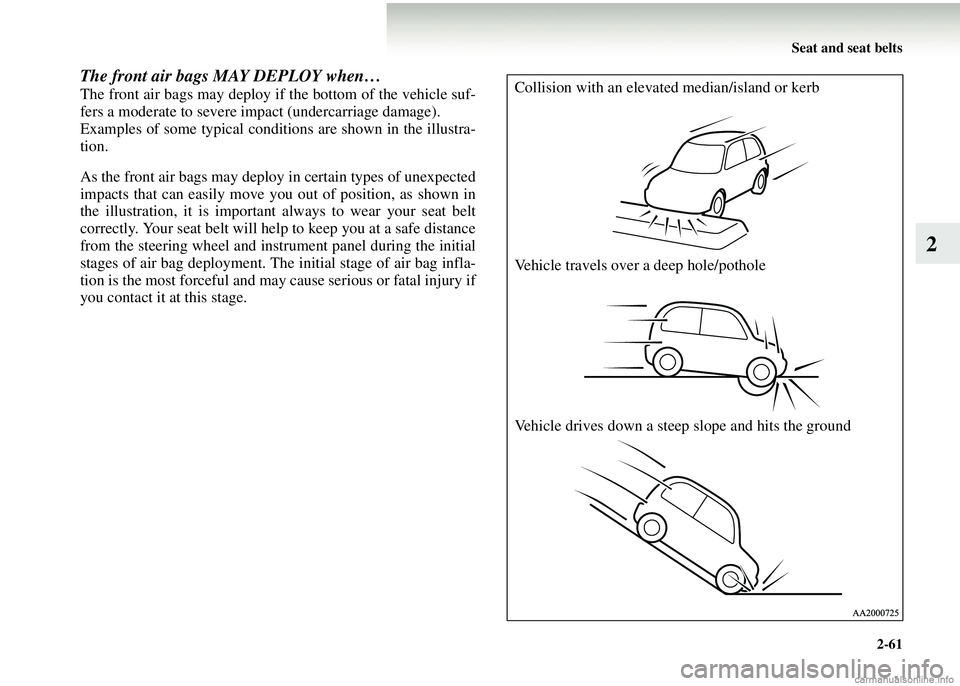
The front air bags MAY DEPLOY when…
The front air bags may deploy if the bottom of the vehicle suf-
fers a moderate to severe impact (undercarriage damage).
Examples of some typical conditions are shown in the illustra-
tion.
As the front air bags may deploy in certain types of unexpected
impacts that can easily move you out of position, as shown in
the illustration, it is important always to wear your seat belt
correctly. Your seat belt will help to keep you at a safe distance
from the steering wheel and instrument panel during the initial
stages of air bag deployment. The initial stage of air bag infla-
tion is the most forceful and may cause serious or fatal injury if
you contact it at this stage.Collision with an elevated median/island or kerb
Vehicle travels over a deep hole/pothole
Vehicle drives down a steep slope and hits the ground
Page 110 of 450

2-62 Seat and seat belts
2
WARNING!
●Do not attach anything to the steering wheel padded
cover, such as trim materi al, badges, etc. It might
strike and injure the occupa nt if the air bag inflates.
●On vehicles with a front passenger air bag, do not
set anything on, or attach anything to, the instru-
ment panel above the glove box. It might strike and
injure the occupant if the air bag inflates.
WARNING!
● Do not attach accessories to , or put them in front of,
the windscreen. These objects could restrict air bag
inflation, or strike and injure the occupant if the air
bags inflate.
● Do not put packages, pets or other objects between
the air bags and the driver or front passenger, as this
could affect air bag perf ormance, or cause injury
when the air bag inflates.
● Immediately after air bag inflation, several air bag
system components will be hot. Do not touch them;
you could be burned.
●The air bag system is desi gned to work only once.
Once the air bags have been deployed, they will not
work again. They must be replaced promptly, and
we recommend that you have the entire air bag sys-
tem inspected by a MITSUBISHI MOTORS
Authorized Service Point.
WARNING!
Page 111 of 450
Seat and seat belts2-63
2
Side air bag system*E00407600084
The side air bags (A) are contai ned in the driver and front pas-
senger seatbacks.
The side air bag is designed to inflate only on the side of the
vehicle that is impact ed, even with no passenger in the front
seat. The label shown here is attached to the seatbacks with a side
air bag.
Page 112 of 450
2-64 Seat and seat belts
2
Curtain air bag system*E00409100067
The curtain air bags are contained in the front pillars, rear pil-
lars and roof side rail. The curt ain air bag is designed to inflate
only on the side of the vehicle that is impacted, even with no
passenger in the front seat or rear seat.
Deployment of side air bags and curtain air bagsE00407700652
The side air bags and curtain air bags ARE
DESIGNED TO DEPLOY when…
The side air bags and curtain air bags are designed to deploy
when the vehicle suffers a moderate to severe side impact to
the middle of the passenger compartment.
A typical situation is shown in the illustration.
The seat belts in your vehicle are your primary means of pro-
tection in a collision. The SRS (Supplemental Restraint Sys-
tem) side air bags and curtain air bags are designed to provide
additional protection. Therefore, for your safety and the safety
of all occupants, make sure that you always wear your seat
belts correctly.
Page 113 of 450
Seat and seat belts2-65
2
The side air bags and curtain air bags MAY NOT
DEPLOY when…
In certain types of side collisions, the vehicle’s body structure
is designed to absorb the shock to help protect the occupants
from harm. (The vehicle body’s side area may deform signifi-
cantly as it absorbs the impact.) Under such circumstances, the
side air bags and curtain air bags may not deploy, irrespective
of the deformation and damage to the vehicle body.
Examples of some typical conditions are shown in the illustra-
tion.
Because the side air bags and curtain air bags do not protect the
occupant in all types of side collisions, make sure that you
always wear your seat belt correctly.
Side impacts in an area aw ay from the passenger compart-
ment
Motorcycle or other similar sm all vehicle collides with the
side of the vehicle
Collision with a utility pole, tree or other narrow object
Page 114 of 450
2-66 Seat and seat belts
2
The side air bags and curtain air bags ARE NOT
DESIGNED TO DEPLOY when…
The side air bags and curtain air bags are not designed to
deploy in conditions where they cannot usually provide protec-
tion to the occupant. Typical conditions are shown in the illus-
tration.
Oblique side impacts
Vehicle rolls onto its side or roof
Head-on collisions
Rear end collisions
Page 115 of 450
Seat and seat belts2-67
2
Because the side air bags and curtain air bags do not protect the
occupant in all types of collisions, be sure always to wear your
seat belts properly.
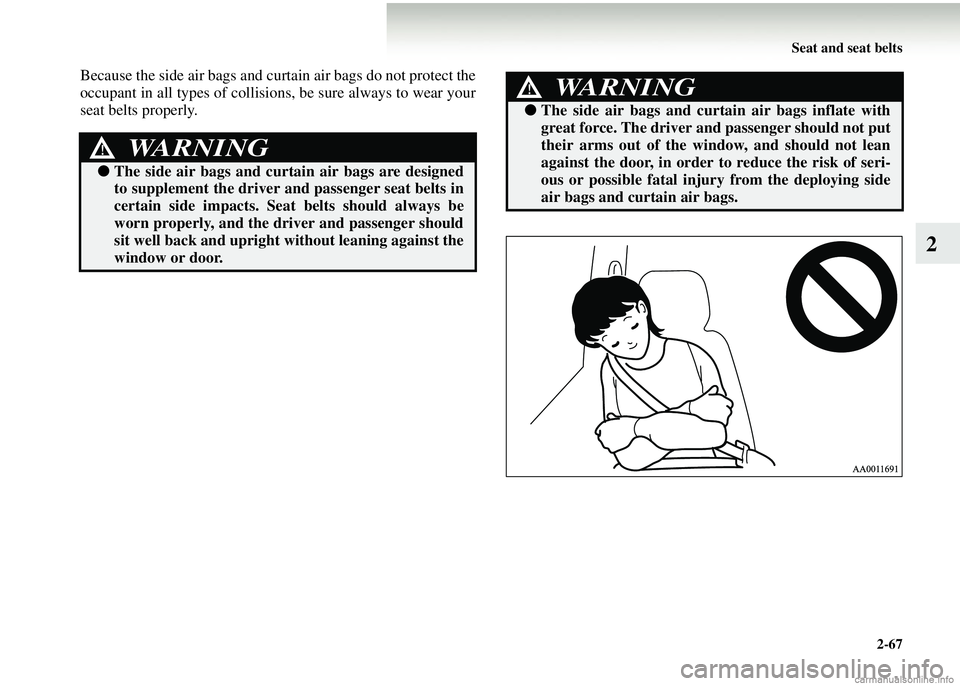
WARNING!
●The side air bags and curtain air bags are designed
to supplement the driver and passenger seat belts in
certain side impacts. Seat belts should always be
worn properly, and the driver and passenger should
sit well back and upright wi thout leaning against the
window or door.
WARNING!
● The side air bags and curtain air bags inflate with
great force. The driver and passenger should not put
their arms out of the wi ndow, and should not lean
against the door, in order to reduce the risk of seri-
ous or possible fatal injury from the deploying side
air bags and curtain air bags.