2008 MERCEDES-BENZ GLK SUV oil temperature
[x] Cancel search: oil temperaturePage 14 of 261
MP3
Operating (on-board computer,
luxury multi-function steering
wheel). .............................................. 99
Multi-function display
Luxury multi-function steering
wheel. ............................................... 94
Multi-function steering wheel. ..........91
Multi-function steering wheel............. 91
Overview. .......................................... 28
Multi-function steering wheel (12-
button)
see Luxury multi-function steering wheel N
Navigation On-board computer (luxury multi-
function steering wheel) ...................97
NECK-PRO head restraints ..................40
Resetting after being triggered. ......215
Notes on running in a new vehicle ...144 O
Odometer Total distance recorder. ..............92, 95
Trip meter. .................................. 92, 95
Off-road
4MATIC ........................................... 105
DSR. ............................................... 105
Off-road ABS. .................................... 51
Off-road drive program. ..................107
Off-road ABS ......................................... 51
Off-road drive program (vehicles
with off-road engineering package) .107
Off-road driving Checklist......................................... 159
Information. .................................... 158
Off-road ESP ®
........................................ 54
Off-road terrain Off-road ESP. .................................... 54
Oil
Consumption. ................................. 148
Topping up. ..................................... 148
On-board computer (luxury multi-
function steering wheel) ......................93
Audio menu ...................................... 98Convenience submenu.
..................104
Display messages ........................... 176
Factory settings submenu ..............104
Instrument cluster submenu ...........101
Lights submenu. ............................. 102
Navigation menu. .............................. 97
Overview. .......................................... 95
Service menu .................................. 101
Settings menu ................................ 101
Standard display submenu................ 95
Telephone menu. .............................. 99
Time/date submenu. ......................102
Trip computer menu. ........................95
Vehicle submenu. ........................... 104
On-board computer (multi-func-
tion steering wheel)............................. 91
Display messages ........................... 176
Overview. .......................................... 92
Range. .............................................. 93
Standard display. .............................. 92
Time/date. ....................................... 93
Trip computer. .................................. 92
On-board computer menu (luxury
multi-function steering wheel).......... 101
One-touch gearshifting........................ 86
Operating system see On-board computer (luxury
multi-function steering wheel)
see On-board computer (multi-
function steering wheel)
Outside temperature display .............90
Override feature Rear side windows ............................ 50 P
Paint code........................................... 244
Panorama sliding sunroof................. 127
Rain closing feature. .......................128
Resetting. ....................................... 129
Parking .................................................. 84
Parking aid Exterior mirror on the front-
passenger side.................................. 69
Parktronic. ...................................... 113
Reversing camera. ..........................115
Parking brake ....................................... 84
Display message ............................. 185 Index
11 X204_AKB; 1; 5, en-GB
wobuchh,
Version: 2.11.4
2008-10-15T13:20:56+02:00 - Seite 11 Dateiname: 6515_0671_02_buchblock.pdf; preflight
Page 149 of 261

!
In countries in which diesel with a higher
sulphur content is available (e.g. 0.035 per-
cent by weight), the engine oil should be
renewed at more frequent intervals. More
information about intervals for changing
the engine oil can be obtained from any
Mercedes-Benz Service Centre.
! The use of fuels which do not meet the
requirements of EN 590 or German stand-
ard DIN 51628 can cause increased wear,
and damage the engine and the exhaust
system.
Do not use the following:
R marine diesel
R heating oil
R bio-diesel
R vegetable oil
R petrol
R paraffin
R kerosene
Do not add such fuels to diesel fuel and do
not use any special additives (exception:
flow improvers – see "Low outside temper-
atures").
Damage caused by the use of unapproved
fuels or additives is not covered by the war-
ranty.
Further information on "Fuel" (Y page 245) .
Low outside temperatures The flow properties of diesel may be inade-
quate at low ambient temperatures.
To prevent operating problems, diesel fuel
with improved cold flow qualities is available
during the winter months. Your vehicle must
be refuelled with winter diesel at tempera-
tures of – 5 † or below.
You can use winter diesel at temperatures
down to about – 20 †without any problems.
If only "summer diesel" or less cold-resistant
"winter diesel" (e.g. in Mediterranean
regions) is available, you should add an amount of flow improver to the fuel corre-
sponding to the outside temperature.
Mix the additive with the diesel in good time,
before the flow properties of the diesel
become inadequate. Otherwise, malfunctions
can only be rectified by heating the entire fuel
system, e.g. by parking the vehicle in a heated
garage.
Flow improver
The effectiveness of a flow improver is not
guaranteed with every fuel. Observe the infor-
mation provided by the manufacturer when
using a flow improver. Only use flow improv-
ers that have been tested and approved by
Mercedes-Benz. You can obtain further infor-
mation from any Mercedes-Benz Service
Centre. Engine compartment
Bonnet
G
Risk of accident
Do not pull the release lever while the vehicle
is in motion. If you do so, the bonnet may open
up and block your view.
Opening G
Risk of injury
There is a risk of injury if the bonnet is open,
even if the engine is not running.
Some engine components can become very
hot.
To avoid the risk of burns, only touch those
components described in the Owner’s Manual
and observe the relevant safety notes. G
Risk of injury
The radiator fan between the radiator and the
engine can start automatically, even if the key
has been removed from the ignition lock. For
this reason, you must not reach into the fan
rotation area. Otherwise, you could be
injured. 146 Engine compartmentOperation
X204_AKB; 1; 5, en-GB
wobuchh,
Version: 2.11.4 2008-10-15T13:20:56+02:00 - Seite 146Dateiname: 6515_0671_02_buchblock.pdf; preflight
Page 151 of 261
i
If the bonnet can be raised slightly, it is
not properly engaged. Open it again and
close it with a little more force. Engine oil
Depending on driving style, the vehicle con-
sumes up to 0.8 l oil per 1,000 km. The oil
consumption may be higher than this when
the vehicle is new or if you frequently drive at
high engine speeds.
Further information on engine oil
(Y page 246).
Checking the engine oil level When doing so:
R
the vehicle should be parked on level
ground.
R the engine should be switched off for at
least five minutes if the engine is at normal
operating temperature.
R the engine should be switched off for at
least 30 minutes if the engine is not at
operating temperature (i.e. if you only start
the engine briefly). Example: vehicles with a petrol engine Example: vehicles with a diesel engine
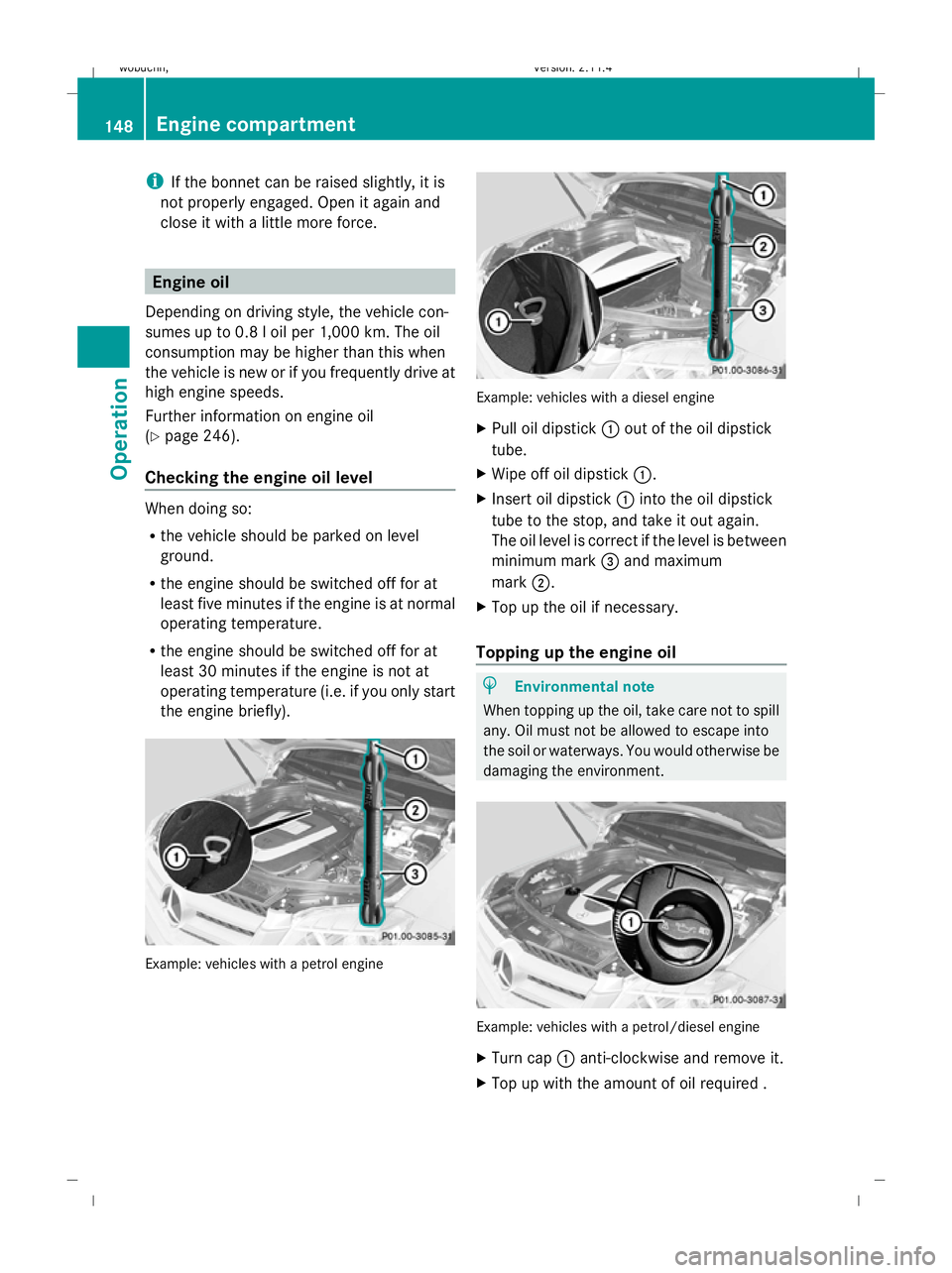
X Pull oil dipstick :out of the oil dipstick
tube.
X Wipe off oil dipstick :.
X Insert oil dipstick :into the oil dipstick
tube to the stop, and take it out again.
The oil level is correct if the level is between
minimum mark =and maximum
mark ;.
X Top up the oil if necessary.
Topping up the engine oil H
Environmental note
When topping up the oil, take care not to spill
any. Oil must not be allowed to escape into
the soil or waterways. You would otherwise be
damaging the environment. Example: vehicles with a petrol/diesel engine
X
Turn cap :anti-clockwise and remove it.
X Top up with the amount of oil required . 148 Engine compartmentOperation
X204_AKB; 1; 5, en-GB
wobuchh,
Version: 2.11.4 2008-10-15T13:20:56+02:00 - Seite 148Dateiname: 6515_0671_02_buchblock.pdf; preflight
Page 152 of 261
i
The difference in quantity between the
minimum mark and maximum mark is
approximately 2 litres.
! Do not add too much oil. If too much oil
is added and the oil level is above the max-
imum mark on the dipstick, the engine or
catalytic converter could be damaged.
Have excess oil siphoned off.
X Replace cap :on the filler neck and
tighten clockwise.
Ensure that the cap locks into place
securely.
For further information on engine oil, see
(Y page 246). Coolant
Only check the coolant level when the vehicle
is on a level surface and the engine has cooled
down.
X Turn the key to position 2(Y page 61) in
the ignition lock.
X Check the coolant temperature gauge in
the multi-function display. G
Risk of injury
The cooling system is pressurised. Therefore,
only unscrew the cap once the engine has
cooled down. The coolant temperature gauge
must display less than 70 †. Otherwise, you
could be scalded by escaping hot coolant. The coolant expansion tank is located in the
engine compartment on the right when
viewed in the direction of travel. X
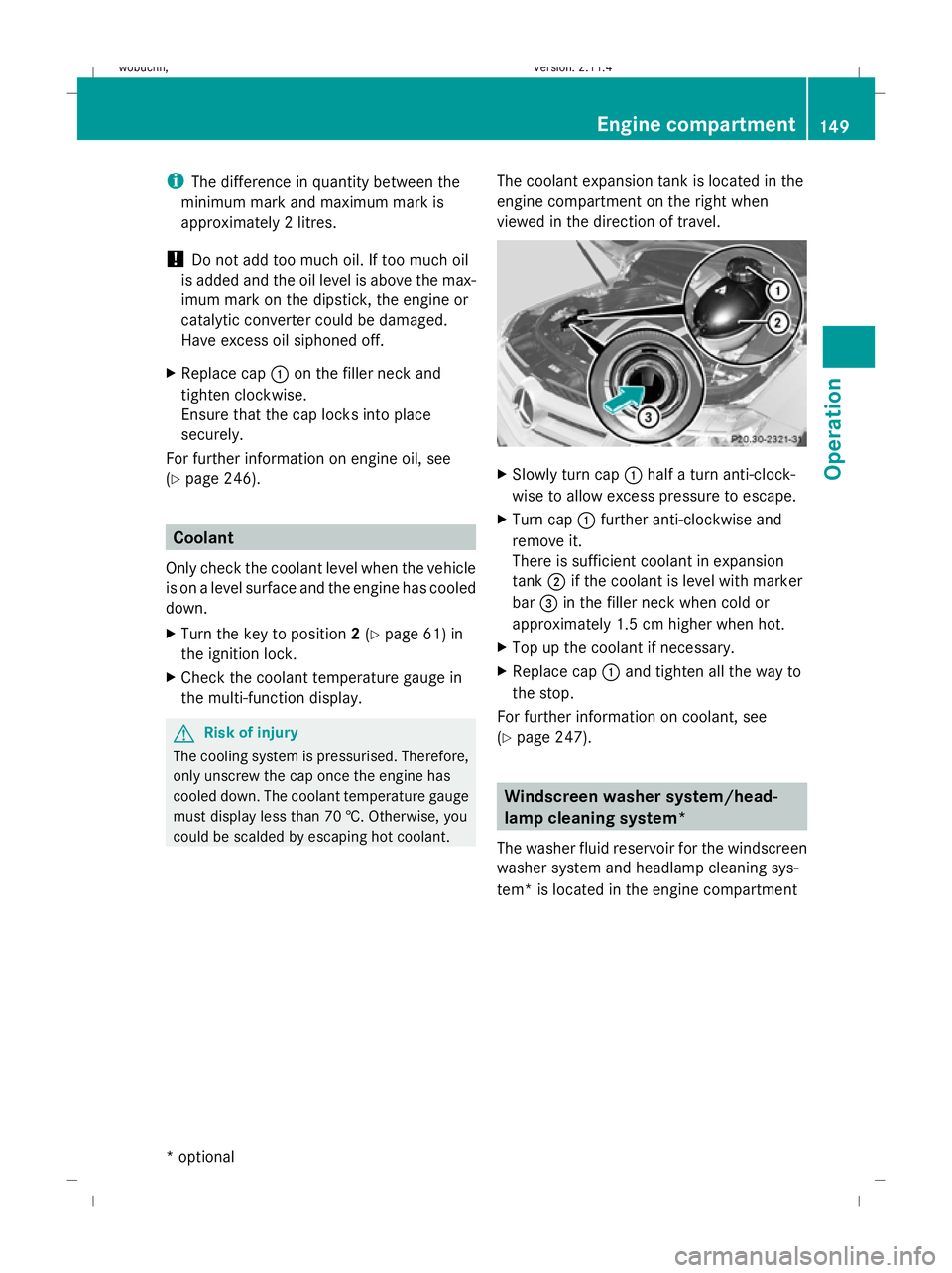
Slowly turn cap :half a turn anti-clock-
wise to allow excess pressure to escape.
X Turn cap :further anti-clockwise and
remove it.
There is sufficient coolant in expansion
tank ;if the coolant is level with marker
bar =in the filler neck when cold or
approximately 1.5 cm higher when hot.
X Top up the coolant if necessary.
X Replace cap :and tighten all the way to
the stop.
For further information on coolant, see
(Y page 247). Windscreen washer system/head-
lamp cleaning system*
The washer fluid reservoir for the windscreen
washer system and headlamp cleaning sys-
tem* is located in the engine compartment Engine compartment
149Operation
* optional
X204_AKB; 1; 5, en-GB
wobuchh,
Version: 2.11.4
2008-10-15T13:20:56+02:00 - Seite 149 ZDateiname: 6515_0671_02_buchblock.pdf; preflight
Page 171 of 261
and rinse off the treated surface afterwards.
Remove:
R tree resin, oils, fuels and greases by rub-
bing gently with a cloth soaked in petro-
leum ether or lighter fluid.
R tar stain with tar remover
R wax with silicone remover
! Do not affix to painted surfaces or plastic
surfaces:
R stickers
R films
R magnetic plates
R scented oil bottles or similar items
Otherwise, you could damage the paint fin-
ish or plastic. H
Environmental note
Dispose of empty packaging, cleaning cloths
and polishing wads in an environmentally
responsible manner. Vehicle care
! Do not park the vehicle for a long period
of time directly after cleaning, especially if
the wheels have just been cleaned with a
wheel cleaner. Wheel cleaners could cause
rapid corrosion of the brake discs and
brake pads/linings. After cleaning, park
the vehicle when it is at normal operating
temperature.
Automatic car wash You can wash the vehicle in an automatic car
wash from the beginning.
! Do not use a touch-free automatic car
wash that uses chemical agents to wash
the vehicle.
Preferably use automatic car washes without
brushes.
If the vehicle is very dirty, pre-wash it before
cleaning it in an automatic car wash. !
Make sure that the automatic car wash is
suitable for the size of the vehicle. Fold in
the exterior mirrors before the vehicle is
washed. There is otherwise a risk of dam-
age to the exterior mirrors.
! Make sure that the automatic transmis-
sion is not in position Pwhen washing your
vehicle in a tow-through car wash.
Do not remove the key from the ignition
lock. Do not open the driver's or front-
passenger door when the engine is
switched off, as this automatically shifts
the automatic transmission to park posi-
tion Pand locks the wheels, unless you
have previously shifted the automatic
transmission to N.
! Make sure that the side windows are com-
pletely closed, that the ventilation/heater
blower is fully turned off and that the wind-
screen wiper switch is set to 0. Otherwise,
the rain sensor may be activated, triggering
unintended wiper movements. This could
cause damage to the vehicle.
After using an automatic car wash, wipe off
wax and drying agents from the windscreen
and the wiper blades. This will prevent smears
and reduce wiping noises caused by residue
on the windscreen.
High-pressure cleaners G
Risk of accident
Do not use high-pressure cleaners with circu-
lar-jet nozzles (dirt grinders) to clean your
vehicle, in particular the tyres. Otherwise, you
could damage the tyres and cause an acci-
dent.
! Observe the instructions issued by the
equipment manufacturer concerning the
distance to be maintained between the
nozzle of the high-pressure cleaner and the
vehicle (at least 30 cm).
Move the high-pressure cleaner nozzle
around when cleaning your vehicle. 168 CareOperation
X204_AKB; 1; 5, en-GB
wobuchh,
Version: 2.11.4 2008-10-15T13:20:56+02:00 - Seite 168Dateiname: 6515_0671_02_buchblock.pdf; preflight
Page 249 of 261
injection system. Damage resulting from
adding the wrong fuel is not covered by the
warranty.
Further information on refuelling and on fuels
(Y page 144).
Notes on fuel consumption The vehicle will use more fuel than usual in
the following situations:
R at very low temperatures
R in urban traffic
R on short trips
R when towing a trailer
R in mountainous terrain
The consumption figures have been deter-
mined in accordance with EU Directive
RL 80 /1268 /EEC.
i Only for certain countries: the respective
current consumption and emission values
of your vehicle can be found in the COC
papers (EC CERTIFICATE OF CONFORM-
ITY). These documents are supplied when
the vehicle is delivered.
! Do not use any special additives, as they
can cause malfunctions and engine dam-
age. Damage resulting from the use of such
additives is not covered by the Mercedes-
Benz warranty. H
Environmental note
CO 2(carbon dioxide) is the gas which scien-
tists believe to be principally responsible for global warming (the greenhouse effect). Your
vehicle's CO
2emissions are directly related
to fuel consumption and therefore depend on:
R efficient use of the fuel by the engine
R driving style
R other non-technical factors, such as envi-
ronmental influences or road conditions
You can minimise your vehicle's CO 2emis-
sions by driving carefully and having it serv-
iced regularly. Engine oil
Only Mercedes-Benz approved engine oils
may be used in Mercedes-Benz engines.
A list of the engine oils tested and approved
in accordance with the Mercedes-Benz Spec-
ifications for Service Products can be called
up by visiting http:\\bevo.daimler.co m and
en tering the MB Sheet number. Further infor-
mation on tested and approved engine oils
can be obtained from any Mercedes-Benz
Service Centre. Engine oils which have been
approved by Mercedes-Benz have the MB
Sheet number indicated on the oil container
under the "MB approval" notice. The table
shows which MB Sheet number applies to
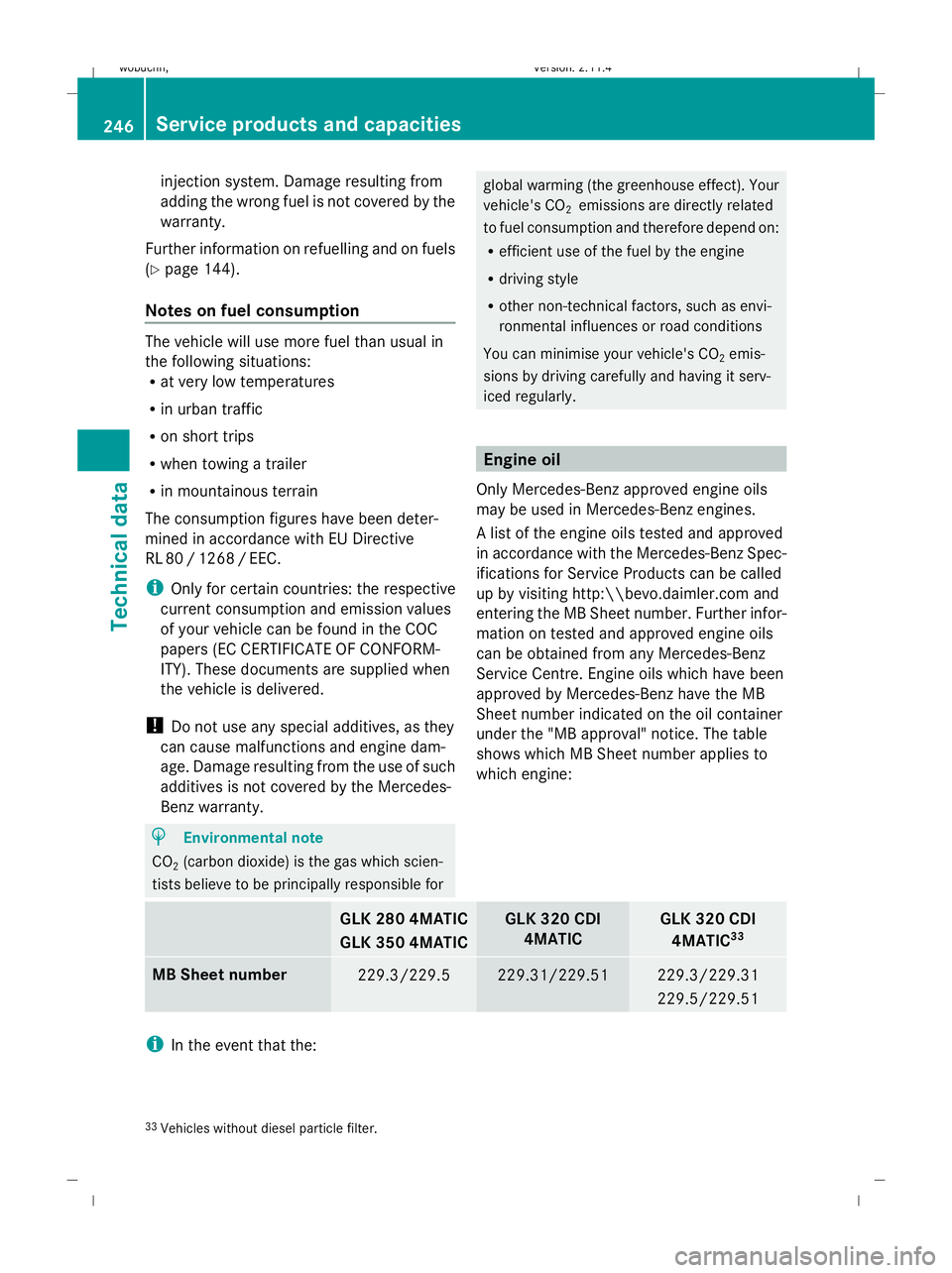
which engine: GLK 280 4MATIC
GLK 350 4MATIC GLK 320 CDI
4MATIC GLK 320 CDI
4MATIC 33 MB Sheet number
229.3/229.5 229.31/229.51 229.3/229.31
229.5/229.51
i
In the event that the:
33 Vehicles without diesel particle filter. 246 Service products and capacitiesTechnical data
X204_AKB; 1; 5, en-GB
wobuchh
,V ersion: 2.11.4
2008-10-15T13:20:56+02:00 - Seite 246 Dateiname: 6515_0671_02_buchblock.pdf; preflight
Page 250 of 261
R
engine oil brand
R grade (MB Sheet number)
R SAE classification (viscosity)
is not available, you can use another min-
eral or synthetic engine oil which has been
approved by Mercedes-Benz. You must
then have an oil change carried out at the
earliest possible opportunity.
Mixing oils reduces the benefits of high-
grade engine oil.
! Do not use lubricant additives as they can
lead to increased wear and damage to
mechanical assemblies. The use of lubri-
cant additives will result in a restriction of
your warranty.
! Engine oils for vehicles without a diesel
particle filter may also be used temporarily
in vehicles with a diesel particle filter if the
engine oil listed is not available. You must
then have an oil change carried out as soon
as possible.
Engine oil viscosity Viscosity describes the flow characteristics
of a fluid. If an engine oil has a high viscosity, this means it is thick; a low viscosity means
that it is thin.
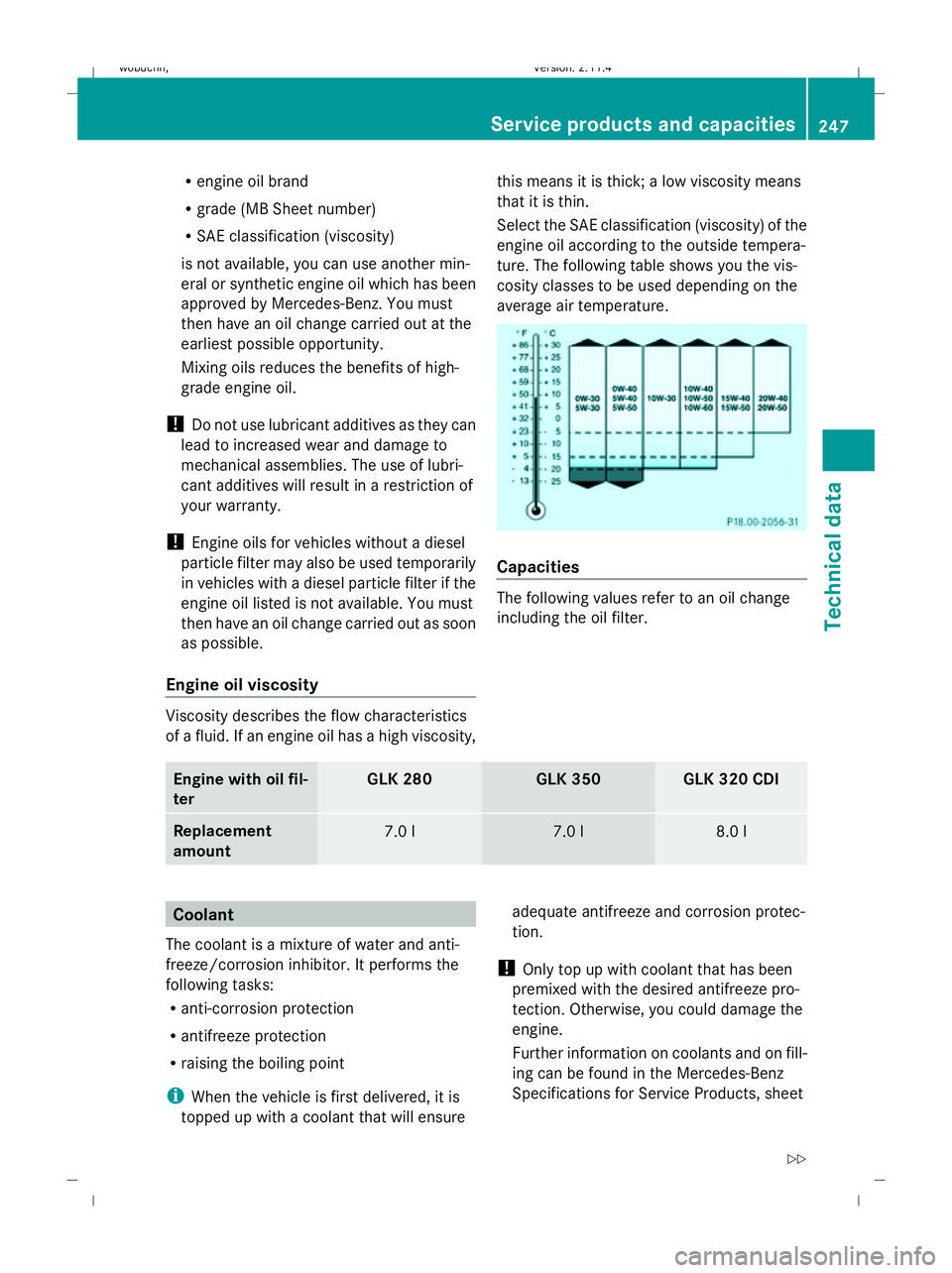
Select the SAE classification (viscosity) of the
engine oil according to the outside tempera-
ture. The following table shows you the vis-
cosity classes to be used depending on the
average air temperature. Capacities
The following values refer to an oil change
including the oil filter.
Engine with oil fil-
ter GLK 280 GLK 350 GLK 320 CDI
Replacement
amount
7.0 l 7.0 l 8.0 l
Coolant
The coolant is a mixture of water and anti-
freeze/corrosion inhibitor. It performs the
following tasks:
R anti-corrosion protection
R antifreeze protection
R raising the boiling point
i When the vehicle is first delivered, it is
topped up with a coolant that will ensure adequate antifreeze and corrosion protec-
tion.
! Only top up with coolant that has been
premixed with the desired antifreeze pro-
tection. Otherwise, you could damage the
engine.
Further information on coolants and on fill-
ing can be found in the Mercedes-Benz
Specifications for Service Products, sheet Service products and capacities
247Technical data
X204_AKB; 1; 5, en-GB
wobuchh, Version: 2.11.4 2008-10-15T13:20:56+02:00 - Seite 247 ZDateiname: 6515_0671_02_buchblock.pdf; preflight
Page 251 of 261
310.1, or at any Mercedes-Benz Service
Centre.
! Always use a suitable coolant mixture,
even in countries where high temperatures
prevail.
Otherwise, the cooling system will not be
sufficiently protected from corrosion, and
the boiling point will be too low.
If antifreeze/corrosion inhibitor is present in
the correct concentration, the boiling point of
the coolant will be around 130 °C.
The antifreeze/corrosion inhibitor concentra-
tion in the cooling system should:
R be at least 50%. This will protect the cooling
system against freezing down to around
–37 °C.
R not exceed 55% concentration (antifreeze
protection down to –45 °C); otherwise,
heat will not be effectively dissipated. If the vehicle has lost coolant, top it up with
equal amounts of water and antifreeze/cor-
rosion inhibitor. Mercedes-Benz recom-
mends an antifreeze/corrosion inhibitor
which has been approved for Mercedes-Benz.
!
The cooling system contains a supply
which must be renewed after 15 years, or
after 250, 000 km at the latest.
The warranty is only valid if you top up with
an antifreeze/corrosion inhibitor which
has been approved by Mercedes-Benz and
the recommended mixture ratio is
observed.
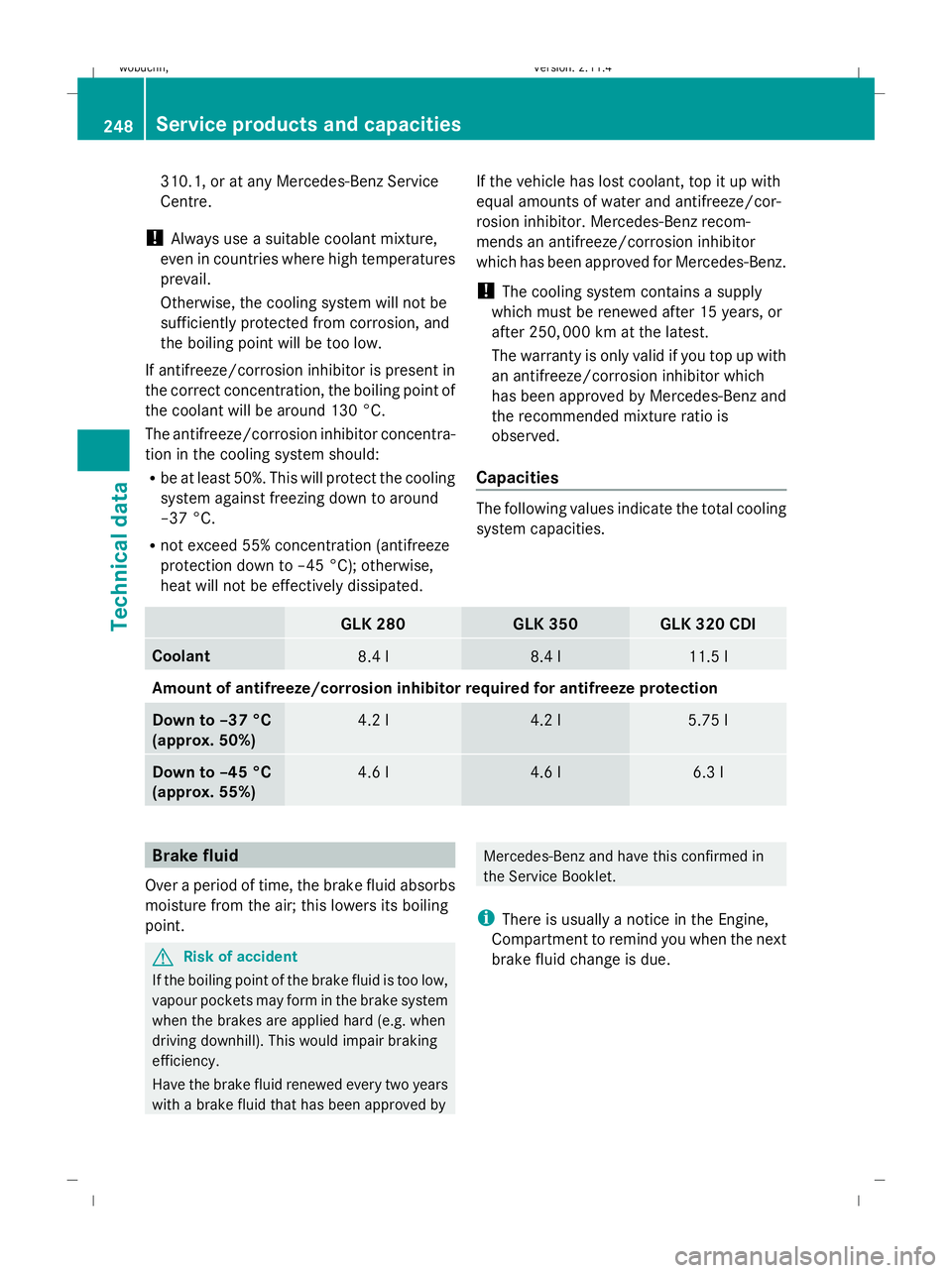
Capacities The following values indicate the total cooling
system capacities.
GLK 280 GLK 350 GLK 320 CDI
Coolant
8.4 l 8.4 l 11.5 l
Amount of antifreeze/corrosion inhibitor required for antifreeze protection
Down to –37 °C
(approx. 50%)
4.2 l 4.2 l 5.75 l
Down to –45 °C
(approx. 55%)
4.6 l 4.6 l 6.3 l
Brake fluid
Over a period of time, the brake fluid absorbs
moisture from the air; this lowers its boiling
point. G
Risk of accident
If the boiling point of the brake fluid is too low,
vapour pockets may form in the brake system
when the brakes are applied hard (e.g. when
driving downhill). This would impair braking
efficiency.
Have the brake fluid renewed every two years
with a brake fluid that has been approved by Mercedes-Benz and have this confirmed in
the Service Booklet.
i There is usually a notice in the Engine,
Compartment to remind you when the next
brake fluid change is due. 248 Service products and capacitiesTechnical data
X204_AKB; 1; 5, en-GB
wobuchh,
Version: 2.11.4 2008-10-15T13:20:56+02:00 - Seite 248Dateiname: 6515_0671_02_buchblock.pdf; preflight