2008 MERCEDES-BENZ G-CLASS SUV sunroof
[x] Cancel search: sunroofPage 124 of 293

Air conditioning
121
i
The reversing camera also functions
when towing a trailer.
Switching off the reversing camera X
Shift the automatic transmission to P,Nor
D.
or
X In COMAND APS, activate another func-
tion. (See the separate COMAND APS oper-
ating instructions.) Air conditioning
General notes
The vehicle is equipped with the Thermatic
air-conditioning system. Thermatic combines
an automatic heating and ventilation system
with a cooling system.
Thermatic controls the temperature and the
humidity of the vehicle interior and filters out
undesirable substances from the air.
Thermatic is only operational when the
engine is running. Optimum operation is ach-
ieved only when you drive with the side win-
dows and sliding/tilting sunroof* closed.
i Ventilate the vehicle for a brief period
during warm weather, e.g. using the sum-
mer opening feature (Y page 85). This will
speed up the cooling process and the desired interior temperature will be
reached more quickly.
i The integrated filter filters out most par-
ticles of dust and completely filters out pol-
len. A clogged filter reduces the amount of
air supplied to the vehicle interior. For this
reason, you should always observe the
interval for replacing the filter, which is
specified in the Service Booklet. As it
depends on environmental conditions, e.g.
heavy air pollution, the interval may be
shorter than stated in the Service Booklet. G
Risk of accident
Observe the settings recommended on the
following pages. The windows could other-
wise mist up. This may obstruct your view
of the traffic situation, thereby causing an
accident. Cont
rols
* option al
463_AKB; 1; 8, en-GB
wobuchh,
Version: 2.10.6 2008-07-17T15:19:41+02:00 - Seite 121 ZDateiname: 6515_4091_02_buchblock.pdf; preflight
Page 135 of 293

Sliding sunroof
132R
whether a signal has been transmitted to
the auxiliary heating or ventilation
R about the remote control's battery
charge status:
If the remote control indicator lamp first
lights up orange when you press one of
the buttons, the battery is almost dis-
charged.
If the remote control indicator lamp only
flashes orange when you press one of the
buttons, the battery is discharged.
Replace the battery (Y page 235).
The signal has been interrupted if the indi-
cator lamp on the remote control flashes
green when switching on or red when
switching off.
In this case, repeat the procedure. Stand
somewhere else or move closer to the vehi-
cle, if necessary.
X To deactivate the auxiliary heating/
ventilation: press and hold the OFFbutton
until indicator lamp 4on the remote con-
trol lights up in red.
The red or the yellow indicator lamp in the
button on the centre console goes out. Sliding sunroof
Sliding/tilting sunroof*
G
Risk of injury
Children could injure themselves if they
operate the sliding/tilting sunroof.
Never leave children unsupervised in the
vehicle. Always take the key with you when
leaving the vehicle, even if you are only
leaving it for a short time. G
Risk of injury
Make sure that nobody can become trap-
ped when you are opening and closing the
sliding/tilting sunroof. If there is a risk of
entrapment, release the switch and push it
briefly in any direction to stop the sliding/
tilting sunroof. G
Risk of injury
If you are not wearing a seat belt, there is
a risk that you could be thrown through the
opening in the event of the vehicle over-
turning. Therefore, always wear a seat belt
to reduce the risk of injuries.
! Only open the sliding/tilting sunroof if it
is free of snow and ice. Otherwise, mal-
functions may occur. Do not allow anything to protrude from the
sliding/tilting sunroof. The seals could oth-
erwise be damaged.
i Resonance noises can occur in addition
to the usual airflow noises when the slid-
ing/tilting sunroof is open. They are caused
by minor pressure fluctuations in the vehi-
cle interior.
Change the position of the sliding/tilting
sunroof or open a side window slightly to
reduce or eliminate these noises.
i It is also possible to open and close the
sliding/tilting sunroof from the outside
using the "Summer opening" and "Conve-
nience closing" features respectively. Controls
* optional
463_AKB; 1; 8, en-GB
wobuchh,
Version: 2.10.6 2008-07-17T15:19:41+02:00 - Seite 132Dateiname: 6515_4091_02_buchblock.pdf; preflight
Page 136 of 293
Cabriolet soft top
1331
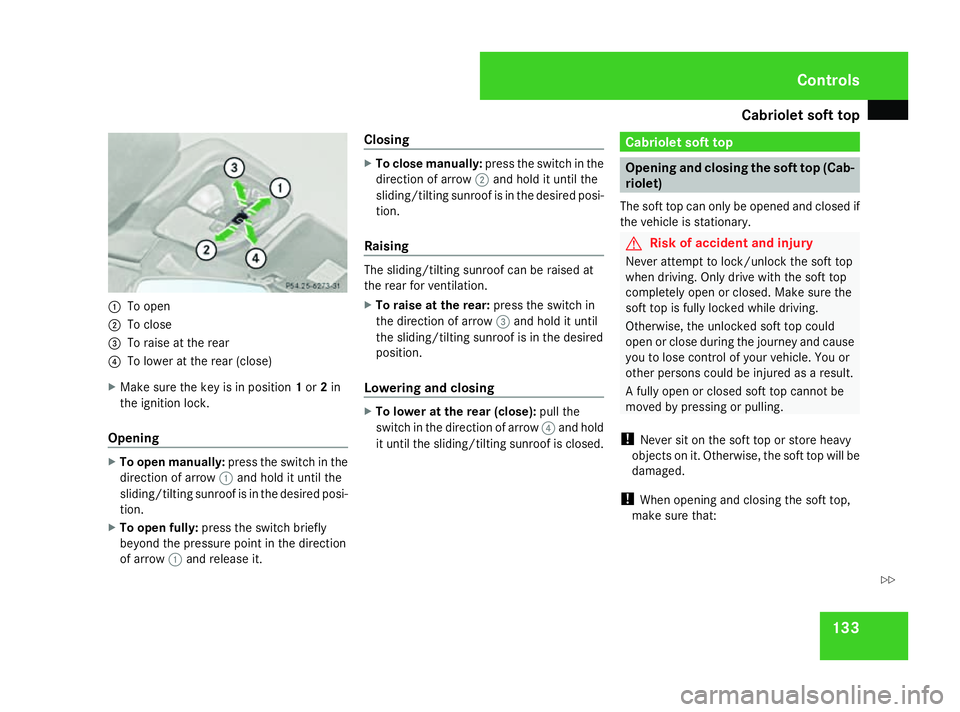
To open
2 To close
3 To raise at the rear
4 To lower at the rear (close)
X Make sure the key is in position 1or 2in
the ignition lock.
Opening X
To open manually: press the switch in the
direction of arrow 1and hold it until the
sliding/tilting sunroof is in the desired posi-
tion.
X To open fully: press the switch briefly
beyond the pressure point in the direction
of arrow 1and release it. Closing X
To close manually: press the switch in the
direction of arrow 2and hold it until the
sliding/tilting sunroof is in the desired posi-
tion.
Raising The sliding/tilting sunroof can be raised at
the rear for ventilation.
X To raise at the rear: press the switch in
the direction of arrow 3and hold it until
the sliding/tilting sunroof is in the desired
position.
Lowering and closing X
To lower at the rear (close): pull the
switch in the direction of arrow 4and hold
it until the sliding/tilting sunroof is closed. Cabriolet soft top
Opening and closing the soft top (Cab-
riolet)
The soft top can only be opened and closed if
the vehicle is stationary. G
Risk of accident and injury
Never attempt to lock/unlock the soft top
when driving. Only drive with the soft top
completely open or closed. Make sure the
soft top is fully locked while driving.
Otherwise, the unlocked soft top could
open or close during the journey and cause
you to lose control of your vehicle. You or
other persons could be injured as a result.
A fully open or closed soft top cannot be
moved by pressing or pulling.
! Never sit on the soft top or store heavy
objects on it. Otherwise, the soft top will be
damaged.
! When opening and closing the soft top,
make sure that: Cont
rols
463_AKB; 1; 8, en-GB
wobuchh,
Version: 2.10.6 2008-07-17T15:19:41+02:00 - Seite 133 ZDateiname: 6515_4091_02_buchblock.pdf; preflight
Page 142 of 293

Loading and stowing
139Roof rack system*
G
Risk of accident and injury
An incorrectly secured roof rack, ski rack
or load could become detached from the
vehicle. These objects may then be thrown
around and can injure you or others or
cause an accident. Follow the roof rack/ski
rack manufacturer's installation instruc-
tions and special instructions for use.
The roof load raises the vehicle's centre of
gravity, thereby affecting vehicle handling.
Always observe the maximum roof load
(see the "Technical Data" section). Always
adapt your driving style to the prevailing
road, traffic and weather conditions and
drive with particular care if the roof is laden.
! Mercedes-Benz recommends that you
only use roof rack systems which have
been tested and approved for Mercedes-
Benz vehicles. This helps to prevent dam-
age to the vehicle.
Position the load on the roof rack in such a
way that the vehicle will not sustain dam-
age even when it is in motion.
Make sure that, depending on the vehicle's
equipment, you can fully raise the sliding/ tilting sunroof* and fully open the rear door
(station wagon).
X Follow the manufacturer’s installation
instructions when fitting the roof carrier
system. Luggage net in the front-passenger
footwell G
Risk of injury
Only place lightweight objects in the lug-
gage net. Do not use it to transport heavy,
sharp-edged or fragile objects. The luggage
net cannot secure the objects sufficiently
in the event of an accident. Loading guidelines
G
Risk of poisoning
Keep the boot lid/tailgate closed when the
engine is running. Otherwise, you could be
poisoned by exhaust fumes entering the
vehicle.
The handling characteristics of a laden vehi-
cle depend on the distribution of the load
within the vehicle. You should therefore load
your vehicle as shown in the illustrations. Load distribution
Observe the following notes when transport-
ing a load:
R When transporting a load, never exceed the
maximum permissible gross vehicle weight
or the permissible axle loads for the vehicle
(including occupants).
R Position heavy loads as far forwards and as
low down in the luggage compartment as
possible.
R The load must not protrude above the
upper edge of the seat backrests.
R Always place the load against the front or
rear seat backrests. Controls
* optional
463_AKB; 1; 8, en-GB
wobuchh,
Version: 2.10.6 2008-07-17T15:19:41+02:00 - Seite 139 ZDateiname: 6515_4091_02_buchblock.pdf; preflight
Page 176 of 293

Off-road driving
173After the brakes have been exposed to dirty
conditions, have them checked and
cleaned at a qualified specialist workshop,
e.g. a Mercedes-Benz Service Centre. Oth-
erwise, there is a risk that braking power
may be insufficient in the event of an emer-
gency, or that braking efficiency may be
unpredictable.
Read this section before driving your vehicle
off-road. Practise by travelling over more gen-
tle off-road terrain first.
The following driving systems are specially
adapted to off-road driving:
R transfer case (Y page 92)
R differential locks (Y page 93)
R 4ETS (Y page 50) Off-road driving
G
Risk of accident
Damage to the vehicle creates the risk of
an accident for yourself and other road
users. If in doubt, have your vehicle
checked at a qualified specialist workshop
which has the necessary specialist knowl-
edge and tools to carry out the work
required. Mercedes-Benz recommends
that you use a Mercedes-Benz Service
Centre for this purpose. H
Environmental note
Protection of the environment is of primary
importance. Treat nature with respect.
Observe all prohibiting signs.
General information R
Stop your vehicle and, if necessary, shift
the transfer case to LOW(Ypage 92)
before driving off-road.
R Check that items of luggage and loads are
stowed safely and are well secured
(Y page 139).
R Engage the differential locks, if necessary
(Y page 93). i
When the differential locks are engaged,
ABS is deactivated. This allows the front
wheels to lock briefly, so that these can dig
into a loose surface. However, please note
that locked wheels skid and can no longer
steer.
R Always keep the engine running and in gear
when driving on a downhill gradient.
R Drive slowly and evenly, if necessary at a
walking pace.
R Ensure that the wheels are in contact with
the ground at all times.
R Drive with extreme care on unknown off-
road routes where visibility is poor. For
safety reasons, get out of the vehicle first
and survey the off-road route.
R Check the depth of water before fording
rivers and streams.
R Look out for obstacles such as rocks, holes,
tree stumps and furrows.
R Always keep the side windows and the slid-
ing /tilting sunroof* closed during the jour-
ney.
R Do not stray from marked routes or paths. Operation
* optional
463_AKB; 1; 8, en-GB
wobuchh,
Version: 2.10.6 2008-07-17T15:19:41+02:00 - Seite 173 ZDateiname: 6515_4091_02_buchblock.pdf; preflight
Page 234 of 293

Locking/unlocking in an emergency
231
Cabriolet The emergency release is located in the lug-
gage compartment, on the left-hand side
when viewed in the direction of travel. 1
Release knob
X Pull release knob 1upwards.
The fuel filler flap is unlocked.
X Open the fuel filler flap. Operating the sliding/tilting sunroof*
manually
The drive is located in the load compartment,
on the left-hand side behind the rear wall trim. 1
Edge protection
2 Rear wall trim
X Open the rear door.
X Pull off edge protection 1on the door pil-
lar.
X Remove rear wall trim 2.
i On vehicles with stowage lockers* you
must first unscrew the retaining screws
inside the stowage lockers. 3
Box spanner (vehicle tool kit)
4 Screwdriver (vehicle tool kit)
X Place box spanner 3onto the drive hex-
agonal nut.
X Insert screwdriver 4into the box spanner
and use it as a lever.
X To open: turn box spanner anti-clockwise.
X To close: turn box spanner clockwise. Practical advice
* optional
463_AKB; 1; 8, en-GB
wobuchh ,V ersion: 2.10.6
2008-07-17T15:19:41+02:00 - Seite 231 ZDateiname: 6515_4091_02_buchblock.pdf; preflight