Page 393 of 459

5
When trouble arises
391
5-2. Steps to take in an emergency
ES350_U_(L/O_0708)
CAUTION
■Using the tire jack
Improper use of the tire jack may lead to death or injuries due to the vehicle sud-
denly falling off the jack.
●Do not use the tire jack for any purpose other than replacing tires or installing and
removing tire chains.
●Only use the tire jack that comes with this vehicle for replacing a flat tire.
Do not use it on other vehicles, and do not use other tire jacks for replacing tires
on this vehicle.
●Always check that the tire jack is securely set to the jack point.
●Do not put any part of your body under the vehicle supported by a jack.
●Do not start or run the engine while your vehicle is supported by the jack.
●Do not raise the vehicle while someone is in it.
●When raising the vehicle, do not put an object on or under the jack.
●Do not raise the vehicle to a height greater than that required to replace the tire.
●Use a jack stand if it is necessary to get under the vehicle.
Take particular care when lowering the vehicle to ensure that no one working on or
near the vehicle may be injured.
■Replacing a flat tire
Observe the following precautions to reduce the risk of death or serious injury.
●Never use oil or grease on the wheel bolts or wheel nuts.
The oil or grease can cause the wheel nuts to loosen, causing a serious accident.
Remove any oil or grease on the wheel bolts or wheel nuts.
●Have the wheel nuts tightened with a torque wrench to 10.5 kgf•m (103 N•m, 76
ft•lbf) as soon as possible after changing wheels.
Failure to follow these precautions could cause the nuts to loosen and the wheels
may fall off, which could lead to an accident causing death or serious injury.
Page 433 of 459
431
6-1. Specifications
6
Vehicle specifications
ES350_U_(L/O_0708)
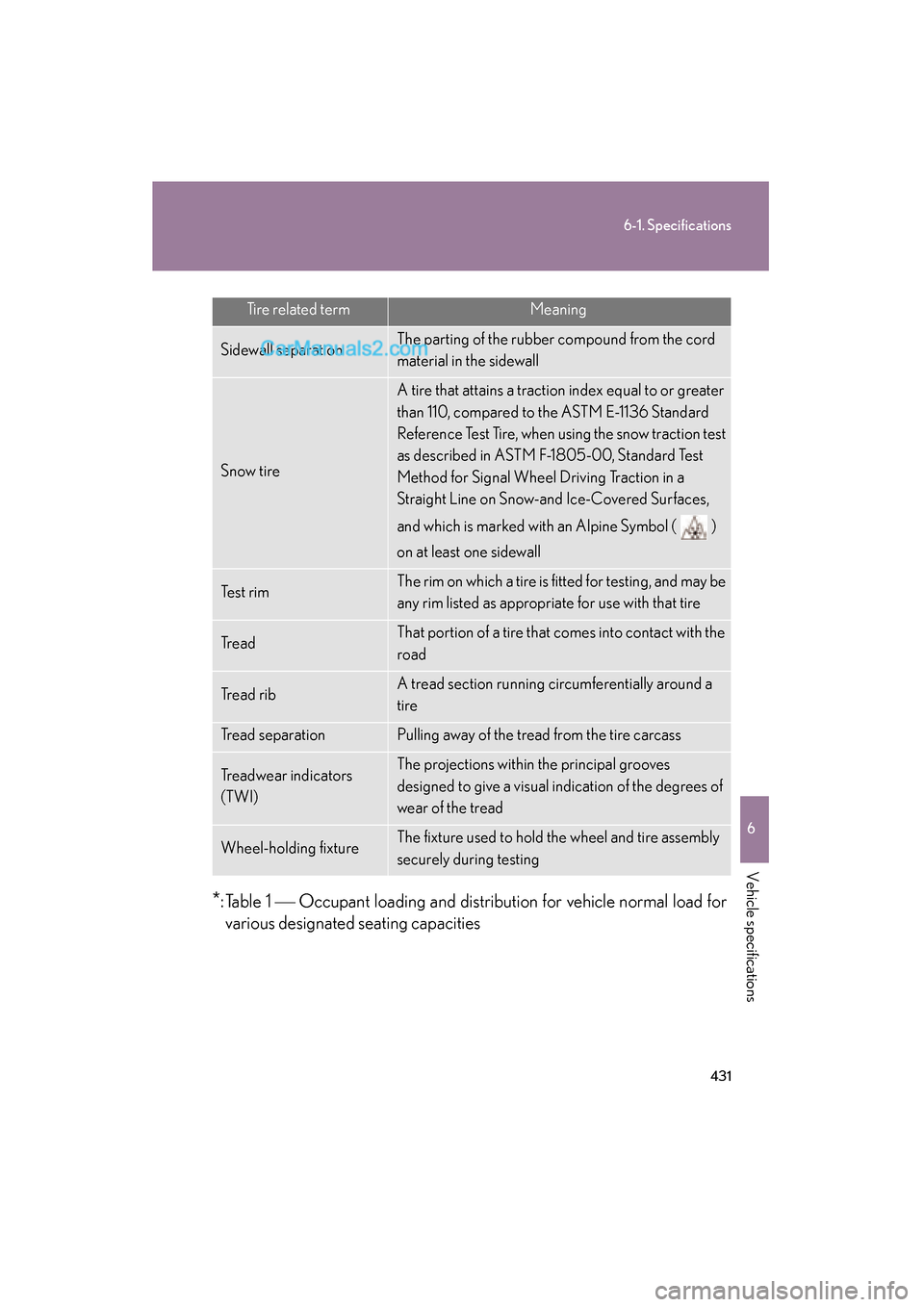
*: Ta b l e 1 Occupant loading and distribution for vehicle normal load forvarious designated seating capacities
Sidewall separationThe parting of the rubber compound from the cord
material in the sidewall
Snow tire
A tire that attains a traction index equal to or greater
than 110, compared to the ASTM E-1136 Standard
Reference Test Tire, when using the snow traction test
as described in ASTM F-1805-00, Standard Test
Method for Signal Wheel Driving Traction in a
Straight Line on Snow-and Ice-Covered Surfaces,
and which is marked with an Alpine Symbol (
)
on at least one sidewall
Te s t r i mThe rim on which a tire is fitted for testing, and may be
any rim listed as appropriate for use with that tire
Tr e a dThat portion of a tire that comes into contact with the
road
Tr e a d r i bA tread section running circumferentially around a
tire
Tread separationPulling away of the tread from the tire carcass
Treadwear indicators
(TWI)The projections within the principal grooves
designed to give a visual indication of the degrees of
wear of the tread
Wheel-holding fixtureThe fixture used to hold the wheel and tire assembly
securely during testing
Tire related termMeaning
Page 444 of 459
442
ES350_U_(L/O_0708)
Abbreviation list
Abbreviation/Acronym list
ABBREVIATIONSMEANING
A /CAir Conditioning
ABSAnti-Lock Brake System
AFSAdaptive Front lighting System
AI-SHIFTArtificial Intelligence Shift
ALRAutomatic Locking Retractor
CRSChild Restraint System
DISPDisplay
ECUElectronic Control Unit
EDREvent data recorder
ELREmergency Locking Retractor
G AW RGross Axle Weight Ratings
GVWRGross Vehicle Weight Rating
HIHigh
I/MEmission inspection and maintenance
INTIntermittent
LEDLight Emitting Diode
LOLow
MMTMethylcyclopentadienyl Manganese Tricarbonyl
MTBEMethyl Tertiary Butyl Ether
OBDOn Board Diagnostics
PCSPre-Collision System
SRSSupplemental Restraint System
TINTire Identification Number
TPMSTire Pressure Warning System
TRACTraction Control
