Page 102 of 459
100
1-7. Safety information
ES350_U_(L/O_0708)
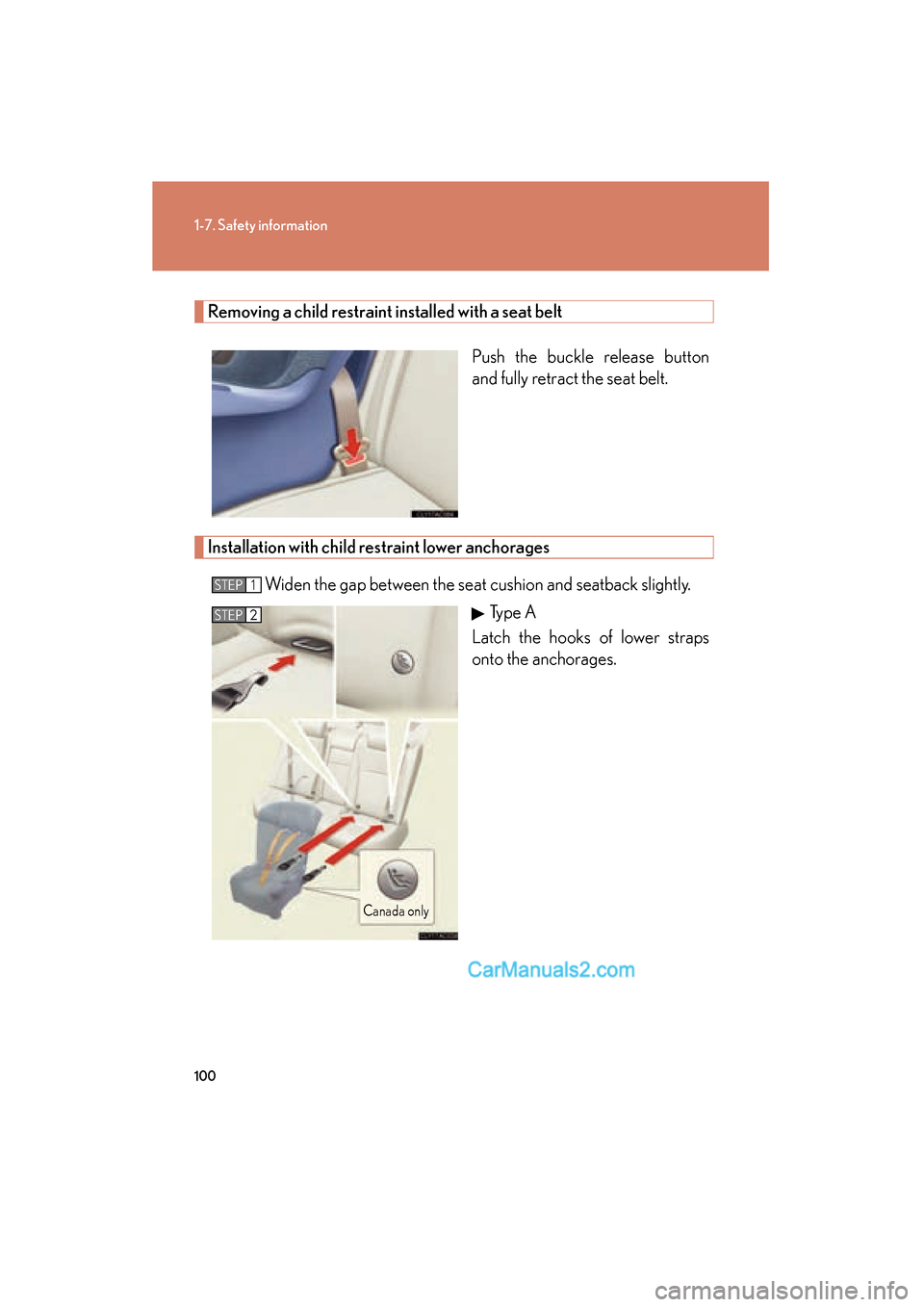
Removing a child restraint installed with a seat beltPush the buckle release button
and fully retract the seat belt.
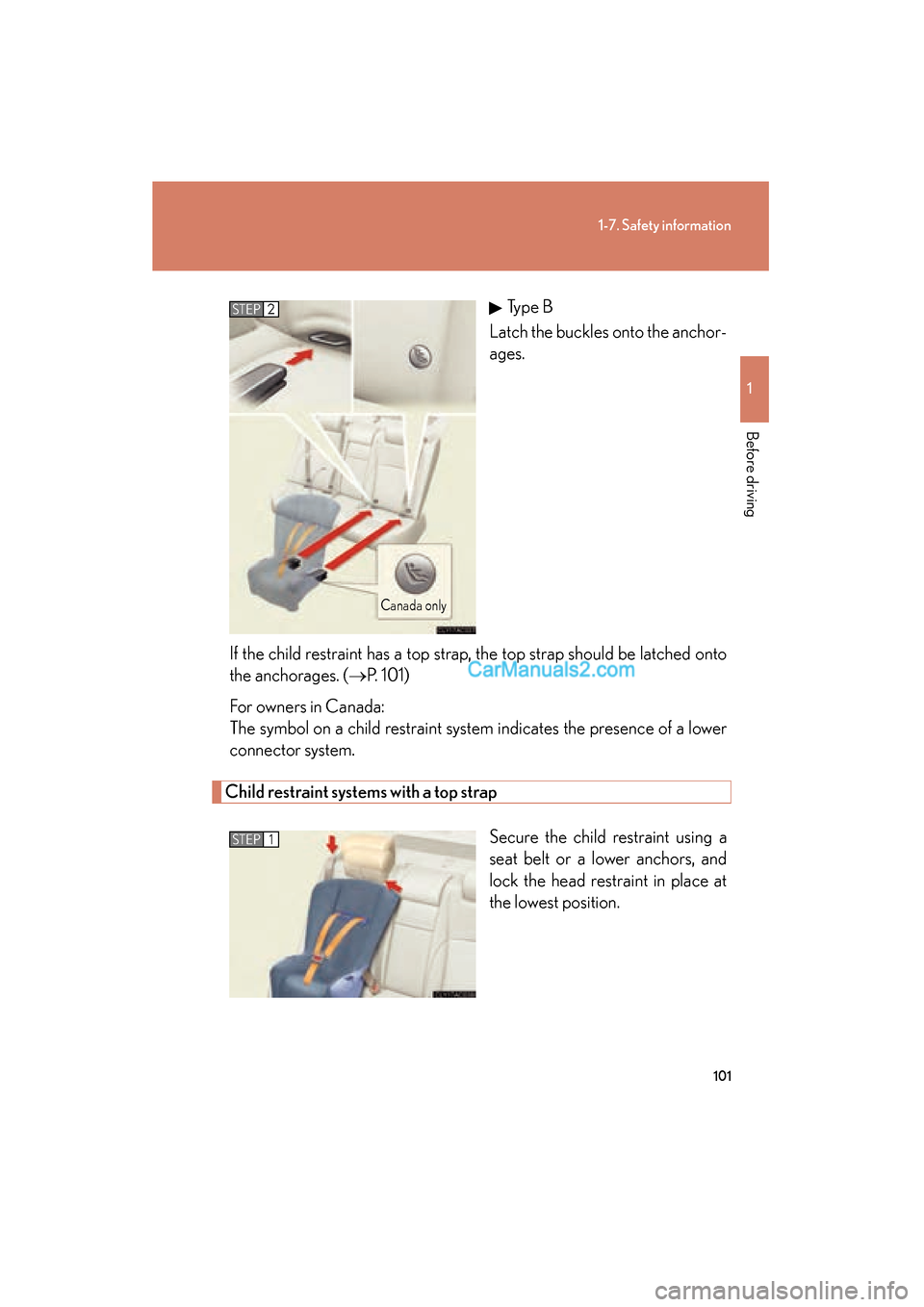
Installation with child restraint lower anchoragesWiden the gap between the seat cushion and seatback slightly. Type A
Latch the hooks of lower straps
onto the anchorages.
STEP1
STEP2
Canada only
Page 103 of 459
101
1-7. Safety information
1
Before driving
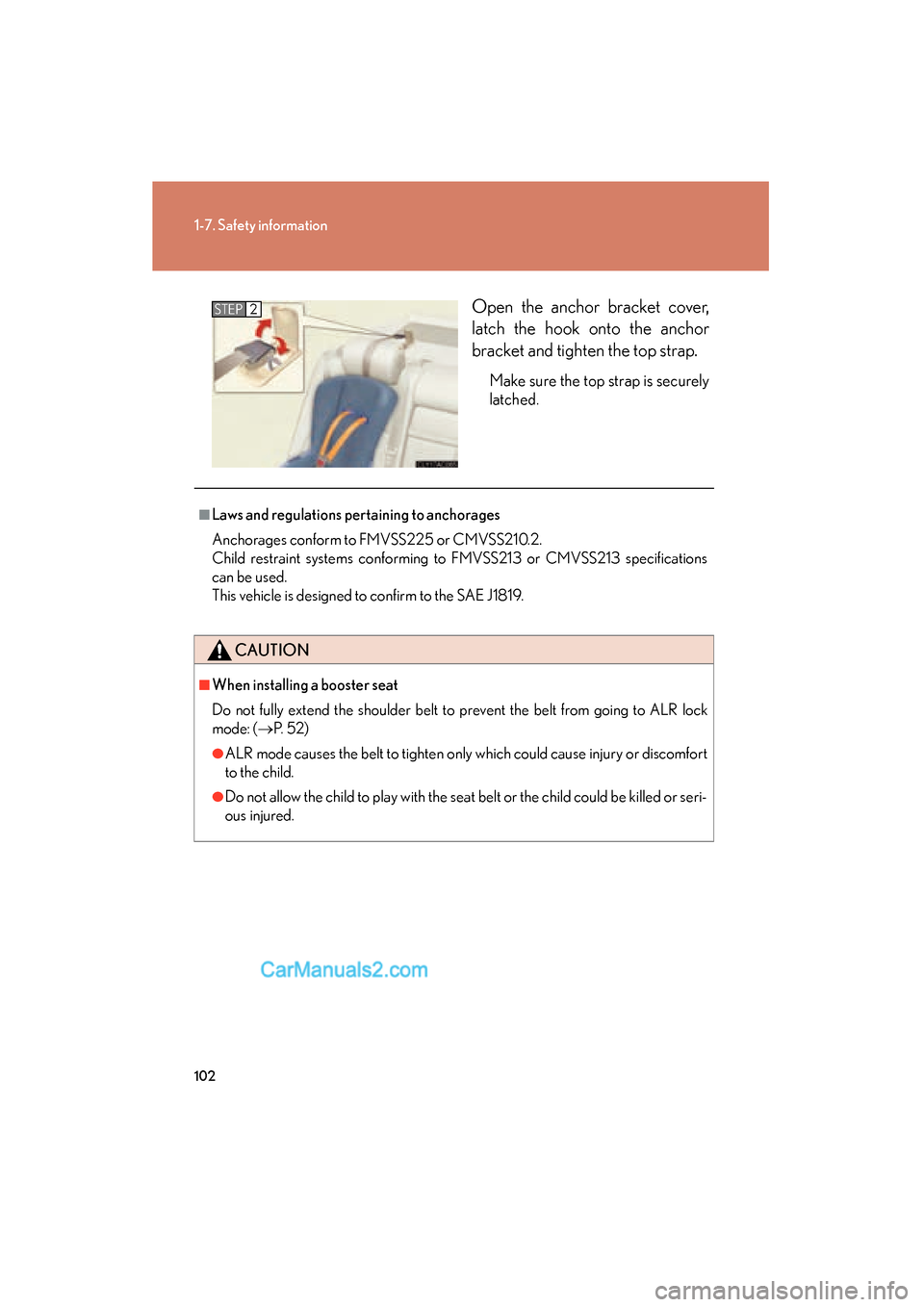
ES350_U_(L/O_0708)Type B
Latch the buckles onto the anchor-
ages.
If the child restraint has a top strap, the top strap should be latched onto
the anchorages. ( →P. 1 0 1 )
For owners in Canada:
The symbol on a child restraint system indicates the presence of a lower
connector system.
Child restraint systems with a top strap
Secure the child restraint using a
seat belt or a lower anchors, and
lock the head restraint in place at
the lowest position.
STEP2
Canada only
STEP1
Page 104 of 459
102
1-7. Safety information
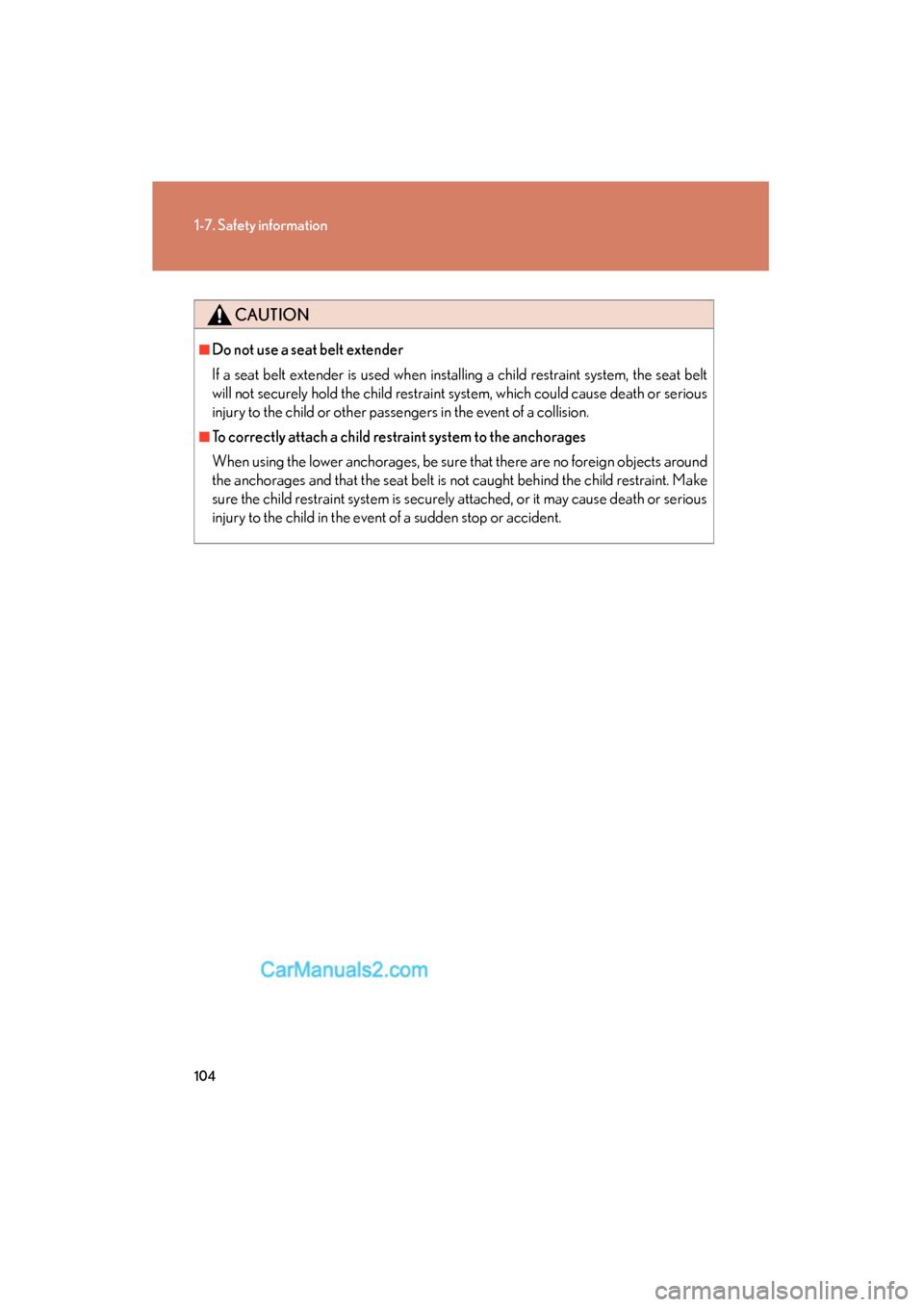
ES350_U_(L/O_0708)Open the anchor bracket cover,
latch the hook onto the anchor
bracket and tighten the top strap.
Make sure the top strap is securely
latched.
STEP2
■Laws and regulations pertaining to anchorages
Anchorages conform to FMVSS225 or CMVSS210.2.
Child restraint systems conforming to FMVSS213 or CMVSS213 specifications
can be used.
This vehicle is designed to confirm to the SAE J1819.
CAUTION
■When installing a booster seat
Do not fully extend the shoulder belt to prevent the belt from going to ALR lock
mode: (
→P. 5 2 )
●ALR mode causes the belt to tighten only which could cause injury or discomfort
to the child.
●Do not allow the child to play with the seat belt or the child could be killed or seri-
ous injured.
Page 105 of 459
103
1-7. Safety information
1
Before driving
ES350_U_(L/O_0708)
CAUTION
■When installing a child restraint system
Follow the directions given in the child restraint system installation manual and fix
the child restraint system securely in place.
If the child restraint system is not correctly fixed in place, the child may be injured or
even killed in the event of sudden braking or an accident.
●When a booster seat is installed, always ensure that the shoulder belt is posi-
tioned across the center of the child's shoulder. The belt should be kept away
from the child's neck, but not so that it could fall off the child's shoulder. Failing to
do so may result in death or serious injury in the event of an accident or sudden
braking.
●Ensure that the belt and tab are securely locked and the seat belt is not twisted.
●Push and pull the child seat in different directions to be sure it is secure.
●Follow all installation instructions provided by the child restraint system manufac-
t u r e r.
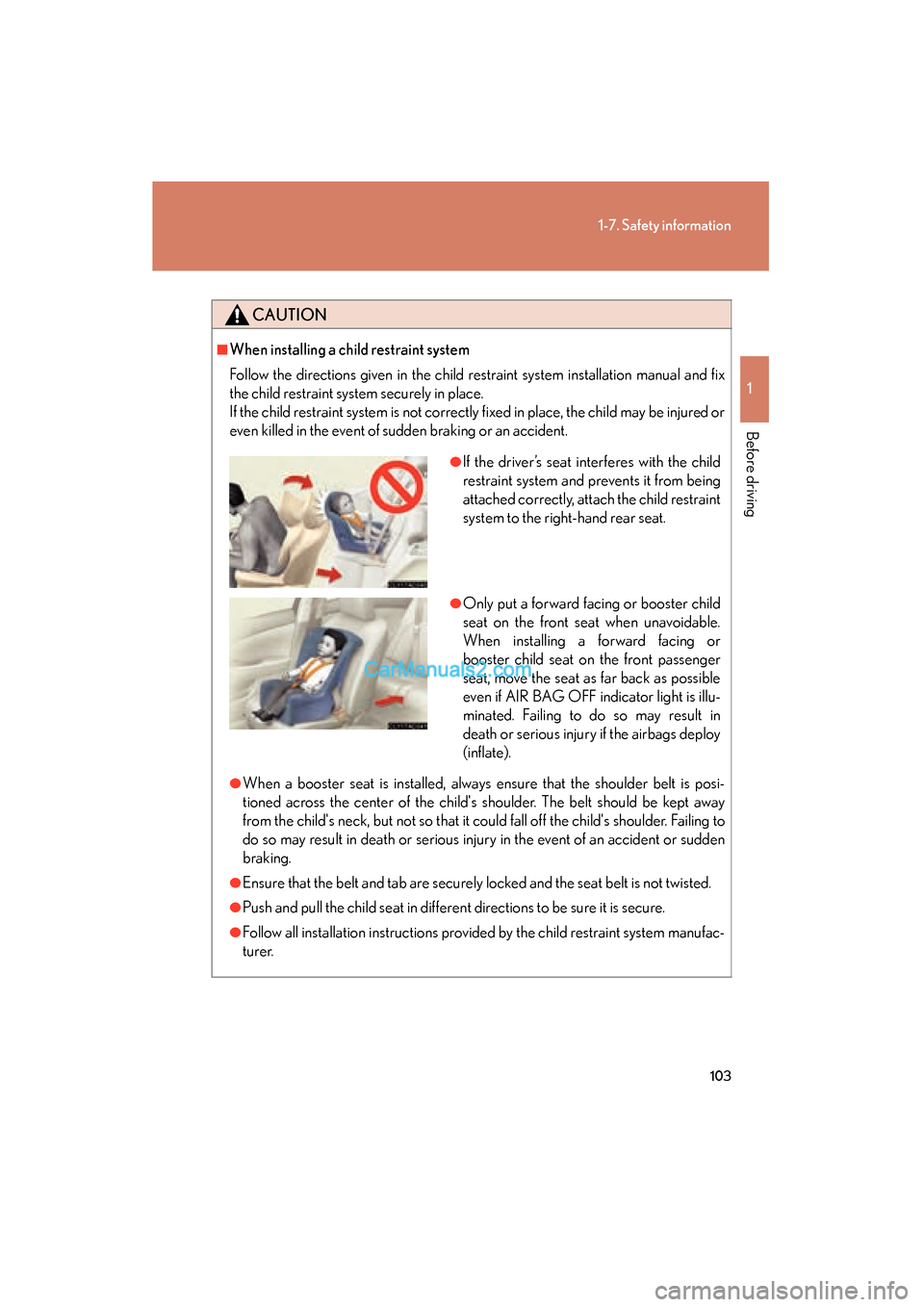
●If the driver’s seat interferes with the child
restraint system and prevents it from being
attached correctly, attach the child restraint
system to the right-hand rear seat.
●Only put a forward facing or booster child
seat on the front seat when unavoidable.
When installing a forward facing or
booster child seat on the front passenger
seat, move the seat as far back as possible
even if AIR BAG OFF indicator light is illu-
minated. Failing to do so may result in
death or serious injury if the airbags deploy
(inflate).
Page 106 of 459
104
1-7. Safety information
ES350_U_(L/O_0708)
CAUTION
■Do not use a seat belt extender
If a seat belt extender is used when installing a child restraint system, the seat belt
will not securely hold the child restraint system, which could cause death or serious
injury to the child or other passengers in the event of a collision.
■To correctly attach a child restraint system to the anchorages
When using the lower anchorages, be sure that there are no foreign objects around
the anchorages and that the seat belt is not caught behind the child restraint. Make
sure the child restraint system is securely attached, or it may cause death or serious
injury to the child in the event of a sudden stop or accident.
Page 162 of 459

160
2-4. Using other driving systems
ES350_U_(L/O_0708)
PCS (Pre-Collision System) (if equipped)
Radar sensorDetects vehicles or other obsta-
cles on or near the road ahead and
determines whether a collision is
imminent based on the position,
speed, and heading of the obsta-
cles. Grille cover
Radar sensor
Safety systems such as the brakes and seat belts are automatically
engaged to lessen impact and injuries to occupants as well as vehicle dam-
age when the radar sensor detects an unavoidable frontal collision.
■Pre-collision seat belts
The front seat belts are immediately retracted as the effect of the
pretensioner is increased ( →P. 51), to provide even greater constraining
force to protect the driver and passengers. In the event of sudden braking
or skidding, the system will operate even if no obstacle has been detected.
■ Pre-collision brake assist
Applies greater braking force in relation to how strongly the brake pedal is
depressed.
■Obstacles not detected
The sensor cannot detect plastic obstacles such as pylons. There may also be occa-
sions when the sensor cannot detect pedestrians, animals, bicycles, motorcycles,
trees, or snowdrifts.
Page 163 of 459

161
2-4. Using other driving systems
2
When driving
ES350_U_(L/O_0708)
■The pre-collision system is operational when
●Seat belt (linked to the radar sensor)
• Vehicle speed is above 3 mph (5 km/h).
• The speed at which your vehicle is approaching the obstacle or oncomingvehicle exceeds 18 to 24 mph (30 to 40 km/h).
• The front occupants are wearing a seat belt.
●Seat belts (linked to brake operation)
• Vehicle speed exceeds 9 mph (15 km/h).
• The system detects sudden braking or skidding.
• The front occupants are wearing a seat belt.
●Brake Assist
• Vehicle speed is above 18 mph (30 km/h).
• The speed at which your vehicle is approaching the obstacle or the vehicle is greater than 18 to 24 mph (30 to 40 km/h).
• The brake pedal is depressed.
■Conditions that may trigger the system even if there is no danger of collision
●When there is an object by the roadside at the entrance to a curve
●When passing an oncoming vehicle on a curve
●When driving over a narrow iron bridge
●When there is a metal object on the road surface
●When driving on an uneven road surface
●When passing an oncoming vehicle on a left-turn
●When your vehicle rapidly closes on the vehicle in front
When the system is activated in the situations described above there is also a possi-
bility that the seat belts will retract quickly and the brakes will be applied with a force
greater than normal. When the seat belt is locked in the retracted position, stop the
vehicle in a safe place, release the seat belt and refasten.
■When there is a malfunction in the system
Warning lights and/or warning messages will turn on or flash. ( →P. 362, 373)
Page 288 of 459

286
4-1. Maintenance and care
ES350_U_(L/O_0708)
■Cleaning the inside of the rear window
Do not use glass cleaner to clean the rear window, as this may cause damage to the
rear window defogger heater wires. Use a cloth dampened with lukewarm water to
gently wipe the window clean. Wipe the window in strokes running parallel to the
heater wires or antenna.
■Caring for leather areas
Lexus recommends cleaning the interior of the vehicle at least twice a year to main-
tain the quality of the vehicle’s interior.
■Shampooing the carpets
There are several commercial foaming-type cleaners available. Use a sponge or
brush to apply the foam. Rub in overlapping circles. Do not apply water. The excel-
lent results are obtained by keeping the carpet as dry as possible.
■Seat belts
Clean with mild soap and lukewarm water using a cloth or sponge. Also check the
belts periodically for excessive wear, fraying or cuts.
CAUTION
■Water in the vehicle
●Be careful not to splash or spill liquid on the floor.
●Do not get any of the SRS components or wiring in the vehicle interior wet.
(→ P. 7 7 )
Electrical malfunction may cause the airbags to deploy or not function properly,
resulting in death or severe injury.