Page 148 of 326

Driving your vehicle
18 4
• For speedometer test or inspection/
maintenance (I/M) program of full-time
4WD vehicle, use a four wheel chassis
dynamometer.• A 4WD vehicle should not be tested on
a 2WD drive roll tester. If a 2WD roll
tester must be used, perform the fol-
lowing:
1. Check the tire pressures recommend-
ed for your vehicle.
2. Place the rear wheels on the roll tester
for speedometer test as shown in the
illustration.
3. Release the parking brake.
4. Place the front wheels on the tempo-
rary free roller as shown in the illustra-
tion.
E5BLA401 Roll tester (speedometer)Temporary free roller
CAUTION
Never engage the parking brake
while performing these tests.
CAUTION
While the full-time 4WD vehicle is
being raised on a jack, never start
the engine or cause the tires to
rotate.
There is the danger that rotating
tires touching the ground could
cause the vehicle to go off the jack
and to jump forward.
If one of the front or rear wheels
begins to spin in mud,snow, etc.
the vehicle can sometimes be driv-
en out by depressing the accelera-
tor pedal further; however avoid
running the engine continuously at
high rpm because doing so could
damage the 4WD system.
WARNING
Keep away from the front of the
vehicle while inspecting. This is
very dangerous as the vehicle can
jump forward and cause serious
injury or death.
Page 161 of 326

431
Driving your vehicle
ESC operation off
ESC OFF state
• To cancel ESC operation,
press the ESC OFF button
(ESC OFF indicator light illu-
minates).
• If the ignition switch is turned
to LOCK position when ESC
is off, ESC remains off. Upon
restarting the engine, the
ESC will automatically turn
on again.
• During ESC operation, if the
transfer shift knob is turned
from 2WD mode (2HI) to
4WD mode (4HI or 4LO), the
ESC will automatically turn
off, and if it is turned from
4WD mode (4HI or 4LO) to
2WD mode (2HI), the ESC
will automatically turn on
again. (if part time 4WD is
equipped)
Indicator light
When ignition switch is turned to ON, the
indicator light illuminates, then goes off if
ESC system is operating normally.
The ESC indicator light blinks whenever
ESC is operating.
ESC OFF indicator light comes on when
either the ESC is turned off with the but-
ton, or ESC malfunctions when turned
on.
ESC
ESC
OFF
■ESC indicator light (blinks)
■ ESC OFF indicator light (comes on)WARNING- ESC
The Electronic Stability Control sys-
tem is only a driving aid; use pre-
cautions for safe driving by slowing
down on curved,snowy, or icy
roads. Don’t attempt to accelerate
excessively just because the ESC
indicator light is blinking.
ESC
OFF
Page 174 of 326

Driving your vehicle
44 4
Low washer fluid level
warning indicator
(If equipped)
This warning light indicates the washer
fluid reservoir is near empty. Refill the
washer fluid as soon as possible.
4WD system warning
(if equipped)
When the key is turned to the “ON” posi-
tion, the 4WD indicator light will come on
and then go off in a few seconds.
The 4WD indicator light will illuminate
when the transfer shift knob is set to 4HI
position (Part time 4WD only).
4WD LOW indicator light
(if equipped)
When the key is turned to the “ON” posi-
tion, the 4WD LOW indicator will come
on and then go off in a few seconds. The
4WD LOW indicator light comes on when
the transfer shift knob is set to 4WD LOW
position.
Part-time 4WD : 4LO position
Full-time 4WD : Low position
Safety belt warning chime
If the driver's safety belt is not fastened
when the ignition key is turned ON or if it
is unfastened after the key is ON, the
safety belt warning chime will sound for
approximately 6 seconds. At this time, if
the safety belt is fastened, the chime will
stop at once.
Door ajar warning chime
(if equipped)
If a door is opened while driving the vehi-
cle more than 3 mph (5 km/h), the warn-
ing chime will sound.
Key reminder warning chime
(if equipped)
If the driver’s door is opened while the
ignition key is left in the ignition switch,
the key reminder warning chime will
sound. This is to prevent you from locking
your keys in the vehicle.
CAUTION
If the 4WD indicator light ( )
blinks (full-time 4WD) or 4WD indi-
cator light ( ) and 4WD LOW indi-
cator light
()illuminate at the
same time (part time 4WD), this
indicates that there is a malfunction
in the 4WD system. If this occurs,
have your vehicle checked by an
Authorized Kia Dealer as soon as
possible.4WD
LOW
4WD
LOW
Page 219 of 326

511
Driving tips
USING FOUR-WHEEL DRIVE
Driving on snow- or ice-covered
roads ("4HI, 4LO" for part-time
4WD operation or "AUTO" for full-
time 4WD operation)
• Use snow tires. See “Tires” in this sec-
tion for more information.
• Keep an adequate distance between
yourself and other vehicles.
• Avoid sudden braking, acceleration or
steering. These actions can cause your
vehicle to lose traction.
Driving in sand or mud ("4HI,
4LO" for part-time 4WD operation
or "AUTO" for full-time 4WD oper-
ation)
• Avoid sudden braking, acceleration or
steering. These actions can cause your
vehicle to get stuck in the sand or mud.
• Drive at low speeds whenever possi-
ble.
• You may need to get out of your vehi-
cle at times to check road conditions.
• If you get stuck in the sand or mud, try
placing stones, wood or other similar
materials under the tires to get traction,
or move forward and backward repeat-
edly to get unstuck.
WARNING- Traction
Make sure that no one stands in
front of or behind the tires when
materials are placed under the tires
to get more traction. The tires may
cause loose materials to fly out
from under the vehicle, potentially
causing serious bodily injury or
death.
CAUTION
Prolonged rocking may cause
engine damage, overheating, trans-
mission differential or transfer case
damage or failure and tire damage.
Page 220 of 326

Driving tips
12 5
Driving on a hill ("4LO" for part-
time 4WD operation or "LOW" for
full-time 4WD operation)
• Use low gear when going uphill or
downhill and avoid sudden braking.
• Do not shift gears or use your clutch
when going downhill. Do not coast
downhill in Neutral.
Crossing a ditch ("4LO" for part-
time 4WD operation or "LOW" for
full-time 4WD operation)
• Avoid driving through ditches if possi-
ble, especially if there is water in the
ditch. Your vehicle may stall if the elec-
trical system gets wet. If you must
cross a ditch, select 4LO or LOW
mode.
• Avoid driving where the water level is
higher than the bottom of the wheel
hub. If the water level rises above this
mark, your vehicle will need to be serv-
iced.
• Tap lightly on the brake pedal during
and after driving through water. This
will help keep the brakes dry and in
proper working order.
• Do not shift gears while crossing a
ditch.
Tight corner brake effect
This is called tight corner brake effect.
Tight corner brake effect is a unique
characteristic of four-wheel drive vehicles
caused by the difference in tire rotation at
the four wheels and the zero-degree
alignment of the front wheels and sus-
pension.
Sharp turns at low speeds should be car-
ried out with caution.
WARNING -4WD
When turning sharply on a paved
road at low speed while in four-
wheel drive, steering control will be
difficult.
Page 239 of 326

531
Driving tips
TRAILER TOWING
To identify what the vehicle trailering
capacity is for your vehicle, you should
refer to the chart on this page.
WARNING- Towing a trail-
er
If you don't use the correct equip-
ment and drive properly, you can
lose control when you pull a trailer.
For example, if the trailer is too
heavy, the brakes may not work well
- or even at all. You and your pas-
sengers could be seriously or fatal-
ly injured. Pull a trailer only if you
have followed all the steps in this
section.
WARNING- Weight limits
Before towing, make sure the total
trailer weight, gross combination
weight, gross vehicle weight, gross
axle weight and trailer tongue load
are all within the limits.
Item
4WD*12WD*24WD*12WD*2
Maximum 3,665 kg 3,572 kg 4,339 kg 4,255 kg
GCWR (8,079 lbs) (7,874 lbs) (9,565 lbs) (9,314 lbs)
Maximum
Trailer Weight
3.3 Engine
1,590 kg (3,500 lbs)
*1: Four Wheel Drive
*2: Two Wheel Drive
2,268 kg (5,000 lbs)3.8 Engine
✽
NOTICE
• For definitions of terms used in this table and instructions on how to calculate
your vehicle load, refer to Weight of the Vehicle in this chapter.
• The combined weight of the completed towing vehicle and the loaded trailer must
not exceed the GCWR.
• When towing maximum loads under high outside temperatures and/or on steep
grades, the A/C system may cycle on and off to protect the engine from overheat-
ing. This may result in a temporary increase of interior temperature.
CAUTION
Pulling a trailer improperly can
damage your vehicle and result in
costly repairs not covered by your
warranty. To pull a trailer correctly,
follow the advice in this section.
Page 262 of 326
In case of an emergency
14 6
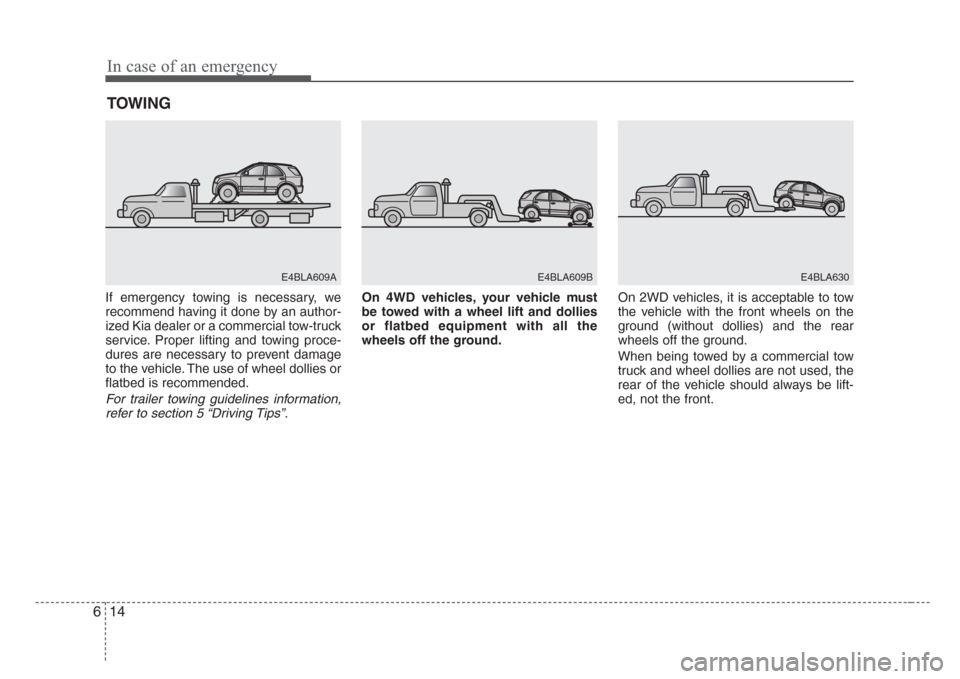
TOWING
If emergency towing is necessary, we
recommend having it done by an author-
ized Kia dealer or a commercial tow-truck
service. Proper lifting and towing proce-
dures are necessary to prevent damage
to the vehicle. The use of wheel dollies or
flatbed is recommended.
For trailer towing guidelines information,
refer to section 5 “Driving Tips”.
On 4WD vehicles, your vehicle must
be towed with a wheel lift and dollies
or flatbed equipment with all the
wheels off the ground.On 2WD vehicles, it is acceptable to tow
the vehicle with the front wheels on the
ground (without dollies) and the rear
wheels off the ground.
When being towed by a commercial tow
truck and wheel dollies are not used, the
rear of the vehicle should always be lift-
ed, not the front.
E4BLA609AE4BLA609BE4BLA630
Page 263 of 326
615
In case of an emergency
When towing your vehicle in an emer-
gency without wheel dollies (2WD
Vehicles or Part-time 4WD Vehicles):
1. Set the ignition switch in the ACC posi-
tion.
2. Place the transmission shift lever in N
(Neutral).
3. Place the transfer shift knob for part-
time 4WD operation in the 2HI posi-
tion.
4. Release the parking brake.
Towing with a vehicle other than
a tow truck
If towing is necessary, we recommend
you to have it done by an Authorized Kia
dealer or a commercial tow truck service.
E4BLA610
CAUTION
• Do not tow the vehicle forwards
with the rear wheels on the
ground as this may cause dam-
age to the vehicle.
• Do not tow with sling-type equip-
ment. Use wheel lift or flatbed
equipment.
CAUTION
Failure to place the transmission
shift lever in N (Neutral) and the
transfer shift knob for part-time
4WD operation to 2HI may cause
internal damage to the transmis-
sion.
6BLA611