Page 288 of 326

Maintenance
14 7
BRAKE FLUID (IF EQUIPPED)
Checking brake fluid level
Check the fluid level in the reservoir peri-
odically. The fluid level should be between
MAX and MIN marks on the side of the
reservoir.
Before removing the reservoir cap and
adding brake fluid, clean the area around
the reservoir cap thoroughly to prevent
brake fluid contamination.
If the level is low, add fluid to the MAX
level. The level will fall with accumulated
mileage. This is a normal condition asso-
ciated with the wear of the brake linings. If
the fluid level is excessively low, have the
brake system checked by an Authorized
Kia Dealer.
Use only the specified brake fluid. (Refer
to “Recommended Lubricants” later in
this section.)
Never mix different types of fluid.
WARNING - Brake fluid
When changing and adding brake
fluid, handle it carefully. Do not let it
come in contact with your eyes.If
brake fluid should come in contact
with your eyes, immediately flush
them with a large quantity of fresh
tap water. Have your eyes examined
by a doctor as soon as possible.
WARNING - Loss of brake
fluid
In the event the brake system
requires frequent additions of fluid,
the vehicle should be inspected by
an Authorized Kia Dealer.
OBL056008N
CAUTION
Do not allow brake fluid to contact
the vehicle's body paint, as paint
damage will result. Brake fluid,
which has been exposed to open air
for an extended time should never
be used as its quality cannot be
guaranteed. It should be thrown
out. Don't put in the wrong kind of
fluid. A few drops of mineral-based
oil,such as engine oil, in your brake
system can damage brake system
parts.
Page 289 of 326

715
Maintenance
POWER STEERING
Checking the power steering fluid
level
With the vehicle on level ground, check
the fluid level in the power steering reser-
voir periodically. The fluid should be
between MAX and MIN marks on the
side of the reservoir at the normal tem-
perature.
Before adding power steering fluid, thor-
oughly clean the area around the reser-
voir cap to prevent power steering fluid
contamination.
If the level is low, add fluid to the MAX
level.In the event the power steering system
requires frequent addition of fluid, the
vehicle should be inspected by an
Authorized Kia Dealer.
Use only the specified power steering
fluid. (Refer to "Recommended
Lubricants" later in this section.)
Power steering hose
Check the connections for oil leaks,
severe damage and the twists in the
power steering hose before driving.
OBL056007
CAUTION
• To avoid damage to the power
steering pump, do not operate the
vehicle for prolonged periods
with a low power steering fluid
level.
• Never start the engine when the
reservoir tank is empty.
• When adding fluid, be careful that
dirt does not get into the tank.
• Too little fluid can make the steer-
ing wheel heavier or strange
noise can be generated.
• The use of the non-specified fluid
could reduce the effectiveness of
the power steering wheel and
cause damage to it.
Page 290 of 326

Maintenance
16 7
AUTOMATIC TRANSMISSION (IF EQUIPPED)
Checking the automatic transmis-
sion fluid level
The automatic transmission fluid
level should be checked regularly.
Keep the vehicle on the level ground with
the parking brake applied and check the
fluid level according to the following pro-
cedure.
1. Place the selector lever in N (Neutral)
position and confirm the engine is run-
ning at idle speed.2. After the transmission is warmed up
sufficiently (fluid temperature 70~80°C
(158~176°F), for example by 10 min-
utes usual driving, shift the selector
lever through all positions then place
the selector lever in “N (Neutral) or P
(Park)” position.
3. Confirm that the fluid level is in “HOT”
range on the level gauge. If the fluid
level is lower, add the specified fluid
from the fill hole. If the fluid level is
higher, drain the fluid from the drain
hole.
4. If the fluid level is checked in cold con-
dition (fluid temperature 20~30°C
(68~86°F) add the fluid to “COLD” line
and then recheck the fluid level
according to the above step 2.
OBL056002
Automatic transmission fluid dipstick
25 C 75 C
E2BLA712A LowHOT
COLDFull
Low
Cold fluid scaleHot fluid scale
Full
Page 291 of 326

717
Maintenance
✽
NOTICE
“COLD” scale is for reference only and
should NOT be used to determine trans-
mission fluid level.
✽
NOTICE
New automatic transmission fluid
should be red. The red dye is added so
the assembly plant can identify it as
automatic transmission fluid and distin-
guish it from engine oil or antifreeze.
The red dye, which is not an indicator of
fluid quality, is not permanent. As the
vehicle is driven, the automatic trans-
mission fluid will begin to look darker.
The color may eventually appear light
brown. Therefore, have an Authorized
Kia dealer change the automatic trans-
mission fluid according to the Scheduled
Maintenance at the beginning of this
section.CAUTION
• Low fluid level causes transmis-
sion slippage. Overfilling can
cause foaming, loss of fluid and
transmission malfunction.
• The use of a non-specified fluid
could result in transmission mal-
function and failure.
WARNING- Parking brake
To avoid sudden movement of the
vehicle, apply parking brake and
depress the brake pedal before
moving the shift lever.
WARNING - Transmission
fluid
The transmission fluid level should
be checked when the engine is at
normal operating temperature. This
means that the engine, radiator,
radiator hose and exhaust system
etc., are very hot. Exercise great
care not to burn yourself during this
procedure.
Page 292 of 326
Maintenance
18 7
LUBRICANTS AND FLUIDS
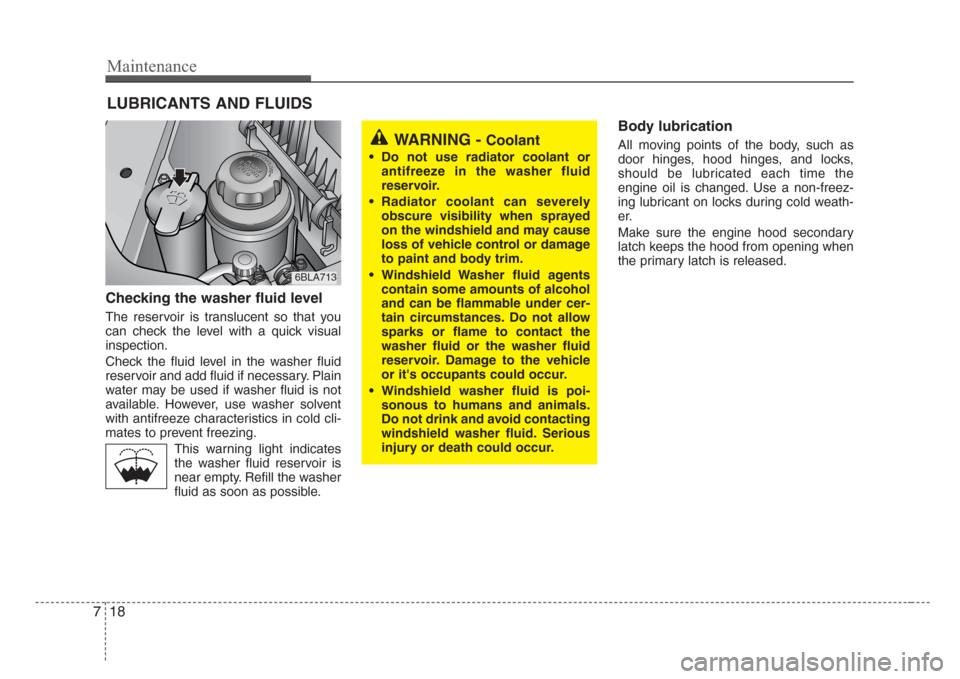
Checking the washer fluid level
The reservoir is translucent so that you
can check the level with a quick visual
inspection.
Check the fluid level in the washer fluid
reservoir and add fluid if necessary. Plain
water may be used if washer fluid is not
available. However, use washer solvent
with antifreeze characteristics in cold cli-
mates to prevent freezing.
This warning light indicates
the washer fluid reservoir is
near empty. Refill the washer
fluid as soon as possible.
Body lubrication
All moving points of the body, such as
door hinges, hood hinges, and locks,
should be lubricated each time the
engine oil is changed. Use a non-freez-
ing lubricant on locks during cold weath-
er.
Make sure the engine hood secondary
latch keeps the hood from opening when
the primary latch is released.WARNING - Coolant
• Do not use radiator coolant or
antifreeze in the washer fluid
reservoir.
• Radiator coolant can severely
obscure visibility when sprayed
on the windshield and may cause
loss of vehicle control or damage
to paint and body trim.
•Windshield Washer fluid agents
contain some amounts of alcohol
and can be flammable under cer-
tain circumstances. Do not allow
sparks or flame to contact the
washer fluid or the washer fluid
reservoir. Damage to the vehicle
or it's occupants could occur.
•Windshield washer fluid is poi-
sonous to humans and animals.
Do not drink and avoid contacting
windshield washer fluid. Serious
injury or death could occur.
6BLA713
Page 293 of 326
719
Maintenance
AIR CLEANER
Element replacement
Have the air cleaner element checked
and replaced in accordance with the
maintenance schedule.
✽
NOTICE
Do not drive with the air cleaner
removed; this will result in excessive
engine wear.
OBL076006N
CAUTION- Engine
Driving without an air cleaner
encourages backfiring, which could
cause a fire in the engine compart-
ment.
Page 297 of 326

723
Maintenance
For best battery service :
• Keep the battery securely mounted.
• Keep the battery top clean and dry.
• Keep the terminals and connections
clean, tight, and coated with petroleum
jelly or terminal grease.
• Rinse any spilled electrolyte from the
battery immediately with a solution of
water and baking soda.
• If the vehicle is not going to be used for
an extended time, disconnect the bat-
tery cables.
(Continued)
If any electrolyte gets into
your eyes, flush your eyes
with clean water for at least
15 minutes and get immedi-
ate medical attention. If
possible, continue to apply
water with a sponge or
cloth until medical attention
is received.
If electrolyte gets on your
skin, thoroughly wash the
contacted area. If you feel a
pain or a burning sensation,
get medical attention imme-
diately.
Wear eye protection when
charging or working near a
battery. Always provide
ventilation when working in
an enclosed space.
(Continued)(Continued)
• When lifting a plastic-cased bat-
tery, excessive pressure on the
case may cause battery acid to
leak, resulting in personal injury.
Lift with a battery carrier or with
your hands on opposite corners.
• Never attempt to recharge the
battery when the battery cables
are connected.
• The electrical ignition system
works with high voltage. Never
touch these components with the
engine running or the ignition
switched on.
Failure to follow the above warn-
ings can result in serious bodily
injury or death.
E2BLA721
Page 298 of 326

Maintenance
24 7
Battery recharging
Your vehicle has a maintenance-free,
calcium-based battery.
• If the battery becomes discharged in a
short time (because, for example, the
headlights or interior lights were left on
while the vehicle was not in use),
recharge it by slow charging (trickle)
for 10 hours.
• If the battery gradually discharges
because of high electric load while the
vehicle is being used, recharge it at 20-
30A for two hours.
Items to be reset after the battery has
been discharged or the battery has
been disconnected.
• Clock (See Chapter 3)
• Trip computer (See Chapter 4)
• Compass (See Chapter 4)
• Climate control system (See Chapter 4)
• Audio (See Chapter 3)
WARNING- Recharging
battery
When recharging the battery,
observe the following precautions:
• The battery must be removed
from the vehicle and placed in an
area with good ventilation.
• Do not allow cigarettes,sparks,or
flame near the battery.
• Watch the battery during charg-
ing, and stop or reduce the charg-
ing rate if the battery cells begin
gassing (boiling) violently or if
the temperature of the electrolyte
of any cell exceeds 49°C (120°F).
• Wear eye protection when check-
ing the battery during charging.
•Disconnect the battery charger in
the following order.
1. Turn off the battery charger main
switch.
2. Unhook the negative clamp from
the negative battery terminal.
3. Unhook the positive clamp from
the positive battery terminal.
CAUTION
• Before performing maintenance
or recharging the battery, turn off
all accessories and stop the
engine.
• The negative battery cable must
be removed first and installed last
when the battery is disconnected.
