Page 30 of 438
3. All doors are closed.
4. The throttle is pressed.
5. The vehicle speed is above 15 mph (24 km/h).
6. The doors were not previously locked using the power
door lock switch or Remote Keyless Entry (RKE) trans-
mitter.
The Automatic Door Lock feature can be enabled or
disabled. Refer to “Personal Settings” under “Electronic
Vehicle Information Center (EVIC) — (if equipped)” in
Section 4.
For vehicles not equipped with the EVIC, the Automatic
Door Locks can be enabled or disabled by performing the
following procedure:
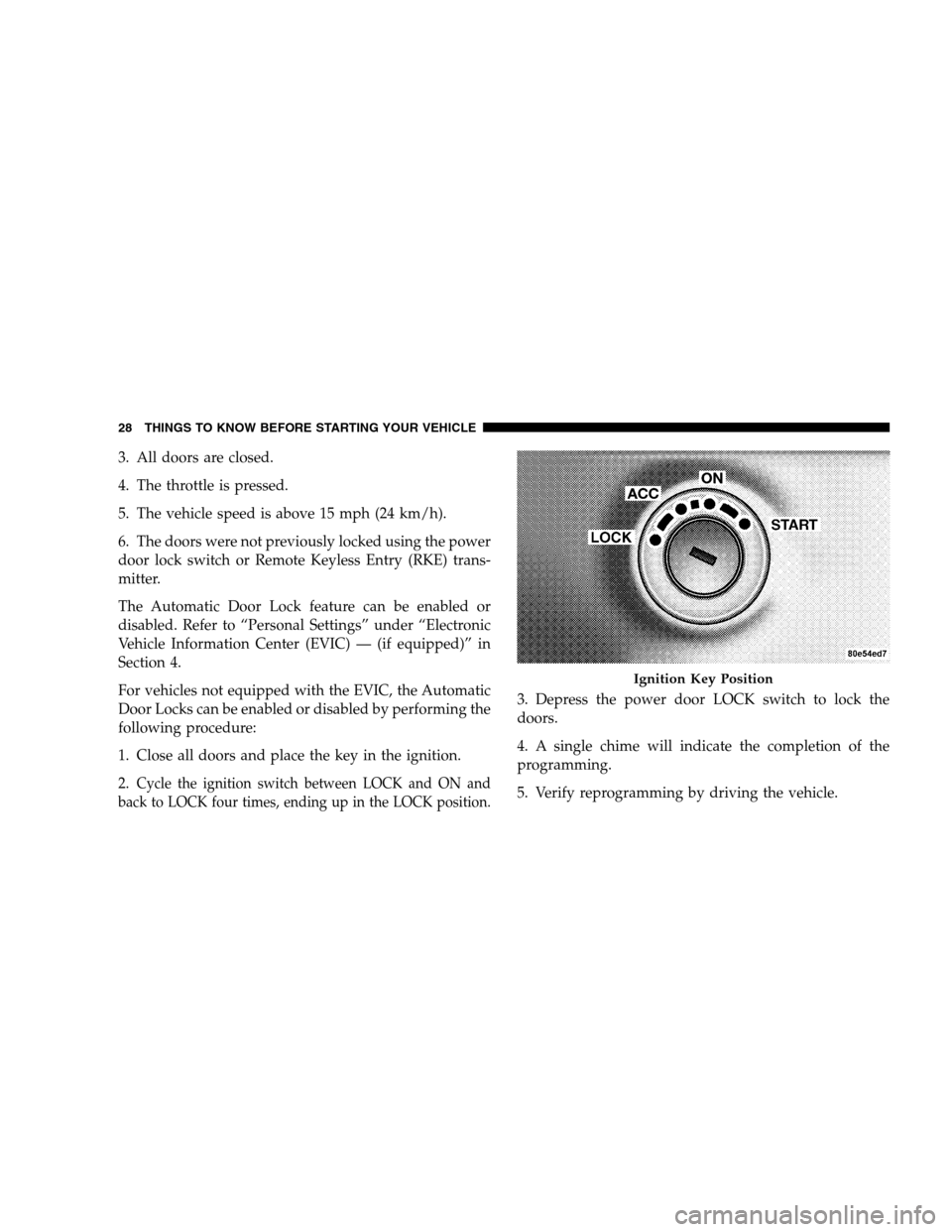
1. Close all doors and place the key in the ignition.
2.
Cycle the ignition switch between LOCK and ON and
back to LOCK four times, ending up in the LOCK position.
3. Depress the power door LOCK switch to lock the
doors.
4. A single chime will indicate the completion of the
programming.
5. Verify reprogramming by driving the vehicle.
Ignition Key Position
28 THINGS TO KNOW BEFORE STARTING YOUR VEHICLE
Page 31 of 438
Auto Unlock
The doors will unlock automatically on vehicles with
power door locks if:
1. The Auto Unlock feature is enabled.
2. The transmission was in gear and the vehicle speed
returned to 0 mph (0 km/h).
3. The transmission is in NEUTRAL or PARK.
4. The drivers door is opened.
5. The doors were not previously unlocked.
The Auto Unlock feature can be enabled or disabled.
Refer to “Personal Settings” under “Electronic Vehicle
Information Center (EVIC) — (if equipped)” in Section 4.
For vehicles not equipped with the EVIC, the Auto
Unlock Feature can be enabled or disabled by performing
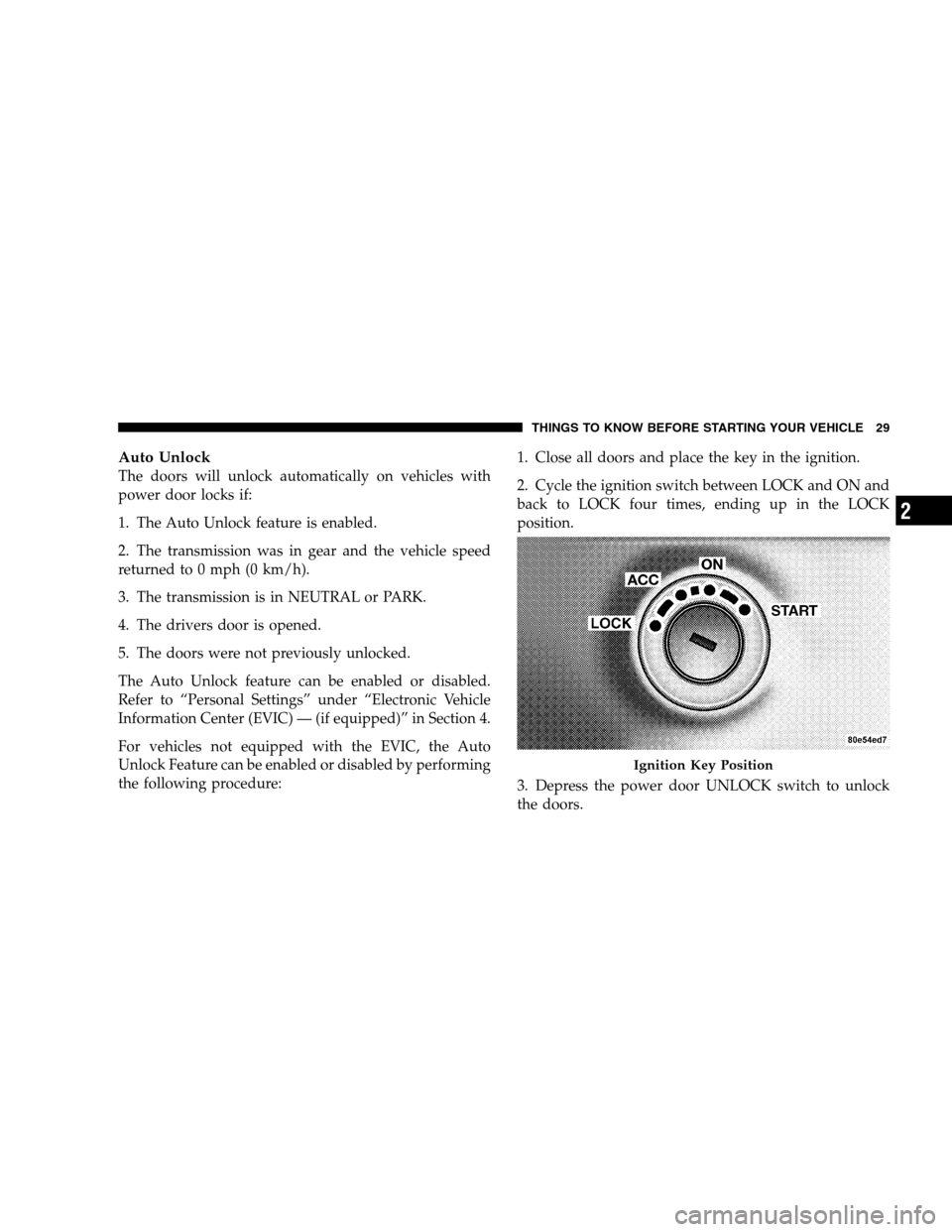
the following procedure:1. Close all doors and place the key in the ignition.
2. Cycle the ignition switch between LOCK and ON and
back to LOCK four times, ending up in the LOCK
position.
3. Depress the power door UNLOCK switch to unlock
the doors.
Ignition Key Position
THINGS TO KNOW BEFORE STARTING YOUR VEHICLE 29
2
Page 32 of 438
4. A single chime will indicate the completion of the
programming.
NOTE:Use the Auto Door Locks and Auto Unlock
features in accordance with local laws.
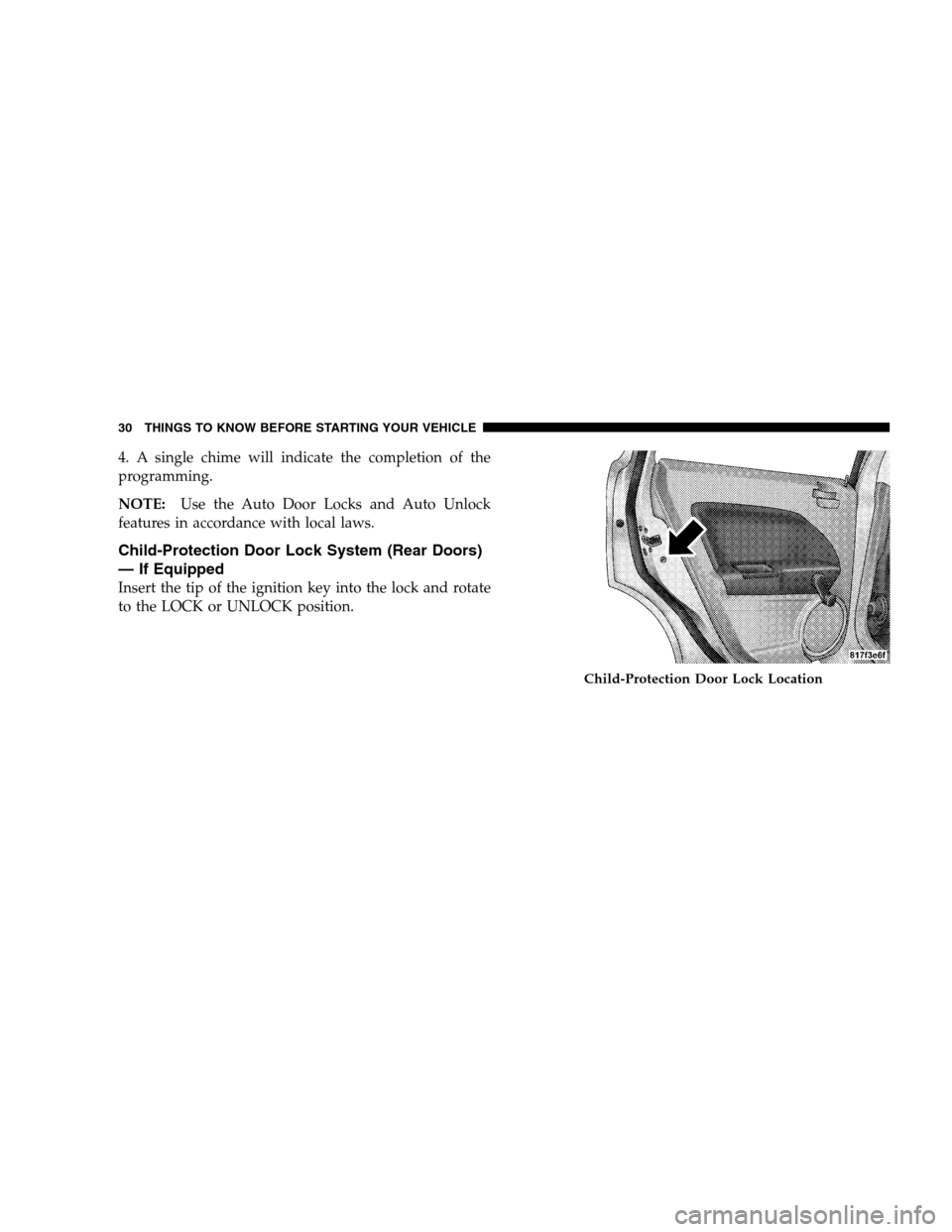
Child-Protection Door Lock System (Rear Doors)
— If Equipped
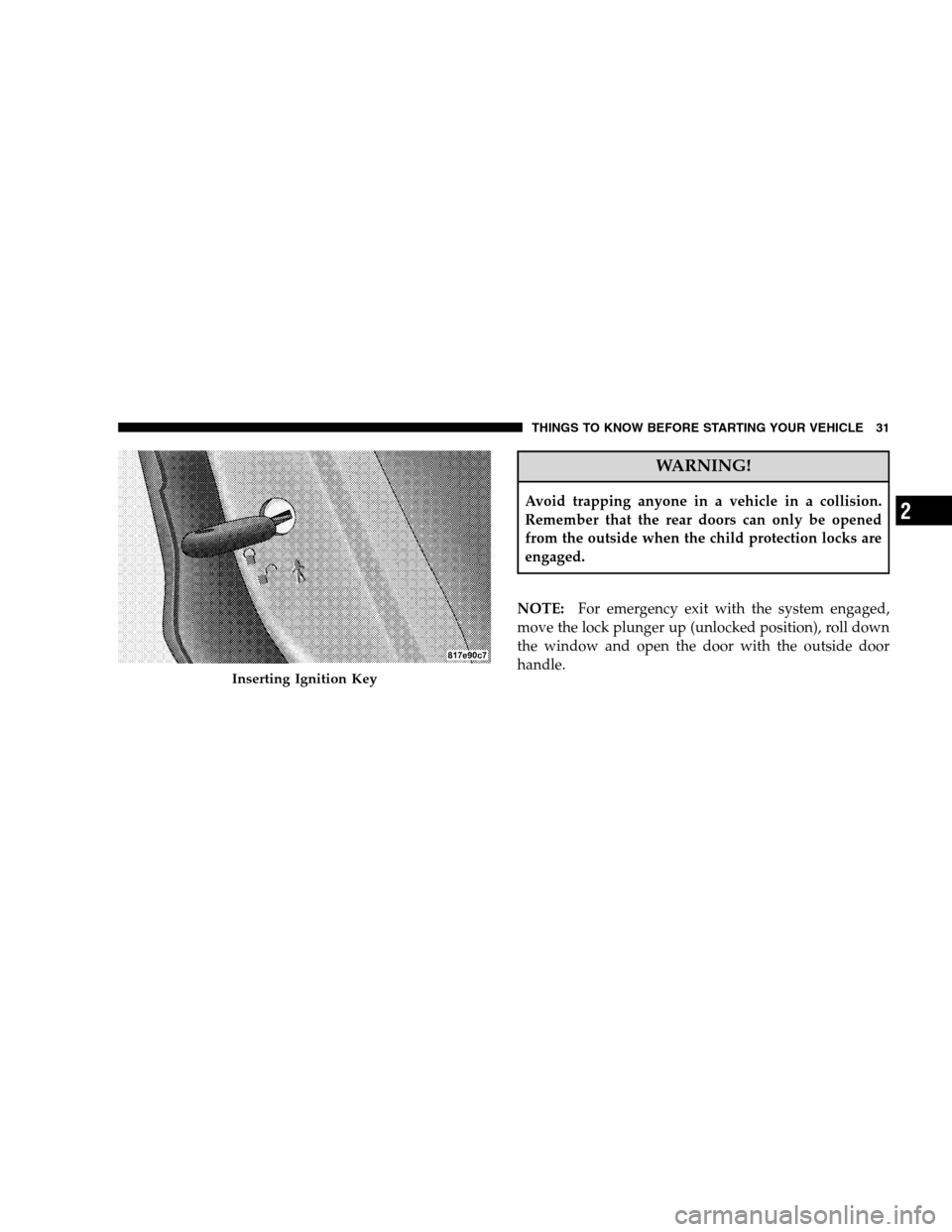
Insert the tip of the ignition key into the lock and rotate
to the LOCK or UNLOCK position.
Child-Protection Door Lock Location
30 THINGS TO KNOW BEFORE STARTING YOUR VEHICLE
Page 33 of 438
WARNING!
Avoid trapping anyone in a vehicle in a collision.
Remember that the rear doors can only be opened
from the outside when the child protection locks are
engaged.
NOTE:For emergency exit with the system engaged,
move the lock plunger up (unlocked position), roll down
the window and open the door with the outside door
handle.
Inserting Ignition Key
THINGS TO KNOW BEFORE STARTING YOUR VEHICLE 31
2
Page 35 of 438
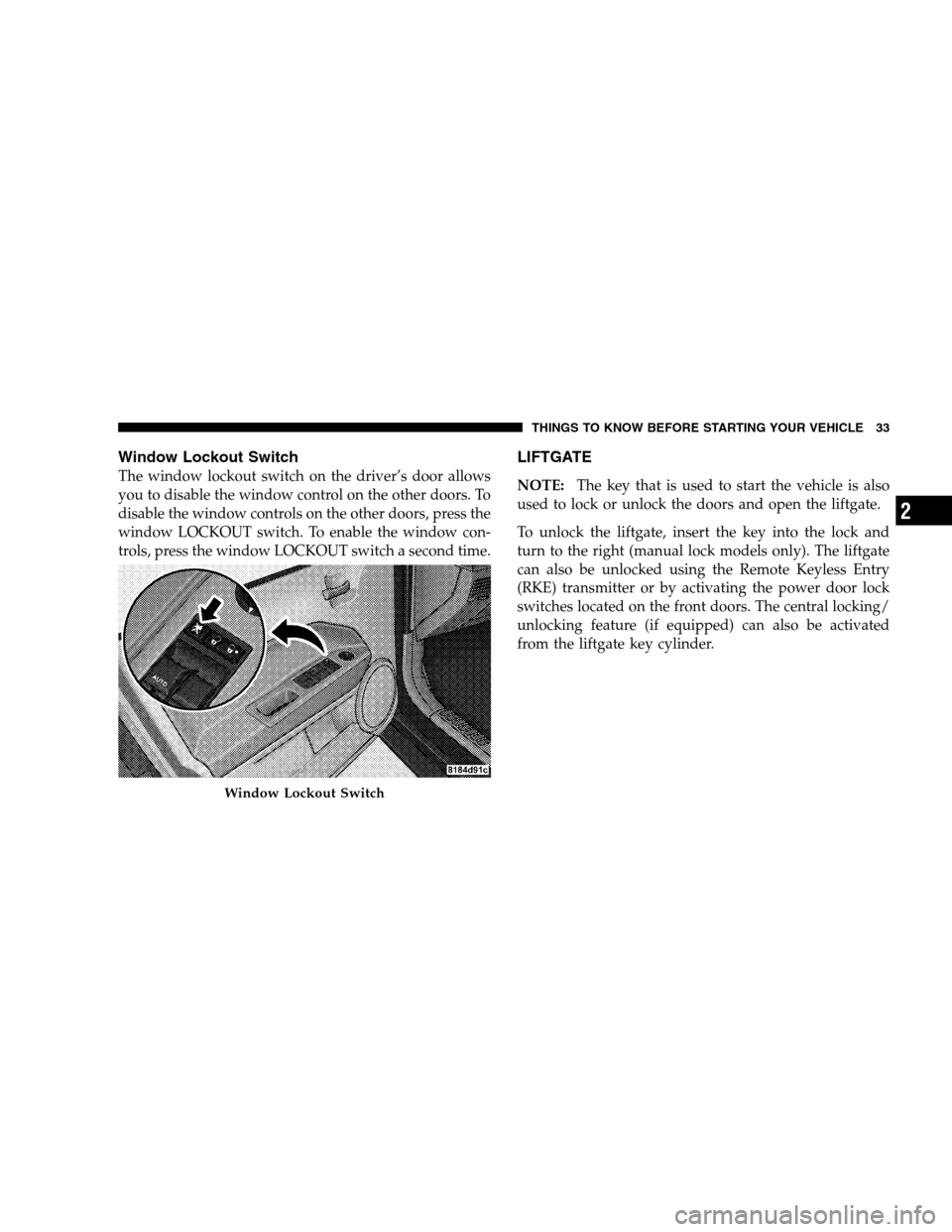
Window Lockout Switch
The window lockout switch on the driver’s door allows
you to disable the window control on the other doors. To
disable the window controls on the other doors, press the
window LOCKOUT switch. To enable the window con-
trols, press the window LOCKOUT switch a second time.
LIFTGATE
NOTE:The key that is used to start the vehicle is also
used to lock or unlock the doors and open the liftgate.
To unlock the liftgate, insert the key into the lock and
turn to the right (manual lock models only). The liftgate
can also be unlocked using the Remote Keyless Entry
(RKE) transmitter or by activating the power door lock
switches located on the front doors. The central locking/
unlocking feature (if equipped) can also be activated
from the liftgate key cylinder.
Window Lockout Switch
THINGS TO KNOW BEFORE STARTING YOUR VEHICLE 33
2
Page 36 of 438
Once unlocked, the liftgate can be opened or closed
without using the key. To open the liftgate, squeeze the
liftgate release and pull the liftgate open with one fluid
motion.NOTE:In the event of a power malfunction, or the RKE
transmitter is inoperative, insert the key into the liftgate
lock cylinder and turn to the right (manual lock models
only). Using the liftgate handle, pull the liftgate open
with one fluid motion.
Although the liftgate has no inside release mechanism,
the liftgate trim panel includes an opening with a snap-in
cap that provides access to release the latch in the event
of an electrical system malfunction.
Opening The Liftgate
34 THINGS TO KNOW BEFORE STARTING YOUR VEHICLE
Page 38 of 438
WARNING!
In a collision, you and your passengers can suffer
much greater injuries if you are not properly buckled
up. You can strike the interior of your vehicle or other
passengers, or you can be thrown out of the vehicle.
Always be sure you and others in your vehicle are
buckled up properly.
Buckle up even though you are an excellent driver, even
on short trips. Someone on the road may be a poor driver
and cause a collision that includes you. This can happen
far away from home or on your own street.
Research has shown that seat belts save lives, and they
can reduce the seriousness of injuries in a collision. Some
of the worst injuries happen when people are thrown
from the vehicle. Seat belts reduce the possibility ofejection and the risk of injury caused by striking the
inside of the vehicle.Everyonein a motor vehicle should
be belted at all times.
Lap/Shoulder Belts
All the seats in your vehicle are equipped with Lap/
Shoulder Belts.
The belt webbing retractor is designed to lock during
very sudden stops or collisions. This feature allows the
shoulder part of the belt to move freely with you under
normal conditions. But in a collision, the belt will lock
and reduce the risk of you striking the inside of the
vehicle or being thrown out.
36 THINGS TO KNOW BEFORE STARTING YOUR VEHICLE
Page 44 of 438
As a guide, if you are shorter than average you will
prefer a lower position, and if you are taller than average
you’ll prefer a higher position. When you release the
anchorage, try to move it up or down to make sure that
it is locked in position.
Second Row Center Lap/Shoulder Belt Operating
Instructions
The second row center lap/shoulder belt features a
three-point seat belt with a mini-latch and buckle, which
allows the shoulder belt to detach from the lower anchor
when the seat is folded. The mini-buckle and shoulder
belt can then be stored out of the way in the right side
trim panel for added convenience.
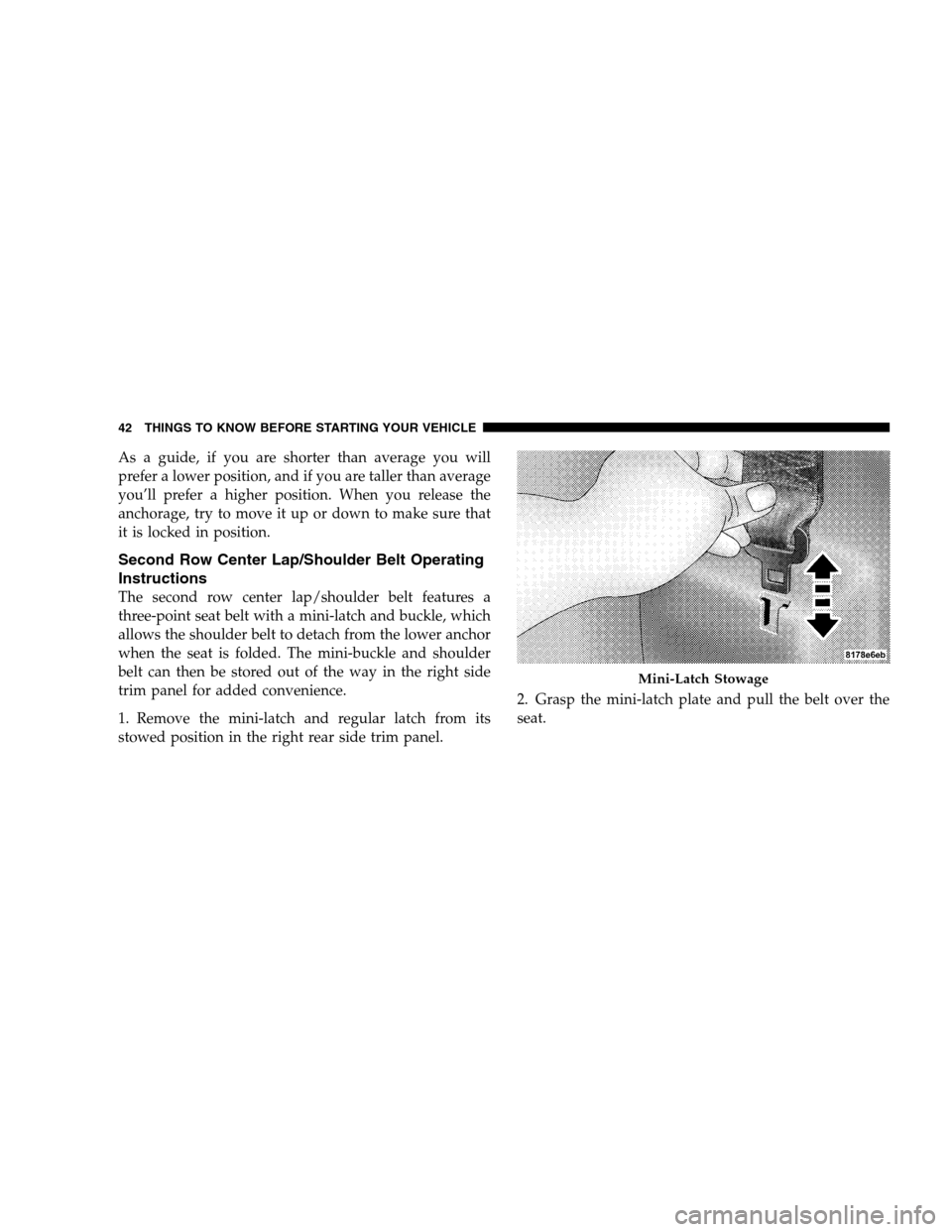
1. Remove the mini-latch and regular latch from its
stowed position in the right rear side trim panel.2. Grasp the mini-latch plate and pull the belt over the
seat.
Mini-Latch Stowage
42 THINGS TO KNOW BEFORE STARTING YOUR VEHICLE