Page 330 of 438
Towing Tips — Automatic Transmission
The automatic transmission fluid and filter should be
changed if you REGULARLY tow a trailer for more than
45 minutes of continuous operation. Refer to the “Main-
tenance Schedule” in Section 8 for transmission fluid
change intervals.
NOTE:Check the automatic transmission fluid level
before towing.
Towing Tips — Electronic Speed Control (If
Equipped)
Don’t use in hilly terrain or with heavy loads.
When using the speed control, if you experience speed
drops greater than 10 mph (16 km/h), disengage until
you can get back to cruising speed.
Use speed control in flat terrain and with light loads to
maximize fuel efficiency.
Towing Tips — Cooling System
To reduce the potential for engine and transmission
overheating, take the following actions:
City Driving
When stopped for short periods of time, put transmission
in NEUTRAL but do not increase engine idle speed.
Highway Driving
Reduce speed.
Air Conditioning
Turn off temporarily.
refer to Cooling System Operating information in the
Maintenance section of this manual for more informa-
tion.
328 STARTING AND OPERATING
Page 333 of 438
WHAT TO DO IN EMERGENCIES
CONTENTS
�Hazard Warning Flasher..................332
�If Your Engine Overheats.................332
�Automatic Transaxle Overheating...........333
�Jacking And Tire Changing................334
▫Jack Location........................334
▫Spare Tire Stowage....................335
▫Preparations For Jacking................335▫Jacking Instructions....................336
�Jump-Starting Procedures Due To A
Low Battery..........................340
�Freeing A Stuck Vehicle..................342
�Towing A Disabled Vehicle................343
▫With Ignition Key.....................343
▫Without The Ignition Key...............344
6
Page 334 of 438

HAZARD WARNING FLASHER
The flasher switch is located on the instrument
panel, below the radio. Depress the switch and
both cluster indicators and all front and rear
directional signals will flash. Depress the
switch again to turn Hazard Warning Flashers off.
Do not use this emergency warning system when the
vehicle is in motion. Use it when your vehicle is disabled
and is creating a safety hazard for other motorists.
If it is necessary to leave the vehicle to go for service, the
flasher system will continue to operate with the ignition
key removed and the vehicle locked.
NOTE:With extended use, the flasher may wear down
your battery.
IF YOUR ENGINE OVERHEATS
In any of the following situations, you can reduce the
potential for overheating by taking the appropriate ac-
tion.
•On the highways — Slow down.
•In city traffic — While stopped, put the transmission in
NEUTRAL, but do not increase engine idle speed.
If the pointer rises to theH(red) mark, the instrument
cluster will sound a chime. When safe, pull over and stop
the vehicle with the engine at idle. Turn off the air
conditioning and wait until the pointer drops back into
the normal range. If the pointer remains on theH(red)
mark for more than a minute, turn the engine off imme-
diately and call for service.
NOTE:There are steps that you can take to slow down
an impending overheat condition. If your air conditioner
is on, turn it off. The air conditioning system adds heat to
332 WHAT TO DO IN EMERGENCIES
Page 335 of 438
the engine cooling system and turning off the A/C
removes this heat. You can also turn the Temperature
control to maximum heat, the Mode control to floor, and
the fan control to HIGH. This allows the heater core to act
as a supplement to the radiator and aids in removing heat
from the engine cooling system.
CAUTION!
Driving with a hot cooling system could damage
your vehicle. If the temperature gauge reads “H”,
pull over when safe and stop the vehicle with the
engine at idle. Turn the air conditioner OFF and wait
until the pointer drops back into the normal range.
After appropriate action has been taken, if the
pointer remains on the “H”, turn the engine OFF
immediately and call for service.
WARNING!
A hot engine cooling system is dangerous. You or
others could be badly burned by steam or boiling
coolant. You may want to call a service center if your
vehicle overheats. If you decide to look under the
hood yourself, refer to “Maintenance”, Section 7 of
this manual. Follow the warnings under the Cooling
System Pressure Cap paragraph.
AUTOMATIC TRANSAXLE OVERHEATING
During sustained high speed driving or trailer towing up
long grades on hot days, the automatic transaxle oil may
become too hot.
If this happens, the transmission overheat indi-
cator light will come on, and the vehicle will
slow slightly until the automatic transaxle cools
down enough to allow a return to the requested speed. If
the high speed is maintained, the overheating will reoccur,
as before, in a cyclic fashion.
WHAT TO DO IN EMERGENCIES 333
6
Page 345 of 438
front wheels. Then shift back and forth between RE-
VERSE and 1st gear. Usually the least accelerator pedal
pressure to maintain the rocking motion without spin-
ning the wheels is most effective.
WARNING!
Fast spinning tires can be dangerous. Forces gener-
ated by excessive wheel speeds may cause axle, tire
damage or failure. A tire could explode and injure
someone. Do not spin your vehicle’s wheels faster
than 30 mph (48 km/h) or for longer than 30 seconds
continuously without stopping when you are stuck.
And don’t let anyone near a spinning wheel, no
matter what the speed.
CAUTION!
Racing the engine or spinning the wheels too fast
may lead to transaxle overheating and failure. It can
also damage the tires. Do not spin the wheels above
30 mph (48 km/h). Do not spin the wheels continu-
ously for more than 30 seconds.
TOWING A DISABLED VEHICLE
With Ignition Key
Automatic And Manual Transaxle
Front wheel drive vehicles must have the front wheels
elevated; 4-wheel drive vehicles must be hauled on a
flatbed truck.
WHAT TO DO IN EMERGENCIES 343
6
Page 359 of 438
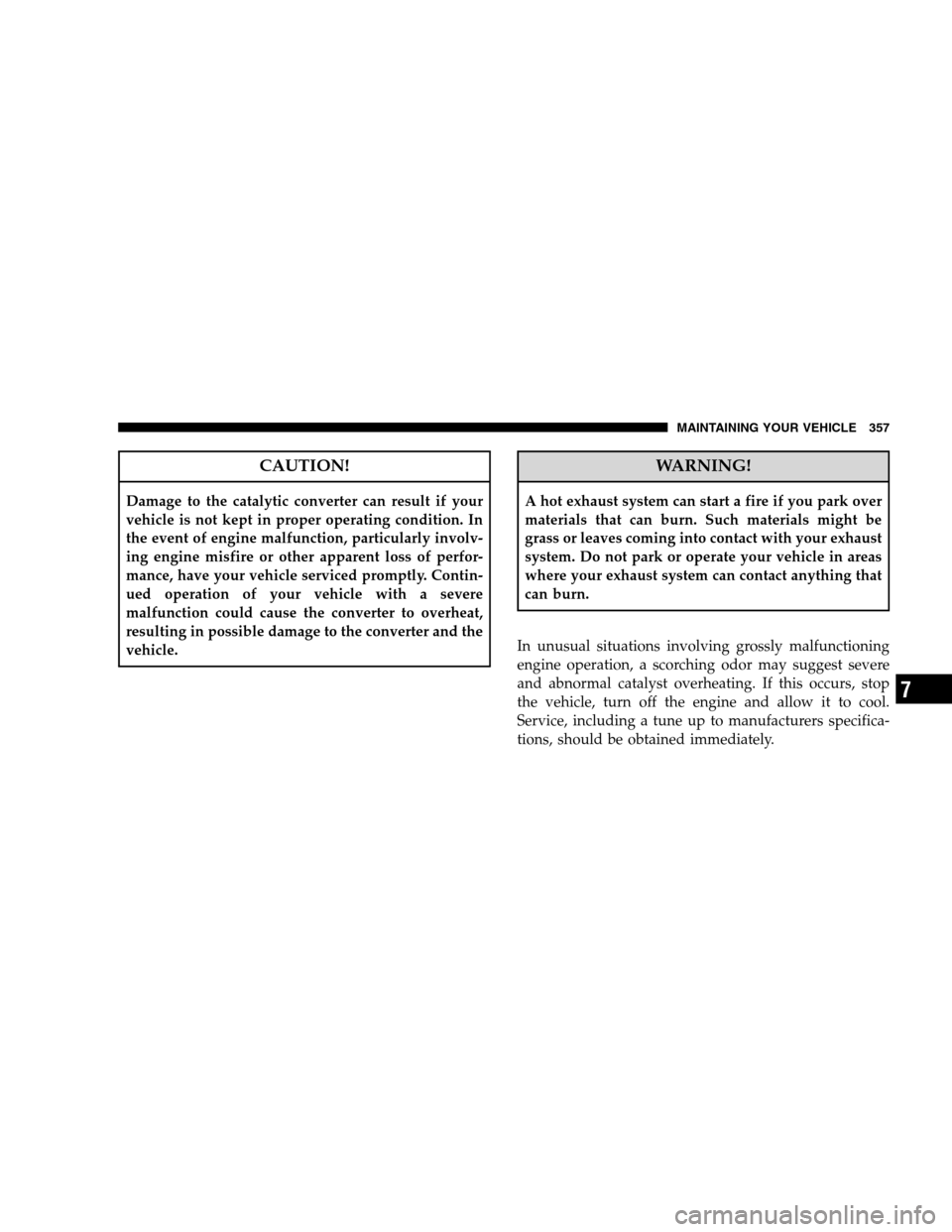
CAUTION!
Damage to the catalytic converter can result if your
vehicle is not kept in proper operating condition. In
the event of engine malfunction, particularly involv-
ing engine misfire or other apparent loss of perfor-
mance, have your vehicle serviced promptly. Contin-
ued operation of your vehicle with a severe
malfunction could cause the converter to overheat,
resulting in possible damage to the converter and the
vehicle.
WARNING!
A hot exhaust system can start a fire if you park over
materials that can burn. Such materials might be
grass or leaves coming into contact with your exhaust
system. Do not park or operate your vehicle in areas
where your exhaust system can contact anything that
can burn.
In unusual situations involving grossly malfunctioning
engine operation, a scorching odor may suggest severe
and abnormal catalyst overheating. If this occurs, stop
the vehicle, turn off the engine and allow it to cool.
Service, including a tune up to manufacturers specifica-
tions, should be obtained immediately.
MAINTAINING YOUR VEHICLE 357
7
Page 420 of 438
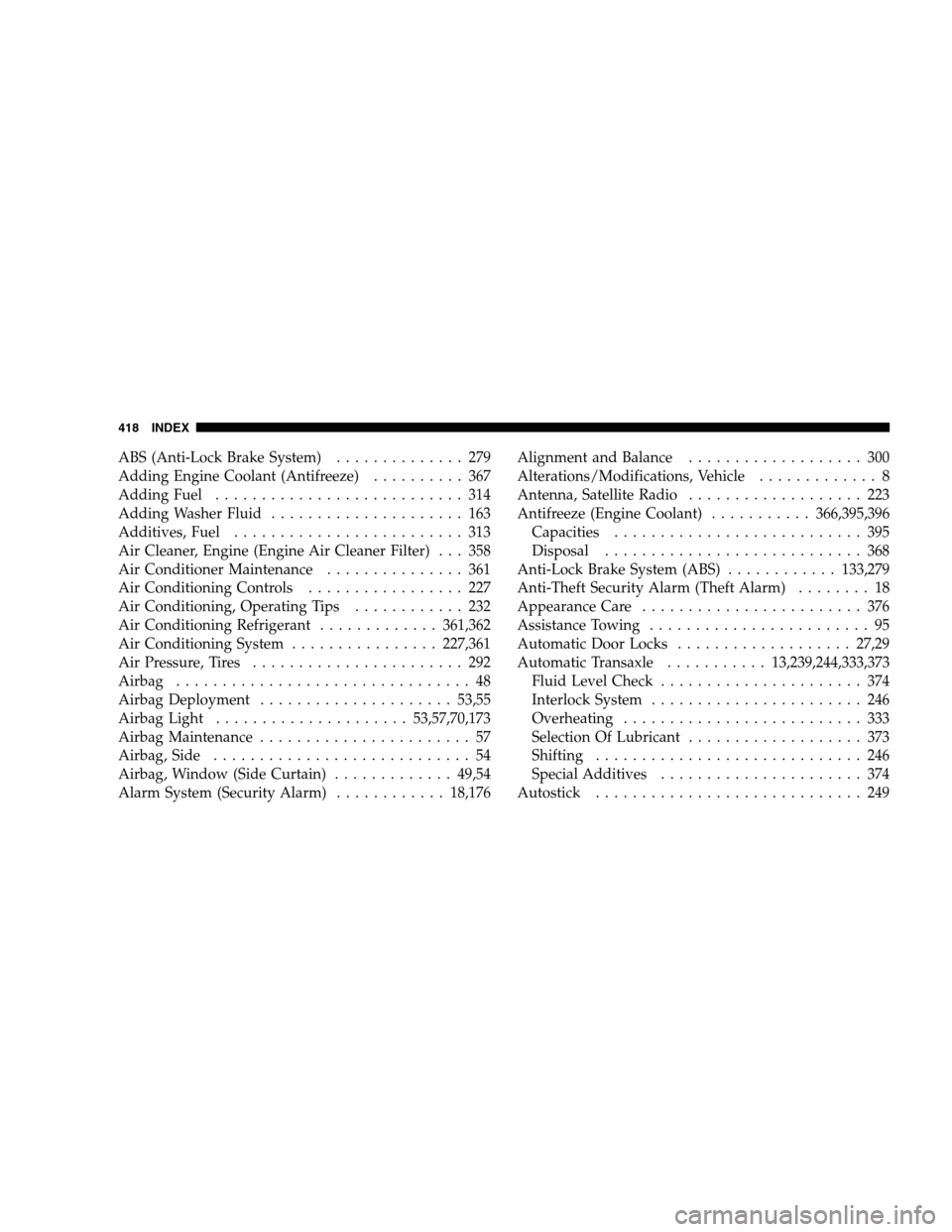
ABS (Anti-Lock Brake System).............. 279
Adding Engine Coolant (Antifreeze).......... 367
Adding Fuel........................... 314
Adding Washer Fluid..................... 163
Additives, Fuel......................... 313
Air Cleaner, Engine (Engine Air Cleaner Filter) . . . 358
Air Conditioner Maintenance............... 361
Air Conditioning Controls................. 227
Air Conditioning, Operating Tips............ 232
Air Conditioning Refrigerant.............361,362
Air Conditioning System................227,361
Air Pressure, Tires....................... 292
Airbag................................ 48
Airbag Deployment..................... 53,55
Airbag Light..................... 53,57,70,173
Airbag Maintenance....................... 57
Airbag, Side............................ 54
Airbag, Window (Side Curtain)............. 49,54
Alarm System (Security Alarm)............ 18,176Alignment and Balance................... 300
Alterations/Modifications, Vehicle............. 8
Antenna, Satellite Radio................... 223
Antifreeze (Engine Coolant)...........366,395,396
Capacities........................... 395
Disposal............................ 368
Anti-Lock Brake System (ABS)............133,279
Anti-Theft Security Alarm (Theft Alarm)........ 18
Appearance Care........................ 376
Assistance Towing........................ 95
Automatic Door Locks................... 27,29
Automatic Transaxle........... 13,239,244,333,373
Fluid Level Check...................... 374
Interlock System....................... 246
Overheating.......................... 333
Selection Of Lubricant................... 373
Shifting ............................. 246
Special Additives...................... 374
Autostick ............................. 249
418 INDEX
Page 424 of 438

Electronic Stability Program (ESP)............ 138
Electronic Vehicle Information Center (EVIC).... 183
Emergency, In Case of
Jacking............................. 334
Jump Starting......................... 340
Towing ............................. 343
Emission Control System Maintenance......350,400
Engine............................. 69,348
Break-In Recommendations................ 69
Checking Oil Level..................... 352
Cooling ............................. 365
Exhaust Gas Caution.................... 314
Fuel Requirements..................... 311
Jump Starting......................... 340
Oil ...........................352,395,396
Oil Change Interval.................... 354
Oil Filler Cap......................348,354
OilFilter ............................ 396
Oil Selection.......................... 354Oil Synthetic......................... 355
Operation............................ 69
Overheating.......................... 332
Temperature Gauge..................... 177
Enhanced Accident Response Feature.......... 56
Event Data Recorder...................... 58
Exhaust Gas Caution.............. 35,69,314,364
Exhaust System......................... 364
Fabric Care............................ 378
Filters
Air Cleaner.......................... 358
Engine Fuel.......................... 358
Engine Oil........................355,396
Flashers.............................. 332
Hazard Warning....................... 332
Turn Signal.......................... 389
Flat Tire Stowage........................ 339
Flooded Engine Starting................... 241
422 INDEX