Page 392 of 490

is functioning and is not on when the engine is running,
and that the OBD (On Board Diagnostic) system is ready
for testing.
Normally, the OBD system will be ready. The OBD
system maynotbe ready if your vehicle was recently
serviced, if you recently had a dead battery, or a battery
replacement. If the OBD system should be determined
not ready for the I/M test, your vehicle may fail the test.
Your vehicle has a simple ignition key actuated test
which you can use prior to going to the test station. To
check if your vehicle's OBD system is ready, you must do
the following:
1. Insert your ignition key into the ignition switch.
2. Turn the ignition to the ON position, but do not crank
or start the engine.
3. If you crank or start the engine, you will have to start
this test over.4. As soon as you turn your key to the ON position, you
will see your MIL symbol come on as part of a normal
bulb check.
5. Approximately 15 seconds later, one of two things will
happen:
a. The MIL will flash for about 10 seconds and then
return to being fully illuminated until you turn off the
ignition key or start the engine. This means that your
vehicle's OBD system isnot readyand you shouldnot
proceed to the I/M station.
b. The MIL will not flash at all and will remain fully
illuminated until you turn off the ignition key or start
the engine. This means that your vehicle's OBD system
isreadyand you can proceed to the I/M station.
If your OBD system isnot ready,you should see your
authorized dealer or repair facility. If your vehicle was
recently serviced or had a battery failure or replacement,
392 MAINTAINING YOUR VEHICLE
Page 398 of 490

Drive Belts Ð Check Condition and Tension
Belt tension is controlled by means of an automatic
tensioner. No belt tension adjustments are required.
However, belt and belt tensioner condition should be
inspected at the specified intervals, and replaced if re-
quired. See your authorized dealer for service.
At the mileage indicated in the maintenance schedule, all
belts and tensioner should be checked for condition.
Improper belt tension can cause belt slippage and failure.
Belts should be inspected for evidence of cuts, cracks,
glazing, or frayed cords and replaced if there is indication
of damage which could result in belt failure. Low gen-
erator belt tension can cause battery failure.
Also, check belt routing to make sure there is no inter-
ference between the belts and other engine components.
Spark Plugs
Spark plugs must fire properly to assure engine perfor-
mance and emission control. New spark plugs should be
installed at the specified mileage. The entire set should be
replaced if there is any malfunction due to a faulty spark
plug. Refer to ªFluids, Lubricants, and Genuine Partsº in
this section for spark plug information.
Spark Plug Wires
The spark plug wires should be kept clean and properly
connected. Terminals should be fully seated. Cracked,
damaged, or faulty wires should be replaced.
Engine Air Cleaner Filter
Refer to the Maintenance Schedule for recommended
Engine Air Cleaner Filter change intervals.
398 MAINTAINING YOUR VEHICLE
Page 401 of 490
Check ventilation hose for indication of damage or
plugging deposits. Replace if necessary.
Maintenance-Free Battery
Your vehicle is equipped with a maintenance-free battery.
You will never have to add water, nor is periodic main-
tenance required.
WARNING!
²Battery fluid is a corrosive acid solution and can
burn or even blind you. Don't allow battery fluid
to contact your eyes, skin or clothing. Don't lean
over a battery when attaching clamps. If acid
splashes in eyes or on skin, flush the area imme-
diately with large amounts of water.
²Battery gas is flammable and explosive. Keep
flame or sparks away from the battery. Don't use a
booster battery or any other booster source with an
output greater than 12 volts. Don't allow cable
clamps to touch each other.
²Battery posts, terminals and related accessories
contain lead and lead compounds. Wash hands
after handling.
MAINTAINING YOUR VEHICLE 401
7
Page 402 of 490
CAUTION!
²It is essential when replacing the cables on the
battery that the positive cable is attached to the
positive post and the negative cable is attached to
the negative post. Battery posts are marked (+)
positive and negative (-) and identified on the
battery case.
²If a ªfast chargerº is used while battery is in the
vehicle, disconnect both vehicle battery cables
before connecting the charger to battery. Do not
use a ªfast chargerº to provide starting voltage.
Air Conditioner Maintenance
For best possible performance, your air conditioner
should be checked and serviced by an Authorized Dealer
at the start of each warm season. This service should
include cleaning of the condenser fins and a performance
test. Drive belt condition should also be checked at this
time.
402 MAINTAINING YOUR VEHICLE
Page 433 of 490
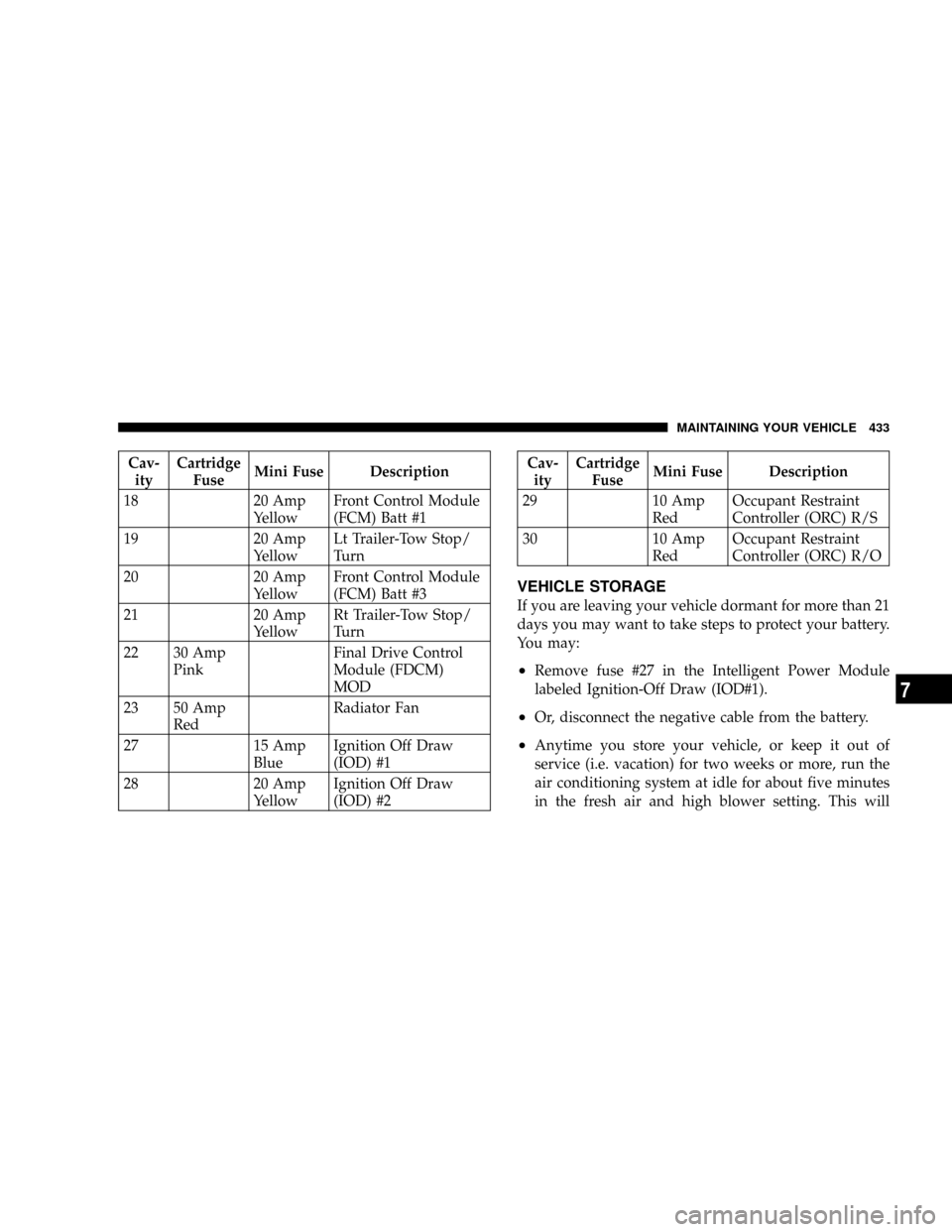
Cav-
ityCartridge
FuseMini Fuse Description
18 20 Amp
YellowFront Control Module
(FCM) Batt #1
19 20 Amp
YellowLt Trailer-Tow Stop/
Turn
20 20 Amp
YellowFront Control Module
(FCM) Batt #3
21 20 Amp
YellowRt Trailer-Tow Stop/
Turn
22 30 Amp
PinkFinal Drive Control
Module (FDCM)
MOD
23 50 Amp
RedRadiator Fan
27 15 Amp
BlueIgnition Off Draw
(IOD) #1
28 20 Amp
YellowIgnition Off Draw
(IOD) #2Cav-
ityCartridge
FuseMini Fuse Description
29 10 Amp
RedOccupant Restraint
Controller (ORC) R/S
30 10 Amp
RedOccupant Restraint
Controller (ORC) R/O
VEHICLE STORAGE
If you are leaving your vehicle dormant for more than 21
days you may want to take steps to protect your battery.
You may:
²Remove fuse #27 in the Intelligent Power Module
labeled Ignition-Off Draw (IOD#1).
²Or, disconnect the negative cable from the battery.
²Anytime you store your vehicle, or keep it out of
service (i.e. vacation) for two weeks or more, run the
air conditioning system at idle for about five minutes
in the fresh air and high blower setting. This will
MAINTAINING YOUR VEHICLE 433
7
Page 445 of 490

²Change your engine oil more often if you drive your
vehicle off-road for an extended period of time.
²Under no circumstances should oil change intervals
exceed 6,000 miles (10,000 km) or 6 months, whichever
comes first.
Your dealer will reset the oil change indicator message
after completing the scheduled oil change. If this sched-
uled oil change is performed by someone other than your
dealer the message can be reset by referring to the steps
described under ªOil Change Requiredº in ªUse Factory
Settingsº of the EVIC section in this manual.
At Each Stop for Fuel
²Check the engine oil level about 5 minutes after a fully
warmed engine is shut off. Checking the oil level while
the vehicle is on level ground will improve the accu-
racy of the oil level reading. Add oil only when the
level is at or below the ADD or MIN mark.
²Check the windshield washer solvent and add if
required.
Once a Month
²Check tire pressure and look for unusual wear or
damage.
²Inspect the battery and clean and tighten the terminals
as required.
²Check the fluid levels of coolant reservoir, brake
master cylinder, power steering and transmission and
add as needed.
²Check all lights and other electrical items for correct
operation.
MAINTENANCE SCHEDULES 445
8
M
A
I
N
T
E
N
A
N
C
E
S
C
H
E
D
U
L
E
S
Page 450 of 490
²Off-road or desert driving.
NOTE:Most vehicles are operated under the conditions
listed for Schedule ªB.º
Second is ScheduleªAº. It is for vehicles that are not
operated under any of the conditions listed under Sched-
ule ªB.º
Use the schedule that best describes your driving condi-
tions. Where time and mileage are listed, follow the
interval that occurs first.
CAUTION!
Failure to perform the required maintenance items
may result in damage to the vehicle.At Each Stop for Fuel
²Check the engine oil level about 5 minutes after a fully
warmed engine is shut off. Checking the oil level while
the vehicle is on level ground will improve the accu-
racy of the oil level reading. Add oil only when the
level is at or below the ADD or MIN mark.
²Check the windshield washer solvent, add as required.
Once a Month
²Check the tire pressure and look for unusual wear or
damage.
²Inspect the battery, clean and tighten the terminals as
required.
²Check the fluid levels of engine coolant/anti-freeze
deaeration bottle, brake master cylinder, and transmis-
sion, and add as needed.
450 MAINTENANCE SCHEDULES
8
M
A
I
N
T
E
N
A
N
C
E
S
C
H
E
D
U
L
E
S
Page 471 of 490

Fluid Type........................... 417
Special Additives...................... 417
Torque Converter...................... 291
Autostick............................. 287
Auxiliary Electrical Outlet (Power Outlet)...... 168
Auxiliary Power Outlet................... 168
Battery............................... 401
Emergency Starting..................... 378
Keyless Transmitter Replacement (RKE)....... 25
Saving Feature (Protection)............... 124
Belts, Drive............................ 398
Belts, Seat.............................. 37
Body Mechanism Lubrication............... 405
B-Pillar Location........................ 314
Brake Assist System...................... 140
Brake Control System, Electronic............. 138
Brake Fluid............................ 414
Brake System........................... 413Anti-Lock (ABS)....................138,305
Fluid Check.......................... 414
Hoses.............................. 413
Master Cylinder....................... 414
Parking............................. 304
Warning Light........................ 188
Brake/Transmission Interlock............... 285
Break-In Recommendations, New Vehicle........ 68
Bulb Replacement.....................434,435
Calibration, Compass..................... 205
Camera, Rear........................... 156
Capacities, Fluid........................ 440
Caps, Filler
Fuel................................ 346
Radiator (Coolant Pressure)............... 409
Car Washes............................ 422
Carbon Monoxide Warning...............69,340
Cargo Area Cover....................... 173
INDEX 471
10