2008 INFINITI FX35 mount
[x] Cancel search: mountPage 3513 of 3924
REAR DRIVE SHAFTRAX-15
< SERVICE INFORMATION >
CEF
G H
I
J
K L
M A
B
RAX
N
O P
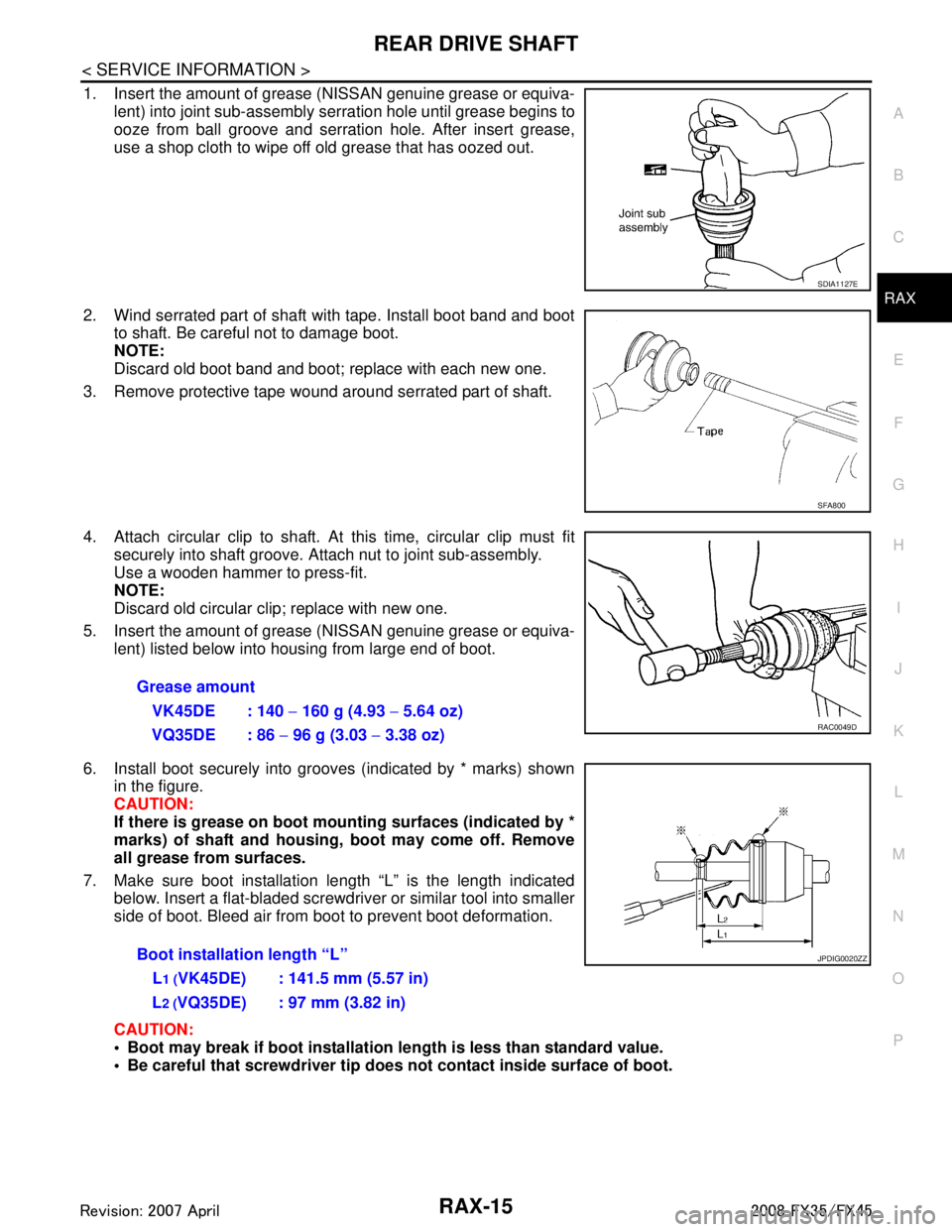
1. Insert the amount of grease (NISSAN genuine grease or equiva-
lent) into joint sub-assembly serration hole until grease begins to
ooze from ball groove and serration hole. After insert grease,
use a shop cloth to wipe off old grease that has oozed out.
2. Wind serrated part of shaft with tape. Install boot band and boot to shaft. Be careful not to damage boot.
NOTE:
Discard old boot band and boot; replace with each new one.
3. Remove protective tape wound around serrated part of shaft.
4. Attach circular clip to shaft. At this time, circular clip must fit securely into shaft groove. Attach nut to joint sub-assembly.
Use a wooden hammer to press-fit.
NOTE:
Discard old circular clip; replace with new one.
5. Insert the amount of grease (NISSAN genuine grease or equiva-
lent) listed below into housing from large end of boot.
6. Install boot securely into grooves (indicated by * marks) shown in the figure.
CAUTION:
If there is grease on boot mo unting surfaces (indicated by *
marks) of shaft and housing, boot may come off. Remove
all grease from surfaces.
7. Make sure boot installation length “L” is the length indicated below. Insert a flat-bladed screwdriver or similar tool into smaller
side of boot. Bleed air from boot to prevent boot deformation.
CAUTION:
Boot may break if boot installation le ngth is less than standard value.
Be careful that screwdriver tip does not contact inside surface of boot.
SDIA1127E
SFA800
Grease amount
VK45DE : 140 − 160 g (4.93 − 5.64 oz)
VQ35DE : 86 − 96 g (3.03 − 3.38 oz)
RAC0049D
Boot installation length “L”
L
1 (VK45DE) : 141.5 mm (5.57 in)
L
2 (VQ35DE) : 97 mm (3.82 in)
JPDIG0020ZZ
3AA93ABC3ACD3AC03ACA3AC03AC63AC53A913A773A893A873A873A8E3A773A983AC73AC93AC03AC3
3A893A873A873A8F3A773A9D3AAF3A8A3A8C3A863A9D3AAF3A8B3A8C
Page 3521 of 3924

RF-6
< SERVICE INFORMATION >
SQUEAK AND RATTLE TROUBLE DIAGNOSES
Insulates where slight movement is present. Ideal for instrument panel applications.
SILICONE GREASE
Used in place of UHMW tape that will be visible or not fit.
Note: Will only last a few months.
SILICONE SPRAY
Use when grease cannot be applied.
DUCT TAPE
Use to eliminate movement.
CONFIRM THE REPAIR
Confirm that the cause of a noise is repaired by test driving the vehicle. Operate the vehicle under the same
conditions as when the noise originally occurred. Refer to the notes on the Diagnostic Worksheet.
Generic Squeak and Rattle TroubleshootingINFOID:0000000001328031
Refer to Table of Contents for specific component removal and installation information.
INSTRUMENT PANEL
Most incidents are caused by contact and movement between:
1. Cluster lid A and instrument panel
2. Acrylic lens and combination meter housing
3. Instrument panel to front pillar garnish
4. Instrument panel to windshield
5. Instrument panel mounting pins
6. Wiring harnesses behind the combination meter
7. A/C defroster duct and duct joint
These incidents can usually be located by tapping or moving the components to duplicate the noise or by
pressing on the components while driving to stop the noi se. Most of these incidents can be repaired by apply-
ing felt cloth tape or silicon spray (in hard to reach areas).Urethane pads can be used to insulate wiring har-
ness.
CAUTION:
Do not use silicone spray to isolate a squeak or ra ttle. If you saturate the area with silicone, you will
not be able to recheck the repair.
CENTER CONSOLE
Components to pay attention to include:
1. Shifter assembly cover to finisher
2. A/C control unit and cluster lid C
3. Wiring harnesses behind audio and A/C control unit
The instrument panel repair and isolation pr ocedures also apply to the center console.
DOORS
Pay attention to the:
1. Finisher and inner panel making a slapping noise
2. Inside handle escutcheon to door finisher
3. Wiring harnesses tapping
4. Door striker out of alignment causing a popping noise on starts and stops
Tapping or moving the components or pressing on them wh ile driving to duplicate the conditions can isolate
many of these incidents. You can usually insulate the areas with felt cloth tape or insulator foam blocks from
the Nissan Squeak and Rattle Kit (J43980) to repair the noise.
TRUNK
Trunk noises are often caused by a loose jack or loose items put into the trunk by the owner.
In addition look for:
1. Trunk lid dumpers out of adjustment
2. Trunk lid striker out of adjustment
3. Trunk lid torsion bars knocking together
4. A loose license plate or bracket
3AA93ABC3ACD3AC03ACA3AC03AC63AC53A913A773A893A873A873A8E3A773A983AC73AC93AC03AC3
3A893A873A873A8F3A773A9D3AAF3A8A3A8C3A863A9D3AAF3A8B3A8C
Page 3522 of 3924

SQUEAK AND RATTLE TROUBLE DIAGNOSESRF-7
< SERVICE INFORMATION >
C
DE
F
G H
J
K L
M A
B
RF
N
O P
Most of these incidents can be repaired by adjusting, se curing or insulating the item(s) or component(s) caus-
ing the noise.
SUNROOF/HEADLINING
Noises in the sunroof/headlining area can often be traced to one of the following:
1. Sunroof lid, rail, linkage or seals making a rattle or light knocking noise
2. Sunvisor shaft shaking in the holder
3. Front or rear windshield touching headlining and squeaking
Again, pressing on the components to stop the noise while duplicating the conditions can isolate most of these
incidents. Repairs usually consist of insulating with felt cloth tape.
SEATS
When isolating seat noise it's important to note the pos ition the seat is in and the load placed on the seat when
the noise is present. These conditions should be duplic ated when verifying and isolating the cause of the
noise.
Cause of seat noise include:
1. Headrest rods and holder
2. A squeak between the seat pad cushion and frame
3. Rear seatback lock and bracket
These noises can be isolated by moving or pressing on the suspected components while duplicating the con-
ditions under which the noise occurs. Most of thes e incidents can be repaired by repositioning the component
or applying urethane tape to the contact area.
UNDERHOOD
Some interior noise may be caused by components under the hood or on the engine wall. The noise is then
transmitted into the passenger compartment.
Causes of transmitted underhood noise include:
1. Any component mounted to the engine wall
2. Components that pass through the engine wall
3. Engine wall mounts and connectors
4. Loose radiator mounting pins
5. Hood bumpers out of adjustment
6. Hood striker out of adjustment
These noises can be difficult to isolate since they cannot be reached from the interior of the vehicle. The best
method is to secure, move or insulate one component at a time and test drive the vehicle. Also, engine RPM
or load can be changed to isolate the noise. Repairs c an usually be made by moving, adjusting, securing, or
insulating the component causing the noise.
3AA93ABC3ACD3AC03ACA3AC03AC63AC53A913A773A893A873A873A8E3A773A983AC73AC93AC03AC3
3A893A873A873A8F3A773A9D3AAF3A8A3A8C3A863A9D3AAF3A8B3A8C
Page 3536 of 3924
SUNROOFRF-21
< SERVICE INFORMATION >
C
DE
F
G H
J
K L
M A
B
RF
N
O P
Wind Deflector InspectionINFOID:0000000001328047
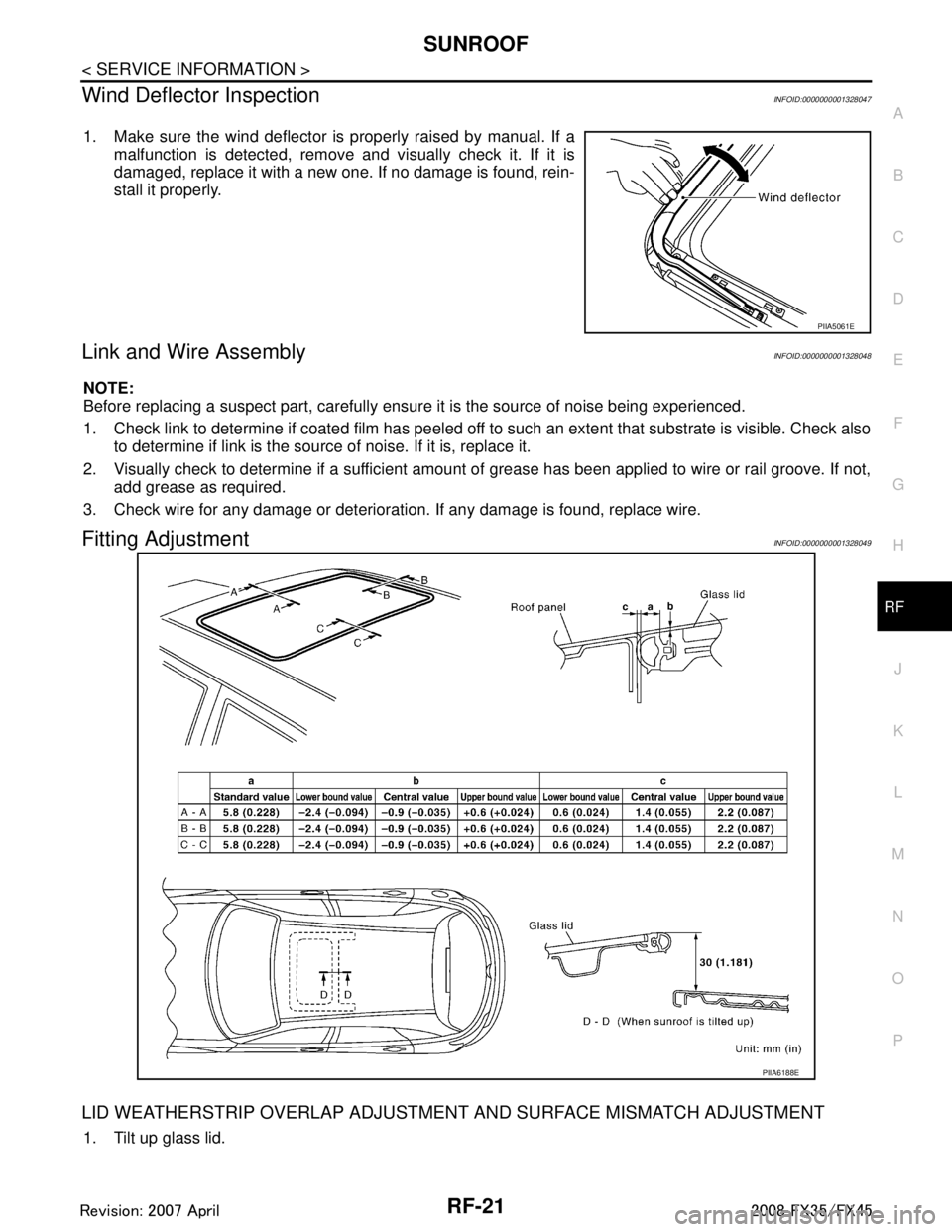
1. Make sure the wind deflector is properly raised by manual. If a malfunction is detected, remove and visually check it. If it is
damaged, replace it with a new one. If no damage is found, rein-
stall it properly.
Link and Wire AssemblyINFOID:0000000001328048
NOTE:
Before replacing a suspect part, carefully ensur e it is the source of noise being experienced.
1. Check link to determine if coated film has peeled off to such an extent that substrate is visible. Check also
to determine if link is the source of noise. If it is, replace it.
2. Visually check to determine if a sufficient amount of grease has been applied to wire or rail groove. If not,
add grease as required.
3. Check wire for any damage or deteriorati on. If any damage is found, replace wire.
Fitting AdjustmentINFOID:0000000001328049
LID WEATHERSTRIP OVERLAP ADJUSTMENT AND SURFACE MISMATCH ADJUSTMENT
1. Tilt up glass lid.
PIIA5061E
PIIA6188E
3AA93ABC3ACD3AC03ACA3AC03AC63AC53A913A773A893A873A873A8E3A773A983AC73AC93AC03AC3
3A893A873A873A8F3A773A9D3AAF3A8A3A8C3A863A9D3AAF3A8B3A8C
Page 3539 of 3924
RF-24
< SERVICE INFORMATION >
SUNROOF
SUNROOF UNIT ASSEMBLY
Removal
CAUTION:
Always work with a helper.
When taking sunroof unit out, use clothes to protect the seats and trim from damage.
After installing the sunroof un it and glass lid, be sure to perform the leakage test and make sure
there is no malfunction.
1. Tilt up glass lid.
2. Remove the headlining. Refer to EI-43, "
Component Parts Location".
3. Disconnect drain hoses.
4. Remove glass lid. Refer to RF-22, "
Removal and Installation".
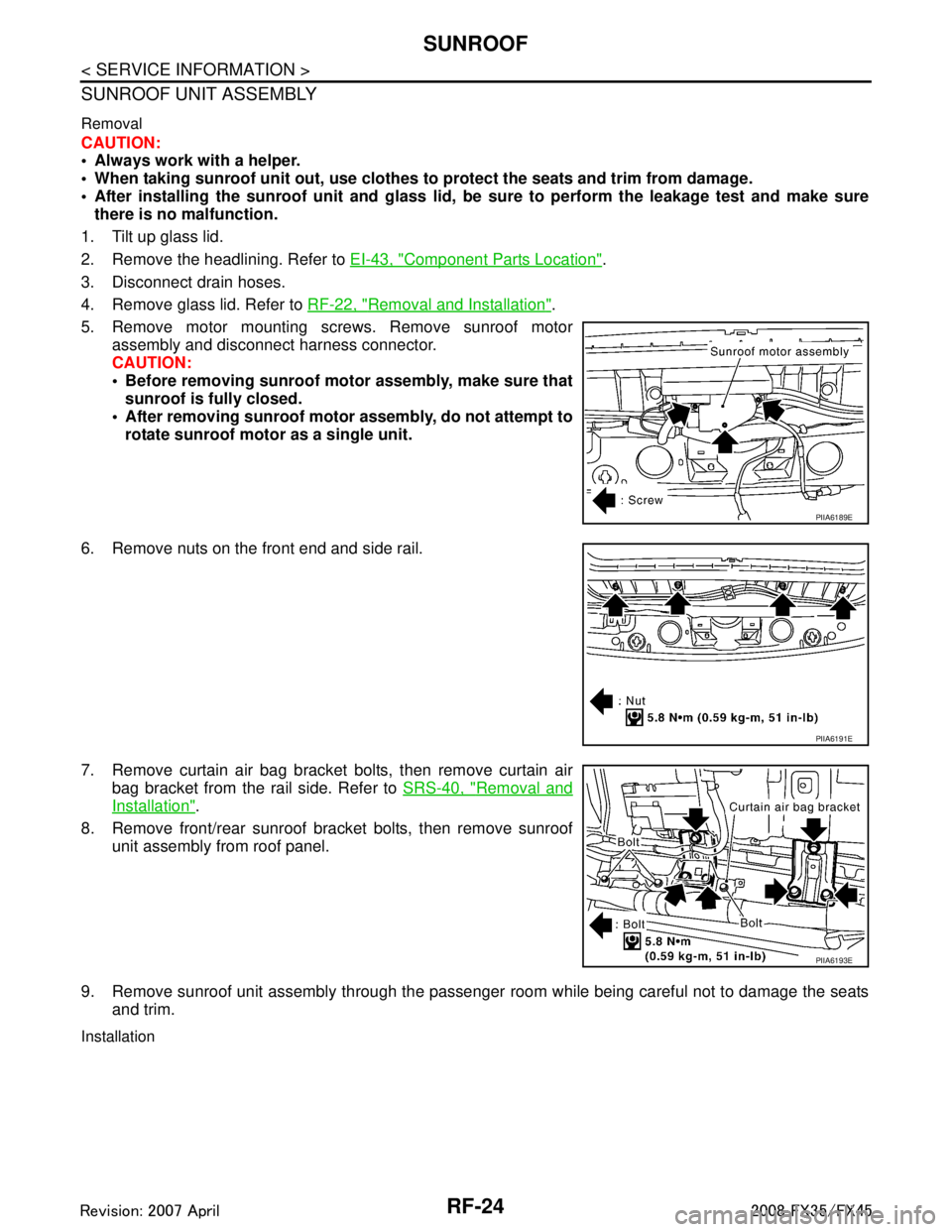
5. Remove motor mounting screws. Remove sunroof motor assembly and disconnect harness connector.
CAUTION:
Before removing sunroof motor assembly, make sure thatsunroof is fully closed.
After removing sunroof motor assembly, do not attempt to
rotate sunroof motor as a single unit.
6. Remove nuts on the front end and side rail.
7. Remove curtain air bag bracket bolts, then remove curtain air bag bracket from the rail side. Refer to SRS-40, "
Removal and
Installation".
8. Remove front/rear sunroof bracket bolts, then remove sunroof unit assembly from roof panel.
9. Remove sunroof unit assembly through the passenger room while being careful not to damage the seats
and trim.
Installation
PIIA6189E
PIIA6191E
PIIA6193E
3AA93ABC3ACD3AC03ACA3AC03AC63AC53A913A773A893A873A873A8E3A773A983AC73AC93AC03AC3
3A893A873A873A8F3A773A9D3AAF3A8A3A8C3A863A9D3AAF3A8B3A8C
Page 3540 of 3924
SUNROOFRF-25
< SERVICE INFORMATION >
C
DE
F
G H
J
K L
M A
B
RF
N
O P
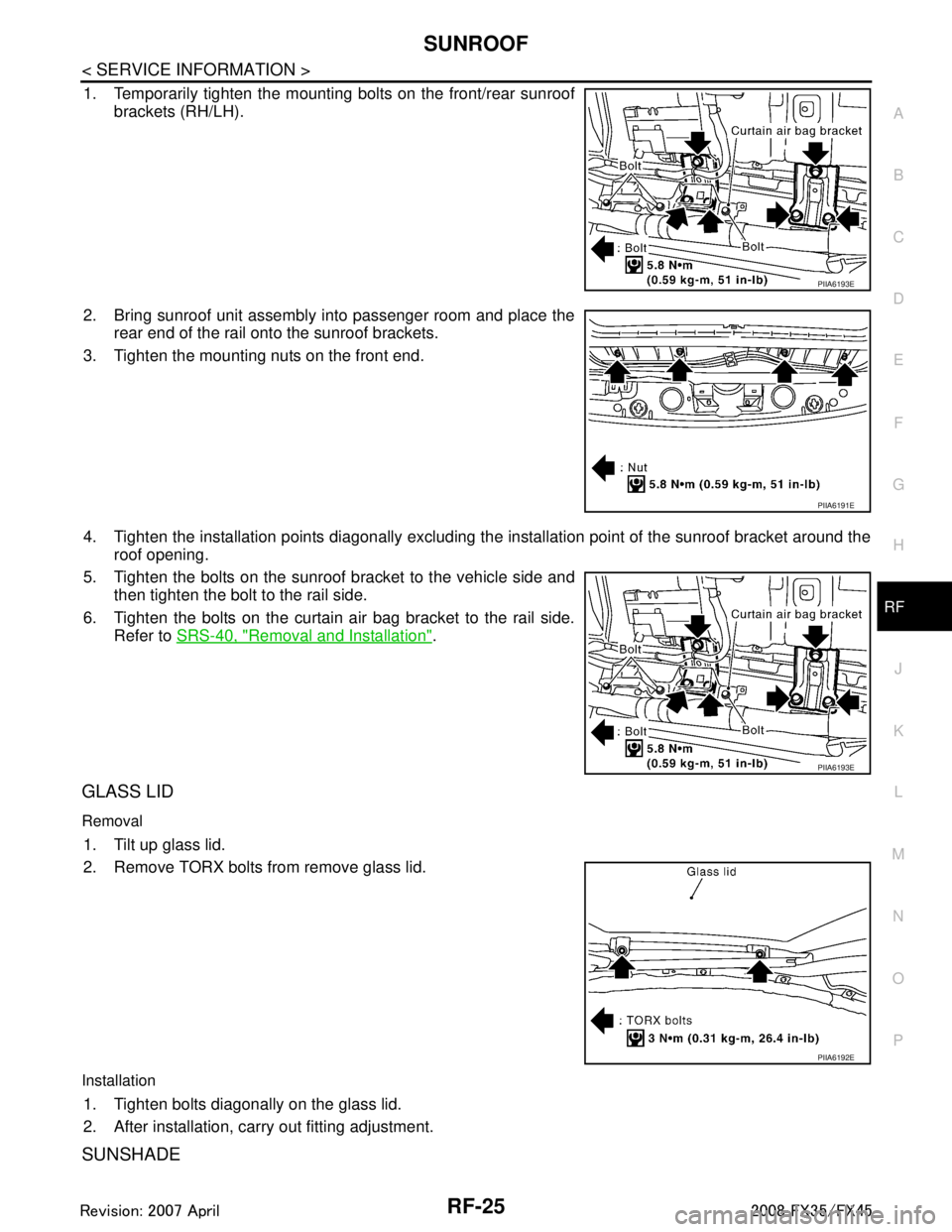
1. Temporarily tighten the mounting bolts on the front/rear sunroof brackets (RH/LH).
2. Bring sunroof unit assembly into passenger room and place the rear end of the rail onto the sunroof brackets.
3. Tighten the mounting nuts on the front end.
4. Tighten the installation points diagonally excluding the installation point of the sunroof bracket around the roof opening.
5. Tighten the bolts on the sunroof bracket to the vehicle side and then tighten the bolt to the rail side.
6. Tighten the bolts on the curtain air bag bracket to the rail side. Refer to SRS-40, "
Removal and Installation".
GLASS LID
Removal
1. Tilt up glass lid.
2. Remove TORX bolts from remove glass lid.
Installation
1. Tighten bolts diagonally on the glass lid.
2. After installation, carry out fitting adjustment.
SUNSHADE
PIIA6193E
PIIA6191E
PIIA6193E
PIIA6192E
3AA93ABC3ACD3AC03ACA3AC03AC63AC53A913A773A893A873A873A8E3A773A983AC73AC93AC03AC3
3A893A873A873A8F3A773A9D3AAF3A8A3A8C3A863A9D3AAF3A8B3A8C
Page 3541 of 3924
RF-26
< SERVICE INFORMATION >
SUNROOF
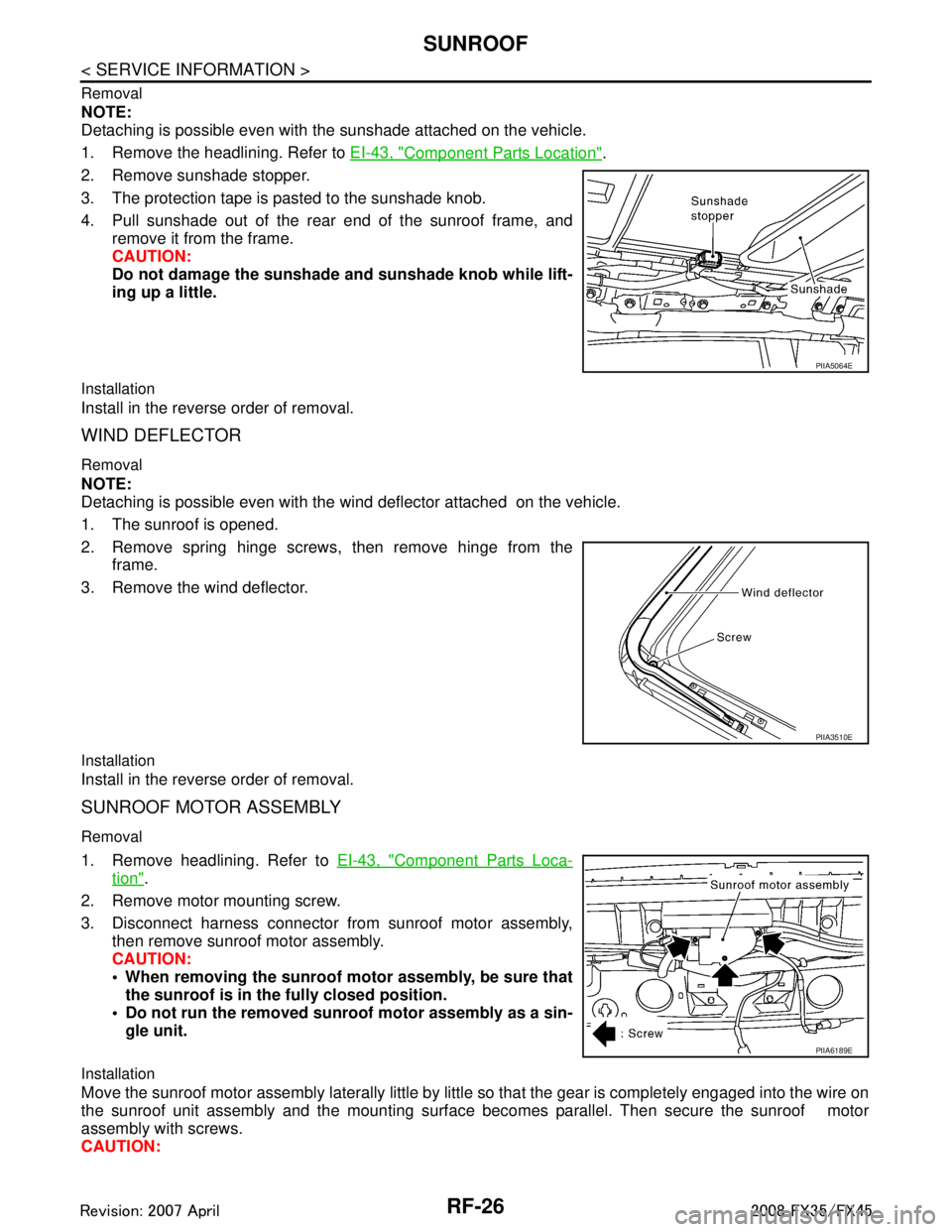
Removal
NOTE:
Detaching is possible even with the sunshade attached on the vehicle.
1. Remove the headlining. Refer to EI-43, "
Component Parts Location".
2. Remove sunshade stopper.
3. The protection tape is pasted to the sunshade knob.
4. Pull sunshade out of the rear end of the sunroof frame, and remove it from the frame.
CAUTION:
Do not damage the sunshade and sunshade knob while lift-
ing up a little.
Installation
Install in the reverse order of removal.
WIND DEFLECTOR
Removal
NOTE:
Detaching is possible even with the wind deflector attached on the vehicle.
1. The sunroof is opened.
2. Remove spring hinge screws, then remove hinge from theframe.
3. Remove the wind deflector.
Installation
Install in the reverse order of removal.
SUNROOF MOTOR ASSEMBLY
Removal
1. Remove headlining. Refer to EI-43, "Component Parts Loca-
tion".
2. Remove motor mounting screw.
3. Disconnect harness connector from sunroof motor assembly, then remove sunroof motor assembly.
CAUTION:
When removing the sunroof motor assembly, be sure that
the sunroof is in the fully closed position.
Do not run the removed sunroof motor assembly as a sin- gle unit.
Installation
Move the sunroof motor assembly laterally little by lit tle so that the gear is completely engaged into the wire on
the sunroof unit assembly and the mounting surface bec omes parallel. Then secure the sunroof motor
assembly with screws.
CAUTION:
PIIA5064E
PIIA3510E
PIIA6189E
3AA93ABC3ACD3AC03ACA3AC03AC63AC53A913A773A893A873A873A8E3A773A983AC73AC93AC03AC3
3A893A873A873A8F3A773A9D3AAF3A8A3A8C3A863A9D3AAF3A8B3A8C
Page 3544 of 3924

RFD-2
< SERVICE INFORMATION >
PRECAUTIONS
SERVICE INFORMATION
PRECAUTIONS
Service Notice or PrecautionINFOID:0000000001327490
• Check for the correct installation status prior to removal or disassembly. If matching marks are required, becertain they do not interfere with the function of the parts when applied.
Overhaul should be done in a clean work area, it is preferable to work in dustproof area.
Before disassembly, using steam or white gasoline, completely remove sand and mud from the exterior of
the unit, preventing them from entering into the unit during disassembly or assembly.
Check appearance of the disassembled parts for dam age, deformation, and unusual wear. Replace them
with a new ones if necessary.
Gaskets, seals and O-rings should be replaced any time when the unit is disassembled.
In principle, tighten bolts or nuts gradually in several steps working diagonally from inside to outside. If tight-
ening sequence is specified, observe it.
Clean and flush the parts sufficiently and blow-dry them.
Be careful not to damage sliding surfaces and mating surfaces.
When applying sealant, remove the old sealant from t he mounting surface; then remove any moisture, oil,
and foreign materials from the application and mounting surfaces.
Always use shop paper for cleaning the inside of components.
Avoid using cotton gloves or shop rags to prevent entering of lint.
During assembly, observe the specified tightening tor que, and apply new gear oil, petroleum jelly, or multi-
purpose grease as specified for each vehicle, if necessary.
3AA93ABC3ACD3AC03ACA3AC03AC63AC53A913A773A893A873A873A8E3A773A983AC73AC93AC03AC3
3A893A873A873A8F3A773A9D3AAF3A8A3A8C3A863A9D3AAF3A8B3A8C