2008 Hyundai Tiburon lock
[x] Cancel search: lockPage 32 of 268
1FEATURES OF YOUR HYUNDAI20
B190A02Y-AATSEAT BELTS -Front Passenger and Rear
Seat 3-Point System with Combination
Locking Retractor
To Fasten Your BeltCombination retractor type seat belts are in-
stalled in the rear seat positions to help accom-
modate the installation of child restraint sys-
tems. Hyundai strongly recommends that chil-
dren always be seated in the rear seat. NEVER
place any infant restraint system in the front
seat of the vehicle.
This type of seat belt combines the features of
both an emergency locking retractor seat belt
and an automatic locking retractor seat belt. To
fasten your seat belt, pull it out of the retractor
and insert the metal tab into the buckle. There
will be an audible "click" when the tab locks into
the buckle.
When not securing a child restraint, the seat belt
operates in the same way as the driver's seat
belt (Emergency Locking Retractor Type). It
automatically adjusts to the proper length only
after the lap belt portion of the seat belt is
adjusted manually so that it fits snugly around
your hips. When the seat belt is fully extended
from the retractor to allow the installation of a
child restraint system, the seat belt operation
changes to allow the belt to retract, but not to
extend. (Automatic Locking Retractor Type)
see page 1-27.
NOTE:Seat belt reminder light comes and stays on
until the seat belt is fastened when the
ignition key is turned "ON" or "START".
And, the warning chime will also sound for
about 6 seconds.
NOTE:Although the combination retractor pro-
vides the same level of protection for seated
passengers in either emergency or auto-
matic locking modes, it is recommended
that seated passengers use the emergency
locking feature for improved convenience.
The automatic locking function is intended
to facilitate child restraint installation. To
convert from the automatic locking feature
to the emergency locking operation mode,
allow the unbuckled seat belt to fully re-
tract.
Page 33 of 268
1
FEATURES OF YOUR HYUNDAI
21
B210A01A-AATTo Release the Seat BeltThe seat belt is released by pressing the re-
lease button in the locking buckle. When it is
released, the belt should automatically draw
back into the retractor.
If this does not happen, check the belt to be sure
it is not twisted, then try again.
B210A01NF
!
WARNING:
o For maximum restraint system protec-
tion, seat belts must always be used
whenever the car is moving.
o Seat belts are most effective when
seatbacks are in the upright position.
o Children age 12 and younger must al-
ways be properly restrained in the rear
seat. Never allow children to ride in the
front passenger seat. If a child over 13
must be seated in the front seat, he/she
must be properly belted and the seat
should be moved as far back as possible.
o Never wear the shoulder belt under your
arm or behind your back. An improperly
positioned shoulder belt can cause se-
rious injuries in a crash. The shoulder
belt should be positioned midway over
your shoulder across your collarbone.
o Avoid wearing twisted seat belts. A
twisted belt can't do its job as well. In a
collision, it could even cut into you. Be
sure the belt webbing is straight and not
twisted.
o Be careful not to damage the belt web-
bing or hardware. If the belt webbing or
hardware is damaged, replace it.
!
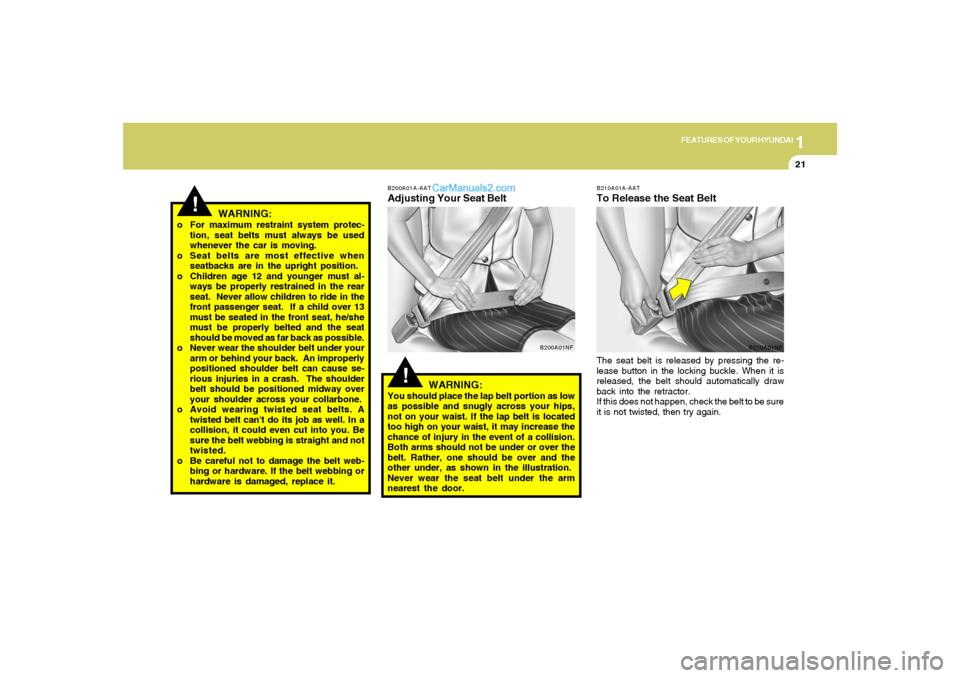
B200A01A-AATAdjusting Your Seat Belt
WARNING:You should place the lap belt portion as low
as possible and snugly across your hips,
not on your waist. If the lap belt is located
too high on your waist, it may increase the
chance of injury in the event of a collision.
Both arms should not be under or over the
belt. Rather, one should be over and the
other under, as shown in the illustration.
Never wear the seat belt under the arm
nearest the door.
B200A01NF
Page 34 of 268
1FEATURES OF YOUR HYUNDAI22
!
WARNING:
o A child restraint system must be placed
in the rear seat. Never install a child or
infant seat on the front passenger's seat.
Should an accident occur and cause the
passenger side airbag to deploy, it could
severely injure or kill an infant or child
seated in an infant or child seat. Thus
only use a child restraint in the rear seat
of your vehicle.
o A safety belt or child restraint system
can become very hot if it is left in a closed
vehicle on a sunny day, even if the out-
side temperature does not feel hot. Be
sure to check the seat cover and buckles
before placing a child there.
o When the child restraint system is not in
use, store it in the trunk or fasten it with
a safety belt so that it will not be thrown
forward in the case of a sudden stop or
an accident.
o Children may be seriously injured or
killed by an inflating airbag. All children,
even those too large for child restraints,
must ride in the rear seat.
CHILD RESTRAINT SYSTEMB230A03A-AATChildren riding in the car should sit in the rear
seat and must always be properly restrained to
minimize the risk of injury in an accident, sudden
stop or sudden maneuver. According to acci-
dent statistics provided by the National High-
way Traffic Safety Administration (NHTSA),
children are safer when properly restrained in
the rear seats than in the front seat. Larger
children not in a child restraint should use one
of the seat belts provided.
All 50 states have child restraint laws. You
should be aware of the specific requirements in
your state. Child and/or infant safety seats must
be properly placed and installed in the rear seat.
You must use a commercially available child
restraint system that meets the requirements of
the Federal Motor Vehicle Safety Standards
(FMVSS).
Children could be injured or killed in a crash if
their restraints are not properly secured. For
small children and babies, a child seat or infant
seat must be used. Before buying a particular
child restraint system, make sure it fits your car
and seat belts, and fits your child. Follow all the
instructions provided by the manufacturer when
installing the child restraint system.
!
To reduce the chance of serious or fatal
injuries:
o Children of all ages are safer when re-
strained in the rear seat. A child riding in
the front passenger seat can be force-
fully struck by an inflating airbag result-
ing in serious or fatal injuries.
o Always follow the instructions for in-
stallation and use of the child restraint
maker.
o Always make sure the child seat is se-
cured properly in the car and your child
is securely restrained in the child seat.
o Never hold a child in your arms or lap
when riding in a vehicle. The violent
forces created during a crash will tear the
child from your arms and throw the child
against the car’s interior.
o Never put a seat belt over yourself and a
child. During a crash, the belt could
press deep into the child causing seri-
ous internal injuries.
o Never leave children unattended in a
vehicle – not even for a short time. The
car can heat up very quickly, resulting in
serious injuries to children inside. Even
very young children may inadvertently
cause the vehicle to move, entangle them-
selves in the windows, or lock them-
selves or others inside the vehicle.
WARNING:
Page 39 of 268
1
FEATURES OF YOUR HYUNDAI
27
!
WARNING:
o If the retractor is not in the Automatic
Locking mode, the child restraint can
move when your vehicle turns or stops
suddenly. A child can be seriously in-
jured or killed if the child restraint is not
properly anchored to the car, including
setting the retractor to the Automatic
Locking mode.
o Do not install any child restraint system
in the front passenger seat. Should an
accident occur and cause the passenger
side airbag to deploy, it could severely
injure or kill an infant or child seated in
an infant or child seat. Therefore, only
use a child restraint system in the rear
seat of your vehicle. If the retractor is in the automatic locking mode,
the belt will be locked. After installation of the
child restraint system, try to move it in all
directions to be sure the child restraint system
is securely installed. If you need to tighten the
belt, pull more webbing toward the retractor.
When you unbuckle the seat belt and allow it to
retract, the retractor will automatically revert
back to its normal seated passenger emer-
gency locking usage condition.
NOTE:o Before installing the child restraint sys-
tem in any seating position, read the
instructions supplied by the child re-
straint system manufacturer.
o If the seat belt does not operate as de-
scribed, have the system checked imme-
diately by your authorized Hyundai
dealer.
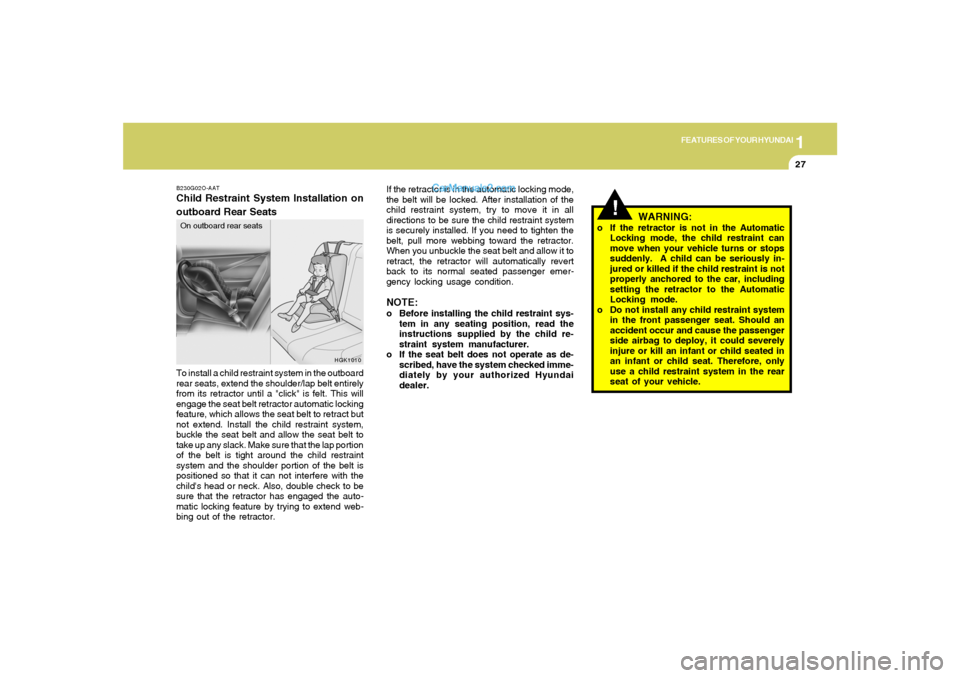
B230G02O-AATChild Restraint System Installation on
outboard Rear SeatsTo install a child restraint system in the outboard
rear seats, extend the shoulder/lap belt entirely
from its retractor until a "click" is felt. This will
engage the seat belt retractor automatic locking
feature, which allows the seat belt to retract but
not extend. Install the child restraint system,
buckle the seat belt and allow the seat belt to
take up any slack. Make sure that the lap portion
of the belt is tight around the child restraint
system and the shoulder portion of the belt is
positioned so that it can not interfere with the
child's head or neck. Also, double check to be
sure that the retractor has engaged the auto-
matic locking feature by trying to extend web-
bing out of the retractor.On outboard rear seats
HGK1010
Page 40 of 268
1FEATURES OF YOUR HYUNDAI28
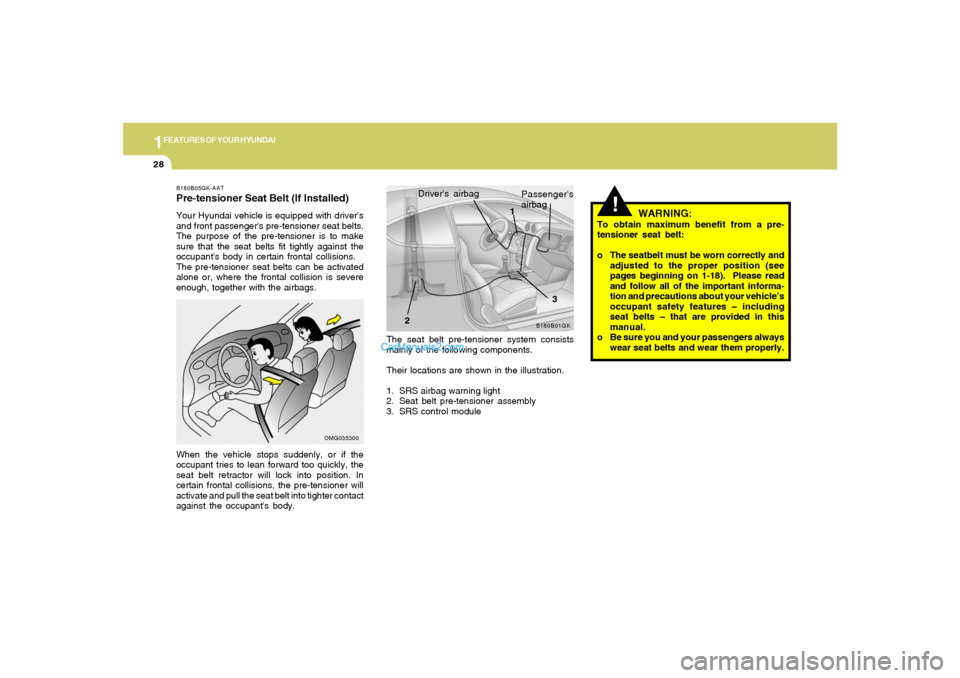
The seat belt pre-tensioner system consists
mainly of the following components.
Their locations are shown in the illustration.
1. SRS airbag warning light
2. Seat belt pre-tensioner assembly
3. SRS control moduleDriver's airbag
B180B01GK
23 Passenger's
airbag
1
!
WARNING:
To obtain maximum benefit from a pre-
tensioner seat belt:
o The seatbelt must be worn correctly and
adjusted to the proper position (see
pages beginning on 1-18). Please read
and follow all of the important informa-
tion and precautions about your vehicle’s
occupant safety features – including
seat belts – that are provided in this
manual.
o Be sure you and your passengers always
wear seat belts and wear them properly.
B180B05GK-AATPre-tensioner Seat Belt (If Installed)Your Hyundai vehicle is equipped with driver's
and front passenger's pre-tensioner seat belts.
The purpose of the pre-tensioner is to make
sure that the seat belts fit tightly against the
occupant's body in certain frontal collisions.
The pre-tensioner seat belts can be activated
alone or, where the frontal collision is severe
enough, together with the airbags.
When the vehicle stops suddenly, or if the
occupant tries to lean forward too quickly, the
seat belt retractor will lock into position. In
certain frontal collisions, the pre-tensioner will
activate and pull the seat belt into tighter contact
against the occupant's body.
OMG035300
Page 49 of 268
1
FEATURES OF YOUR HYUNDAI
37
CAUTION:
When installing a container of liquid air
freshener inside a vehicle, do not place it
near the instrument cluster nor on the in-
strument panel pad surface. If there is any
leakage from the air freshener onto these
areas (instrument cluster, instrument panel
pad or air ventilator), it may damage these
parts. If the liquid from the air freshener
does leak onto these areas, wash them with
water immediately.
!
!
B240B05L
WARNING:
o If an airbag deploys, there may be a loud
noise followed by a fine dust released in
the vehicle. These conditions are nor-
mal and are not hazardous - the airbags
are packed in this fine powder. The dust
generated during airbag deployment
may cause skin or eye irritation as well as
aggravate asthma for some persons.
Always wash all exposed skin areas thor-
oughly with lukewarm water and a mild
soap after an accident in which the
airbags were deployed.
o The SRS can function only when the
ignition key is in the "ON" position. If the
SRS "AIRBAG" warning light does not
illuminute, or continuously remains on
after illuminating for about 6 seconds
when the ignition key is turned to the
"ON" position, or after the engine is
started, illuminates while driving, the
SRS is not working properly. If this oc-
curs, have your vehicle immediately in-
spected by your Hyundai dealer.
o Before you replace a fuse or disconnect
a battery terminal, turn the ignition key
to the "LOCK" position or remove the
ignition key. Never remove or replace the
air bag related fuse(s) when the ignition
key is in the "ON" position. Failure to
heed this warning will cause the SRS
"AIRBAG" warning light to illuminate. Passenger's Airbag
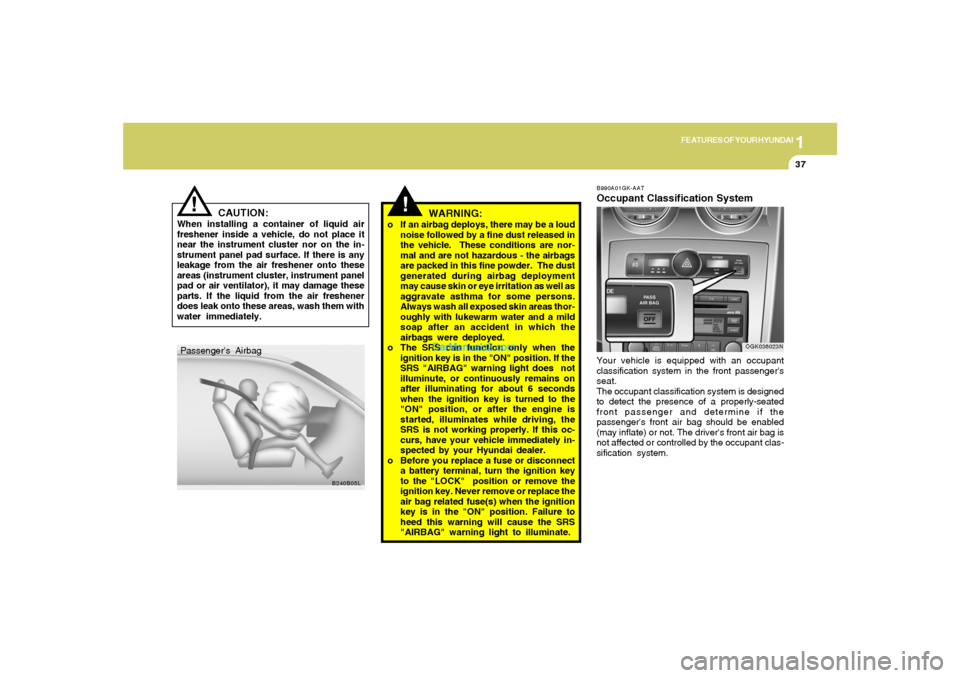
B990A01GK-AATOccupant Classification System
OGK036023N
Your vehicle is equipped with an occupant
classification system in the front passenger's
seat.
The occupant classification system is designed
to detect the presence of a properly-seated
front passenger and determine if the
passenger's front air bag should be enabled
(may inflate) or not. The driver's front air bag is
not affected or controlled by the occupant clas-
sification system.
Page 52 of 268
1FEATURES OF YOUR HYUNDAI40
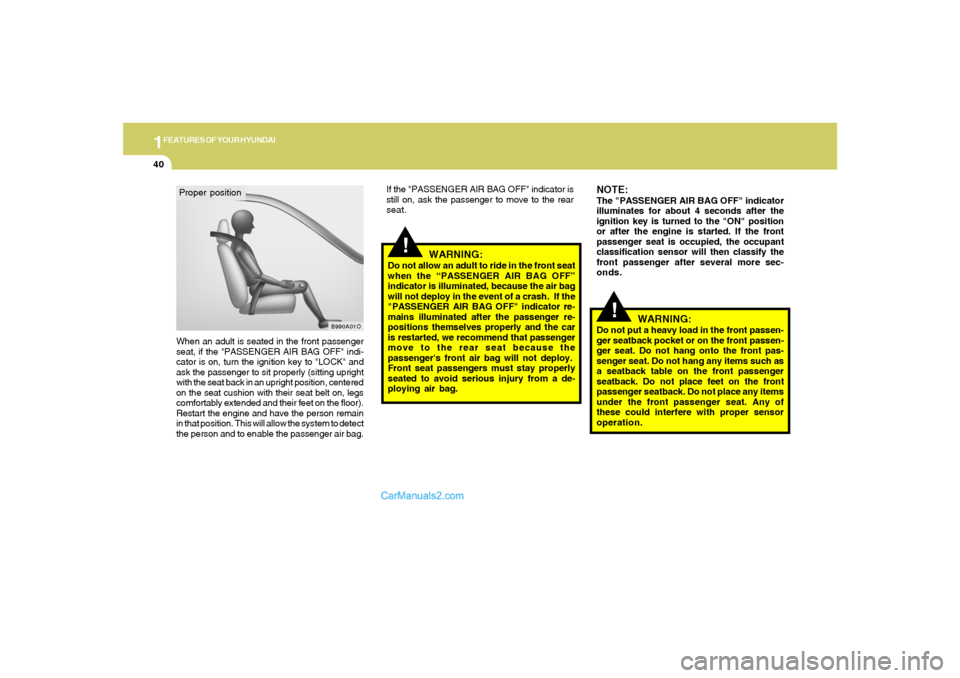
When an adult is seated in the front passenger
seat, if the "PASSENGER AIR BAG OFF" indi-
cator is on, turn the ignition key to "LOCK" and
ask the passenger to sit properly (sitting upright
with the seat back in an upright position, centered
on the seat cushion with their seat belt on, legs
comfortably extended and their feet on the floor).
Restart the engine and have the person remain
in that position. This will allow the system to detect
the person and to enable the passenger air bag.
Proper position
B990A01O
If the "PASSENGER AIR BAG OFF" indicator is
still on, ask the passenger to move to the rear
seat.
!
WARNING:
Do not allow an adult to ride in the front seat
when the “PASSENGER AIR BAG OFF”
indicator is illuminated, because the air bag
will not deploy in the event of a crash. If the
"PASSENGER AIR BAG OFF" indicator re-
mains illuminated after the passenger re-
positions themselves properly and the car
is restarted, we recommend that passenger
move to the rear seat because the
passenger's front air bag will not deploy.
Front seat passengers must stay properly
seated to avoid serious injury from a de-
ploying air bag.
NOTE:The "PASSENGER AIR BAG OFF" indicator
illuminates for about 4 seconds after the
ignition key is turned to the "ON" position
or after the engine is started. If the front
passenger seat is occupied, the occupant
classification sensor will then classify the
front passenger after several more sec-
onds.
!
WARNING:
Do not put a heavy load in the front passen-
ger seatback pocket or on the front passen-
ger seat. Do not hang onto the front pas-
senger seat. Do not hang any items such as
a seatback table on the front passenger
seatback. Do not place feet on the front
passenger seatback. Do not place any items
under the front passenger seat. Any of
these could interfere with proper sensor
operation.
Page 54 of 268
1FEATURES OF YOUR HYUNDAI42
!
WARNING:
!
WARNING:
o The side impact airbag is supplemental
to the driver's and the passenger's seat
belt systems and is not a substitute for
them. Therefore your seat belts must be
worn at all times while the vehicle is in
motion. The airbags deploy only in cer-
tain side impact conditions.
o For best protection from the side impact
airbag system and to avoid being injured
by the deploying side impact airbag,
both front seat occupants should sit in
an upright position with the seat belt
properly fastened. The driver's hands
should be placed on the steering wheel
at the 9:00 and 3:00 o'clock positions.
The passenger's arms and hands should
be placed on their laps.
o Do not use any accessory seat covers.
o Use of seat covers could prevent or
reduce the effectiveness of the system.
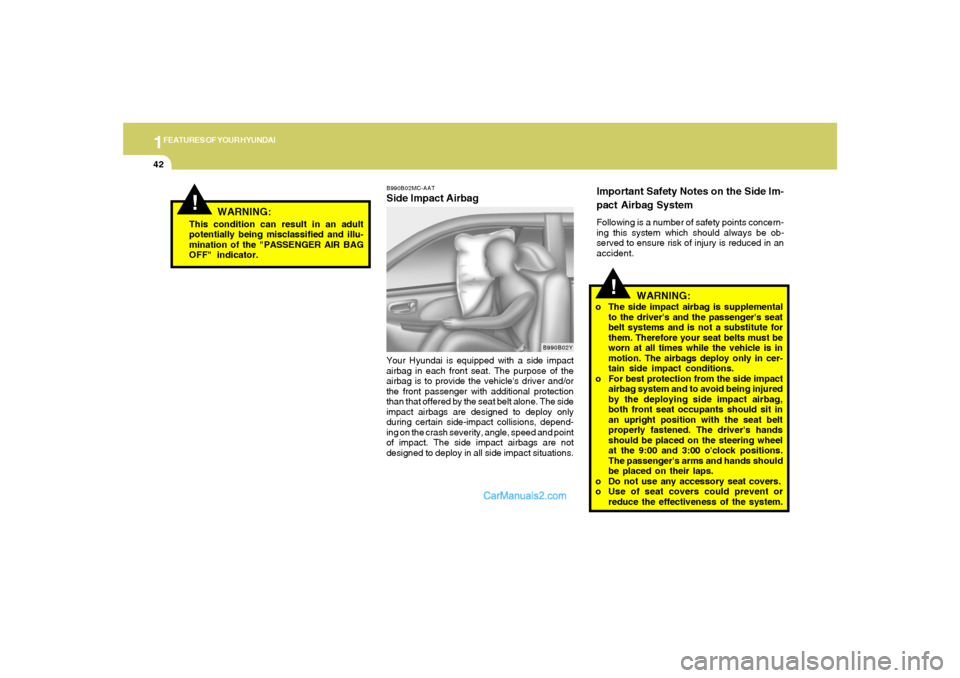
B990B02MC-AATSide Impact AirbagYour Hyundai is equipped with a side impact
airbag in each front seat. The purpose of the
airbag is to provide the vehicle's driver and/or
the front passenger with additional protection
than that offered by the seat belt alone. The side
impact airbags are designed to deploy only
during certain side-impact collisions, depend-
ing on the crash severity, angle, speed and point
of impact. The side impact airbags are not
designed to deploy in all side impact situations.
B990B02Y
This condition can result in an adult
potentially being misclassified and illu-
mination of the "PASSENGER AIR BAG
OFF" indicator.
Important Safety Notes on the Side Im-
pact Airbag SystemFollowing is a number of safety points concern-
ing this system which should always be ob-
served to ensure risk of injury is reduced in an
accident.