2008 HYUNDAI ENTOURAGE esc
[x] Cancel search: escPage 3 of 393
F1
OWNER'S MANUAL
Operation
Maintenance
Specifications
All information in this Owner's Manual is current at the time of publication.
However, Hyundai reserves the right to make changes at any time so that
our policy of continual product improvement may be carried out.
This manual applies to all Hyundai models and includes descriptions and
explanations of optional as well as standard equipment. As a result, you
may find material in this manual that does not apply to your specific vehi-
cle.
Page 23 of 393
37
Features of your vehicle
This system is designed to provide pro-
tection from unauthorized entry into the
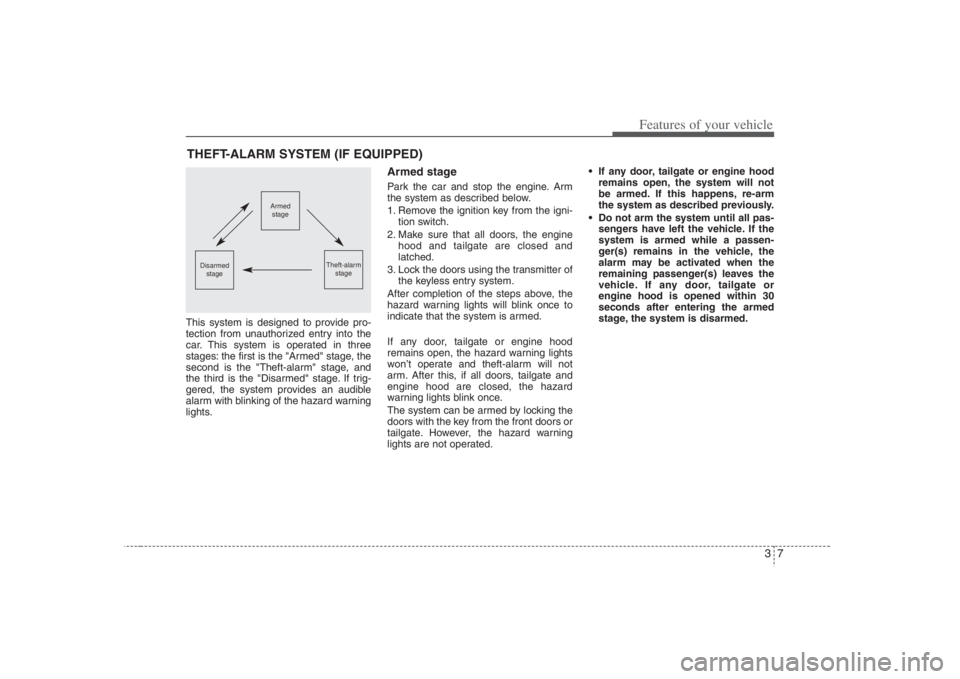
car. This system is operated in three
stages: the first is the "Armed" stage, the
second is the "Theft-alarm" stage, and
the third is the "Disarmed" stage. If trig-
gered, the system provides an audible
alarm with blinking of the hazard warning
lights.
Armed stagePark the car and stop the engine. Arm
the system as described below.
1. Remove the ignition key from the igni-
tion switch.
2. Make sure that all doors, the engine
hood and tailgate are closed and
latched.
3. Lock the doors using the transmitter of
the keyless entry system.
After completion of the steps above, the
hazard warning lights will blink once to
indicate that the system is armed.
If any door, tailgate or engine hood
remains open, the hazard warning lights
won’t operate and theft-alarm will not
arm. After this, if all doors, tailgate and
engine hood are closed, the hazard
warning lights blink once.
The system can be armed by locking the
doors with the key from the front doors or
tailgate. However, the hazard warning
lights are not operated. If any door, tailgate or engine hood
remains open, the system will not
be armed. If this happens, re-arm
the system as described previously.
Do not arm the system until all pas-
sengers have left the vehicle. If the
system is armed while a passen-
ger(s) remains in the vehicle, the
alarm may be activated when the
remaining passenger(s) leaves the
vehicle. If any door, tailgate or
engine hood is opened within 30
seconds after entering the armed
stage, the system is disarmed.
THEFT-ALARM SYSTEM (IF EQUIPPED)
Armed
stage
Theft-alarm
stage
Disarmed
stage
Page 30 of 393
Features of your vehicle14 3 When pushing down on the front por-
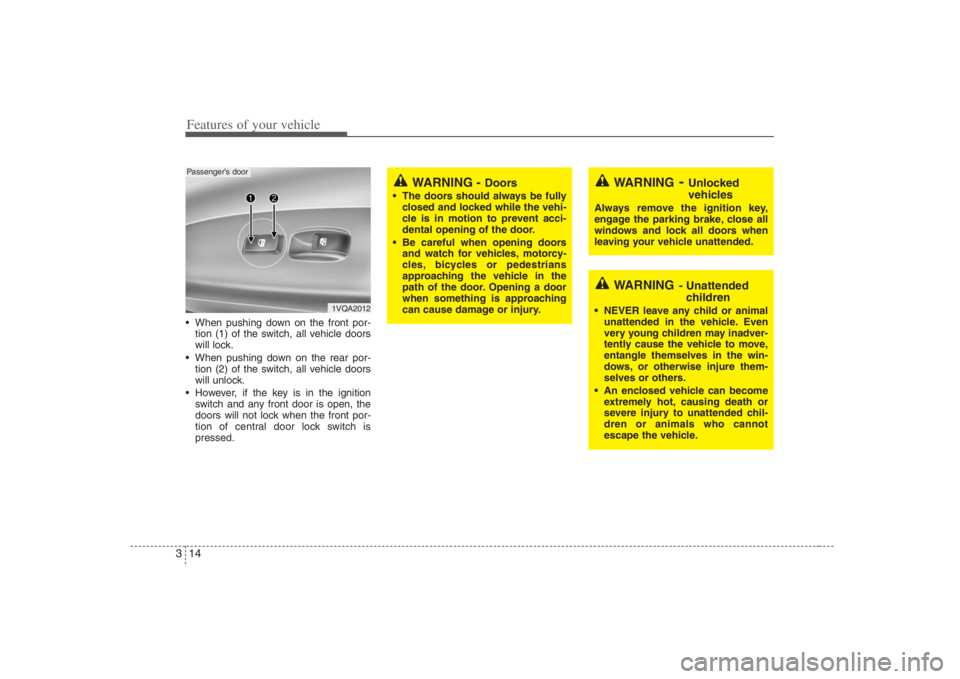
tion (1) of the switch, all vehicle doors
will lock.
When pushing down on the rear por-
tion (2) of the switch, all vehicle doors
will unlock.
However, if the key is in the ignition
switch and any front door is open, the
doors will not lock when the front por-
tion of central door lock switch is
pressed.
1VQA2012
Passenger’s door
WARNING
- Unlocked
vehicles
Always remove the ignition key,
engage the parking brake, close all
windows and lock all doors when
leaving your vehicle unattended.
WARNING
- Unattended
children
NEVER leave any child or animal
unattended in the vehicle. Even
very young children may inadver-
tently cause the vehicle to move,
entangle themselves in the win-
dows, or otherwise injure them-
selves or others.
An enclosed vehicle can become
extremely hot, causing death or
severe injury to unattended chil-
dren or animals who cannot
escape the vehicle.
WARNING -
Doors
The doors should always be fully
closed and locked while the vehi-
cle is in motion to prevent acci-
dental opening of the door.
Be careful when opening doors
and watch for vehicles, motorcy-
cles, bicycles or pedestrians
approaching the vehicle in the
path of the door. Opening a door
when something is approaching
can cause damage or injury.
Page 81 of 393

365
Features of your vehicle
3-Point rear center seat belt (3rd row)To fasten the rear center belt
1. Extract the tongue plate from the hole
on the belt assembly cover and slowly
pull the tongue plates out from the
retractor.2. Insert the tongue plate (A) into the
open end of the buckle (C) until an
audible “click" is heard, indicating the
latch is locked. Make sure the belt is
not twisted.3. Pull the tongue plate (B) and insert the
tongue plate (B) into the open end of
the buckle (D) until an audible “click” is
heard, indicating the latch is locked.
Make sure the belt is not twisted.
1VQH3903
CAUTION
- Cargo
Be sure that cargo is securely
loaded in the rear cargo area.
Failing to do so may cause damage
to the rear center seat belt in sud-
den stops or collisions.
OVQ036225N
OVQ036097N
WARNING
Never let anyone ride in the rear
center seat without fastening all
metal tabs and buckles as
described in this section. This seat
belt is designed to function as a
typical 3-point restraint (lap/shoul-
der belt). Using only the shoulder
portion or lap portion of the belt
can result in serious or fatal injuries
in the event of a collision or sudden
stop.
Page 139 of 393
3 123
Features of your vehicle
ESC indicator
(Electronic Stability
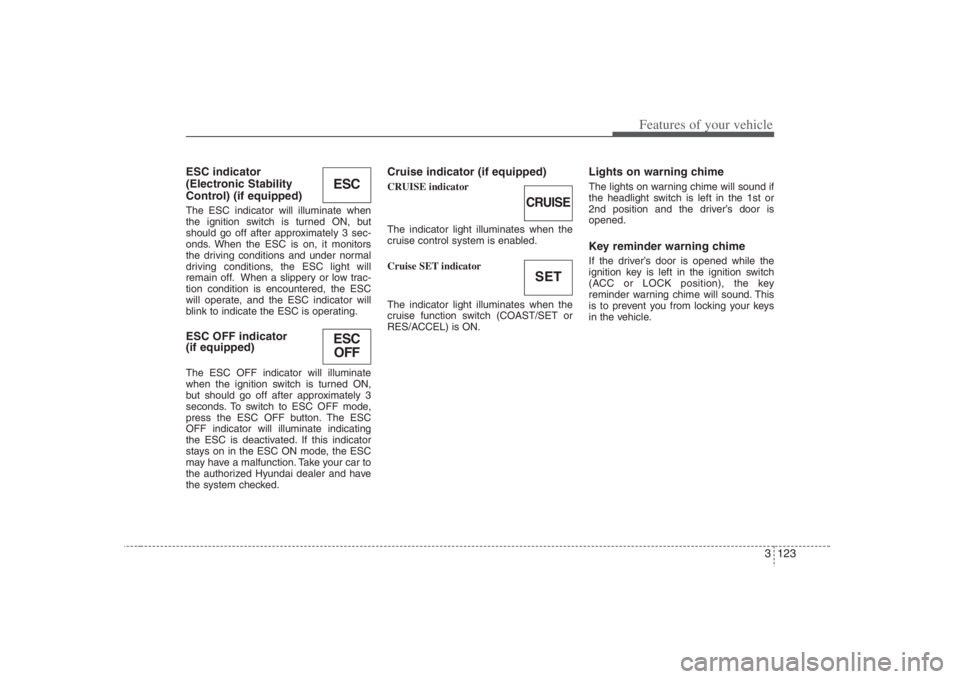
Control) (if equipped)The ESC indicator will illuminate when
the ignition switch is turned ON, but
should go off after approximately 3 sec-
onds. When the ESC is on, it monitors
the driving conditions and under normal
driving conditions, the ESC light will
remain off. When a slippery or low trac-
tion condition is encountered, the ESC
will operate, and the ESC indicator will
blink to indicate the ESC is operating.ESC OFF indicator
(if equipped)The ESC OFF indicator will illuminate
when the ignition switch is turned ON,
but should go off after approximately 3
seconds. To switch to ESC OFF mode,
press the ESC OFF button. The ESC
OFF indicator will illuminate indicating
the ESC is deactivated. If this indicator
stays on in the ESC ON mode, the ESC
may have a malfunction. Take your car to
the authorized Hyundai dealer and have
the system checked.
Cruise indicator (if equipped)CRUISE indicator
The indicator light illuminates when the
cruise control system is enabled.
Cruise SET indicator
The indicator light illuminates when the
cruise function switch (COAST/SET or
RES/ACCEL) is ON.
Lights on warning chimeThe lights on warning chime will sound if
the headlight switch is left in the 1st or
2nd position and the driver’s door is
opened.Key reminder warning chimeIf the driver’s door is opened while the
ignition key is left in the ignition switch
(ACC or LOCK position), the key
reminder warning chime will sound. This
is to prevent you from locking your keys
in the vehicle.
ESCESC
OFF
CRUISESET
Page 145 of 393
3 129
Features of your vehicle
Rescue mode functionIf your vehicle has any problem on the
vehicle network system, the headlights
(low beam) and parking lights turn on
automatically with the ignition switch in
the ON position even though the head-
light switch is not turned on. At this time,
the emergency lighting is not turned off
when the headlight switch is turned off.
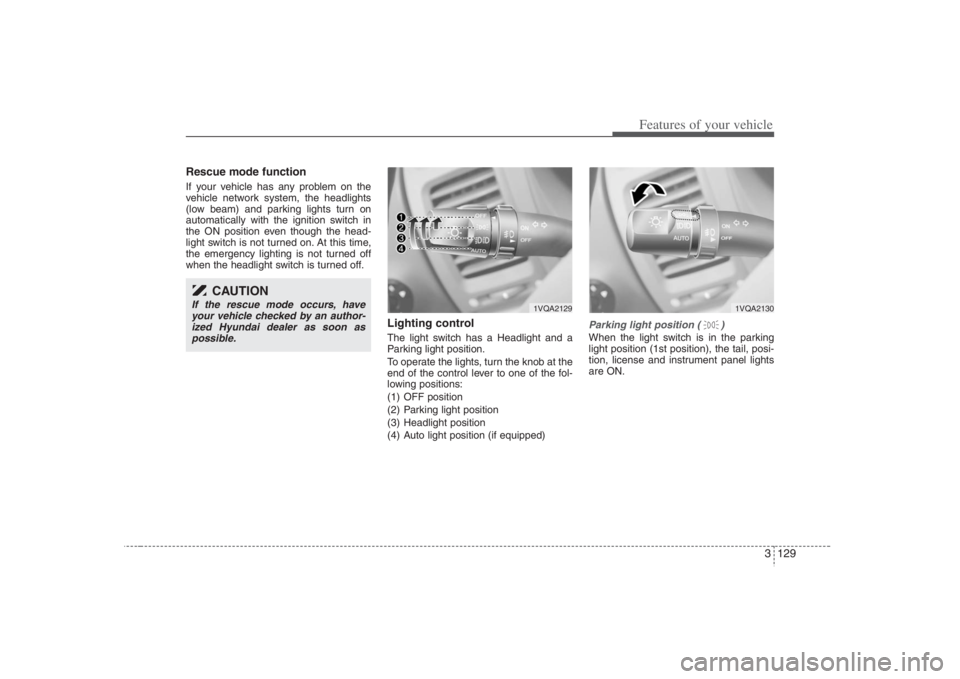
Lighting controlThe light switch has a Headlight and a
Parking light position.
To operate the lights, turn the knob at the
end of the control lever to one of the fol-
lowing positions:
(1) OFF position
(2) Parking light position
(3) Headlight position
(4) Auto light position (if equipped)
Parking light position ( )When the light switch is in the parking
light position (1st position), the tail, posi-
tion, license and instrument panel lights
are ON.
CAUTION
If the rescue mode occurs, have
your vehicle checked by an author-
ized Hyundai dealer as soon as
possible.
1VQA2129
1VQA2130
Page 164 of 393
Features of your vehicle148 3Air conditioning system operation tips
If the vehicle has been parked in direct
sunlight during hot weather, open the
windows for a short time to let the hot
air inside the vehicle escape.
To help reduce moisture inside of win-
dows on rainy humid days, decrease
the humidity inside the vehicle by oper-
ating the air conditioning system.
During air conditioning system opera-
tion, you may occasionally notice a
slight change in engine speed as the
air conditioning compressor cycles on.
This is a normal system operation
characteristics.
Use the air conditioning system every
month for a few minutes to ensure
maximum system performance.
When using the air conditioning sys-
tem, you may notice water dripping (or
puddling) on the ground under the
passenger side of the vehicle. This is a
normal system operation characteris-
tic.
Operating the air conditioning system
in the recirculated air position does
provide maximum cooling, however,
continual operation in this mode may
cause the air inside the vehicle to
become stale.
Checking the amount of air con-
ditioner refrigerant and compres-
sor lubricantWhen the amount of refrigerant is low,
the performance of the air conditioning is
reduced. Overfilling also has negative
result on the air conditioning system.
Therefore, if abnormal operation is
found, have the system inspected by an
authorized Hyundai dealer.
WARNING
The air conditioning system should
be serviced by an authorized
Hyundai dealer. Improper service
may cause serious injury.
CAUTION
When the performance of the air
conditioning system is reduced it is
important that the correct type and
amount of oil and refrigerant is
used. Otherwise, damage to the
compressor and abnormal system
operation may occur.
Page 176 of 393

Features of your vehicle160 3Air conditioning (Automatic system)All Hyundai Air Conditioning Systems
use R-134a refrigerant which is not dam-
aging to the ozone layer.
1. Start the engine. Push the AUTO but-
ton.
2. Set the temperature control to the
desired position.Air conditioning system operation tips
If the vehicle has been parked in direct
sunlight during hot weather, open the
windows for a short time to let the hot
air inside the vehicle escape.
To help reduce moisture inside of win-
dows on rainy humid days, decrease
the humidity inside the vehicle by oper-
ating the air conditioning system.
During air conditioning system opera-
tion, you may occasionally notice a
slight change in engine speed as the
air conditioning compressor cycles on.
This is a normal system operation
characteristics.
Use the air conditioning system every
month for a few minutes to ensure
maximum system performance.
When using the air conditioning sys-
tem, you may notice water dripping (or
puddling) on the ground under the
passenger side of the vehicle. This is a
normal system operation characteris-
tic.
Operating the air conditioning system
in the recirculated air position does
provide maximum cooling, however,
continual operation in this mode may
cause the air inside the vehicle to
become stale.
CAUTION
When using the air conditioning
system, monitor the temperature
gauge closely while driving up
hills or in heavy traffic when out-
side temperatures are high. Air
conditioning system operation
may cause engine overheating.
Continue to use the blower fan by
turning the air conditioning sys-
tem off if the engine temperature
gauge indicates engine overheat-
ing.
When opening the windows in
humid weather, the air condition-
ing system may cause condensa-
tion inside the vehicle. Since
excessive condensation (water)
may cause damage to electrical
equipment, the air conditioning
should only be run with the win-
dows closed.