2008 HYUNDAI ENTOURAGE esc
[x] Cancel search: escPage 342 of 393

633
Maintenance
Description Fuse rating Protected component
IPM 1 50A Instrument panel module
IPM 2 50A Instrument panel module
IPM 3 50A Instrument panel module
FRT BLOWER 40A Inside relay box(Front blower
relay)
RR BLOWER 30A Inside relay box(Rear blower
relay)
IG 2 RELAY - Ignition relay
A/C COMP RELAY - Air conditioner compressor relay
MAIN RELAY - Main relay
START RELAY - Start relay
FUEL PUMP RELAY - Fuel pump relayEngine compartment (main fuse)
Description Fuse rating Protected component
ALT 150A Generator
C/FAN 60A Cooling fan
Page 353 of 393

Maintenance44 6Tire tractionTire traction can be reduced if you
drive on worn tires, tires that are
improperly inflated or on slippery
road surfaces. Tires should be
replaced when tread wear indicators
appear. To reduce the possibility of
losing control, slow down whenever
there is rain, snow or ice on the road.Tire maintenance In addition to proper inflation, correct
wheel alignment helps to decrease
tire wear. If you find a tire is worn
unevenly, have your dealer check the
wheel alignement.
When you have new tires installed,
make sure they are balanced. This
will increase vehicle ride comfort and
tire life. Additionally, a tire should
always be rebalanced if it is removed
from the wheel.
Tire sidewall labelingFederal law requires tire manufactur-
ers to place standardized information
on the sidewall of all tires. This infor-
mation identifies and describes the
fundamental characteristics of the
tire and also provides the tire identifi-
cation number (TIN) for safety stan-
dard certification. The TIN can be
used to identify the tire in case of a
recall.1. Manufacturer or brand nameManufacturer or Brand name is
shown.
2. Tire size designation A tire’s sidewall is marked with a tire
size designation. You will need this
information when selecting replace-
ment tires for your car. The following
explains what the letters and num-
bers in the tire size designation
mean.
Example tire size designation:
(These numbers are provided as an
example only; your tire size designa-
tor could vary depending on your
vehicle.)
P185/65R14 86H
P - Applicable vehicle type (tires
marked with the prefix “P’’ are
intended for use on passenger
cars or light trucks; however, not
all tires have this marking).
185 - Tire width in millimeters.
65 - Aspect ratio. The tire’s section
height as a percentage of its
width.
R - Tire construction code (Radial).
14 - Rim diameter in inches.
I030B04JM
1
1
2
34
5,6
7
Page 371 of 393
Maintenance62 6To help prevent corrosionYou can help prevent corrosion from get-
ting started by observing the following:Keep your car cleanThe best way to prevent corrosion is to
keep your car clean and free of corrosive
materials. Attention to the underside of
the car is particularly important.
If you live in a high-corrosion area —
where road salts are used, near the
ocean, areas with industrial pollution,
acid rain, etc.—, you should take extra
care to prevent corrosion. In winter,
hose off the underside of your car at
least once a month and be sure to
clean the underside thoroughly when
winter is over.
give particular attention to the compo-
nents under the fenders and other
areas that are hidden from view. Do a
thorough job; just dampening the accu-
mulated mud rather than washing it
away will accelerate corrosion rather
than prevent it. Water under high pres-
sure and steam are particularly effec-
tive in removing accumulated mud and
corrosive materials.
rocker panels and frame members, be
sure that drain holes are kept open so
that moisture can escape and not be
trapped inside to accelerate corrosion.
Keep your garage dryDon't park your car in a damp, poorly
ventilated garage. This creates a favor-
able environment for corrosion. This is
particularly true if you wash your car in
the garage or drive it into the garage
when it is still wet or covered with snow,
ice or mud. Even a heated garage can
contribute to corrosion unless it is well
ventilated so moisture is dispersed.
Keep paint and trim in good condi-
tionScratches or chips in the finish should be
covered with "touch-up" paint as soon as
possible to reduce the possibility of cor-
rosion. If bare metal is showing through,
the attention of a qualified body and paint
shop is recommended.
Bird droppings : Bird droppings are high-
ly corrosive and may damage painted
surfaces in just a few hours. Always
remove bird droppings as soon as possi-
ble.Don't neglect the interiorMoisture can collect under the floor mats
and carpeting to cause corrosion. Check
under the mats periodically to be sure
the carpeting is dry. Use particular care if
you carry fertilizers, cleaning materials or
chemicals in the car.
These should be carried only in proper
containers and any spills or leaks should
be cleaned up, flushed with clean water
and thoroughly dried.
Page 375 of 393
Maintenance66 6Cleaning the lap/shoulder belt web-
bing Clean the belt webbing with any mild
soap solution recommended for cleaning
upholstery or carpet. Follow the instruc-
tions provided with the soap. Do not
bleach or re-dye the webbing because
this may weaken it.Cleaning the interior window glass If the interior glass surfaces of the vehi-
cle become fogged (that is, covered with
an oily, greasy or waxy film), they should
be cleaned with glass cleaner. Follow the
directions on the glass cleaner container.The emission control system of your
vehicle is covered by a written limited
warranty. Please see the warranty infor-
mation contained in the Owner’s
Handbook & Warranty Information book-
let in your vehicle.
Your Hyundai is equipped with an emis-
sion control system to meet all emission
regulations.
There are three emission control sys-
tems which are as follows.
(1) Crankcase emission control system
(2) Evaporative emission control system
(3) Exhaust emission control system
In order to assure the proper function of
the emission control systems, it is rec-
ommended that you have your car
inspected and maintained by an author-
ized Hyundai dealer in accordance with
the maintenance schedule in this manu-
al.Caution for the Inspection and
Maintenance Test (With Electronic
Stability Control (ESC) system)
To prevent the vehicle from misfir-
ing during dynamometer testing,
turn the Electronic Stability Control
(ESC) system off by pressing the
ESC switch.
After dynamometer testing is com-
pleted, turn the ESC system back on
by pressing the ESC switch again.
1. Crankcase emission control
systemThe positive crankcase ventilation sys-
tem is employed to prevent air pollution
caused by blow-by gases being emitted
from the crankcase. This system supplies
fresh filtered air to the crankcase through
the air intake hose. Inside the crankcase,
the fresh air mixes with blow-by gases,
which then pass through the PCV valve
into the induction system.
CAUTION
Do not scrape or scratch the inside
of the rear window. This may result
in damage to the rear window
defroster grid.
EMISSION CONTROL SYSTEM
Page 376 of 393
667
Maintenance
2. Evaporative emission control
(including ORVR: Onboard
Refueling Vapor Recovery)
SystemThe Evaporative Emission Control
System is designed to prevent fuel
vapors from escaping into the atmos-
phere.
(The ORVR system is designed to allow
the vapors from the fuel tank to be
loaded into a canister while refueling at
the gas station, preventing the escape of
fuel vapors into the atmosphere.)CanisterFuel vapors generated inside the fuel
tank are absorbed and stored in the
onboard canister. When the engine is
running, the fuel vapors absorbed in the
canister are drawn into the surge tank
through the purge control solenoid valve.Purge Control Solenoid Valve (PCSV)The purge control solenoid valve is con-
trolled by the Engine Control Module
(ECM); when the engine coolant temper-
ature is low during idling, the PCSV clos-
es so that evaporated fuel is not taken
into the engine. After the engine warms-
up during ordinary driving, the PCSV
opens to introduce evaporated fuel to the
engine.
3. Exhaust emission control
systemThe Exhaust Emission Control System is
a highly effective system which controls
exhaust emissions while maintaining
good vehicle performance.Vehicle modifications This vehicle should not be modified.
Modification of your Hyundai could affect
its performance, safety or durability and
may even violate governmental safety
and emissions regulations.
In addition, damage or performance
problems resulting from any modification
may not be covered under warranty.Engine exhaust gas precautions (car-
bon monoxide) Carbon monoxide can be present with
other exhaust fumes. Therefore, if you
smell exhaust fumes of any kind inside
your vehicle, have it inspected and
repaired immediately. If you ever sus-
pect exhaust fumes are coming into
your vehicle, drive it only with all the
windows fully open. Have your vehicle
checked and repaired immediately.
WARNING
- Exhaust
Engine exhaust gases contain car-
bon monoxide (CO). Though color-
less and odorless, it is dangerous
and could be lethal if inhaled.
Follow the instructions following to
avoid CO poisoning.
PROPOSITION 65
WARNING
Engine exhaust and a wide variety
of automobile components and
parts, including components found
in the interior furnishings in a vehi-
cle, contain or emit chemicals
known to the State of California to
cause cancer and birth defects and
reproductive harm. In addition, cer-
tain fluids contained in vehicles
and certain products of component
wear contain or emit chemicals
known to the State of California to
cause cancer and birth defects or
other reproductive harm.
Page 377 of 393
Maintenance68 6 Do not operate the engine in confined
or closed areas (such as garages) any
more than what is necessary to move
the vehicle in or out of the area.
When the vehicle is stopped in an
open area for more than a short time
with the engine running, adjust the
ventilation system (as needed) to draw
outside air into the vehicle.
Never sit in a parked or stopped vehi-
cle for any extended time with the
engine running.
When the engine stalls or fails to start,
excessive attempts to re-start the
engine may cause damage to the
emission control system.Operating precautions for catalyt-
ic converters Your vehicle is equipped with a catalytic
converter emission control device.
Therefore, the following precautions
must be observed: Use only UNLEADED FUEL for gaso-
line engine.
Do not operate the vehicle when there
are signs of engine malfunction, such
as misfire or a noticeable loss of per-
formance.
Do not misuse or abuse the engine.
Examples of misuse are coasting with
the ignition off and descending steep
grades in gear with the ignition off.
Do not operate the engine at high idle
speed for extended periods (5 minutes
or more).
Do not modify or tamper with any part
of the engine or emission control sys-
tem. All inspections and adjustments
must be made by an authorized
Hyundai dealer.
Avoid driving with a very low fuel level.
If you run out of gasoline, it could
cause the engine to misfire and result
in excessive loading of the catalytic
converter.
Failure to observe these precautions
could result in damage to the catalytic
converter and to your vehicle.
Additionally, such actions could void your
warranties.Perchlorate Material-special handling
may apply, See www.dtsc.ca.gov/haz-
ardouswaste/perchlorate.
Notice to California Vehicle Dismantlers:
Perchlorate containing materials, such as
airbag inflators, seatbelt pretensioners
and keyless remote entry batteries, must
be disposed of according to Title 22
California Code of Regulations Section
67384.10 (a).
WARNING
- Fire
A hot exhaust system can ignite
flammable items under your vehi-
cle. Do not park the vehicle over or
near flammable objects, such as
grass, vegetation, paper, leaves,
etc.
CALIFORNIA PERCHLORATE
NOTICE
Page 388 of 393
93
Index
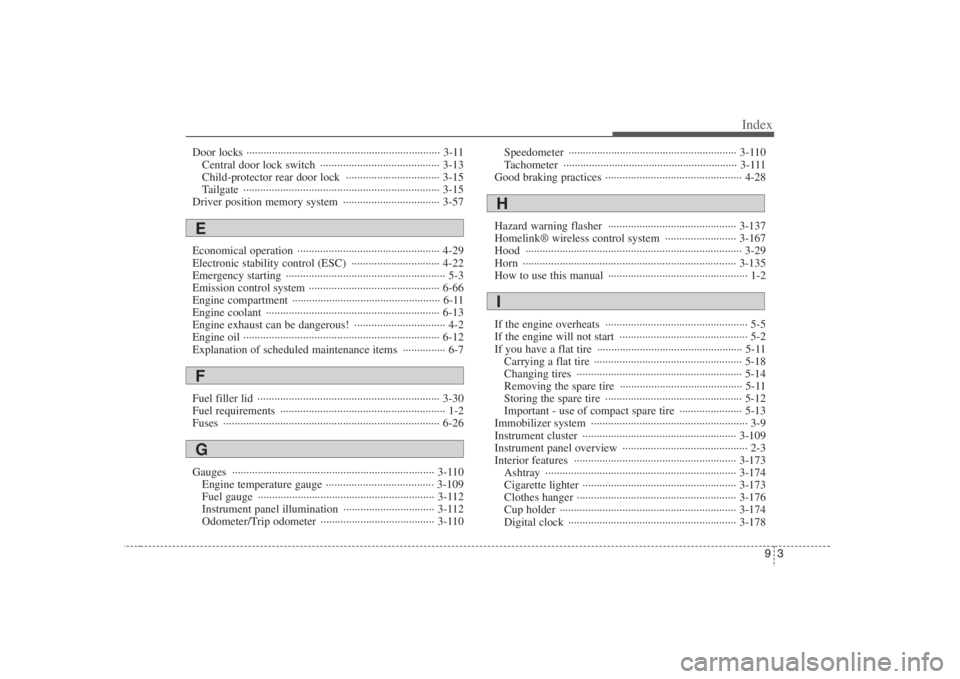
Door locks ···································································· 3-11
Central door lock switch ·········································· 3-13
Child-protector rear door lock ································· 3-15
Tailgate ····································································· 3-15
Driver position memory system ·································· 3-57
Economical operation ·················································· 4-29
Electronic stability control (ESC) ······························· 4-22
Emergency starting ························································ 5-3
Emission control system ·············································· 6-66
Engine compartment ···················································· 6-11
Engine coolant ····························································· 6-13
Engine exhaust can be dangerous! ································ 4-2
Engine oil ····································································· 6-12
Explanation of scheduled maintenance items ··············· 6-7
Fuel filler lid ································································ 3-30
Fuel requirements ·························································· 1-2
Fuses ············································································ 6-26
Gauges ······································································· 3-110
Engine temperature gauge ······································ 3-109
Fuel gauge ······························································ 3-112
Instrument panel illumination ································ 3-112
Odometer/Trip odometer ········································ 3-110Speedometer ··························································· 3-110
Tachometer ····························································· 3-111
Good braking practices ················································ 4-28
Hazard warning flasher ············································· 3-137
Homelink® wireless control system ························· 3-167
Hood ············································································ 3-29
Horn ··········································································· 3-135
How to use this manual ················································· 1-2
If the engine overheats ·················································· 5-5
If the engine will not start ············································· 5-2
If you have a flat tire ··················································· 5-11
Carrying a flat tire ···················································· 5-18
Changing tires ·························································· 5-14
Removing the spare tire ··········································· 5-11
Storing the spare tire ················································ 5-12
Important - use of compact spare tire ······················ 5-13
Immobilizer system ······················································· 3-9
Instrument cluster ······················································ 3-109
Instrument panel overview ············································ 2-3
Interior features ························································· 3-173
Ashtray ··································································· 3-174
Cigarette lighter ······················································ 3-173
Clothes hanger ························································ 3-176
Cup holder ······························································ 3-174
Digital clock ··························································· 3-178EFG
HI