2008 GREAT WALL FLORID ABS
[x] Cancel search: ABSPage 94 of 281

Downloaded from www.Manualslib.com manuals search engine 87Suspension System
Inspection, installation, and removal of the
trailing arm spindle sleeve assembly
1. Trailing arm spindle sleeve inspection.
(a) Inspect the trailing arm spindle sleeve for deformities,
shifting, partial or serious cracks, or loosening.
(b) If any existing damage of the trailing arm spindle
sleeve is not clearly seen, take the following steps:
Wash the trailing arm spindle sleeve's rubber areas with
clean water. Rub it clean with cotton meanwhile (shown
on the left). Check and make sure the rubber surface has
none of the previously mentioned flaws. If it does, re-
place with a new trailing arm spindle sleeve assembly.
2. Trailing arm spindle sleeve removal.
(a) Use a white paint pen to mark, and remember the trail-
ing arm spindle sleeve assembly direction.
(b) T h e t r a i l i n g a r m s p i n d l e s l e e v e i s d i s p o s a b l e . I f
damaged, first use a pry bar to lift up the edge of the
trailing arm spindle sleeve's outer tube in order to
install the SST (Special Service Tools).
Rear twist beam assembly removal
1. Hold up the rear twist beam assembly with a lift, and
remove the rear shock absorber and rear coil spring.
For detailed steps, refer to the rear shock absorber and
coil spring removal.
2. Remove the hexagon bolt for flange face
Q151B12110TF2 + Q402 (d2=35 t=5) FD, and slowly
set down the twist beam (as shown on the left).
Tightening torque: 77-87 N·m
When removing bolts, check and ensure that the rear
twist beam is reliably supported, to avoid injury from it
falling.
4. Remove the rear shock absorber.
Screw down the hexagon nut for flange face Q32012T13F2
(M12×1.25) FD linking the rear shock absorber and rear
twist beam, and remove the rear shock absorber. Make sure
the rear twist beam is firmly supported meanwhile.
Tightening torque: 44-54 N·m
5. Remove the coil spring.
Slowly release the firmly supported rear twist beam, at
the same time support the coil spring, until the coil spring
loosens, then take it down.
Rear shock absorber
Large washer
Hexagon nut for flange face
Page 96 of 281

Downloaded from www.Manualslib.com manuals search engine 89Suspension System
Wheel and Tire
Tire
Remark
This vehicle's tire is of the tubeless type. The optimal design condition is met when the inflation pressure is at
the recommended value, and the tire is under full load. Maintaining suitable tire pressure and proper driving
habits greatly influence the tire's use life. For the vehicle, it improves riding comfort, stability, and handling. For
the tire, it reduces tread wear, damage to the tire and extends tire life. Overloading, speeding, and unnecessary
emergency braking will all add to the tire's wear and tear.
Tire pressure measurements should be taken under normal temperature. If the tire pressure rises due to motion
generated heat when driving, cooling it will return to the normal temperature. Therefore, do not deflate the tire
when the air pressure has risen to this point. The tire's air pressure will naturally and slowly decrease when used
under normal conditions. Hence please inspect the air pressure regularly (suggested once a month). The spare
tire should be kept in a useable condition at all times.
Inspect the tire pressure when it is cool monthly or before a long drive. Adjust the tire pressure to the recom-
mended level. The air pressure will normally rise because the tire warms up due to movement. Therefore, after
driving, you absolutely must not deflate or reduce the tire's air pressure, as deflating could reduce the cool tire's
air pressure.
Tire inflation
During a new tire's initial stage of use, warning due to bending motions will cause the tire to swell, and thus
reduce the corresponding air pressure. After 24 hours or 2000-3000 km worth of drive, charge the air pressure.
After inflating, check if the air nozzle core is leaking air with soapy \
water, then lock on the cap.
Possible problems caused by tire pressure
Exceeding the recommended air
pressure
Below the recommended air pressureSame vehicle axle, different
air pressure
Possible problems it
can create
1. Bumpy ride
2. The tear or rupturing of the tire
3. Rapid wear of the tire tread's center
1. Noisy turns
2. Uneasy turns
3. Tread edge wear is accelerated and uneven
4. The tire's rim is damaged or ruptured
5. The tire cord ruptures
6. High tire temperature
7. Steering failure
8. Large oil consumption
1. Uneven braking
2. Over steering
3. Steering failure
4. Deviation while accelerating
Tire and wheel (steel wheel) installation instructions
When installing the tire and wheel, the tire's radial hardware components, also called "high spot", should be at
the same level of the wheel's minimum radius or so called "low spot".
The "high spot" of the tire is initially marked by the paint spot on the side of the tire's surface. This paint will
eventually be washed away.
The "low spot" of the wheel is initially marked by a paint spot on the wheel flange. Whenever the tire is
removed from the wheel, the tire and wheel need re-balancing to make sure the vehicle runs smoothly. If no
paint spot is found on the tire, draw a line on the tire and the wheel before they are removed, in order to make
sure that the tire and the wheel will be re-assembled at the same place.\
Tire replacement
When a tire needs to be replaced, make sure to use a tire with the same specification as the original one. A new
tire used for replacement must be of the same dimension, load area, and structure as the original one. Using tires
that are different in dimension or type will influence the vehicle's riding comfort, handling, speedometer and
odometer calibration, vehicle ground clearance, and the clearance between the tire or the tire's snow chain and
the vehicle body or chassis.
It is suggested to use a new pair of tires on the same axle. If only one tire is needed to be replaced, make sure to
use a tire with a tread most similar to the original, so as to keep brak\
e power and traction balanced.
Warning: Do not mix radial tires, bias tires, bias belted tires, etc., which are of different structure on the
same vehicle unless it is an emergency. Mixing different tires would seriously influence the vehicle's
handling and stability, and even possibly lead to losing control of the vehicle.
Page 100 of 281

Downloaded from www.Manualslib.com manuals search engine 93Suspension System
Dynamic balance and static balance
There are two types of wheel balance: static and dynamic.
Picture 1 shows static balance. Picture 2 shows dynamic
balance.
Static balance means that the weight distribution around the
wheel is equal. If the wheel is static and unbalanced, violent
vibrations may be created, called jump vibration.This kind
of situation can ultimately lead to the uneven wear and tear
of the tires. Shown in diagram 1.
Dynamic balance means that the weight distribution on the
two sides of the medium plane of the wheel is equal, so
during the rotation process, the tire assembly cannot create a
tendency for the medium plane of the wheel to shift from one
side to the other. If the wheel is dynamic and unbalanced, it
can create a shimmying effect. Shown in diagram 2.
1. Wheel shimmy important points[C]: Counterweight not yet added
2. Locations to add counterweight[D]: Counterweight added
3. Axis
Wheel maintenance
Do not use welding, heating, or hammering to repair wheels. All damaged wheels must be replaced.
If the vehicle's wheel is twisted or deformed, sunken or depressed, having too much horizontal or radial hop,
leaking air from the welded parts, stretched out at the bolt holes , having flimsy nut bolt lock, or severely rusty,
the wheel must be replaced. When the wheel is hopping too much, it will lead to undesirable vibratio\
ns.
When replacing the tire, be sure that the load capacity, diameter, rim width, offset distance, and the installation
structure of it, are equal to the settings of original wheel. If the wheel dimensions are not appropriate, this will
influence the wheel and bearing's life, brake cooling effect, speedometer and odometer calibration, vehicle
ground clearance, as well as the clearance between the tire and the vehi\
cle body, and the tire and vehicle chassis.
Wheel (steel wheel) removal
1. Remove the wheelhouse and loosen the nuts, 1-2 turns is
enough.
2. Hoist the vehicle.
3. Screw off the nuts and remove the wheel.
Nut tightening torque: 110±10 N·m
Caution: Heating methods absolutely must not be used
to loosen tightened wheels, otherwise the heat will
reduce its use life and damage the hub bearing.
Wheel (steel wheel) installation
Installation according to the reversed instructions used for
removal, and pay attention to the following requirements:
Wheel nuts must be tightened in proper order and according to
the specified torque, as to avoid wheel or brake disc deformity.
When installing the wheel house, be sure to line up the wheel
housing notch locations with the inflation nozzle.
Tightening sequence: A – C – B – D
Caution: Before installing the wheel, first clean off the
corrosion on the wheel's mounting surface and drum
brake or brake disc's installation surface with a wire
brush, in order to make the wheel installing easier by
making the space between its metal firmly connect
to the mounting surface, otherwise it may lead to the
wheel nuts loosening to the extent that the vehicle's
wheel may come off while driving some day.
1
3
2[A][B]
1. Wheel hop important points[A]: Counterweight not yet added
2. Locations to add counterweight[B]: Counterweight added
3. Axis
Diagram 1
Diagram 2
[C][D]
1
3
2
AB
CD
Page 101 of 281

Downloaded from www.Manualslib.com manuals search engine GWFLORID Maintenance Manual94
Brake System
Brake System Components Arrangement Schematics.......95
Brake System Maintenance................................................96
Brake Pedal ........................................................................\
98
Parking Brake Control Mechanism Assembly...................102
Vacuum Booster with Brake Cylinder Assembly ...............103
Anti-lock Brake System ....................................................107
ABS General Problem Maintenance and
Areas of Importance .........................................................109
Steering Knuckle and Hub Brake Assembly .....................112
Front Brake Caliper ..........................................................118
Rear Brake .......................................................................124
Rear Support Axle ............................................................131
Page 102 of 281

Downloaded from www.Manualslib.com manuals search engine 95Brake System
Brake System Components Arrangement Schematics
Brake pedal assembly
Vacuum booster with brake cylinder assembly
Left steering knuckle and hub brake assembly
Left parking brake cable assembly
Rear brake assembly RHRear brake drum
Rear wheel speed sensor assembly RH
Right parking brake cable assembly
ABS controller assembly
Right steering knuckle and hub brake assembly
Brake line assembly
Rear wheel speed
sensor assembly LH
Front wheel speed sensor assembly RHFront wheel speed sensor assembly LH
Rear brake assembly LH
Parking brake control mechanism assembly
Page 103 of 281
Downloaded from www.Manualslib.com manuals search engine GWFLORID Maintenance Manual96
Brake System Maintenance
Brake fluid inspection and replacement
Brake fluid directly influences the brake performance and the operating conditions and use life of the brake
system components. Brake fluid has very strong hygroscopic properties, and thus absorbs water easily,
which will then deteriorate the metal and rubber pieces. Polluted and deteriorated brake fluid or its mixture
would cause the brake fluid to boil and gasify, hence reduces braking efficiency. Therefore, pay attention to
the items below when filling or changing the brake fluid:
1. Containers used to hold brake fluid must be tightly closed and sealed
2. Brake fluid is poisonous and damaging to the paint. Hence if it gets on the vehicle surface, rub it
off at once
3. If water or other contaminates found in the brake fluid, and the brake master cylinder's piston seal
has been broken, then the brake fluid and all the rubber pieces inside the brake system including
the brake hose must be replaced
4. The correct brake fluid level in the reservoir must be between MAX and MIN. After the vehicle has
been driven for over 1000 km, check the brake fluid level in the reservoir. If the brake fluid level is
not up to regulation, more brake fluid should be added to the reservoir \
until it reaches MAX.
Hydraulic component inspection and system flushing
1. If the oil-based solvent gets into the hydraulic system, flush the whole system and change all of
the rubber pieces
2. Clean your hands before installing new rubber pieces or other components
3. Do not use regular solvents (kerosene, gas, etc.) when inspecting or cleaning hydraulic
components, instead use absorbing alcohol or brake fluid
4. After inspecting the components, drain the brake fluid from the system. Use new brake fluid to
flush the system. Afterwards, add new brake fluid to perform hydraulic system exhaust
5. Flushing completion sign: When the brake fluid flowing out of the dump valve is clear from any
contaminate.
Hydraulic pressure system drainage
If the brake fluid inside the whole hydraulic pressure system needs to be emptied, open all the bleed screws
with each connected to a hose, as to allow the brake fluid to flow into a container. Step on the pedal slowly
until only air flows out. During the whole procedure, make sure all the \
valves are open.
Hydraulic pressure system air bleeding
The hydraulic brake system must work under a vacuum environment. The air will cause spongy brake or
overall brake failure when it flows into the hydraulic system. It is extremely necessary to bleed system air
when performing any operation on the brake system or if any air inside t\
he brake system is suspected.
1. Air bleeding sequence
If air inside the brake master cylinder is suspected, first perform air bleeding.
(a) If numerous valves are equipped, air bleed each valve
(b) Another sequence principle is: Air bleed from the wheel brake furthest away from the master cylinder.
The air bleeding sequence for the LHD modules is: rear right wheel - left rear wheel - front right wheel
- front left wheel, Right rudder vehicles: rear right wheel - left rear wheel - front left wheel - front right
wheel.
2. Air bleeding method
(1) Manual air bleeding
Use the brake pedal or pump as the air bleeding power source. When the air bleed screws are open, vent the
brake fluid containing the bubbles from the system. Usually this is simultaneously done by two people. One
steps on the brake pedal and the other operates the air bleed screws. Important points to take note of when
performing the operation:
(a) Place the ignition switch to the off position and step on the pedal repeatedly to remove the
vacuum pressure or hydraulic pressure.
(b) Before and after air bleeding, add clean brake fluid into the master cylinder until it reaches
the correct (stated) level.
(c) Check the fluid level frequently to make sure that more than half of the reservoir's capacity is
available.
(d) Bleed screws should only be opened when the pedal is pressed down, and closed before the
pedal is loosened. Meanwhile, check if the vented brake fluid has bubble\
s inside.
Page 114 of 281
Downloaded from www.Manualslib.com manuals search engine 107Brake System
Anti-lock Brake System
ABS/EBD introduction
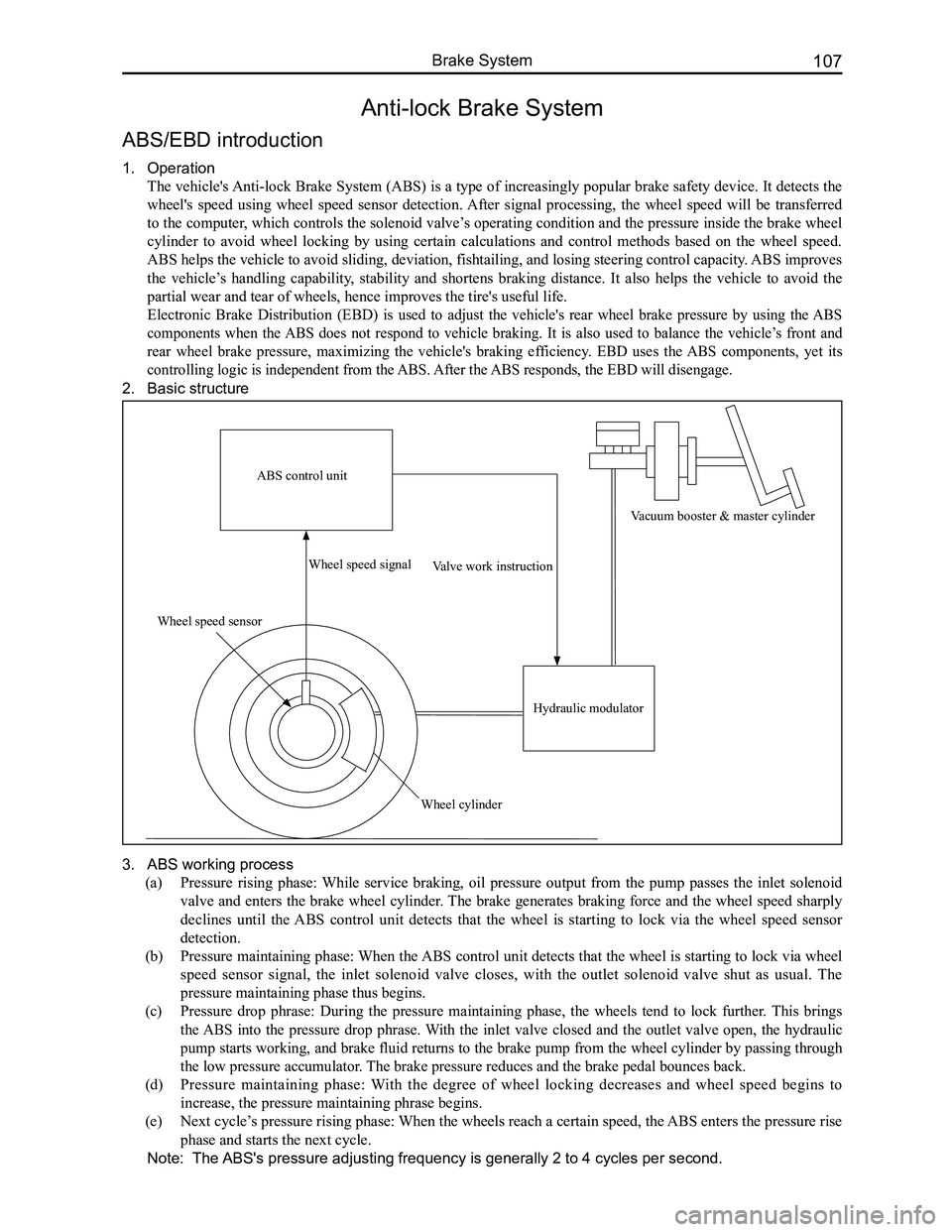
1. Operation
The vehicle's Anti-lock Brake System (ABS) is a type of increasingly popular brake safety device. It detects the
wheel's speed using wheel speed sensor detection. After signal processing, the wheel speed will be transferred
to the computer, which controls the solenoid valve’s operating condition and the pressure inside the brake wheel
cylinder to avoid wheel locking by using certain calculations and control methods based on the wheel speed.
ABS helps the vehicle to avoid sliding, deviation, fishtailing, and losing steering control capacity. ABS improves
the vehicle’s handling capability, stability and shortens braking distance. It also helps the vehicle to avoid the
partial wear and tear of wheels, hence improves the tire's useful life.
Electronic Brake Distribution (EBD) is used to adjust the vehicle's rear wheel brake pressure by using the ABS
components when the ABS does not respond to vehicle braking. It is also used to balance the vehicle’s front and
rear wheel brake pressure, maximizing the vehicle's braking efficiency. EBD uses the ABS components, yet its
controlling logic is independent from the ABS. After the ABS responds, the EBD will disengage.
2. Basic structure
3. ABS working process
(a) Pressure rising phase: While service braking, oil pressure output from the pump passes the inlet solenoid
valve and enters the brake wheel cylinder. The brake generates braking force and the wheel speed sharply
declines until the ABS control unit detects that the wheel is starting to lock via the wheel speed sensor
detection.
(b) Pressure maintaining phase: When the ABS control unit detects that the wheel is starting to lock via wheel
speed sensor signal, the inlet solenoid valve closes, with the outlet solenoid valve shut as usual. The
pressure maintaining phase thus begins.
(c) Pressure drop phrase: During the pressure maintaining phase, the wheels tend to lock further. This brings
the ABS into the pressure drop phrase. With the inlet valve closed and the outlet valve open, the hydraulic
pump starts working, and brake fluid returns to the brake pump from the wheel cylinder by passing through
the low pressure accumulator. The brake pressure reduces and the brake pedal bounces back.
(d) Pressure maintaining phase: With the degree of wheel locking decreases and wheel speed begins to
increase, the pressure maintaining phrase begins.
(e) Next cycle’s pressure rising phase: When the wheels reach a certain speed, the ABS enters the pressure rise
phase and starts the next cycle.
Note: The ABS's pressure adjusting frequency is generally 2 to 4 cycles per second.
ABS control unit
Wheel speed sensor
Wheel speed signal
Wheel cylinder
Valve work instruction
Hydraulic modulator
Vacuum booster & master cylinder
Page 115 of 281
Downloaded from www.Manualslib.com manuals search engine GWFLORID Maintenance Manual108
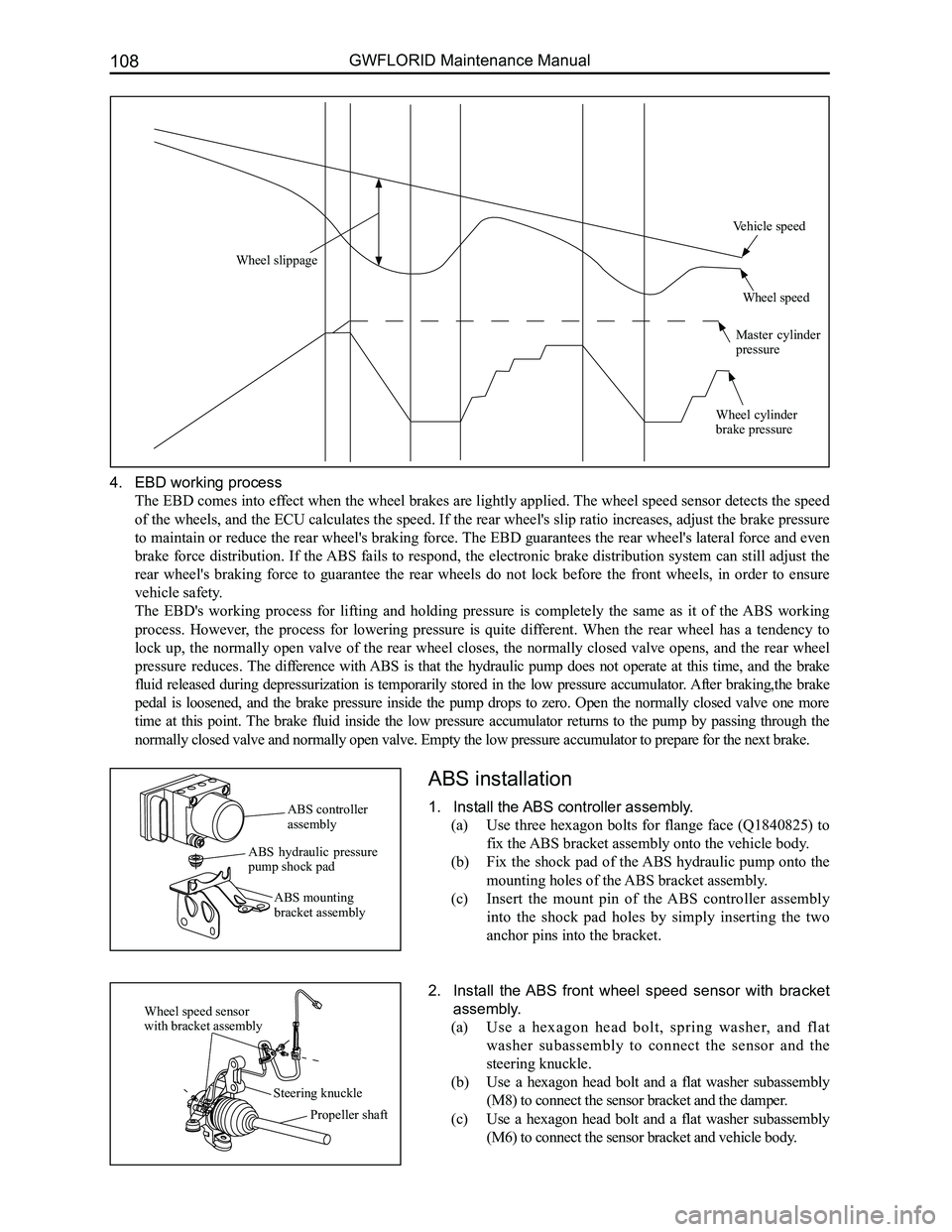
4. EBD working process
The EBD comes into effect when the wheel brakes are lightly applied. The wheel speed sensor detects the speed
of the wheels, and the ECU calculates the speed. If the rear wheel's slip ratio increases, adjust the brake pressure
to maintain or reduce the rear wheel's braking force. The EBD guarantees the rear wheel's lateral force and even
brake force distribution. If the ABS fails to respond, the electronic brake distribution system can still adjust the
rear wheel's braking force to guarantee the rear wheels do not lock before the front wheels, in order to ensure
vehicle safety.
The EBD's working process for lifting and holding pressure is completely the same as it of the ABS working
process. However, the process for lowering pressure is quite different. When the rear wheel has a tendency to
lock up, the normally open valve of the rear wheel closes, the normally closed valve opens, and the rear wheel
pressure reduces. The difference with ABS is that the hydraulic pump does not operate at this time, and the brake
fluid released during depressurization is temporarily stored in the low pressure accumulator. After braking,the brake
pedal is loosened, and the brake pressure inside the pump drops to zero. Open the normally closed valve one more
time at this point. The brake fluid inside the low pressure accumulator returns to the pump by passing through the
normally closed valve and normally open valve. Empty the low pressure ac\
cumulator to prepare for the next brake.
ABS installation
1. Install the ABS controller assembly.
(a) Use three hexagon bolts for flange face (Q1840825) to
fix the ABS bracket assembly onto the vehicle body.
(b) Fix the shock pad of the ABS hydraulic pump onto the
mounting holes of the ABS bracket assembly.
(c) Insert the mount pin of the ABS controller assembly
into the shock pad holes by simply inserting the two
anchor pins into the bracket.
2. Install the ABS front wheel speed sensor with bracket
assembly.
(a) Use a hexagon head bolt, spring washer, and flat
washer subassembly to connect the sensor and the
steering knuckle.
(b) Use a hexagon head bolt and a flat washer subassembly
(M8) to connect the sensor bracket and the damper.
(c) Use a hexagon head bolt and a flat washer subassembly
(M6) to connect the sensor bracket and vehicle body.
ABS controller assembly
ABS hydraulic pressure pump shock pad
ABS mounting bracket assembly
Wheel speed sensor with bracket assembly
Steering knuckle
Propeller shaft
Wheel slippage
Vehicle speed
Wheel speed
Master cylinder pressure
Wheel cylinder brake pressure