2008 GREAT WALL FLORID clutch
[x] Cancel search: clutchPage 44 of 281

Downloaded from www.Manualslib.com manuals search engine 37Clutch Operational System
Areas of Importance
1. Clutch Rigid Pipe Installation
Before installing, check to make sure that the rigid pipe flare contact area is in good condition, the pipeline is
clean, and that there is no foreign materials.
2. Clutch Hose Installation
Check the surface of the clutch hose to make sure that there is no scuffing and that the pipeline is clean.
3. Coat grease on the U-joint of the pedal and the master cylinder.
4. Strictly adhere to the set torque guidelines when tightening the pipe fittings.
Rigid pipe and the master cylinder: M10 16±2 N·m
Clutch rigid pipe and hose: M10 16±2 N·m
5. While the clutch system is undergoing the exhausting process, make sure that all the air bubbles in
the pipeline are cleared out. Then check the brake fluid level in the reservoir, it should be between
MIN and MAX.
Troubleshooting
The numbers in the table represent the order of the possible malfunction causes, so be sure to check each part in
turn. If necessary, replace the part.
SymptomsPossible Causes
Clutch vibration1. Engine mounting bracket (loose)
2. Clutch plate (axial runout is too much)
3. Clutch plate (oil build-up)
4. Clutch plate (polished)
5. Clutch plate (hardened)
6. Diaphragm spring (damaged)
Clutch pedal is spongy1. Clutch pipeline (air entering)
2. Clutch master cylinder cup (damaged)
3. Clutch slave cylinder cup (damaged)
Clutch makes abnormal noise1. Clutch release bearing (wear and tear, dirty or damaged)
2. Driven plate torsion damper (damaged)
Clutch slips1. Clutch pedal (free play is out of alignment)
2. Clutch plate (oil build-up)
3. Clutch plate (polished)
4. Diaphragm spring (damaged)
5. Pressure plate (deformed)
6. Flywheel (deformed)
Clutch cannot be disengaged1. Clutch pedal (free play out of alignment)
2. Clutch pipeline (air entering)
3. Clutch master cylinder cup (damaged)
4. Clutch slave cylinder cup (damaged)
5. Clutch plate (axial runout is too much)
6. Clutch plate (wear out from friction)
7. Clutch plate (dirty or burnt)
8. Clutch plate (oil build-up)
9. Clutch plate (lack of grease on the spline)
Page 45 of 281

Downloaded from www.Manualslib.com manuals search engine GWFLORID Maintenance Manual38
Clutch Operational System
Components
Clutch Master Cylinder Removal
1. Use a combination plier to loosen the steel band elastic
hoop, and to remove the clutch feed connecting hose.
Caution: Release the brake fluid in the reservoir before
disconnecting the hose.
Steel band elastic hoop
Clutch feed connecting hose
Reservoir
Steel band elastic hoop
Clutch feed connecting hose
Clutch discharge pipe
Clutch master cylinder
Limit adjusting bolt
Return spring
Lock nut
Page 46 of 281

Downloaded from www.Manualslib.com manuals search engine 39Clutch Operational System
2. Remove the driven clutch discharge pipe with a M10
open-end wrench.
3. Remove the pedal lock pin.
4. Remove the return spring and the connecting pin.
5. Remove the lock nuts of the clutch pedal with a M13
sleeve and an extension bar.
6. Remove the clutch master cylinder.
Clutch discharge pipe
Pedal lock pin
Return springConnecting pin
Lock nut
Clutch master cylinder
Page 47 of 281
Downloaded from www.Manualslib.com manuals search engine GWFLORID Maintenance Manual40
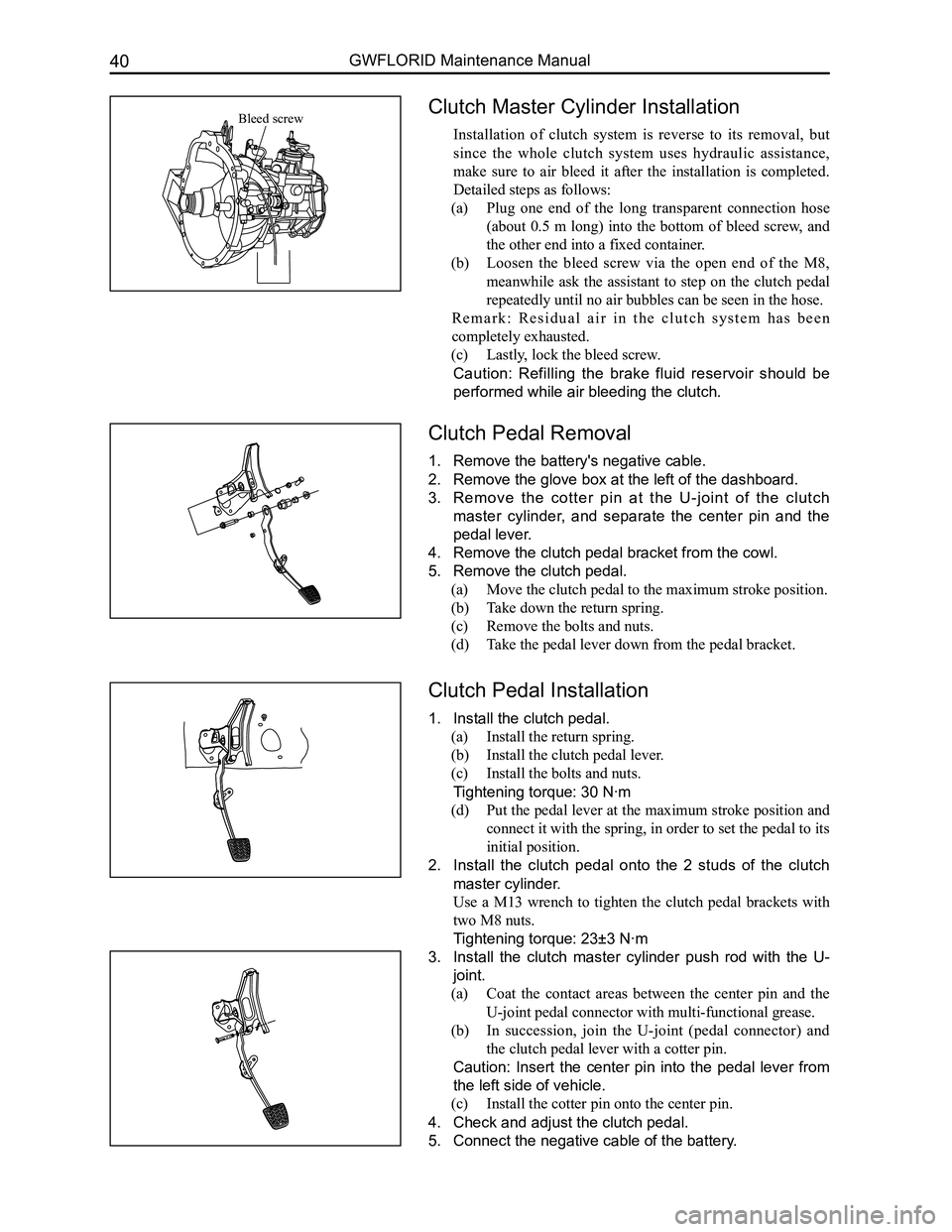
Clutch Master Cylinder Installation
Installation of clutch system is reverse to its removal, but
since the whole clutch system uses hydraulic assistance,
make sure to air bleed it after the installation is completed.
Detailed steps as follows:
(a) Plug one end of the long transparent connection hose
(about 0.5 m long) into the bottom of bleed screw, and
the other end into a fixed container.
(b) Loosen the bleed screw via the open end of the M8,
meanwhile ask the assistant to step on the clutch pedal
repeatedly until no air bubbles can be seen in the hose.
R e m a r k : R e s i d u a l a i r i n t h e c l u t c h s y s t e m h a s b e e n
completely exhausted.
(c) Lastly, lock the bleed screw.
Caution: Refilling the brake fluid reservoir should be
performed while air bleeding the clutch.
Clutch Pedal Removal
1. Remove the battery's negative cable.
2. Remove the glove box at the left of the dashboard.
3. Remove the cotter pin at the U-joint of the clutch
master cylinder, and separate the center pin and the
pedal lever.
4. Remove the clutch pedal bracket from the cowl.
5. Remove the clutch pedal.
(a) Move the clutch pedal to the maximum stroke position.
(b) Take down the return spring.
(c) Remove the bolts and nuts.
(d) Take the pedal lever down from the pedal bracket.
Clutch Pedal Installation
1. Install the clutch pedal.
(a) Install the return spring.
(b) Install the clutch pedal lever.
(c) Install the bolts and nuts.
Tightening torque: 30 N·m
(d) Put the pedal lever at the maximum stroke position and
connect it with the spring, in order to set the pedal to its
initial position.
2. Install the clutch pedal onto the 2 studs of the clutch
master cylinder.
Use a M13 wrench to tighten the clutch pedal brackets with
two M8 nuts.
Tightening torque: 23±3 N·m
3. Install the clutch master cylinder push rod with the U-
joint.
(a) Coat the contact areas between the center pin and the
U-joint pedal connector with multi-functional grease.
(b) In succession, join the U-joint (pedal connector) and
the clutch pedal lever with a cotter pin.
Caution: Insert the center pin into the pedal lever from
the left side of vehicle.
(c) Install the cotter pin onto the center pin.
4. Check and adjust the clutch pedal.
5. Connect the negative cable of the battery.
Bleed screw
Page 48 of 281

Downloaded from www.Manualslib.com manuals search engine 41Clutch Operational System
Clutch Pedal Examination and Adjustment
1. Check if the pedal height is correct.
Height from the carpet: 100-110 mm
2. Adjust the pedal height.
Loosen the lock nut and adjust the clutch pedal limit adjust-
ing bolt until its height is correct, and then tighten the lock
nut.
Tightening torque: 20 N·m
3. Check if the pedal free play is correct.
Step on the pedal until one can feel the resistance.
Pedal free play: 13.7 mm
4. Adjust the free play.
(a) Loosen the lock nuts of the clutch master cylinder and
rotate the push rod until the pedal reaches the correct
free play.
(b) Tighten the lock nuts.
Tightening torque: 20 N·m
(c) Recheck the clutch pedal height.
Pedal height
Lock nut
Limit adjusting bolt
Lock nut
Free play
Page 49 of 281

Downloaded from www.Manualslib.com manuals search engine GWFLORID Maintenance Manual42
Transmission
037A Transmission’s Overall External Schematics ............43
Main Technical Parameters ...............................................43
Transmission's Proper Use and Care .................................44
Technical Specifications for Transmission Installation
and Adjustment ...................................................................44
Areas of Importance ...........................................................45
Troubleshooting ..................................................................46
037A Transmission Structural Schematics .........................47
Clutch ........................................................................\
.........48
Gear Shift Fork and Fork Shaft...........................................49
Transmission Case .............................................................50
Disassembling the Input Shaft Subassembly .....................56
Disassembling the Output Shaft Subassembly ..................60
Disassembling the Shift Cover Subassembly .....................64
Disassembling the Differential Subassembly .....................68
Page 52 of 281

Downloaded from www.Manualslib.com manuals search engine 45Transmission
Areas of Importance
Removal
During removal, all components should be gently handled to avoid knocking, especially the joint surface.
All components should be placed in the proper order to avoid misplacing \
and mistaking.
Installation
1. Clean all parts before installation (except rubber pieces and gaskets)\
.
2. All oil seals, shaft retainers, and elastic pins should not be reused.
3. All rubbing surfaces should be coated with lubricant, and the lips of all oil seals should be coated with
grease.
4. During installation of the bearings, do not use any kind of rolling element to transmit pressure, and
make sure not to tilt it.
5. During the installation of synchronizer components, the two sides of the spring piston's openings
should alternate.
6. When the transmission is operating under normal working conditions, there should be no lubricant
leakage from any of the parts.
Transportation and storage
1. When transporting a transmission, make sure the conditions are dustproof and rainproof, as well as
take proper care not to damage it due to jolting, shaking, removal, or i\
nstallation.
2. Transmission assembly should be stored in a ventilated, dustproof, and dr\
y place.
3. Users with special transportation or storage requirements should have another discussion to reach an
agreement on this matter in the supply contract.
Use partsBolt codeSpecificationsQuantity
Tighten-
ing torque
(N·m)
Differential case × differential ring gear037-2303309M12 × 1.06123.6
C l u t c h h o u s i n g × r e v e r s e g e a r a r m
bracket subassembly037-1702073M8 × 1.25217.2
No. 1 gear shift fork shaft × No. 1 gear
shift fork037-1702056M6 × 0.75115.7
No. 2 gear shift fork shaft × No. 2 gear
shift fork037-1702056M6 × 0.75115.7
Transmission case × clutch housing037-1701012M8 × 1.251329.4
Transmission case × manipulation lid
subassembly037-1702051M8 × 1.25412.0
Transmission case × position mechanism
component037-1702042M18 × 1.5136.8
Transmission case × reverse gear idler
shaft × sealing ring037-1701404M8 × 1.25129.4
Transmission case × hexagon head plug037-1701016M18 × 1.5239.2
Transmission case × reverse gear switch
subassembly037-1701022M18 × 1.5140.2
Transmission case × cable bracket037-1701019M8 × 1.25411.3
Clutch housing × clutch slave cylinder
subassembly037-1601019M8 × 1.25211.3
Select lever assembly × gear shifting
block037-1702027M8 × 1.25138.0
Clutch housing × release fork support
nail037-1601011M10 × 1.25136.8
Counterweight component × shift lever
component037-1702030M8 × 1.25220.0
Release fork support nail129.4
Thread fastening piece tightening torque table
Page 53 of 281

Downloaded from www.Manualslib.com manuals search engine GWFLORID Maintenance Manual46
Troubleshooting
Common problemsPossible causesSolving methods
Difficult gear
engagement
Not applying clutchUse correct driving methods
Insufficient clutch separation Inspection & adjustment
Serious abrasion of the synchronizer ringReplace component
Positioning spring is too hardReplace component
Noise is too loud or
abnormal
Oil level is too lowFill oil to the specified level
Lubricant is of poor qualityReplace the specified oil
Untimely oil changesReplace oil and damaged part
Improper gear axial position and clearanceInspect and adjust
Damaged bearingReplace component
Gear has a burr or has been knockedRepair or replace gear
Oil leakageToo much oil is added, oil level too high.Fill the oil level to the specified position.
Bolt loose or missingReassemble and screw in according to regu-
lations.
Breather plug failsReplace
Damaged sealReplace
Synchronizer is damagedExcessive gear shifting force Replace synchronizer
Not applying clutchUse correct driving methods
Synchronizer's spring expan-
sion ring is damagedReplace
Gear disengagementControl mechanism malfunctionInspect and adjust
Retaining spring or steel ball missingAdditional assembly
Retaining spring malfunctionReplace
Fork groove of the gear sleeve is worn outReplace
Shifting fork is worn out.Replace
Bearing and gear are burntOil level is too lowReplace part and fill oil
Lubricant is of poor quality.Replace part and lubricant
Untimely oil replacement causes
the oil to be too dirtyReplace part and lubricant
Mixed use of different oils
or use of additivesReplace part and lubricant
Difficulty shifting gearsSynchronizer spring malfunctionReplace
The internal groove of the syn-
chronizer ring is worn outReplace
The synchronizer ring is seized
into the conical surfaceReplace
Deformed shifting fork or
shifting fork shaftReplace
Shifting fork is worn outReplace