Page 37 of 96
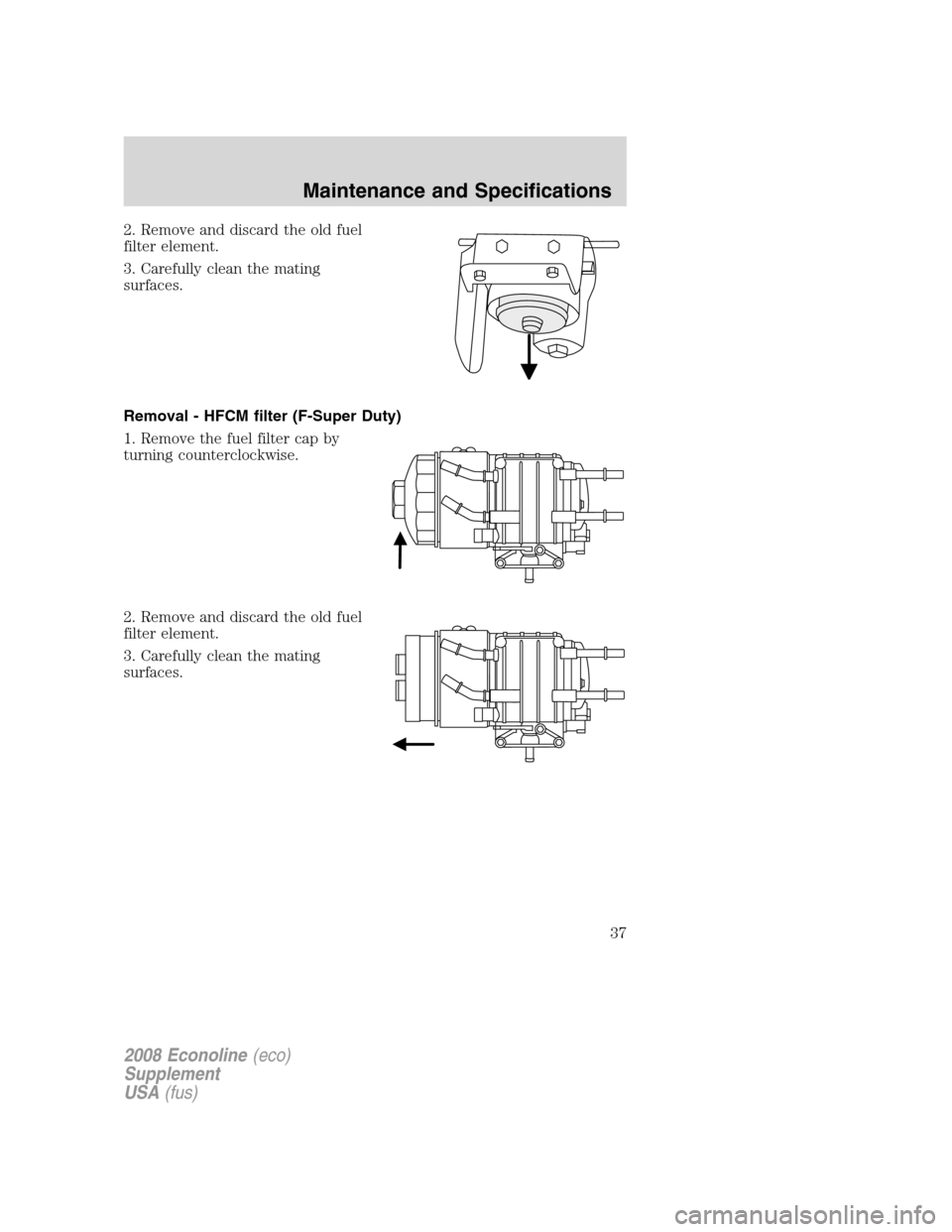
2. Remove and discard the old fuel
filter element.
3. Carefully clean the mating
surfaces.
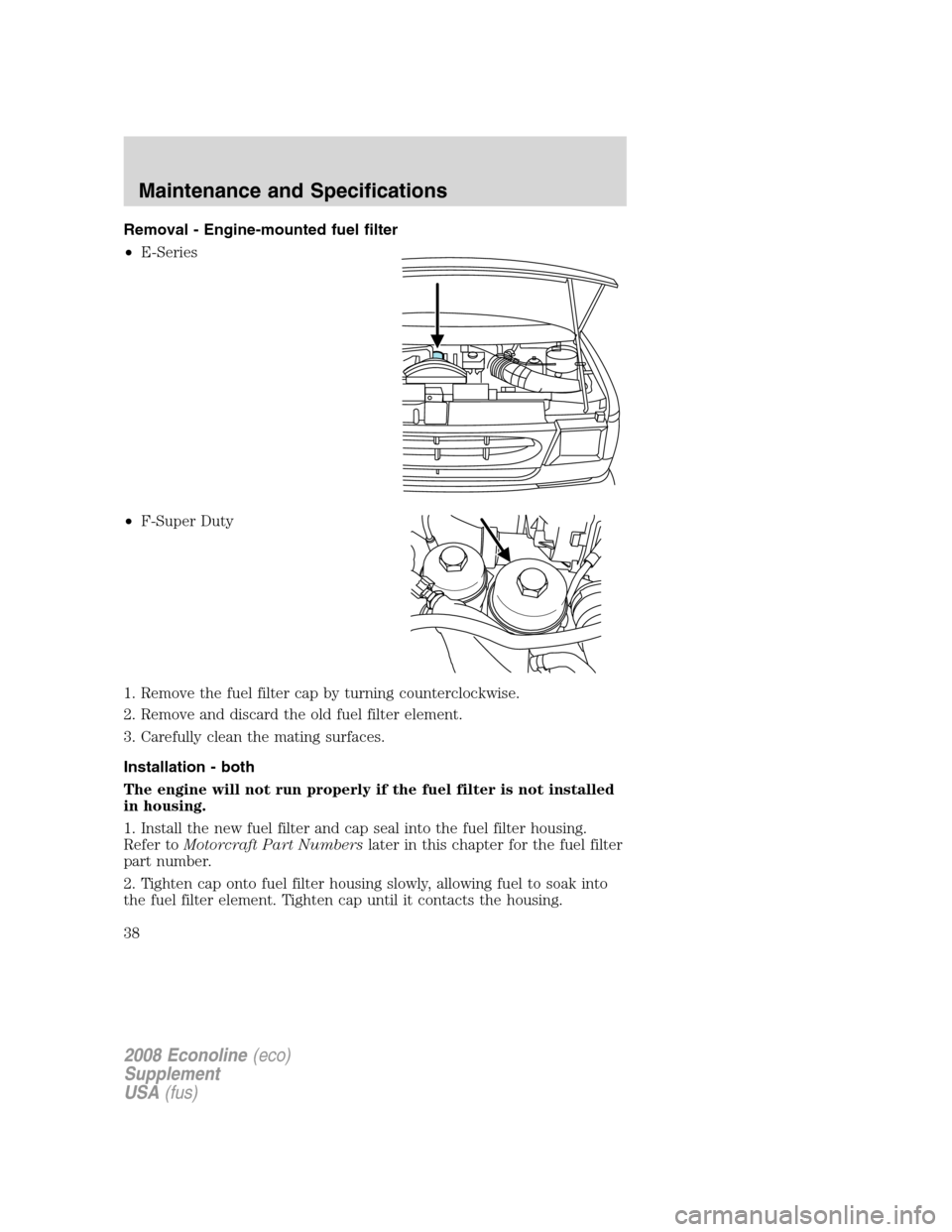
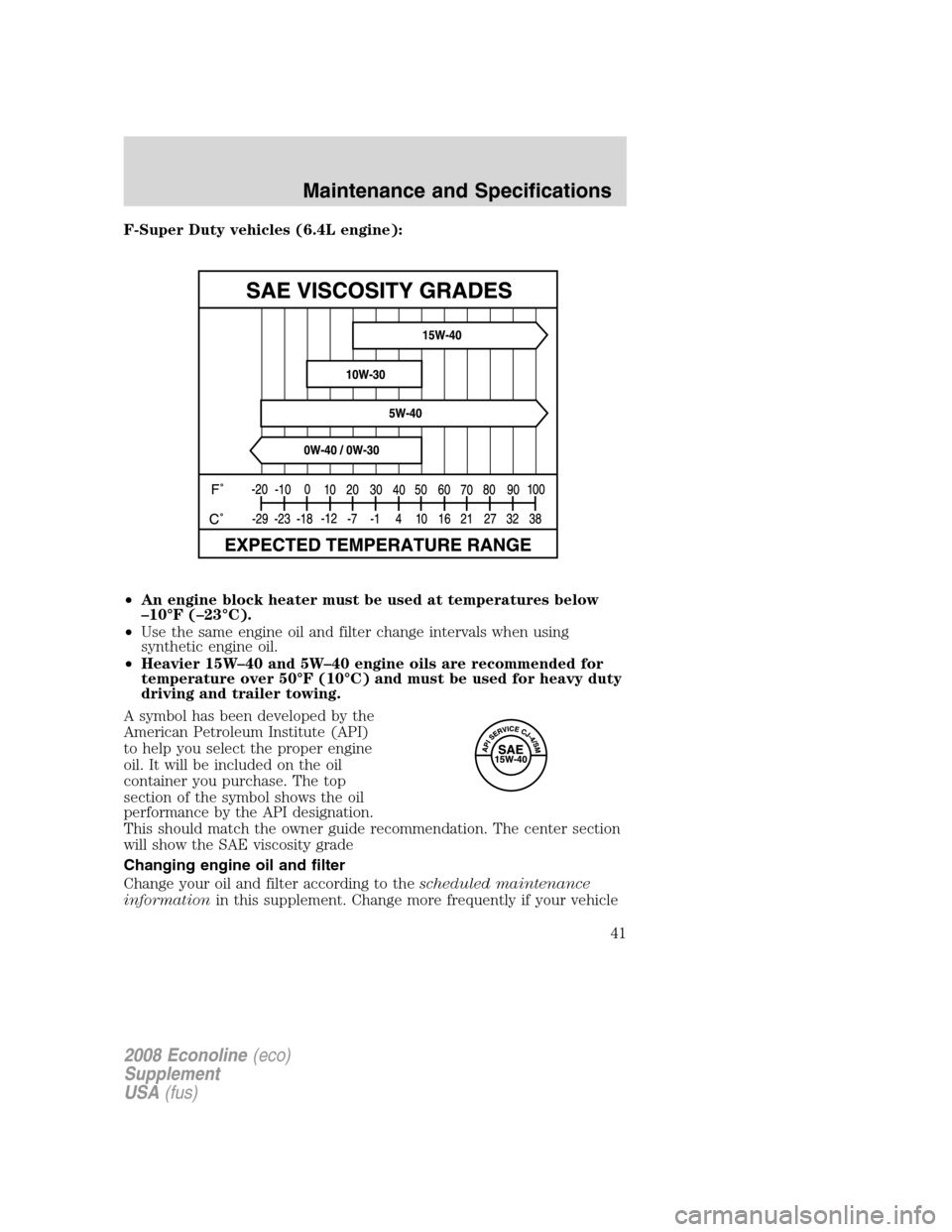
Removal - HFCM filter (F-Super Duty)
1. Remove the fuel filter cap by
turning counterclockwise.
2. Remove and discard the old fuel
filter element.
3. Carefully clean the mating
surfaces.
2008 Econoline(eco)
Supplement
USA(fus)
Maintenance and Specifications
37
Page 38 of 96
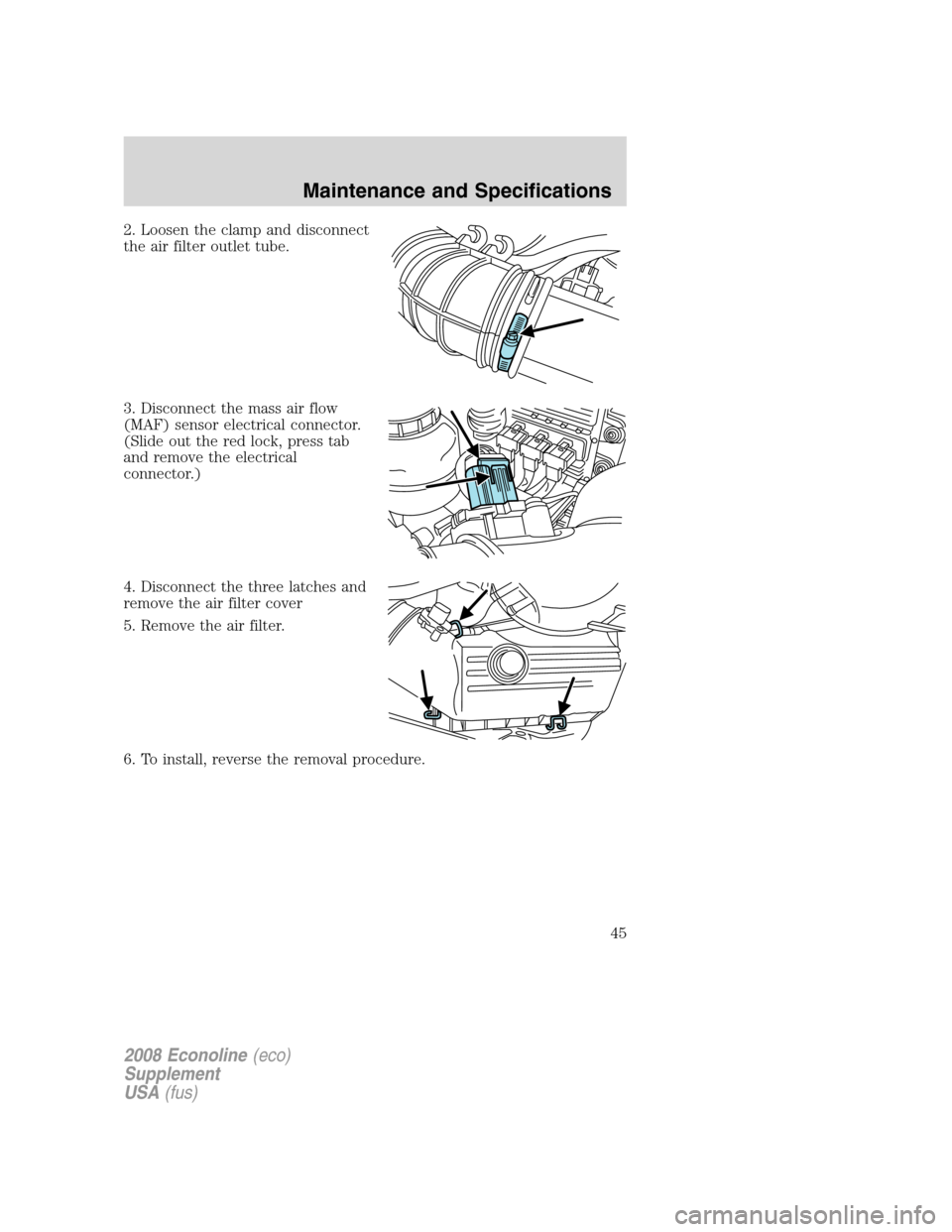
Removal - Engine-mounted fuel filter
•E-Series
•F-Super Duty
1. Remove the fuel filter cap by turning counterclockwise.
2. Remove and discard the old fuel filter element.
3. Carefully clean the mating surfaces.
Installation - both
The engine will not run properly if the fuel filter is not installed
in housing.
1. Install the new fuel filter and cap seal into the fuel filter housing.
Refer toMotorcraft Part Numberslater in this chapter for the fuel filter
part number.
2. Tighten cap onto fuel filter housing slowly, allowing fuel to soak into
the fuel filter element. Tighten cap until it contacts the housing.
2008 Econoline(eco)
Supplement
USA(fus)
Maintenance and Specifications
38
Page 41 of 96
F-Super Duty vehicles (6.4L engine):
•An engine block heater must be used at temperatures below
–10°F (–23°C).
•Use the same engine oil and filter change intervals when using
synthetic engine oil.
•Heavier 15W–40 and 5W–40 engine oils are recommended for
temperature over 50°F (10°C) and must be used for heavy duty
driving and trailer towing.
A symbol has been developed by the
American Petroleum Institute (API)
to help you select the proper engine
oil. It will be included on the oil
container you purchase. The top
section of the symbol shows the oil
performance by the API designation.
This should match the owner guide recommendation. The center section
will show the SAE viscosity grade
Changing engine oil and filter
Change your oil and filter according to thescheduled maintenance
informationin this supplement. Change more frequently if your vehicle
2008 Econoline(eco)
Supplement
USA(fus)
Maintenance and Specifications
41
Page 45 of 96
2. Loosen the clamp and disconnect
the air filter outlet tube.
3. Disconnect the mass air flow
(MAF) sensor electrical connector.
(Slide out the red lock, press tab
and remove the electrical
connector.)
4. Disconnect the three latches and
remove the air filter cover
5. Remove the air filter.
6. To install, reverse the removal procedure.
2008 Econoline(eco)
Supplement
USA(fus)
Maintenance and Specifications
45
Page 48 of 96
Resonator/Tailpipe assembly maintenance
The diesel resonator tail-pipe assembly is a uniquely functioning device
that accompanies the Oxidation Catalyst/DPF assembly. The assembly
serves multiple functions. First it serves as an acoustic device to
attenuate exhaust noise. Second it provides an exit path for the exhaust
from the vehicle. It also is designed to help control the temperature of
the exhaust during DPF regeneration events. The visible holes in each
leg of the twin tip and the holes under the shield just inboard of the
right rear tire(s) are functional. The holes need to be kept clear of
mud/debris or foreign material to maintain proper function of the
exhaust system. Clean and remove debris or foreign material if present
as needed. Spraying with a hose during regular washing of vehicle should
help keep holes clean/clear of debris or foreign material.
Note:Additions of aftermarket devices or modifications to the exhaust
system can reduce the effectiveness of the exhaust system as well as
cause damage to the exhaust system and/or engine. These actions may
also affect the vehicle’s warranty. See the vehicle’s warranty guide for
more information.
Failure to maintain the functional holes, in the tailpipe section of
the exhaust, clean and free of debris or foreign material may
result in the holes becoming blocked or plugged. Do not modify or
remove the tail-pipe section. Blocked or plugged holes or
removal/modification of the system could result in elevated exhaust gas
temperatures which may result in vehicle/property damage or personal
injury.
The normal operating temperature of the exhaust system is very
high. Never work around or attempt to repair any part of the
exhaust system until it has cooled. Use special care when working
around the diesel oxidation catalytic converter and/or the diesel
particulate filter (DPF). The diesel oxidation catalytic converter and/or
the DPF heats up to a high temperature after only a short period of
engine operation and can stay hot even after the engine is turned off.
Failure to follow these instructions may result in personal injury.
2008 Econoline(eco)
Supplement
USA(fus)
Maintenance and Specifications
48
Page 52 of 96
•Leaving the ignition key turned to ON for over two minutes without
starting may make starting difficult because the glow plugs will cease
activation. Reset the system by turning the ignition key to OFF and
then back to ON again.
If the engine runs hot
The following could cause the engine to overheat:
•Lack of coolant.
•Dirty cooling system.
•Plugged radiator fins, charge air cooler, A/C condenser and/or oil
cooler.
•Driving with frozen coolant.
•Sticking thermostat.
•Overloading or pulling heavy trailers during hot weather.
•Grill or radiator air blockage.
•Slipping or missing drive belt.
•Plugged or very dirty air filter.
If fuses burn out
Burned-out or blown fuses usually indicate an electrical short-circuit,
although a fuse may occasionally burn out from vibration. Insert a second
fuse. If this fuse immediately burns out and you cannot locate the cause,
return your vehicle to your dealer for a circuit check.
Replacement fuses and circuit breakers must always be the same
rating as the original equipment shown. Never replace a fuse or
circuit breaker with one of a higher rating. Higher rated fuses or circuit
breakers could allow circuit overloading in the event of a circuit
malfunction, resulting in severe vehicle damage or personal injury due
to fire.
Refer to theOwner’s Guidefor replacement of fuses.
2008 Econoline(eco)
Supplement
USA(fus)
Maintenance and Specifications
52
Page 58 of 96
request your authorization to perform additional operations to determine
the final diagnosis. The technician’s goal is to ensure that your vehicle is
fixed right the first time, at the best value to you.
The following list represents several of the Factory Authorized Systems
Checks available at participating Ford or Lincoln Mercury dealers:
•Air Conditioning
•Check Engine Light
•All Wheel Drive and4X4
•Automatic Transmission
•Engine Cooling and Cabin Heating
•Steering and Suspension
•Charge/Start/Battery
•Wheel Alignment
•Anti-Lock Brake System
Genuine Ford and Motorcraft Replacement Parts
Ford and Lincoln Mercury dealerships stock Ford and Motorcraft
branded replacement parts. These parts meet or exceed Ford Motor
Company’s specifications, and we stand behind them. Maintenance parts
installed at your Ford or Lincoln Mercury dealership carry a nationwide,
12 months, 12,000 mile (20,000 km) parts and labor limited warranty.
Your dealer can give you details.
Value Shopping for Your Vehicle’s Maintenance Needs
Your dealership recognizes the competitive landscape of maintenance and
light repair automotive services. With factory-trained technicians, and
one-stop service from routine maintenance like oil changes and tire
rotations to repairs like brake service, check out the value your Ford and
Lincoln Mercury dealers can offer.
2008 Econoline(eco)
Supplement
USA(fus)
Scheduled Maintenance: General Information
58
Page 60 of 96
Motorcraft Premium Gold Engine Coolant change interval (F-Super Duty)
❑6 years or 100,000 miles (160,000 km) - change Motorcraft Premium Gold Engine Coolant (whichever comes first)❑After initial change - change Motorcraft Premium Gold Engine Coolant every 3 years or 50,000 miles (80,000 km)
Check every month
❑Check function of all interior and exterior lights❑Check tires for wear and adjust air pressure (including spare tire)
❑Check that holes in the tail-pipe of the exhaust system are clear of debris-the holes/slots are functional (F-Super Duty)
❑Check engine oil level
❑Check windshield washer fluid level
❑Check and drain fuel filter/water separator
Check every six months
❑Check lap/shoulder belts and seat latches for wear and function❑Check that externally-mounted spare tire is tight (seeOwner’s Guide)
❑Check power steering fluid level
❑Check washer spray, wiper operation and clean all wiper blades (replace as necessary)
❑Check parking brake for proper operation
❑Check and lubricate all hinges, latches and outside locks
❑Check and lubricate door rubber weatherstrips
❑Check and clean body and door drain holes
❑Check safety warning lamps (brake, ABS, air bag, safety belt) for operation
❑Check cooling system fluid level and coolant strength (E-Series)
❑Check engine and fuel cooling systems for fluid level and coolant strength (F-Super Duty)
❑Check battery connections and clean if necessary
❑Check clutch fluid level, if equipped
Retightening lug nuts
❑On vehicles equipped with single rear wheels, retighten the lug nuts to the specified torque at 500 miles (800 km) after
any wheel disturbance (tire rotation, changing a flat tire, wheel removal, etc.).
❑On vehicles equipped with dual rear wheels, retighten the wheel lug nuts to the specified torque at 100 miles (160 km),
and again at 500 miles (800 km) of new vehicle operation and after any wheel disturbance (tire rotation, changing a flat
tire, wheel removal, etc.).
❑Refer toWheel Lug Nut Torque Specificationin yourOwner’s Guidefor the proper lug nut torque specification.
2008 Econoline(eco)
Supplement
USA(fus)
Scheduled Maintenance: General Information
60