2008 FORD SUPER DUTY lock
[x] Cancel search: lockPage 11 of 96
STARTING THE ENGINE
Read all starting instructions carefully before you start your vehicle.
For temperatures below 32°F (0°C), the use of the correct grade engine
oil is essential for proper operation. Refer toEngine oil specifications
in theMaintenance and Specificationschapter for more information.
If your vehicle is equipped with a manual transmission,make sure
the parking brake is fully set before you turn the key. Depress the clutch
pedal and place the gearshift in the neutral position. The clutch must be
fully depressed in order to operate the starter. Do not press the
accelerator during starting.
If your vehicle is equipped with an automatic transmission,ensure
the gearshift lever is in P (Park) and the parking brake is fully set before
you turn the key. Do not press the accelerator during starting.
Engine-driven cooling fan (Fan clutch)
Your vehicle is equipped with an engine driven cooling fan drive (also
called a fan clutch). This fan drive changes the fan speed to match the
vehicle’s changing cooling air flow requirements. Fan speed, fan noise
level and fuel consumption all will increase based on the driving
conditions that include trailer towing, hill climbing, heavy loads, high
speed and high ambient temperature, individually or in combination. The
fan drive is designed to provide the minimum fan speed (and resulting
fan noise and fuel consumption) required to meet the ever changing
vehicle cooling air flow requirements. You will hear the amount of fan
noise increasing and decreasing as the engine power requirements and
vehicle driving conditions change as you drive. This is to be expected as
being normal to the operation of your vehicle. High levels of fan noise
might also be heard when your engine is first started, and should
normally decrease after driving for a short time.
Cold weather starting
It is recommended that the engine block heater be used for starting
when the temperature is -10°F (-23°C) or colder. Refer toUsing the
engine block heater (if equipped)in theDrivingchapter of the
Owner’s Guide.
When operating in cold weather, use a minimum of 45 Cetane Diesel fuel
or use Cetane improvers from a reputable manufacturer.
Do not crank the engine for more than 30 seconds as starter damage
may occur. If the engine fails to start, turn the key to 3 (OFF) and wait
30 seconds before trying again.
2008 Econoline(eco)
Supplement
USA(fus)
Driving
11
Page 13 of 96
FCM (E-Series) or an HFCM (F-Super Duty) which acts as a fuel
filter/water separator to keep the wax melted which will help prevent
fuel filter clogging. However, if the engine starts but stalls after a short
time and will not restart, the fuel filter(s) may be clogged. For best
results in cold weather, use Number 1–D diesel fuel or “winterized”
Number 2–D diesel fuel which has an additive to minimize wax
formation.
Your vehicle is also equipped with a bypass relief valve, located on the
fuel control module, which provides fuel flow to the engine if the fuel
pickup should become plugged by ice or wax. To allow the bypass valve
to function and avoid engine fuel starvation, it is recommended that,
during cold weather operation 32°F (0°C) or below, the fuel level in your
tank should not be allowed to drop below
14full. This will help prevent
air from entering the fuel system and stalling the engine.
In cold weather below 32°F (0°C), the engine will slowly increase to a
higher idle speed if left idling in P (Park). As the engine warms-up, the
engine sound level will decrease due to the activation of PCM-controlled
sound reduction features.
If your vehicle is operated in a heavy snow storm or blowing snow
conditions, the engine air induction may become partially clogged with
snow and/or ice. If this occurs, the engine may experience a significant
reduction in power output. At the earliest opportunity, clear all the snow
and/or ice away from inside the air filter assembly. Take the top off the
assembly, leaving the air filter in, and remove any snow or ice.
In order to operate the engine in temperatures of 32°F (0°C) or lower,
read the following instructions:
•Make sure that the batteries are of sufficient size and are fully
charged. Check other electrical components to make sure they are in
optimum condition.
•Use Motorcraft Premium Gold Engine Coolant solution at the
concentration recommended to protect the engine against damage
from freezing.
•Try to keep the fuel tank full as much as possible at the end of
operation to prevent condensation in the fuel system.
•Make sure you use proper cold weather engine oil and that it is at its
proper level. Also, if necessary, make sure to follow the engine oil and
filter change schedule found under theSpecial Operating Conditions
section in theScheduled Maintenance Guidechapter.
•At temperatures of -10°F (-23°C) or below, it is recommended that
you use an engine block heater to improve cold engine starting.
2008 Econoline(eco)
Supplement
USA(fus)
Driving
13
Page 14 of 96
•If operating in arctic temperatures of -20°F (-29°C) or lower, consult
your truck dealer for information about special cold weather
equipment and precautions.
Note:Idling in cold weather will not heat the engine to its normal
operating temperature. Long periods of idling in cold weather can cause
a buildup of heavy deposits of carbon and rust on valve stems causing
them to stick, which in turn, can cause valve train damage.
The following cold weather idling guidelines must be followed:
•Avoid idling the engine for more than 10 minutes at a time.
•Use Motorcraft Cetane improvers or non alcohol-based Cetane
improvers from a reputable manufacturer.
•Maintain the engine cooling system properly.
•Do not shut the engine down after an extensive idling period (10
minutes or more). Drive the vehicle for several miles with the engine
at normal operating temperatures under a moderate load to burn off
any accumulated carbon and varnish.
•Consider using an engine block heater.
•For extended idle times use an approved idle speed increase device.
Winter operating tips for Arctic operation -20°F (-29°C) and below
The following information is provided as a guideline only, and is not
intended to be the only source of possible solutions in resolving extreme
cold temperature issues.
Starting aids:
The use of the factory engine block heater (refer toUsing the engine
block heater [if equipped]in theDrivingchapter of theOwner’s
Guide) and oil pan heaters (aftermarket) will assist in engine starting, in
extreme cold ambient temperatures.
Do not use starting fluid, such as ether, in the air intake system
(see air filter decal). Such fluid could cause immediate explosive
damage to the engine and possible personal injury.
Idle control:
For periods of extended idle, the throttle should be set at an rpm that is
sufficient to keep the engine at normal operating temperatures. This
action can reduce the amount of engine damaging deposits.
2008 Econoline(eco)
Supplement
USA(fus)
Driving
14
Page 15 of 96
•The engine contains a unique “Cold Weather - Idle up feature”
calibration strategy within the PCM. Under the appropriate conditions,
the strategy will automatically elevate the engine idle speed after 130
seconds of idling in cold ambient temperatures. For this feature to be
activated, the truck must be in P (Park) (for automatic transmission),
in neutral (for manual transmission) with the parking brake applied
and engine oil temperature below 158°F (70°C). This strategy raises
the rpm to a level that reduces the potential to produce “coking” or
“wet stacking”, which is common to all diesel engines when idling for
extended periods during cold ambient temperatures.
•On F-Super Duty vehicles,a factory option for Stationary Elevated
Idle Control (SEIC) through dash-mounted Upfitter switches will allow
the operator to elevate the idle rpm for extended idle periods, as well
as aftermarket equipment such as PTO operation. This feature must
be configured even if ordered from the factory. See your authorized
dealer for required upfitting.
Operation in snow
Vehicle operation in heavy snowfall or in dry loose snow that may swirl
around the front of the vehicle may feed excessive amounts of snow into
the air intake system. This could plug the air filter with snow and cause
the engine to stall and/or lose power.
Refer toAir filter and restriction gaugein theMaintenance and
Specificationschapter of this supplement for more information.
Operation in standing water
Ingestion of water into the diesel engine can result in immediate and
severe damage to the engine. If driving through water, slow down to
avoid splashing water into the intake. If the engine stalls, and ingestion
of water into the engine is suspected, do not try to restart the engine.
Consult your dealer for service immediately.
Engine block heater (if equipped)
Refer to theDrivingchapter in theOwner’s Guide.
Rapid Heat supplemental heating system (if equipped)
The optional Rapid Heat feature is an electrically powered device that is
designed to provide supplemental heat during engine warm up. For
maximum effectiveness mid to low blower speed is recommended during
initial warm up. When operating in automatic mode (when equipped) the
climate control unit will determine the appropriate blower speed for
existing conditions.
2008 Econoline(eco)
Supplement
USA(fus)
Driving
15
Page 25 of 96
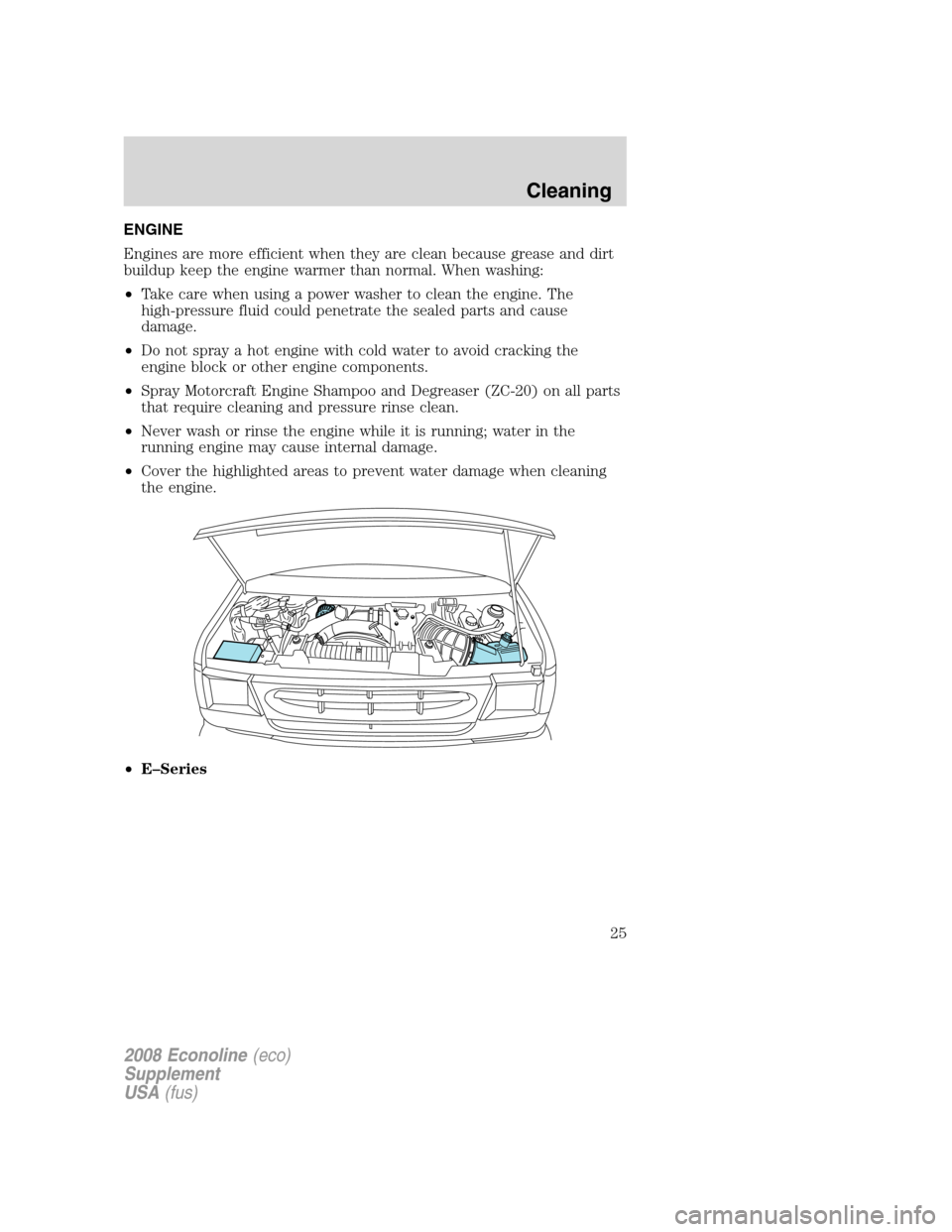
ENGINE
Engines are more efficient when they are clean because grease and dirt
buildup keep the engine warmer than normal. When washing:
•Take care when using a power washer to clean the engine. The
high-pressure fluid could penetrate the sealed parts and cause
damage.
•Do not spray a hot engine with cold water to avoid cracking the
engine block or other engine components.
•Spray Motorcraft Engine Shampoo and Degreaser (ZC-20) on all parts
that require cleaning and pressure rinse clean.
•Never wash or rinse the engine while it is running; water in the
running engine may cause internal damage.
•Cover the highlighted areas to prevent water damage when cleaning
the engine.
•E–Series
2008 Econoline(eco)
Supplement
USA(fus)
Cleaning
25
Page 27 of 96
Failure to maintain the functional holes, in the tailpipe section of
the exhaust, clean and free of debris or foreign material may
result in the holes becoming blocked or plugged. Do not modify or
remove the tail-pipe section. Blocked or plugged holes or
removal/modification of the system could result in elevated exhaust gas
temperatures which may result in vehicle/property damage or personal
injury
The normal operating temperature of the exhaust system is very
high. Never work around or attempt to repair any part of the
exhaust system until it has cooled. Use special care when working
around the diesel oxidation catalytic converter and/or the diesel
particulate filter (DPF). The diesel oxidation catalytic converter and/or
the DPF heats up to a high temperature after only a short period of
engine operation and can stay hot even after the engine is turned off.
Failure to follow these instructions may result in personal injury.
2008 Econoline(eco)
Supplement
USA(fus)
Cleaning
27
Page 33 of 96
equivalent. The customer warranty may be void from using additives that
do not meet or exceed Ford specifications.
Fueling tips
If the engine fails to start in 30 seconds, turn the key to the OFF
position and wait 30 seconds before trying again.
Truck stops have pumps and nozzles designed for larger, heavy-duty
trucks. When refueling at truck stops: if the nozzle shuts off repeatedly
when refueling, wait 5–10 seconds; then use a slower rate of flow (don’t
depress the nozzle trigger as far).
If air is allowed to enter the fuel system (during fuel filter change or if
you run out of fuel) the engine will purge the trapped air as it runs. The
engine may run rough and produce white smoke while air is in the
system. This is normal and should correct itself in a short time.
An engine that suddenly becomes noisy or operates poorly after a fuel fill
could be using substandard fuel (i.e., high water content, low cetane
rating or gasoline in the fuel). Diesel fuel should be purchased from a
reputable station which sells a large amount of diesel fuel.
Care should be taken whenever diesel fuel is stored. Use only clean,
approved containers which will prevent the entry of dirt or water.
Diesel fuel must not be stored in a galvanized container. The fuel will
dissolve the zinc in a galvanized container. The zinc will then remain in
solution until it is run through the engine where it will be deposited in
the fuel injectors causing expensive-to-repair damage.
Diesel fuel dispensing nozzle fill rate
This truck is equipped with a fuel fill pipe which is able to accept fuel up
to 20 gallons per minute from an 1
18” fuel dispensing nozzle. Pumping
fuel at greater flow rates may result in premature nozzle shut-off or
spitback.
Fuel filler cap
When fueling your vehicle:
1. Turn the engine off.
2. Carefully turn the filler cap counterclockwise until it stops.
3. Pull to remove the cap from the fuel filler pipe.
4. To install the cap, align the tabs on the cap with the notches on the
filler pipe.
5. Turn the filler cap clockwise until a few clicks are heard.
2008 Econoline(eco)
Supplement
USA(fus)
Maintenance and Specifications
33
Page 36 of 96
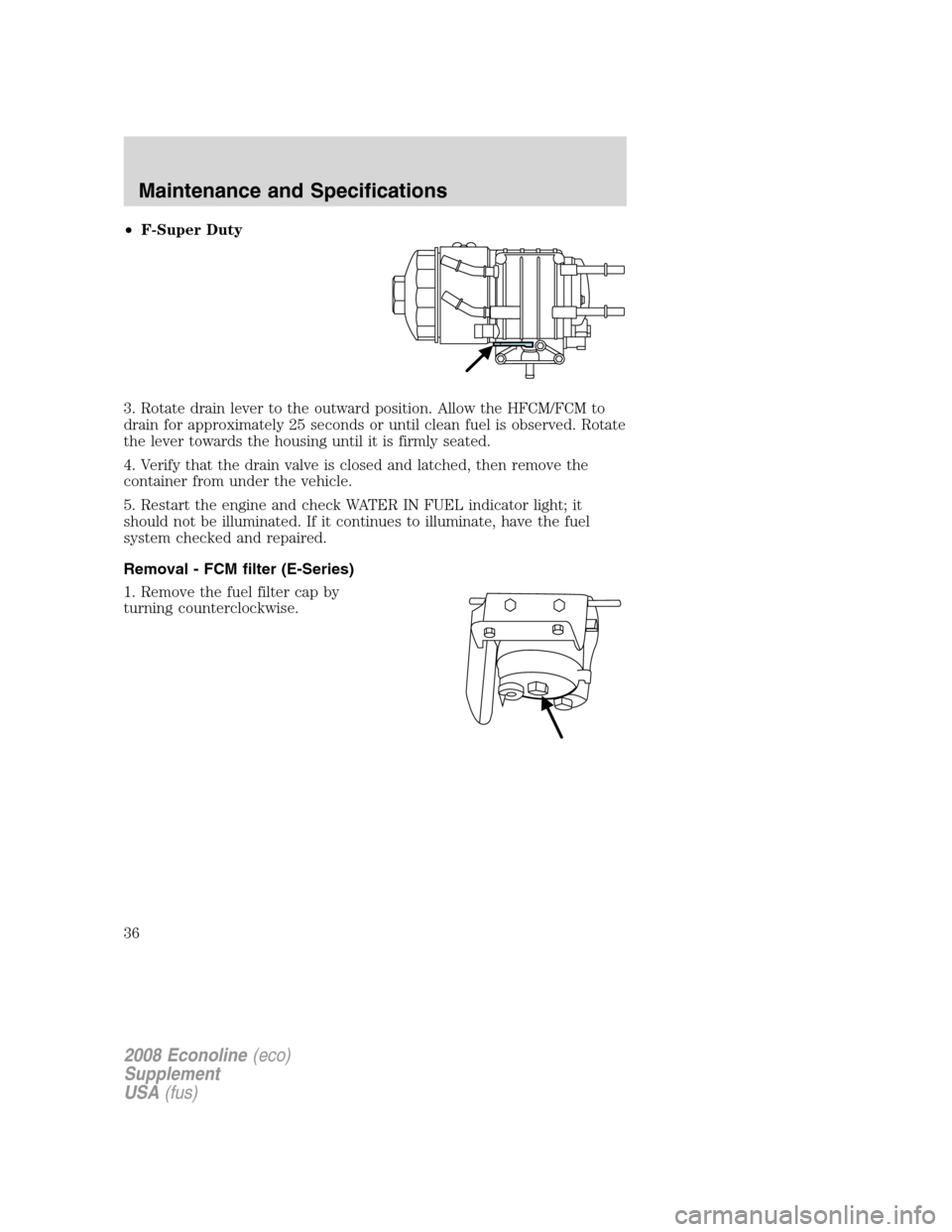
•F-Super Duty
3. Rotate drain lever to the outward position. Allow the HFCM/FCM to
drain for approximately 25 seconds or until clean fuel is observed. Rotate
the lever towards the housing until it is firmly seated.
4. Verify that the drain valve is closed and latched, then remove the
container from under the vehicle.
5. Restart the engine and check WATER IN FUEL indicator light; it
should not be illuminated. If it continues to illuminate, have the fuel
system checked and repaired.
Removal - FCM filter (E-Series)
1. Remove the fuel filter cap by
turning counterclockwise.
2008 Econoline(eco)
Supplement
USA(fus)
Maintenance and Specifications
36