2008 FIAT DOBLO Petrol
[x] Cancel search: PetrolPage 108 of 222

107DRIVING YOUR VEHICLE
HOW TO WARM UP THE
ENGINE AFTER IS HAS JUST
STARTED (petrol and diesel
versions)
– Begin to move forward slowly let-
ting the engine turn at medium revs.
Do not accelerate abruptly.
– Do not push the engine to its lim-
it for the first few kilometres. You are
recommended to wait until the
coolant temperature gauge starts
moving.
EMERGENCY START-UP
If the Fiat CODE system fails to
recognise that code transmitted by the
ignition key (instrument panel warning
light ¢(Y) on) the emergency start-
up can be performed by using the
CODE card code.
See section “In an emergency”. The warning light m
will flash (for approxi-
mately 60 seconds) at
start-up or during prolonged
cranking to signal a fault in the
glow plug heating system. You
can use the vehicle as usual if the
engine starts but you should con-
tact a Fiat Dealership as soon as
possible to have problem seen to.
If the engine does not start at the
first attempt, return the ignition key
to STOPbefore trying to start the
engine again.
If with key at MARwarning light ¢
(Y) stays on, turn the key to STOP
and then to MARagain; if the warn-
ing light stays on, try with the other
keys provided.
If you still cannot start the engine, get
in touch with Fiat Dealership.
IMPORTANTNever leave the ig-
nition key at MARwhen the engine is
off.Catalysed vehicles must
not be bump started
(pushed, towed or coast-
ed downhill) as this could cause
fuel to flow into the catalytic ex-
haust system and damage it be-
yond repair.
Remember that until
the engine has started the
brake booster and hy-
draulic power steering systems
will not work and a greater effort
will therefore be required to de-
press the brake pedal or turn the
steering wheel.
106-118 Doblo GB 9-05-2008 12:09 Pagina 107
Page 113 of 222

112DRIVING YOUR VEHICLE
CHEAP RUNNING
THAT RESPECTS THE ENVIRONMENT
LOOKING
AFTER EMISSION
CONTROL DEVICES
The correct use of pollution control
devices not only ensures respect for
the environment but also has an effect
on the vehicle’s performance. Keeping
these devices in good condition is
therefore a fundamental rule for dri-
ving that is easy on your pocket and
on the environment too.
The first step to take is to follow the
SERVICE SCHEDULE to the letter.
If your vehicle has a petrol engine use
only unleaded petrol.
If you have trouble starting, do not
keep turning the ignition key for long
periods. Be especially careful to avoid
bump starting the vehicle by pushing,
towing or rolling downhill: these are
all manoeuvres that can damage the
catalytic exhaust. Use an auxiliary bat-
tery for start-ups only.If the engine begins to “loose its
smoothness”, when travelling, contin-
ue your journey but reduce the de-
mands you are making on the engine
and have the vehicle seen to at a Fi-
at Dealershipas soon as possible.
When the instrument panel fuel re-
serve warning light comes on, fill up as
soon as possible. A low level of fuel
can cause an uneven supply of fuel to
the engine with the inevitable increase
in the temperature of the exhaust gas
and serious damage to the catalytic
converter.
Never run the engine with one or
more spark plugs disconnected, even
for testing purposes.
Do not warm up the engine by let-
ting it idle for a while before moving
off unless the outside temperature is
very low and, even in this case, only
do so for less than 30 seconds.
Do not install other heat shields and
do not remove those already fitted to
the catalytic converter and exhaust
pipe. Environmental protection has been
one of the guiding principles in the
production of the Fiat Doblò. It is no
accident that its pollution control
equipment is much more effective than
that required by current legislation.
Nonetheless, the environment can-
not get by without a concerted effort
from everyone.
By following a few simple rules you
can avoid harming the environment
and often cut down fuel consumption
at the same time.
On this subject, a few useful tips have
been given below to supplement those
marked by symbol #, at various points
of the handbook.
You are asked to read both the for-
mer and the latter carefully.
106-118 Doblo GB 9-05-2008 12:09 Pagina 112
Page 143 of 222

142IN AN EMERGENCY
Engine control unit (power)
Engine control unit (ignition switch powered)
Glow plug control unit
Horn
Manual climate control enable control
Ignition switch
Manual climate control compressor
Headlight beam adjuster
Petrol fume recirculation solenoid valve
Tachometer generator
Injectors
Heated rear window
One-speed radiator fan
Fuel pump
Fuel pump
Windscreen-rear window washer pump
Supplementary power socket
ABS power (valve)
Radiator fan first speed
(versions with manual climate control system)
Radiator fan first speed (1.3 -1.9 Multijet versions)
Radiator fan second speed
(1.4 - 1.6 versions with manual climate control system)
Radiator fan second speed (1.3 -1.9 Multijet versions)
Heated seats
+ 30 services
(sound system, cellular telephone, diagnostic socket)
Figure Fuse Ampere
10
7.5
15
15
7.5
20
7.5
10
15
15
20
30
30
20
15
30
20
30
30
40
60
40
15
10 F17
F16
F11
F10
F31
F03 – MAXI FUSE
F19
F13
F11
F11
F22
F40
F06 – MAXI FUSE
F22
F21
F43
F44
F05 – MAXI FUSE
F06 – MAXI FUSE
F06 – MAXI FUSE
F07 – MAXI FUSE
F07 – MAXI FUSE
F45
F39 42
42
42
42
41
42
42
41
42
42
42
41
42
42
42
41
41
42
42
42
42
42
41
41
119-148 Doblo GB 9-05-2008 12:09 Pagina 142
Page 149 of 222
148IN AN EMERGENCY
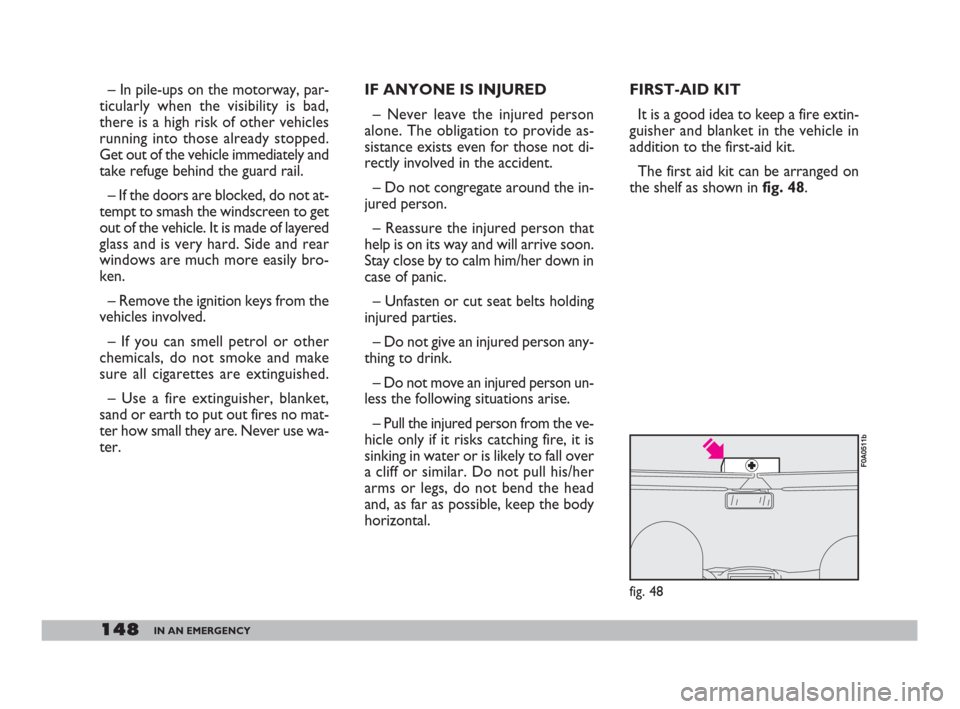
FIRST-AID KIT
It is a good idea to keep a fire extin-
guisher and blanket in the vehicle in
addition to the first-aid kit.
The first aid kit can be arranged on
the shelf as shown in fig. 48.
fig. 48
F0A0511b
– In pile-ups on the motorway, par-
ticularly when the visibility is bad,
there is a high risk of other vehicles
running into those already stopped.
Get out of the vehicle immediately and
take refuge behind the guard rail.
– If the doors are blocked, do not at-
tempt to smash the windscreen to get
out of the vehicle. It is made of layered
glass and is very hard. Side and rear
windows are much more easily bro-
ken.
– Remove the ignition keys from the
vehicles involved.
– If you can smell petrol or other
chemicals, do not smoke and make
sure all cigarettes are extinguished.
– Use a fire extinguisher, blanket,
sand or earth to put out fires no mat-
ter how small they are. Never use wa-
ter.IF ANYONE IS INJURED
– Never leave the injured person
alone. The obligation to provide as-
sistance exists even for those not di-
rectly involved in the accident.
– Do not congregate around the in-
jured person.
– Reassure the injured person that
help is on its way and will arrive soon.
Stay close by to calm him/her down in
case of panic.
– Unfasten or cut seat belts holding
injured parties.
– Do not give an injured person any-
thing to drink.
– Do not move an injured person un-
less the following situations arise.
– Pull the injured person from the ve-
hicle only if it risks catching fire, it is
sinking in water or is likely to fall over
a cliff or similar. Do not pull his/her
arms or legs, do not bend the head
and, as far as possible, keep the body
horizontal.
119-148 Doblo GB 9-05-2008 12:09 Pagina 148
Page 152 of 222

151VEHICLE MAINTENANCE
20 40 60 80 100 120 140 160 180
●●●●
●●●
●●●●●●●●●
●●
●
●●●●
●●●●
●●
●●●●●●●●●
(●)(●)(●)(●)(●)(●)(●)(●)(●)
●●●
●●●●●●●●●thousands of kilometres
Replace air cleaner cartridge (petrol versions)
Replace air cleaner cartridge (Multijet versions)
Top up fluids (engine coolant, brakes, windscreen washer, battery, etc.)
Check timing belt conditions (excluding 1.3 Multijet versions)
Replace timing belt (excluding 1.3 Multijet versions) (*)
Replace spark plugs (petrol versions)
Check engine control systems (via diagnostic socket)
Check mechanical transmission oil level
Change engine oil and oil filter (versions without DPF) (O)
Change engine oil and oil filter (Multijet versions with DPF)
(or every 2 years) (**)
Change brake fluid (or every 2 years)
Change pollen filter (or every 2 years)
(*) Or every 4 years for very demanding use (cold climate, idling in city traffic, dusty areas).
Or every 5 years, regardless from the distance travelled.
(
O) Every 30.000 km or 2 years for Multijet versions
(**)Engine oil and oil filter shall be changed according to their actual exhaust conditions, indicated by warning light/message (where provided) on the
instrument panel (see section “Warning lights and messages”).
149-173 Doblo GB 9-05-2008 12:10 Pagina 151
Page 163 of 222

162VEHICLE MAINTENANCE
REPLACING THE FILTER
fig. 16
Loosen the screws A, remove the
cover and remove the filtering ele-
ment to be replaced B.1.9 Multijet versions
Loosen the three screws A-fig. 18
on the air cleaner cover, remove the
cover B-fig. 19and remove the fil-
tering element C, to be replaced.
A
A
B
A
fig. 18
F0A0155b
B
C
fig. 19
F0A0156b
AIR CLEANER
REPLACEMENT
Petrol versions
Loosen the screws on the side and
on the air cleaner cover, remove the
cover A-fig. 17and remove the fil-
tering element to be replaced.
fig. 17
F0A0720b
A
B
fig. 16
F0A0150b
149-173 Doblo GB 9-05-2008 12:10 Pagina 162
Page 174 of 222

173VEHICLE MAINTENANCE
CLEANING SEATS
AND FABRICS
– Remove dust with a soft brush and
vacuum cleaner.
– Brush the seats with a damp
sponge with water and a neutral soap.
PLASTIC PARTS INSIDE THE
VEHICLE
Use appropriate products designed
to preserve the appearance of com-
ponents.
IMPORTANTDo not use alcohol
or petrol to clean the instrument pan-
el.
Do not keep aerosol
cans in the vehicle. There
is the risk they might ex-
plode. Aerosol cans must never
be exposed to a temperature
above 50°C; when the weather
starts to get hot the temperature
inside the vehicle might go well
beyond that figure. INTERIORS
From time to time check that water
has not collected under the mats
(from dripping shoes, umbrellas etc.)
which could cause the steel to rust.
Never use inflammable
products such as petrole-
um ether or petrol to
clean inside the vehicle. The elec-
trostatic charges that are gener-
ated while rubbing to clean could
become a fire risk.
STEERING WHEEL / GEAR
LEVER KNOB WITH
GENUINE LEATHER
COVERING
These components shall only be
cleaned with water and neutral soap.
Never use spirit or alcohol-based
products.
Before using special products for
cleaning interiors, read carefully label
instructions and indications to make
sure they are free from spirit and/or
alcohol-based substances.
If when cleaning the windscreen with
special glass products, some drops fall
on the leather covering of the steer-
ing wheel/gear lever knob remove
them immediately and then clean with
water and neutral soap.
IMPORTANTTake the utmost
care when engaging the steering lock
to prevent scratching the leather cov-
ering.
149-173 Doblo GB 9-05-2008 12:10 Pagina 173
Page 180 of 222
179TECHNICAL SPECIFICATIONS
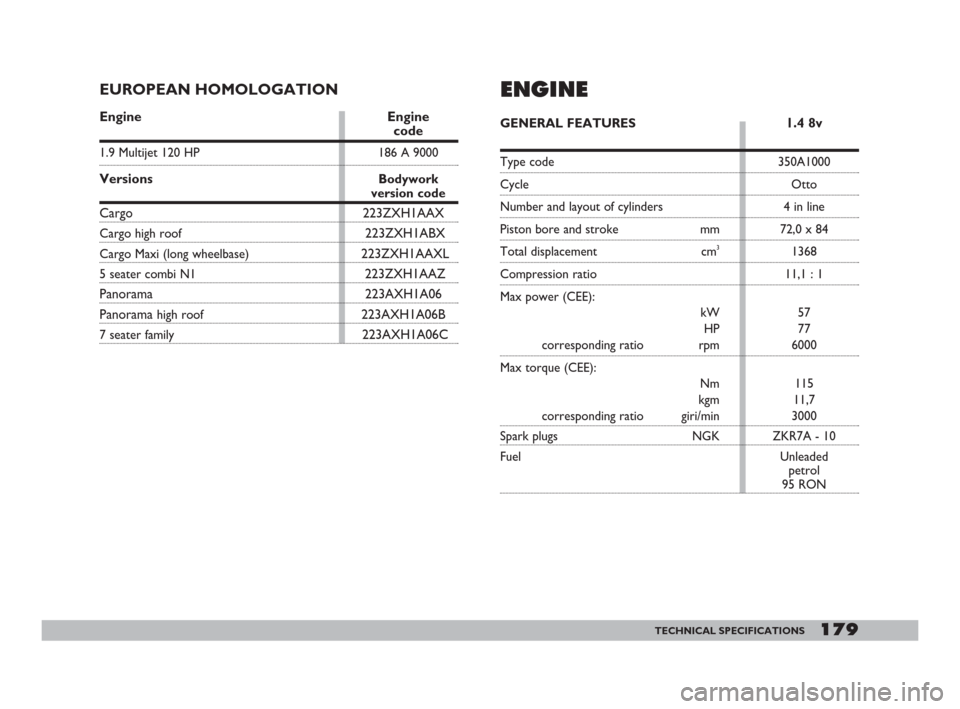
EUROPEAN HOMOLOGATION
Engine Engine code
1.9 Multijet 120 HP 186 A 9000
VersionsBodywork version code
Cargo 223ZXH1AAX
Cargo high roof223ZXH1ABX
Cargo Maxi (long wheelbase)223ZXH1AAXL
5 seater combi N1223ZXH1AAZ
Panorama 223AXH1A06
Panorama high roof223AXH1A06B
7 seater family223AXH1A06C
ENGINE
GENERAL FEATURES1.4 8v
Type code 350A1000
Cycle Otto
Number and layout of cylinders 4 in line
Piston bore and stroke mm 72,0 x 84
Total displacement cm31368
Compression ratio 11,1 : 1
Max power (CEE):
kW 57
HP 77
corresponding ratio rpm 6000
Max torque (CEE):
Nm 115
kgm 11,7
corresponding ratio giri/min 3000
Spark plugs NGK ZKR7A - 10
Fuel Unleaded
petrol
95 RON
174-211 Doblo GB 16-12-2008 14:26 Pagina 179