Page 530 of 666
528 Practical hintsChanging bulbs
5
\1
Press catches
1
down.
\1
Swing housing cover
2
in the direc-
tion of the arrow and remove it.
3Low-beam headlamps
4Halogen high-beam headlamps/xenon
headlamp cornering lamp*
\1
Pull the connector off the bulb hold-
er.
\1
Unclip the retainer spring and re-
move the bulb.
\1
Insert the new bulb such that the
base locates in the recess of the bulb
holder.
\1
Clip on the retainer spring and plug
the connector onto the bulb.
\1
Insert housing cover
2
into lower
brackets.
\1
Swing housing cover
2
toward
headlamp casing.
\1
Pull first the inner and then the outer
catch
1
upward until it audibly en-
gages in place.
Turn signals1Bulb holder
nf_BA.book Page 528 Friday, January 25, 2008 3:53 PM
Page 586 of 666
584 Practical hintsJump-starting
5
Use a rigid towing bar and secure this
only to the front towing eye
(\2
page 585).
Tow-starting!
CAUTION
Your vehicle is equipped with an au-
tomatic transmission. Do not tow-
start your vehicle.
Warning
G
When tow-starting another vehicle, its
weight should not be greater than the per-
missible gross weight of your vehicle.
nf_BA.book Page 584 Friday, January 25, 2008 3:53 PM
Page 587 of 666

585 Practical hints
Towing
5
\3 Towing
Comply with legal regulations when tow-
ing.Having the vehicle carried away on a
transporter or trailer is preferable to
towing it away. We recommend the use
of a rigid towing bar if towing is neces-
sary.
The fixture for the front towing eye is lo-
cated behind the cover in the bumper on
the right-hand side when viewed in the
direction of travel.
Warning
G
Tow the vehicle using a rigid towing bar if:the engine is not running,there is a malfunction in the power supply
or the vehicle’s electrical system.There is no power assistance for the
steering and braking when the engine is
not running. You must then use signifi-
cantly greater force to steer the vehicle
and brake.
Continued
Warning (Continued)
G
Do not tow the vehicle if the key cannot
be turned in the ignition lock. The steering
is then locked and it will not be possible
to steer the vehicle.When towing another vehicle, its weight
should not be greater than the permissi-
ble gross weight of your vehicle.
Installing / removing the towing
eye
nf_BA.book Page 585 Friday, January 25, 2008 3:53 PM
Page 588 of 666
586 Practical hintsTowing
5
1Cover
Installing the towing eye
\1
Press bottom of cover
1
in the di-
rection of the arrow and remove it.
You will see the fixture for the towing
eye.
\1
Take the towing eye and the wheel
wrench from the vehicle tool kit
(\2
page 515).
\1
Screw in the towing eye clockwise to
the stop.
\1
Insert the wheel wrench handle into
the towing eye and tighten.
Removing the towing eye
\1
Remove the wheel wrench from the
vehicle tool kit.
\1
Insert the wheel wrench handle into
the towing eye and turn the wrench
counterclockwise.
\1
Unscrew the towing eye.
\1
Insert bottom of cover
1
using the
lug and press it in at the top until it
engages.
\1
Return the towing eye and the wheel
wrench to the vehicle tool kit.
nf_BA.book Page 586 Friday, January 25, 2008 3:53 PM
Page 589 of 666

587 Practical hints
Towing
5
\1
Switch on the ignition (
\2
page 111).
\1
For a distance of up to 30 miles
(50 km), move the selector lever to
position
N.
\1
For a distance greater than 30 miles
(50 km), remove the propeller shafts
to the driven axles.
Take great care when attempting to tow
the vehicle free if its drive wheels have
become embedded in loose earth or
mud, particularly if the vehicle is loaded.
Tow the vehicle smoothly and straight-
ahead. The chassis could otherwise be
damaged.
Do not attempt to tow out the vehicle if
a trailer is coupled up.Where possible, tow the vehicle out
backwards along the track made by the
vehicle previously.
With transmission damage
\1
Always remove the propeller shafts
to the driven axles.
iDeactivate the automatic locking
while driving function when towing .
You could otherwise become locked
out when pushing or towing the vehi-
cle.!
CAUTION
Do not exceed a towing speed of
50 km / h, otherwise the transmis-
sion could be damaged.
Towing out a vehicle that is stuck
Towing the vehicle in the event of
particular malfunctions!
CAUTION
Use new self-securing nuts when in-
stalling the propeller shafts.
nf_BA.book Page 587 Friday, January 25, 2008 3:53 PM
Page 590 of 666

588 Practical hintsTowing
5
With front axle damage
\1
Turn the key to position
1 in the igni-
tion lock(
\2
page 111).
In the event of a malfunction in the
electrical systemIf the battery is malfunctioning, the auto-
matic transmission will be locked in
position
P. To shift the automatic trans-
mission to position
N, you must provide
power to the vehicle’s electrical system
in the same way as jump-starting
(
\2
page 581).
Have the vehicle transported on a trans-
porter or trailer.The towing eye can be used to pull the
vehicle onto a special transporter or
trailer for transportation.
\1
Shift the transmission to neutral or
move the selector lever to
position
N.
!
CAUTION
The vehicle must not be towed with
its front wheels raised and with the
key in position
2 in the ignition lock.
Active brake intervention by ESP
® or
ASR could otherwise lock the wheels
and damage the brake system.
Transporting the vehicle!
CAUTION
Only secure the vehicle at the
wheels / rims. Your vehicle could oth-
erwise be damaged.
nf_BA.book Page 588 Friday, January 25, 2008 3:53 PM
Page 624 of 666
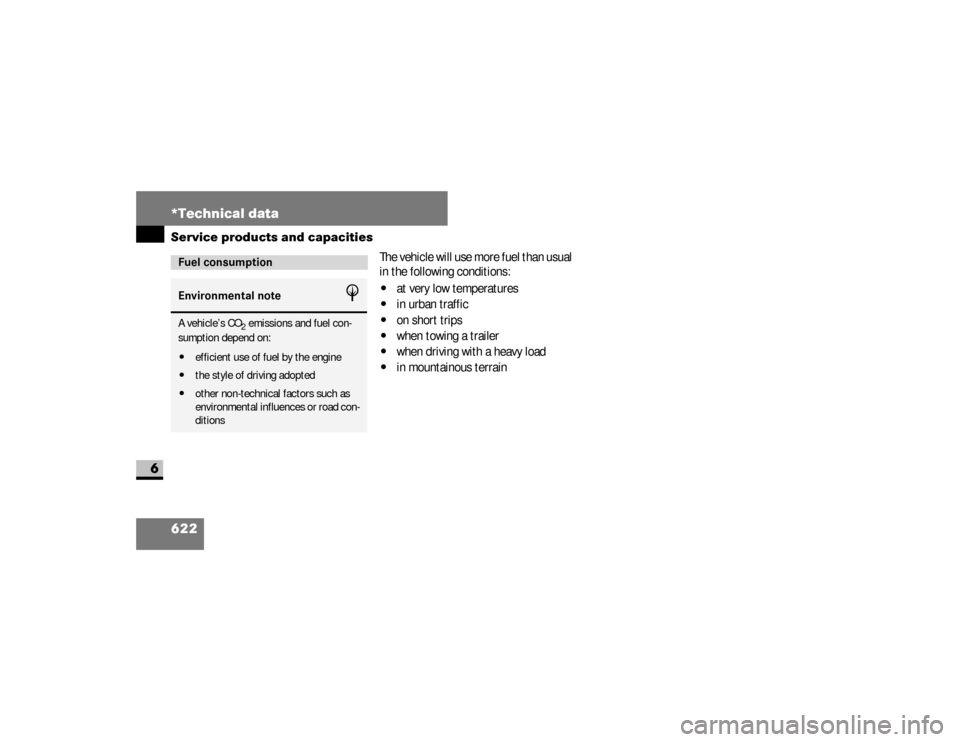
622 *Technical dataService products and capacities
6
The vehicle will use more fuel than usual
in the following conditions:\4
at very low temperatures
\4
in urban traffic
\4
on short trips
\4
when towing a trailer
\4
when driving with a heavy load
\4
in mountainous terrain
Fuel consumptionEnvironmental note
H
A vehicle’s CO
2 emissions and fuel con-
sumption depend on:
\4efficient use of fuel by the engine
\4the style of driving adopted
\4other non-technical factors such as
environmental influences or road con-
ditions
nf_BA.book Page 622 Friday, January 25, 2008 3:53 PM
Page 641 of 666

639 Index
stopping . . . . . . . . . . . . . . . . . . . 206
towing . . . . . . . . . . . . . . . . . . . . 587
trailer towing . . . . . . . . . . . . . . . 207
working on the vehicle . . . . . . . . 207Auxiliary heating
. . . . . . . . . . . . . 236
heater booster function . . . . . . . 234
malfunctions . . . . . . . . . . . . . . . 453
with water heater
changing the remote control
batteries . . . . . . . . . . . . . . . . . 541
remote control . . . . . . . . . . . . 239
selecting a switch-on time . . . 240
setting the switch-on time . . . 242
B
Bar
. . . . . . . . . . . . . . . . . . . . . . . . 394
BASsee Brake AssistBatteryauxiliary . . . . . . . . . . . . . . . . . . . 577
charge indicator lamp . . . . . . . . 469
check lamp (auxiliary heating
remote control) . . . . . . . . . . . . . 240
display message . . . . . . . . . . . . 497
in the auxiliary heating remote
control . . . . . . . . . . . . . . . . . . . . 541
in the engine compartment . . . . 577
in the key . . . . . . . . . . . . . . . . . . 540
indicator lamp (key) . . . . . . . . . . . 86
isolating switch . . . . . . . . . 338
,339
recharging . . . . . . . . . . . . . . . . . 579
reconnecting . . . . . . . . . . . . . . . 580
removing . . . . . . . . . . . . . . . . . . 578safety notes . . . . . . . . . . . . . . . . 335
starter battery
disconnecting . . . . . . . . . . . . 575
Bead
. . . . . . . . . . . . . . . . . . . . . . . 394
Belt force limiters
. . . . . . . . . . . . .44
Bi-xenon headlamps
. . . . . . . . . . 527
driving abroad . . . . . . . . . . . . . . 311
Body builder guideline
. . . . . . . . . .11
Bottle holdersee Cup holdersBrake Assist (BAS)
. . . . . . . . . . . . .71
display message . . . . . . . . 500
–501
indicator lamp . . . . . . . . . . 462,465
malfunction . . . . . . . . . . . . . . . . 465
Brake fluid
. . . . . . . . . . . . . . . . . . 617
checking the brake fluid level . . 331
display message . . . . . . . . . . . . 498
B
nf_BA.book Page 639 Friday, January 25, 2008 3:53 PM