2008 DODGE DAKOTA seats
[x] Cancel search: seatsPage 36 of 426
of ejection and the risk of injury caused by striking the
inside of the vehicle.Everyonein a motor vehicle should
be belted at all times.
Lap/Shoulder Belts
All seating positions except the front center seating
position (with full bench seat) have combination lap/
shoulder belts. The belt webbing retractor is designed to
lock during very sudden stops or collisions. This feature
allows the shoulder part of the belt to move freely with
you under normal conditions. But in a collision, the belt
will lock and reduce the risk of your striking the inside of
the vehicle or being thrown out.
WARNING!
It is extremely dangerous to ride in a cargo area,
inside or outside of a vehicle. In a collision, people
riding in these areas are more likely to be seriously
injured or killed.
Do not allow people to ride in any area of your
vehicle that is not equipped with seats and seat belts.
Be sure everyone in your vehicle is in a seat and
using a seat belt properly.
36 THINGS TO KNOW BEFORE STARTING YOUR VEHICLE
Page 40 of 426
6. To release the belt, push the red button on the buckle.
The belt will automatically retract to its stowed position.
If necessary, slide the latch plate down the webbing to
allow the belt to retract fully.
WARNING!
A frayed or torn belt could rip apart in a collision and
leave you with no protection. Inspect the belt system
periodically, checking for cuts, frays, or loose parts.
Damaged parts must be replaced immediately. Do
not disassemble or modify the system. Seat belt
assemblies must be replaced after a collision if they
have been damaged (bent retractor, torn webbing,
etc.).
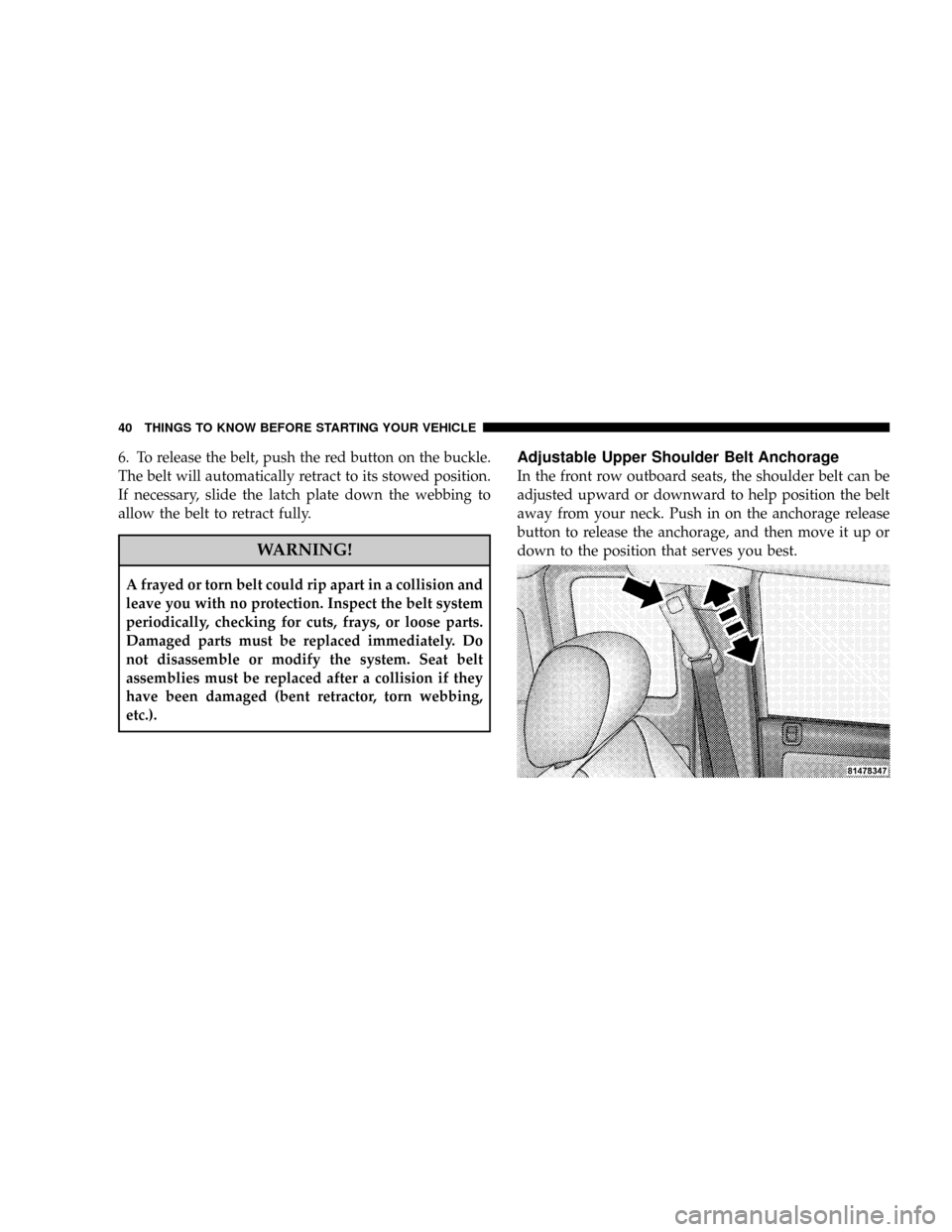
Adjustable Upper Shoulder Belt Anchorage
In the front row outboard seats, the shoulder belt can be
adjusted upward or downward to help position the belt
away from your neck. Push in on the anchorage release
button to release the anchorage, and then move it up or
down to the position that serves you best.
40 THINGS TO KNOW BEFORE STARTING YOUR VEHICLE
Page 47 of 426

Here are some simple steps you can follow to minimize
the risk of harm from a deploying airbag.
1. Children 12 years and under should always ride
buckled up in a rear seat in an appropriate child restraint.
Infants in rear-facing child restraints shouldNEVERride
in the front seat of a vehicle with a passenger front airbag.
An airbag deployment can cause severe injury or death to
infants in that position.
If a child from 1 to 12 years old must ride in the front
passenger seat because the vehicle is crowded, move the
seat as far back as possible, and use the proper child
restraint. See9Child Restraint9in this section.
You should read the instructions provided with your
child restraint to make sure that you are using it properly.2. All occupants should use their lap and shoulder belts
properly.
3. The driver and front passenger seats should be moved
back as far as practical to allow the airbag room to inflate.
4. If your vehicle has window airbags, do not lean
against the door or window, airbags will inflate forcefully
into the space between you and the door.
5. If the airbag system in this vehicle needs to be
modified to accommodate a disabled person, contact the
Customer Center. Phone numbers are provided in the9If
You Need Customer Assistance9section later in this
owner's manual.
THINGS TO KNOW BEFORE STARTING YOUR VEHICLE 47
2
Page 55 of 426

2. Used in defense of litigation involving a
DaimlerChrysler Corporation product
3. Requested by police under a legal warrant
4. Otherwise required by law
Data Parameters that May Be Recorded:
²Diagnostic trouble code(s) and warning lamp status
for electronically-controlled safety systems, including
the airbag system
²9Time9of airbag deployment (in terms of ignition
cycles and vehicle mileage)
²Airbag deployment level (if applicable)
²Impact acceleration and angle
²Seatbelt status
²Brake status (service and parking brakes)
²Accelerator status (including vehicle speed)
²Engine control status (including engine speed)
²Transmission gear selection
²Cruise control status
²Traction/stability control status
²Tire pressure monitoring system status (if equipped)
Child Restraint
Everyone in your vehicle needs to be buckled up all the
time - babies and children, too. Every state in the United
States and all Canadian provinces require that small
children ride in proper restraint systems. This is the law,
and you can be prosecuted for ignoring it. Children 12
years and under should ride properly buckled up in a
rear seat, if available. According to crash statistics, chil-
dren are safer when properly restrained in the rear seats
rather than in the front.
THINGS TO KNOW BEFORE STARTING YOUR VEHICLE 55
2
Page 56 of 426

There are different sizes and types of restraints for
children from newborn size to the child almost large
enough for an adult seat belt. Always check the child seat
owner's manual to ensure you have the right seat for
your child. Use the restraint that is correct for your child:
Infants and Small Children
²
Safety experts recommend that children ride
rearward-facing in the vehicle until they are at least
one year old and weigh at least 20 lbs (9 kg). Two types
of child restraints can be used rearward facing: infant
carriers and9convertible9child seats.
²The infant carrier is only used rearward-facing in the
vehicle. It is recommended for children who weigh up
to about 20 lbs (9 kg).9Convertible9child seats can be
used either rearward-facing or forward-facing in the
vehicle. Convertible child seats often have a higher
weight limit in the rearward-facing direction than
infant carriers do, so they can be used rearward-facingby children who weigh more than 20 lbs (9 kg) but are
less than one year old. Both types of child restraints are
held in the vehicle by the seatbelt or the LATCH child
restraint anchorage system. (See the LATCH - Child
Seat Anchorage System section.)
²Rearward-facing child seats mustNEVERbe used in
the front seat of a vehicle with a front passenger airbag
that does not have a switch to turn the airbag Off. An
airbag deployment could cause severe injury or death
to infants in this position.
Older Children and Child Restraints
²Children who weigh more than 20 lbs (9 kg) and who
are older than one year can ride forward-facing in the
vehicle. Forward-facing child seats and convertible
child seats used in the forward-facing direction are for
children who weigh 20 to 40 lbs (9 to 18 kg), and are
older than one year old. These child seats are also held
56 THINGS TO KNOW BEFORE STARTING YOUR VEHICLE
Page 57 of 426

in the vehicle by the seatbelt or the LATCH child
restraint anchorage system. (See the LATCH - Child
Seat Anchorage System section.)
²The belt-positioning booster seat is for children weigh-
ing more than 40 lbs (18 kg), but who are still too small
to fit the vehicle's seat belts properly. If the child
cannot sit with knees bent over the seat cushion while
the child's back is against the seatback, they need a
belt-positioning booster seat. The child and booster
seat are held in the vehicle by the lap/shoulder belt.
Children Too Large for Booster Seats
²Children who are large enough to wear the shoulder
belt comfortably, and whose legs are long enough to
bend over the front of the seat when their back is
against the seat back should use the lap/shoulder belt
in a rear seat.
²Make sure that the child is upright in the seat.
²The lap portion should be low on the hips and as snug
as possible.
²Check belt fit periodically. A child's squirming or
slouching can move the belt out of position.
²If the shoulder belt contacts the face or neck, move the
child closer to the center of the vehicle. Never allow a
child to put the shoulder belt under an arm.
For additional information, refer to www.seatcheck.org.
THINGS TO KNOW BEFORE STARTING YOUR VEHICLE 57
2
Page 58 of 426
WARNING!
²Improper installation can lead to failure of an
infant or child restraint. It could come loose in a
collision. The child could be badly injured or
killed. Follow the manufacturer's directions ex-
actly when installing an infant or child restraint.
²A rearward facing infant restraint should only be
used in a rear seat of a vehicle that does not have
an airbag off switch. A rearward facing infant
restraint in the front seat may be struck by a
deploying passenger airbag which may cause se-
vere or fatal to the infant.
Here are some tips for getting the most out of your child
restraint:
²Before buying any restraint system, make sure that it
has a label certifying that it meets all applicable SafetyStandards. The manufacturer recommends that you
try a child restraint in the vehicle seats where you will
use it before you buy it.
²The restraint must be appropriate for your child's
weight and height. Check the label on the restraint for
weight and height limits.
²Carefully follow the instructions that come with the
restraint. If you install the restraint improperly, it may
not work when you need it.
²The Extended Cab first and Club/Crew Cab second
row outside seating positions have cinching latch
plates. These are designed to keep the lap portion tight
around the child restraint so that it is not necessary to
use a locking clip. If the seat belt has a cinching latch
plate, pulling up on the shoulder portion of the
lap/shoulder belt will tighten the belt. The cinching
latch plate will keep the belt tight, however, any seat
58 THINGS TO KNOW BEFORE STARTING YOUR VEHICLE
Page 60 of 426

Crew Cab
²The Crew Cab second row seat has lower anchorages
that are capable of accommodating LATCH-
compatible child seats having flexible, webbing-
mounted lower attachments at all three seating posi-
tions. Child seats with fixed lower attachments must
be installed in the outboard positions only. Regardless
of the specific type of lower attachment, NEVER install
LATCH compatible child seats such that two seats
share a common lower anchorage. If you are installing
LATCH-compatible child restraints in adjacent rear
seating positions, you can use the LATCH anchors or
the vehicle's seat belt for the outboard position, but
you must use the vehicle's seat belt at the center
position.If your child restraints are not LATCH compatible, you
can only install the child restraints using the vehicle's
seat belts. Please refer to the next section for typical
installation instructions.
60 THINGS TO KNOW BEFORE STARTING YOUR VEHICLE