Page 289 of 426

Gross Axle Weight Rating (GAWR)
The GAWR is the maximum permissible load on the front
and rear axles. The load must be distributed in the cargo
area so that the GAWR of each axle is not exceeded.
Each axle GAWR is determined by the component in the
system with the lowest load carrying capacity (axle,
springs, tires, or wheels).
Heavier axles or suspension components sometimes
specified by purchasers for increased durability do not
necessarily increase the vehicle's GVWR.
Tire Size
This is the minimum allowable tire size for your vehicle.
Replacement tires must be equal to the load capacity of
this tire size.
Rim Size
This is the rim size that is appropriate for the tire size
listed.
Inflation Pressure (Cold)
This is the cold tire inflation pressure for your vehicle for
all loading conditions up to full GAWR.
Curb Weight
The curb weight of a vehicle is defined as the total weight
of the vehicle with all fluids, including vehicle fuel, at full
capacity conditions, and with no occupants or cargo
loaded into the vehicle. The front and rear curb weight
values are determined by weighing your vehicle on a
commercial scale before any occupants or cargo are
added.
Loading
The actual total weight and the weight of the front and
rear of your vehicle at the ground can best be determined
by weighing it when it is loaded and ready for operation.
The entire vehicle should first be weighed on a commer-
cial scale to insure that the GVWR has not been exceeded.
The weight on the front and rear of the vehicle should
STARTING AND OPERATING 289
5
Page 313 of 426
WARNING!
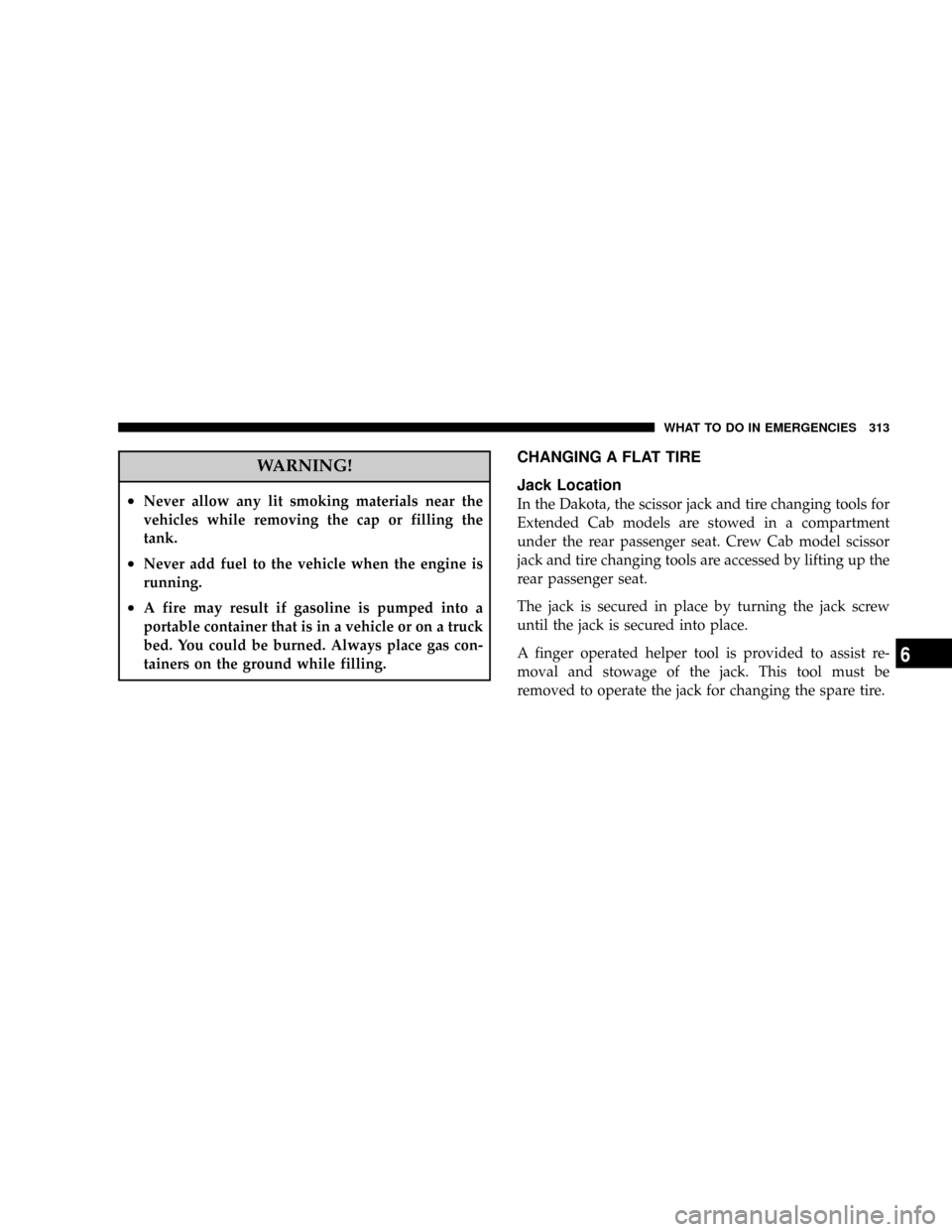
²Never allow any lit smoking materials near the
vehicles while removing the cap or filling the
tank.
²Never add fuel to the vehicle when the engine is
running.
²A fire may result if gasoline is pumped into a
portable container that is in a vehicle or on a truck
bed. You could be burned. Always place gas con-
tainers on the ground while filling.
CHANGING A FLAT TIRE
Jack Location
In the Dakota, the scissor jack and tire changing tools for
Extended Cab models are stowed in a compartment
under the rear passenger seat. Crew Cab model scissor
jack and tire changing tools are accessed by lifting up the
rear passenger seat.
The jack is secured in place by turning the jack screw
until the jack is secured into place.
A finger operated helper tool is provided to assist re-
moval and stowage of the jack. This tool must be
removed to operate the jack for changing the spare tire.
WHAT TO DO IN EMERGENCIES 313
6
Page 329 of 426
MAINTAINING YOUR VEHICLE
CONTENTS
m3.7L Engine Compartment................332
m4.7L Engine Compartment................333
mOnboard Diagnostic System Ð OBD II........334
NLoose Fuel Filler Cap Message............335
mEmissions Inspection And Maintenance
Programs............................335
mReplacement Parts......................337
mDealer Service.........................337
mMaintenance Procedures..................337NEngine Oil..........................338
NEngine Oil Filter......................341
NDrive Belts Ð Check Condition And Tension . . 342
NSpark Plugs.........................342
NEngine Air Cleaner Filter................343
NEngine Fuel Filter.....................343
NCatalytic Converter....................343
NMaintenance Free Battery................345
NAir Conditioner Maintenance.............346
7
Page 335 of 426

Loose Fuel Filler Cap Message
After fuel is added, the vehicle diagnostic system can
determine if the fuel filler cap is possibly loose, improp-
erly installed, or damaged. A loose fuel filler cap message
will be displayed in the instrument cluster. Tighten the
gas cap until a9clicking9sound is heard. This is an
indication that the gas cap is properly tightened. Press
the odometer reset button to turn the message off. If the
problem persists, the message will appear the next time
the vehicle is started. This might indicate a damaged cap.
If the problem is detected twice in a row, the system will
turn on the Malfunction Indicator Light (MIL). Resolving
the problem will turn the MIL light off.
EMISSIONS INSPECTION AND MAINTENANCE
PROGRAMS
In some localities, it may be a legal requirement to pass
an inspection of your vehicle's emissions control system.
Failure to pass could prevent vehicle registration.
For states which have an I/M (Inspection and
Maintenance) requirement, this check verifies the
following: the MIL (Malfunction Indicator Lamp)
is functioning and is not on when the engine is running,
and that the OBD (On Board Diagnostic) system is ready
for testing.
Normally, the OBD system will be ready. The OBD
system maynotbe ready if your vehicle was recently
serviced, if you recently had a dead battery, or a battery
replacement. If the OBD system is determined not ready
for the I/M test, your vehicle may fail the test.
MAINTAINING YOUR VEHICLE 335
7
Page 340 of 426

Dusty Conditions
Driving through dust-laden air increases the problems of
keeping abrasive materials out of the engine. Under these
conditions, special attention should be given to the
engine air cleaner. The crankcase ventilation system
should also be checked periodically. Make sure that these
units are always clean. This will tend to reduce to a
minimum the amount of abrasive material that may enter
the engine.
Engine Oil Selection
For best performance and maximum protection under all
types of operating conditions, the manufacture only
recommends engine oils that are API certified and meet
the requirements of DaimlerChrysler Material Standard
MS-6395.
American Petroleum Institute (API) Engine Oil
Identification Symbol
This symbol means that the oil has
been certified by the American
Petroleum Institute (API). The
manufacturer only recommends
API Certified engine oils.
Engine Oil Viscosity (SAE Grade)
SAE 5W-20 engine oil is recommended for all operating
temperatures. This engine oil improves low tempera-
ture starting and vehicle fuel economy. The engine oil
filler cap also shows the recommended engine oil
viscosity for your vehicle.
340 MAINTAINING YOUR VEHICLE
Page 384 of 426
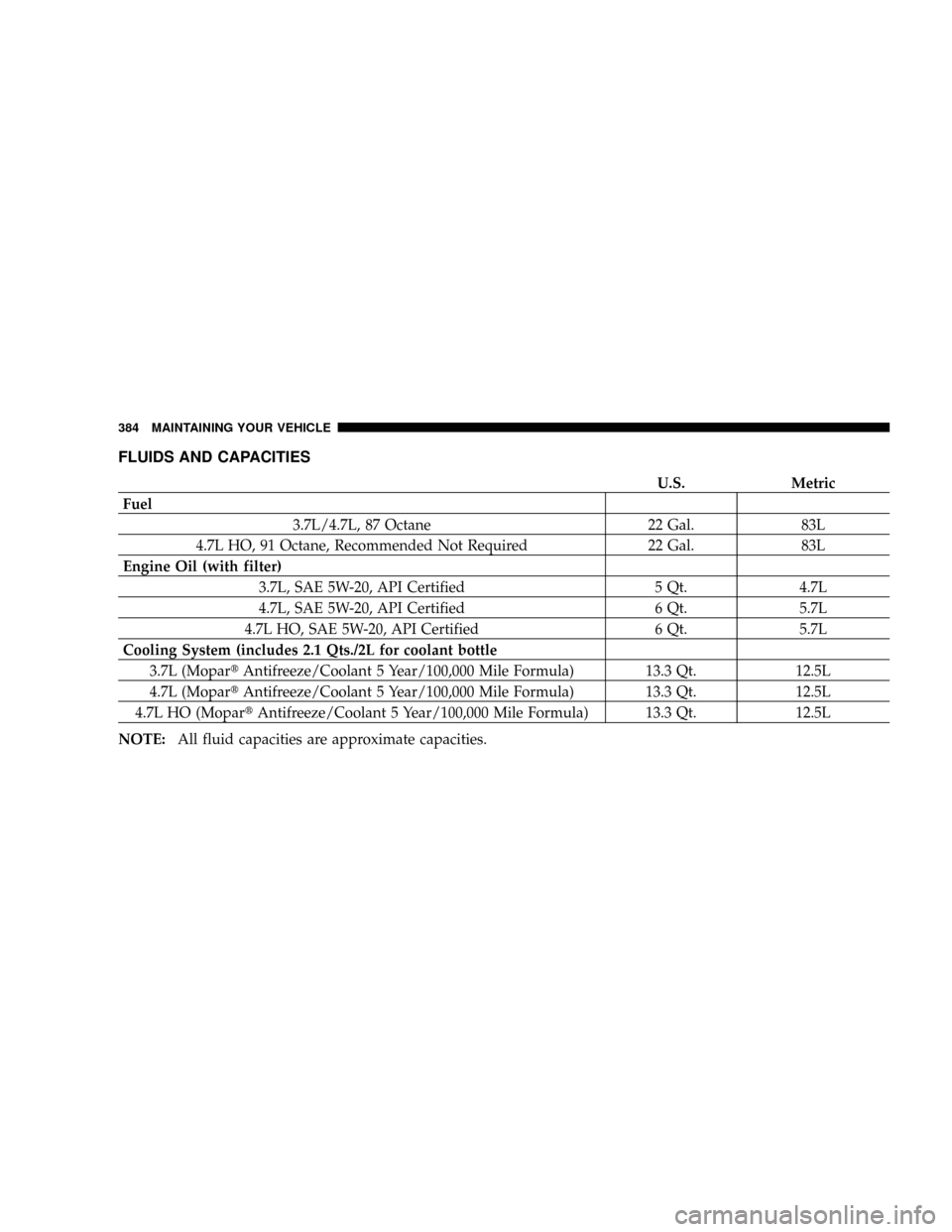
FLUIDS AND CAPACITIES
U.S. Metric
Fuel
3.7L/4.7L, 87 Octane 22 Gal. 83L
4.7L HO, 91 Octane, Recommended Not Required 22 Gal. 83L
Engine Oil (with filter)
3.7L, SAE 5W-20, API Certified 5 Qt. 4.7L
4.7L, SAE 5W-20, API Certified 6 Qt. 5.7L
4.7L HO, SAE 5W-20, API Certified 6 Qt. 5.7L
Cooling System (includes 2.1 Qts./2L for coolant bottle
3.7L (MopartAntifreeze/Coolant 5 Year/100,000 Mile Formula) 13.3 Qt. 12.5L
4.7L (MopartAntifreeze/Coolant 5 Year/100,000 Mile Formula) 13.3 Qt. 12.5L
4.7L HO (MopartAntifreeze/Coolant 5 Year/100,000 Mile Formula) 13.3 Qt. 12.5L
NOTE:All fluid capacities are approximate capacities.
384 MAINTAINING YOUR VEHICLE
Page 385 of 426
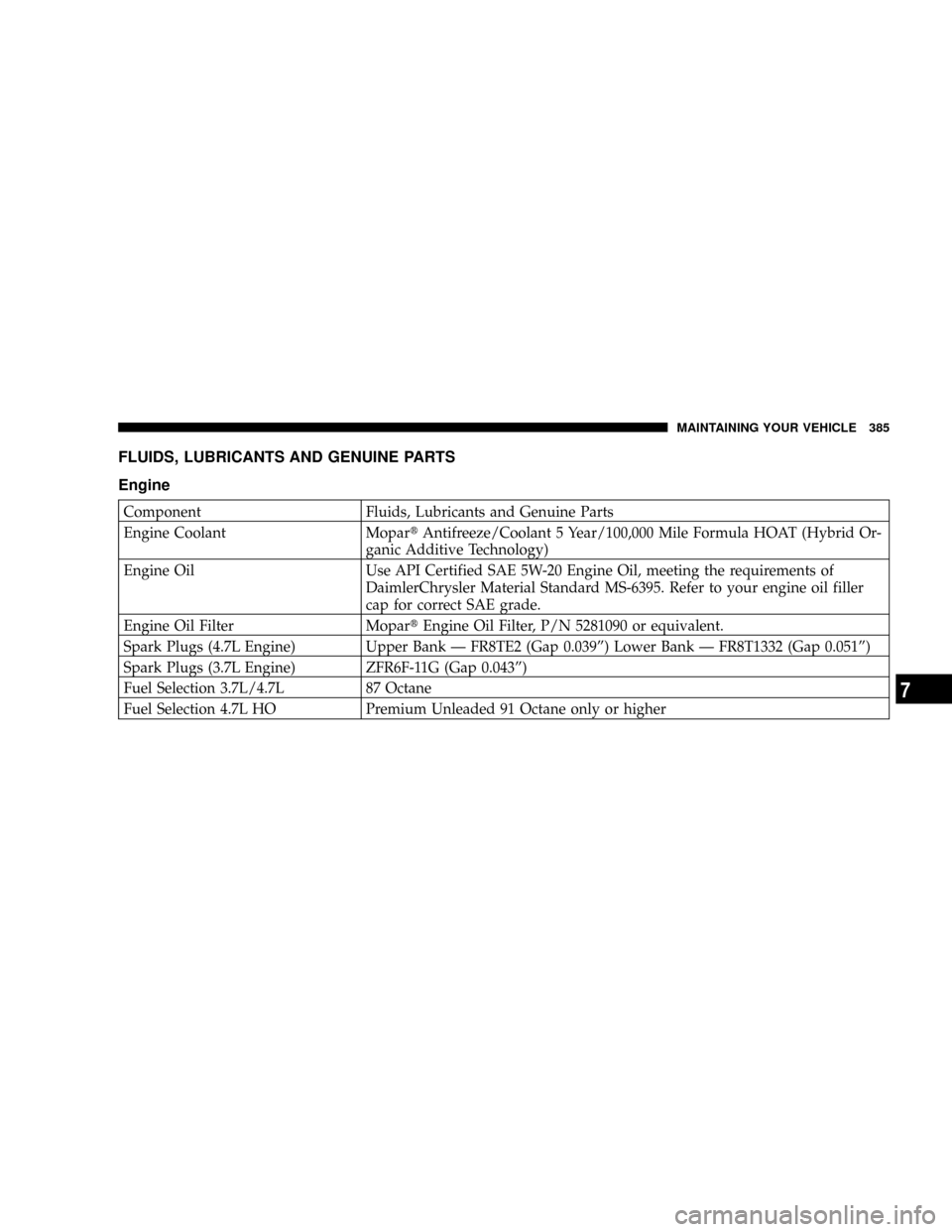
FLUIDS, LUBRICANTS AND GENUINE PARTS
Engine
Component Fluids, Lubricants and Genuine Parts
Engine Coolant MopartAntifreeze/Coolant 5 Year/100,000 Mile Formula HOAT (Hybrid Or-
ganic Additive Technology)
Engine Oil Use API Certified SAE 5W-20 Engine Oil, meeting the requirements of
DaimlerChrysler Material Standard MS-6395. Refer to your engine oil filler
cap for correct SAE grade.
Engine Oil Filter MopartEngine Oil Filter, P/N 5281090 or equivalent.
Spark Plugs (4.7L Engine) Upper Bank Ð FR8TE2 (Gap 0.039º) Lower Bank Ð FR8T1332 (Gap 0.051º)
Spark Plugs (3.7L Engine) ZFR6F-11G (Gap 0.043º)
Fuel Selection 3.7L/4.7L 87 Octane
Fuel Selection 4.7L HO Premium Unleaded 91 Octane only or higher
MAINTAINING YOUR VEHICLE 385
7
Page 412 of 426

Jacking............................. 318
Tow Hooks.......................... 326
Towing............................. 327
Emission Control System Maintenance......... 388
Emission Related Components.............. 356
Engine
Air Cleaner.......................... 343
Block Heater......................... 224
Break-In Recommendations................ 68
Coolant (Antifreeze).................... 385
Exhaust Gas Caution..................69,281
Flooded, Starting...................... 222
Fuel Requirements..................... 384
Jump Starting......................... 323
Oil ...........................338,384,385
Oil Filler Cap......................... 340
Oil Selection.......................... 384
Oil Synthetic......................... 341
Starting............................. 221Temperature Gauge..................... 158
Entry System, Illuminated.................. 20
Equipment Identification Plate.............. 310
Event Data Recorder...................... 53
Exhaust Gas Caution................69,281,350
Exhaust System.......................69,350
Extender, Seat Belt........................ 44
Exterior Lighting........................ 114
Fabric Care............................ 365
Filters
Air Cleaner.......................... 343
Engine Fuel.......................... 343
Engine Oil........................341,385
Engine Oil Disposal.................... 341
Flashers
Hazard Warning....................... 312
Turn Signal..................... 117,158,377
Flat Tire Stowage........................ 322
412 INDEX