2008 DODGE AVENGER lock
[x] Cancel search: lockPage 51 of 467
BeltAlert t will be reactivated if the driver's seat belt is
unbuckled for more than 10 seconds and the vehicle
speed is greater than 5 mph (8 km/h).
BELTALERT T PROGRAMMING
BeltAlert t can be enabled or disabled by your authorized
dealer or by following these steps:
NOTE: The following steps must occur within the first
60 seconds of the ignition switch being turned to the ON
or START position. DaimlerChrysler does not recom-
mend deactivating BeltAlert t .
1. Turn the ignition switch to the LOCK position and
buckle the driver's seat belt.
2. Turn the ignition switch to the ON position and wait
for the Seat Belt Warning Light to turn off. 3. Within 60 seconds of turning the ignition switch to the
ON position, unbuckle and then re-buckle the driver's
seat belt at least three times within 10 seconds, ending
with the seat belt buckled.
NOTE: Watch for the Seat Belt Warning Light to turn on
while unbuckling and off while re-buckling the seat belt.
It may be necessary to retract the seat belt partially each
time when unbuckling.
4. Turn the ignition switch to the LOCK position. A
single chime will sound to signify that you have success-
fully completed the programming.
BeltAlert t can be reactivated by repeating this procedure.
NOTE: Although BeltAlert t has been deactivated, the
Seat Belt Warning Light will continue to illuminate while
the driver's seat belt remains unbuckled. THINGS TO KNOW BEFORE STARTING YOUR VEHICLE 49
2
Page 52 of 467
AUTOMATIC LOCKING MODE
In this mode, the shoulder belt is automatically pre-
locked. However, the belt will still retract to remove any
slack in the shoulder belt. The Automatic Locking Mode
is available on all passenger-seating positions. Use the
Automatic Locking Mode anytime a child safety seat is
installed in a passenger seating position. Children 12
years old and under should be properly restrained in the
rear seat whenever possible.
How To Engage The Automatic Locking Mode
1. Buckle the combination lap/shoulder belt.
2. Grasp the shoulder portion and pull downward until
the entire belt is extracted.
3. Allow the belt to retract. As the belt retracts, you will
hear a clicking sound. This indicates the safety belt is
now in the Automatic Locking Mode. How To Disengage The Automatic Locking Mode
Unbuckle the combination lap/shoulder belt and allow it
to retract completely to disengage the Automatic Locking
Mode and activate the vehicle sensitive (emergency)
locking mode.
SEAT BELTS AND PREGNANT WOMEN
We recommend that pregnant women use the seat belts
throughout their pregnancy. Keeping the mother safe is
the best way to keep the baby safe.
Pregnant women should wear the lap part of the belt
across the thighs and as snug across the hips as possible.
Keep the belt low so that it does not come across the
abdomen. That way the strong bones of the hips will take
the force if there is a collision.50 THINGS TO KNOW BEFORE STARTING YOUR VEHICLE
Page 58 of 467
WARNING!² Do not put anything on or around the airbag
covers or attempt to open them manually. You may
damage the airbags and you could be injured
because the airbags are not there to protect you.
These protective covers for the airbag cushions are
designed to open only when the airbags are inflat-
ing.
² Do not use accessory seat covers or place objects
between you and the side airbags; the performance
could be adversely affected and/or objects could
be pushed into you, causing serious injury. WARNING!² If your vehicle is equipped with left and right
window bags, do not stack luggage or other cargo
up high enough to block the location of the Side
Airbag Inflatable Curtains (SABIC). The area
where the side curtain airbag is located should
remain free from any obstructions.
² Do not attach cup holders or any other objects on
or around the door. The inflating side airbag could
drive the object into occupants, causing serious
injury.
Airbags inflate in moderate to high speed impacts. Along
with seat belts and pretensioners, front airbags, and side
airbags work with the knee bolsters to provide improved
protection for the driver and front passenger.56 THINGS TO KNOW BEFORE STARTING YOUR VEHICLE
Page 64 of 467

Enhanced Accident Response System
In the event of an impact that causes airbag deployment,
with the vehicle stopped, and the vehicle communication
network intact, and the power intact, the Enhanced
Accident Response System performs the following func-
tions:
² Cuts off fuel to the engine
² Flashes hazard lights
² Turns on the interior lights which remain on as long as
the battery has power or until the ignition key is
removed
² Unlocks the doors automatically
If A Deployment Occurs
The airbag systems are designed to deploy when the
Occupant Restraint Controller (ORC) detect a moderate-
to-severe collision, to help restrain the driver and front
passenger, and then immediately deflate. NOTE: A frontal collision that is not severe enough to
need airbag protection will not activate the system. This
does not mean something is wrong with the airbag
system.
If you do have a collision, which deploys the airbags, any
or all of the following may occur:
² The nylon airbag material may sometimes cause abra-
sions and/or skin reddening to the driver and front
passenger as the airbags deploy and unfold. The
abrasions are similar to friction rope burns or those
you might get sliding along a carpet or gymnasium
floor. They are not caused by contact with chemicals.
They are not permanent and normally heal quickly.
However, if you haven't healed significantly within a
few days, or if you have any blistering, see your doctor
immediately.
² As the airbags deflate, you may see some smoke-like
particles. The particles are a normal by-product of the62 THINGS TO KNOW BEFORE STARTING YOUR VEHICLE
Page 67 of 467

Airbag Light
You will want to have the airbags ready to
inflate for your protection in a collision. While
the airbag system is designed to be mainte-
nance free, if any of the following occurs, have
an authorized dealer service the system immediately.
² The AIRBAG light does not come on during the 6 to 8
seconds when the ignition switch is first turned on.
² The light remains on after the 6 to 8 second interval.
² The light comes on and remains on while driving.
NOTE: If the speedometer, tachometer, or any engine
related gauges are not working, the Occupant Restraint
Controller (ORC) may also be disabled. The airbags may
not be ready to inflate for your protection. Promptly
check fuse block for blown fuses. Refer to the label
located on the inside of the fuse block cover for the
proper airbag fuses. See your dealer if the fuse is good. EVENT DATA RECORDER (EDR)
In the event of an accident, your vehicle is designed to
record up to 5 seconds of specific vehicle data parameters
(see the following list) in an event data recorder prior to
the moment of airbag deployment, or near deployment,
and up to a quarter second of high-speed deceleration
data during and/or after airbag deployment. EDR data
are ONLY recorded if an airbag deploys, or nearly
deploys, and are otherwise unavailable.
NOTE:
1. A near-deployment event occurs when the airbag
sensor detects severe vehicle deceleration usually indica-
tive of a crash, but not severe enough to warrant airbag
deployment.
2. Under certain circumstances, EDR data may not be
recorded (e.g., loss of battery power).
In conjunction with other data gathered during a com-
plete accident investigation, the electronic data may be THINGS TO KNOW BEFORE STARTING YOUR VEHICLE 65
2
Page 72 of 467
Here are some tips on getting the most out of your
child restraints:
² Children who are large enough to wear the shoulder
belt comfortably, and whose legs are long enough to
bend over the front of the seat when their back is
against the seatback, should use the lap/shoulder belt
in a rear seat.
² Before buying any restraint system, make sure that it
has a label certifying that it meets all applicable Safety
Standards. We also recommend that you make sure
that you can install the child restraint in the vehicle
where you will use it, before you buy it.
² The restraint must be appropriate for your child's
weight and height. Check the label on the restraint for
weight and height limits. ² Carefully follow the instructions that come with the
restraint. If you install the restraint improperly, it may
not work when you need it.
² All passenger seating positions contain automatic
locking retractors. However, any seat belt system will
loosen with time, so check the belt occasionally and
pull it tight if necessary.
² In the rear seat, you may have trouble tightening the
lap/shoulder belt on the child restraint because the
buckle or latch plate is too close to the belt path
opening on the restraint. Disconnect the latch plate
from the buckle and twist the short buckle end of the
belt several times to shorten it. Insert the latch plate
into the buckle with the release button facing out.
² If the belt still can't be tightened, or if by pulling and
pushing on the restraint loosens the belt, disconnect
the latch plate from the buckle, turn the latch plate70 THINGS TO KNOW BEFORE STARTING YOUR VEHICLE
Page 78 of 467
between the two posts. If not possible, lower the head
restraint and pass the tether strap around the outboard
side of the head restraint.
3. Attach the tether strap hook (A) of the child restraint
to the anchor (B) and remove slack in the tether strap
according to the child restraint manufacturer's instruc-
tions.
WARNING!An incorrectly anchored tether strap could lead to
increased head motion and possible injury to the
child. Use only the anchor positions directly behind
the child seat to secure a child restraint top tether
strap. Installing Child Restraints Using the Vehicle Seat
belt
The passenger seat belts are equipped with Automatic
Locking Retractors (ALRs), which are designed to keep
the lap portion tight around the child restraint.
The seat belt must be in the Automatic Locking Mode in
order to enable a child restraint to be tightly installed.
Refer to ªAutomatic Locking Modeº in this section for
details. A locking clip should not be necessary once the
automatic locking feature is enabled. Position the shoul-
der and lap belt on the child restraint. The Automatic
Locking Retractor (ALR) is activated by first attaching
the child seat, then pulling all of the webbing out of the
retractor, then allowing the webbing to retract. As the
webbing retracts, you will hear a clicking sound. This
indicates the safety belt is now in the Automatic Locking
Mode. To release, simply unbuckle the seat belt by
depressing the button, and allow the webbing to retract
into the retractor.76 THINGS TO KNOW BEFORE STARTING YOUR VEHICLE
Page 128 of 467
FOLDING REAR SEAT
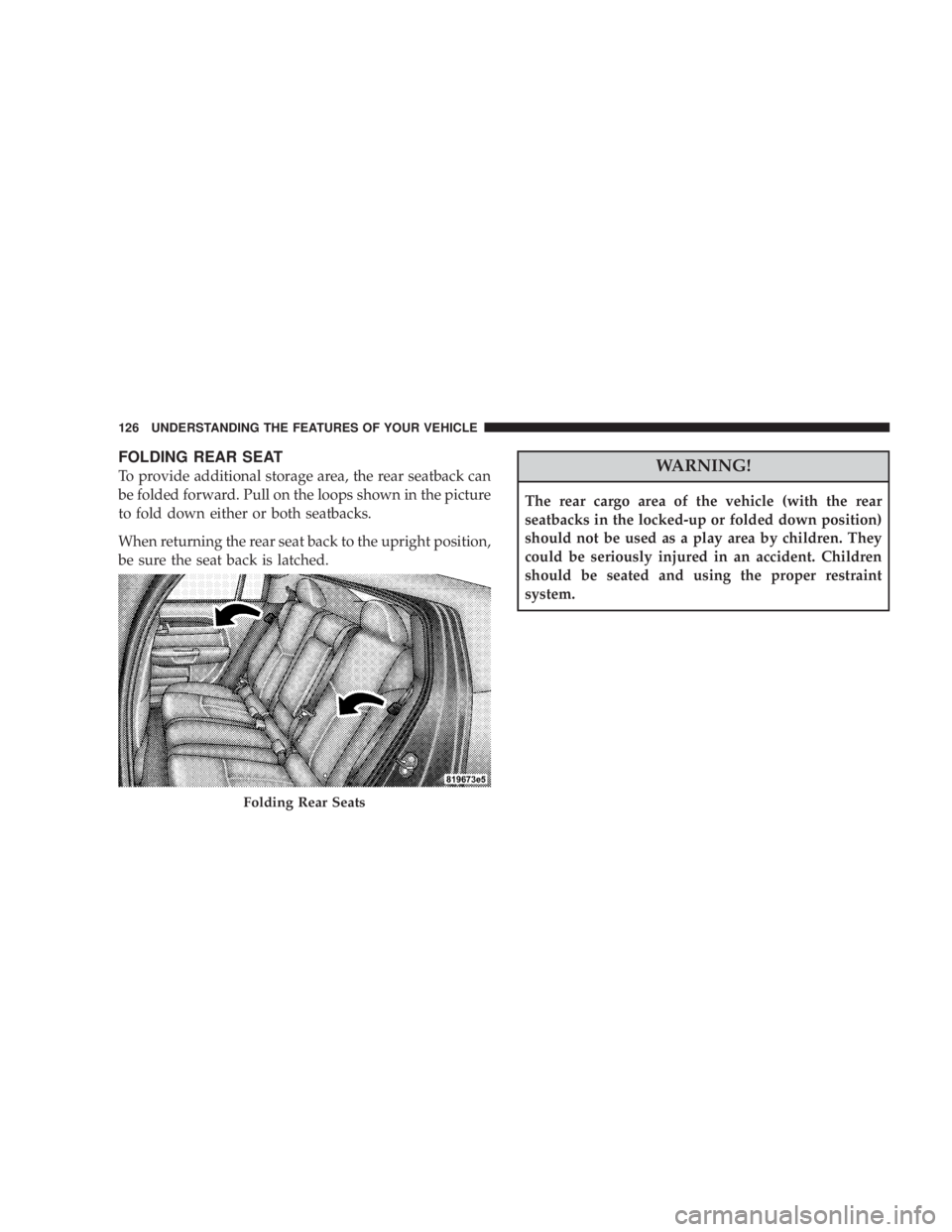
To provide additional storage area, the rear seatback can
be folded forward. Pull on the loops shown in the picture
to fold down either or both seatbacks.
When returning the rear seat back to the upright position,
be sure the seat back is latched. WARNING!The rear cargo area of the vehicle (with the rear
seatbacks in the locked-up or folded down position)
should not be used as a play area by children. They
could be seriously injured in an accident. Children
should be seated and using the proper restraint
system.
Folding Rear Seats126 UNDERSTANDING THE FEATURES OF YOUR VEHICLE