Page 388 of 467
STEERING LINKAGE
The tie rod end ball joints should be inspected for
external leakage and damage when other maintenance is
performed.
BODY LUBRICATION
Locks and all body pivot points, including seat tracks,
door hinges, trunk hinges, and hood hinges, should be
lubricated periodically to assure quiet, easy operation
and to protect against rust and wear. Prior to the appli-
cation of any lubricant, the parts concerned should be
wiped clean to remove dust and grit. After lubricating,
excess oil and grease should be removed. Particular
attention should also be given to hood latching compo-
nents to ensure proper function. When performing other
underhood services, the hood latch, release mechanism,
and safety catch should be cleaned and lubricated.
The external lock cylinders should be lubricated twice a
year, preferably in the fall and spring. Apply a small amount of a high quality lubricant such as Mopar t Lock
Cylinder Lubricant or equivalent directly into the lock
cylinder.
WINDSHIELD WIPER BLADES
Clean the rubber edges of the wiper blades and the
windshield periodically with a sponge or soft cloth and a
mild non-abrasive cleaner or use the washer solvent. This
will remove accumulations of salt, waxes, or road film
and help reduce streaking and smearing.
Operation of the wipers on dry glass for long periods
may cause deterioration of the wiper blades. Always use
washer fluid when using the wipers to remove salt or dirt
from a dry windshield.
Avoid using the wiper blades to remove frost or ice from
the windshield. Make sure that they are not frozen to the
glass before turning them on to avoid damaging the
blade.386 MAINTAINING YOUR VEHICLE
Page 389 of 467

Keep the blade rubber out of contact with petroleum
products such as engine oil, gasoline, etc.
NOTE: Always refer to the wiper blade packaging for
specific installation instructions. Many wiper blade re-
placements fit multiple vehicles.
WINDSHIELD WASHERS
NOTE: Refer to the appropriate ªEngine Compartmentº
diagram in Section 7 for the location of the windshield
washer fluid reservoir.
The fluid reservoir for the windshield washers is located
in the engine compartment. Be sure to check the fluid
level in the reservoir at regular intervals. Fill the reservoir
with windshield washer solvent (not radiator antifreeze)
and operate the system for a few seconds to flush out the
residual water. WARNING!Commercially available windshield washer solvents
are flammable. They could ignite and burn you. Care
must be exercised when filling or working around
the washer solution.
EXHAUST SYSTEM
The best protection against carbon monoxide entry into
the vehicle body is a properly maintained engine exhaust
system.
If you notice a change in the sound of the exhaust system
or if exhaust fumes can be detected inside the vehicle or
when the underside or rear of the vehicle is damaged,
have a competent technician inspect the complete ex-
haust system and adjacent body areas for broken, dam-
aged, deteriorated, or mispositioned parts. Open seams
or loose connections could permit exhaust fumes to seep MAINTAINING YOUR VEHICLE 387
7
Page 390 of 467
into the passenger compartment. In addition, inspect the
exhaust system each time the vehicle is raised for an oil
change or lubrication. Replace as required.
WARNING!Exhaust gases can injure or kill. They contain carbon
monoxide (CO) which is colorless and odorless.
Breathing it can make you unconscious and can
eventually poison you. To avoid breathing CO, refer
to Exhaust Gas in the Safety Tips section of this
manual. COOLING SYSTEM
WARNING!² When working near the radiator cooling fan, dis-
connect the fan motor lead or turn the ignition
switch to the LOCK position. The fan is tempera-
ture controlled and can start at anytime the igni-
tion switch is in the ON position.
² You or others can be badly burned by hot coolant
or steam from your radiator. If you see or hear
steam coming from under the hood, don't open the
hood until the radiator has had time to cool. Never
try to open a cooling system pressure cap when the
radiator is hot.388 MAINTAINING YOUR VEHICLE
Page 397 of 467
WARNING!Riding the brakes can lead to brake failure and
possibly an accident. Driving with your foot resting
or riding on the brake pedal can result in abnormally
high brake temperatures, excessive lining wear, and
possible brake damage. You wouldn't have your full
braking capacity in an emergency.
Brake And Power Steering Hoses
When servicing the vehicle for scheduled maintenance,
inspect the surface of the hoses and nylon tubing for
evidence of heat and mechanical damage. Hard and
brittle rubber, cracking, tears, cuts, abrasions, and exces-
sive swelling suggest deterioration of the rubber. Particu-
lar attention should be made to examining those hose
surfaces nearest to high heat sources, such as the exhaust
manifold. Ensure nylon tubing in these areas has not melted or
collapsed.
Inspect all hose clamps and couplings to make sure they
are secure and no leaks are present.
NOTE:
² Often, fluids such as oil, power steering fluid, and
brake fluid are used during assembly plant operations
to ease the assembly of hoses to couplings. Therefore,
oil wetness at the hose-coupling area is not necessarily
an indication of leakage. Actual dripping of hot fluid
when systems are under pressure (during vehicle
operation) should be noted before a hose is replaced
based on leakage.
² Inspect the brake hoses whenever the brake system is
serviced and at every engine oil change. Inspect hy-
draulic brake hoses for surface cracking, scuffing, or
worn spots. If there is any evidence of cracking,
scuffing, or worn spots, the hose should be replaced MAINTAINING YOUR VEHICLE 395
7
Page 399 of 467

WARNING!² Overfilling the brake fluid reservoir can result in
spilling brake fluid on hot engine parts and the
brake fluid catching fire.
² Use of a brake fluid that has a lower initial boiling
point than the recommended MOPAR t DOT 3
product or a brake fluid that is unidentified as to
FMVSS specification may result in sudden brake
failure during hard prolonged braking. You could
have an accident.
Use only brake fluid that has been in a tightly closed
container to avoid contamination from foreign matter or
moisture. CAUTION!Do not allow petroleum base fluid to contaminate the
brake fluid, all brake seal components could be
damaged causing partial or complete brake failure.
AUTOMATIC TRANSAXLE
The automatic transaxle and differential assembly are
contained within a single housing.
The fluid level in the automatic transaxle should be
checked whenever the vehicle is serviced. Operation with
an improper fluid level will greatly reduce the life of the
transaxle and the fluid.
Fluid Level Check Ð Vehicles with 3.5L Engine
The automatic transaxle has no dipstick and is dealer
serviced only. MAINTAINING YOUR VEHICLE 397
7
Page 404 of 467
² If your vehicle is damaged due to an accident or
similar cause which destroys the paint and protective
coating, have your vehicle repaired as soon as pos-
sible. The cost of such repairs is considered the respon-
sibility of the owner.
² If you carry special cargo such as chemicals, fertilizers,
de-icer salt, etc., be sure that such materials are well
packaged and sealed.
² If a lot of driving is done on gravel roads, consider
mud or stone shields behind each wheel.
² Use Mopar t touch up paint on scratches as soon as
possible. Your authorized dealer has touch up paint to
match the color of your vehicle.
Wheel and Wheel Trim Care
All wheels and wheel trim, especially aluminum and
chrome plated wheels, should be cleaned regularly with
a mild soap and water to prevent corrosion. To remove heavy soil and/or excessive brake dust, use Mopar t
Wheel Cleaner (05066247AB) or equivalent or select a
nonabrasive, non-acidic cleaner. Do not use scouring
pads, steel wool, a bristle brush, or metal polishes. Only
Mopar t or equivalent is recommended. Do not use oven
cleaner. Avoid automatic car washes that use acidic
solutions or harsh brushes that may damage the wheels'
protective finish.
Cleaning Headlights
Your vehicle has plastic headlights that are lighter and
less susceptible to stone breakage than glass headlights.
Plastic is not as scratch resistant as glass and therefore
different lens cleaning procedures must be followed.
To minimize the possibility of scratching the lenses and
reducing light output, avoid wiping with a dry cloth. To
remove road dirt, wash with a mild soap solution fol-
lowed by rinsing.402 MAINTAINING YOUR VEHICLE
Page 405 of 467
Do not use abrasive cleaning components, solvents, steel
wool or other aggressive material to clean the lenses.
Interior Care
Instrument Panel Cover
The instrument panel cover has a low glare surface,
which minimizes reflections in the windshield. Do not
use protectants or other products, which may cause
undesirable reflections. Use soap and warm water to
restore the low glare surface.
Cleaning Interior Trim
Interior Trim should be cleaned starting with a damp
cloth, a damp cloth with Mopar t Total Clean, then
Mopar t Spot & Stain Remover if absolutely necessary. Do
not use harsh cleaners or Armorall. Use Mopar t Total
Clean to clean vinyl upholstery Cleaning Leather Upholstery
Mopar t Total Clean is specifically recommended for
leather upholstery.
Your leather upholstery can be best preserved by regular
cleaning with a damp soft cloth. Small particles of dirt
can act as an abrasive and damage the leather upholstery
and should be removed promptly with a damp cloth.
Stubborn soils can be removed easily with a soft cloth
and Mopar t Total Clean. Care should be taken to avoid
soaking your leather upholstery with any liquid. Please
do not use polishes, oils, cleaning fluids, solvents, deter-
gents, or ammonia-based cleaners to clean your leather
upholstery. Application of a leather conditioner is not
required to maintain the original condition. MAINTAINING YOUR VEHICLE 403
7
Page 415 of 467
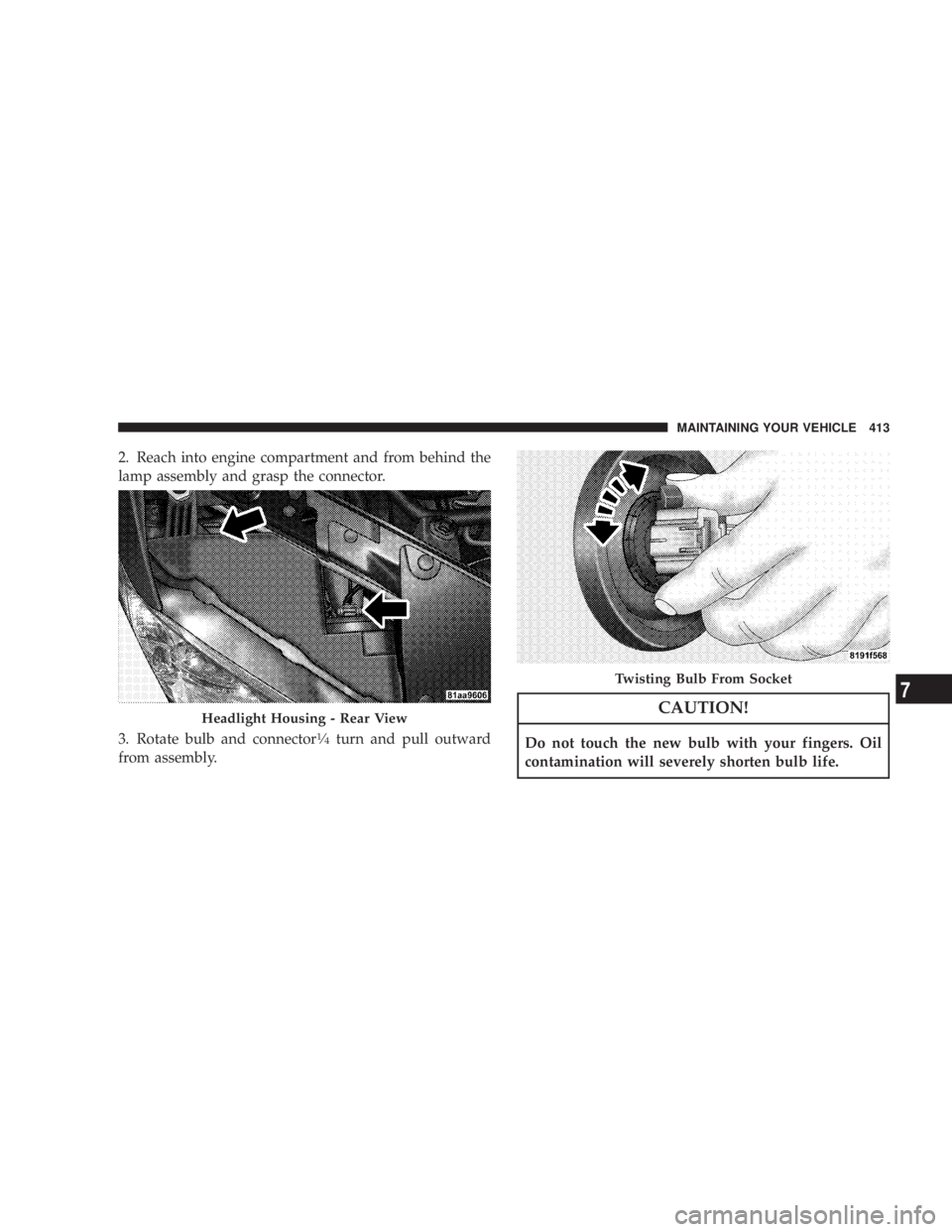
2. Reach into engine compartment and from behind the
lamp assembly and grasp the connector.
3. Rotate bulb and connector 1
¤ 4
turn and pull outward
from assembly. CAUTION!Do not touch the new bulb with your fingers. Oil
contamination will severely shorten bulb life.Headlight Housing - Rear View Twisting Bulb From Socket MAINTAINING YOUR VEHICLE 413
7