2008 DODGE AVENGER light
[x] Cancel search: lightPage 62 of 467

WARNING!Ignoring the AIRBAG light in your instrument panel
could mean you won't have the airbags to protect you
in a collision. If the light does not come on, stays on
after you start the vehicle, or if it comes on as you
drive, have the airbag system checked right away.
Impact Sensors
Two sensors, located on the front body structure, trigger
airbag deployment in direct frontal impacts and aid the
Occupant Restraint Controller (ORC) in determining
appropriate response to frontal impact events. Additional
sensors in the ORC determine the level of airbag deploy-
ment and provide deployment verification. Side Inflatable Curtain and Front Seat Mounted
Airbags Ð If equipped
The Occupant Restraint Controller System (ORC) de-
ploys the side inflatable curtain and seat mounted thorax
side airbags during collision with other vehicles and
during collisions where the impact is confined to a
particular area of the vehicle Ð such as collisions with
poles, trees or similar objects.
It will deploy the side inflatable curtains and front seat
thorax mounted airbags only on the impact side of the
vehicle.
The front driver and passenger seat contain inflatable
side airbags to protect the occupant from impact injuries.
Correctly functioning front passenger seat components
are critical for the Occupant Restraint Controller System60 THINGS TO KNOW BEFORE STARTING YOUR VEHICLE
Page 64 of 467

Enhanced Accident Response System
In the event of an impact that causes airbag deployment,
with the vehicle stopped, and the vehicle communication
network intact, and the power intact, the Enhanced
Accident Response System performs the following func-
tions:
² Cuts off fuel to the engine
² Flashes hazard lights
² Turns on the interior lights which remain on as long as
the battery has power or until the ignition key is
removed
² Unlocks the doors automatically
If A Deployment Occurs
The airbag systems are designed to deploy when the
Occupant Restraint Controller (ORC) detect a moderate-
to-severe collision, to help restrain the driver and front
passenger, and then immediately deflate. NOTE: A frontal collision that is not severe enough to
need airbag protection will not activate the system. This
does not mean something is wrong with the airbag
system.
If you do have a collision, which deploys the airbags, any
or all of the following may occur:
² The nylon airbag material may sometimes cause abra-
sions and/or skin reddening to the driver and front
passenger as the airbags deploy and unfold. The
abrasions are similar to friction rope burns or those
you might get sliding along a carpet or gymnasium
floor. They are not caused by contact with chemicals.
They are not permanent and normally heal quickly.
However, if you haven't healed significantly within a
few days, or if you have any blistering, see your doctor
immediately.
² As the airbags deflate, you may see some smoke-like
particles. The particles are a normal by-product of the62 THINGS TO KNOW BEFORE STARTING YOUR VEHICLE
Page 67 of 467

Airbag Light
You will want to have the airbags ready to
inflate for your protection in a collision. While
the airbag system is designed to be mainte-
nance free, if any of the following occurs, have
an authorized dealer service the system immediately.
² The AIRBAG light does not come on during the 6 to 8
seconds when the ignition switch is first turned on.
² The light remains on after the 6 to 8 second interval.
² The light comes on and remains on while driving.
NOTE: If the speedometer, tachometer, or any engine
related gauges are not working, the Occupant Restraint
Controller (ORC) may also be disabled. The airbags may
not be ready to inflate for your protection. Promptly
check fuse block for blown fuses. Refer to the label
located on the inside of the fuse block cover for the
proper airbag fuses. See your dealer if the fuse is good. EVENT DATA RECORDER (EDR)
In the event of an accident, your vehicle is designed to
record up to 5 seconds of specific vehicle data parameters
(see the following list) in an event data recorder prior to
the moment of airbag deployment, or near deployment,
and up to a quarter second of high-speed deceleration
data during and/or after airbag deployment. EDR data
are ONLY recorded if an airbag deploys, or nearly
deploys, and are otherwise unavailable.
NOTE:
1. A near-deployment event occurs when the airbag
sensor detects severe vehicle deceleration usually indica-
tive of a crash, but not severe enough to warrant airbag
deployment.
2. Under certain circumstances, EDR data may not be
recorded (e.g., loss of battery power).
In conjunction with other data gathered during a com-
plete accident investigation, the electronic data may be THINGS TO KNOW BEFORE STARTING YOUR VEHICLE 65
2
Page 69 of 467
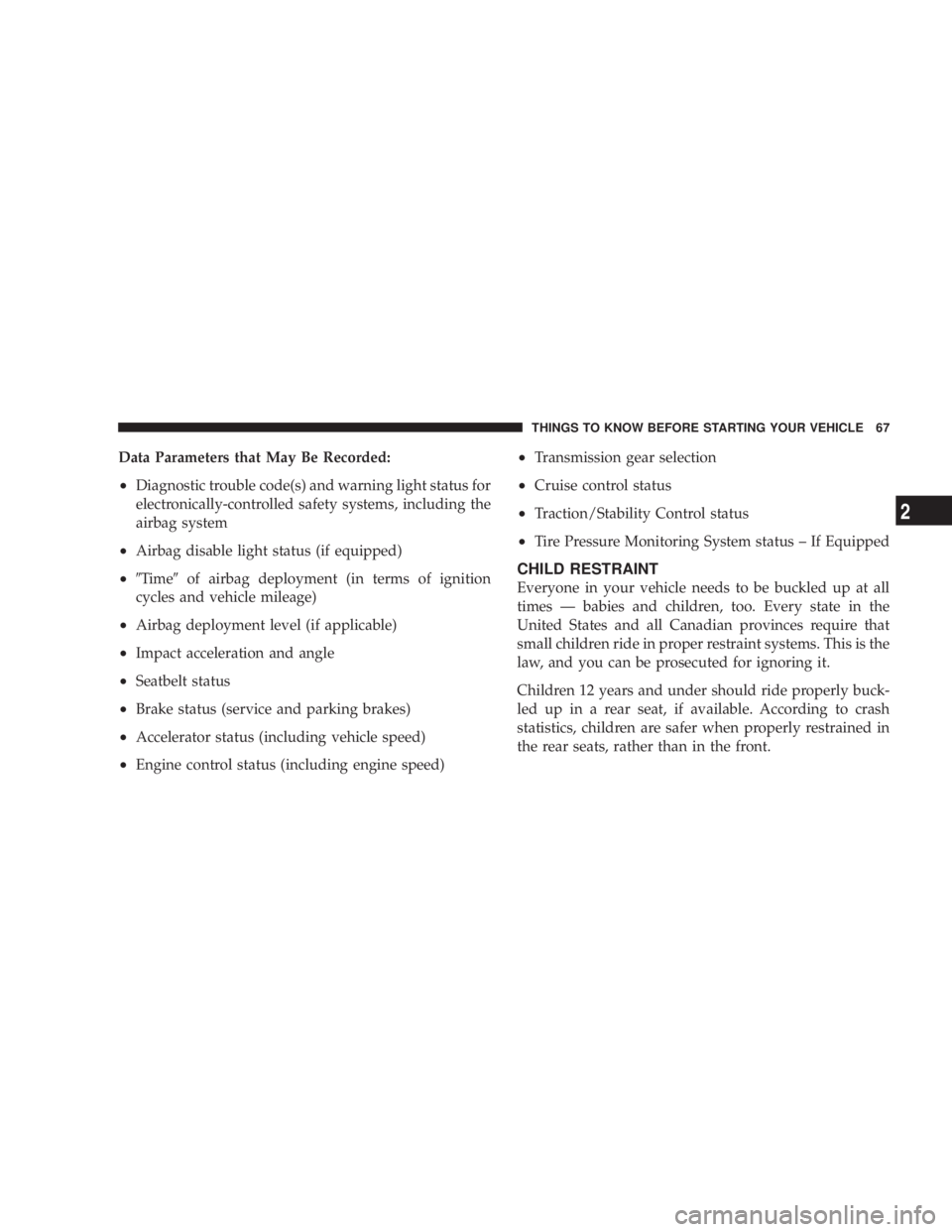
Data Parameters that May Be Recorded:
² Diagnostic trouble code(s) and warning light status for
electronically-controlled safety systems, including the
airbag system
² Airbag disable light status (if equipped)
² 9 Time 9 of airbag deployment (in terms of ignition
cycles and vehicle mileage)
² Airbag deployment level (if applicable)
² Impact acceleration and angle
² Seatbelt status
² Brake status (service and parking brakes)
² Accelerator status (including vehicle speed)
² Engine control status (including engine speed) ² Transmission gear selection
² Cruise control status
² Traction/Stability Control status
² Tire Pressure Monitoring System status ± If Equipped
CHILD RESTRAINT
Everyone in your vehicle needs to be buckled up at all
times Ð babies and children, too. Every state in the
United States and all Canadian provinces require that
small children ride in proper restraint systems. This is the
law, and you can be prosecuted for ignoring it.
Children 12 years and under should ride properly buck-
led up in a rear seat, if available. According to crash
statistics, children are safer when properly restrained in
the rear seats, rather than in the front. THINGS TO KNOW BEFORE STARTING YOUR VEHICLE 67
2
Page 81 of 467

Do not run the engine in a closed garage or in confined
areas any longer than needed to move your vehicle in or
out of the area.
If it is necessary to sit in a parked vehicle with the engine
running, adjust your heating or cooling controls to force
outside air into the vehicle. Set the blower at high speed.
WARNING!If you are required to drive with the deck lid open,
make sure that all windows are closed, and the
climate control blower switch is set at high speed.
DO NOT use the recirculation mode. Safety Checks You Should Make Inside The
Vehicle
Seat Belts
Inspect the belt system periodically, checking for cuts,
frays and loose parts. Damaged parts must be replaced
immediately. Do not disassemble or modify the system.
Front seat belt assemblies must be replaced after a
collision. Rear seat belt assemblies must be replaced after
a collision if they have been damaged (bent retractor, torn
webbing, etc.). If there is any question regarding belt or
retractor condition, replace the belt.
Airbag Light
The light should come on and remain on for six to eight
seconds as a bulb check when the ignition switch is first
turned ON. If the LED is not lit during starting, have it
checked. If the light stays on or comes on while driving,
have the system checked by an authorized dealer. THINGS TO KNOW BEFORE STARTING YOUR VEHICLE 79
2
Page 82 of 467

Defroster
Check operation by selecting the defrost mode and place
the blower control on high speed. You should be able to
feel the air directed against the windshield.
NOTE: If the defrost feature is not functioning, the
cause should be located and corrected immediately by an
authorized service center. The windshield could fog up
while driving and obscure your visibility.
Periodic Safety Checks You Should Make Outside
The Vehicle
Tires
Examine tires for excessive tread wear or uneven wear
patterns. Check for stones, nails, glass, or other objects
lodged in the tread. Inspect tread and sidewall for cuts or
cracks. Check wheel nuts for tightness, and tires (includ-
ing spare) for proper pressure. Lights
Have someone observe the operation of exterior lights
while you work the controls. Check turn signal and high
beam indicator lights on the instrument panel.
Fluid Leaks
Check area under vehicle after overnight parking for fuel,
engine coolant, oil, or other fluid leaks. In addition, if
gasoline fumes are detected or fuel, power steering fluid,
transmission fluid, or brake fluid leaks are suspected, the
cause should be located and corrected immediately.80 THINGS TO KNOW BEFORE STARTING YOUR VEHICLE
Page 84 of 467
N Voice Training ........................119
m Seats ................................120
N Manual Front Seat Adjustments ...........120
N Power Seats Ð If Equipped ..............123
N Heated Seats Ð If Equpped ..............123
N Fold-Flat Front Passenger Seat ............124
N Adjustable Head Restraints ..............125
N Folding Rear Seat .....................126
N Folding Rear Seat Center Armrest ..........127
m To Open And Close The Hood .............127
m Lights ...............................129
N Map/Reading/Interior Lights ............129
N Multi-Function Control Lever .............130 N Headlights; Parking Lights; Instrument Lights . . 130
N Automatic Headlight System Ð If Equipped . . 131
N Headlight Time Delay ..................131
N Passing Light / Flash-To-Pass .............131
N Daytime Running Lights (DRL) Ð
If Equipped .........................132
N Lights On Reminder ...................132
N Fog Lights Ð If Equipped ...............132
N Turn Signals .........................133
N Highbeam/Lowbeam Select Switch .........134
m Windshield Wipers And Washers ............134
N Intermittent Wiper System ...............136
N Mist Feature .........................13782 UNDERSTANDING THE FEATURES OF YOUR VEHICLE
Page 85 of 467
N Headlights With Wipers Feature
(Available With Auto Headlights Only) ......137
N Windshield Washers ...................138
N Adding Washer Fluid ..................138
m Tilt/Telescoping Steering Column ...........139
m Electronic Speed Control Ð If Equipped ......140
N To Activate ..........................140
N To Set Desired Speed ...................141
N To Deactivate ........................141
N To Resume Speed .....................141
N To Vary Speed Setting ..................142
N To Accelerate For Passing ...............142
m Garage Door Opener Ð If Equipped .........143 N Programming HomeLink t ...............144
N Gate Operator/Canadian Programming .....148
N Security ............................148
N Troubleshooting Tips ...................149
N General Information ...................149
m Power Sunroof Ð If Equipped .............150
N Sunroof Operation ....................151
N Auto Sunroof Express With Anti-Pinch
Protection Ð If Equipped ...............151
N Sunshade Operation ...................152
N Wind Buffeting .......................152
N Sunroof Maintenance ...................152
N Ignition Off Operation ..................152UNDERSTANDING THE FEATURES OF YOUR VEHICLE 83
3