2008 CHRYSLER SEBRING CONVERTIBLE Tie down
[x] Cancel search: Tie downPage 60 of 454

fuses. Refer to ªFusesº in this manual for fuse location
information. See your authorized dealer for service.
Event Data Recorder (EDR)
In the event of an accident, your vehicle is designed to
record up to five seconds of specific vehicle data param-
eters (see the following list) in an event data recorder
prior to the moment of airbag deployment, or near
deployment, and up to a quarter second of high-speed
deceleration data during and/or after airbag deploy-
ment. EDR data are ONLY recorded if an airbag deploys,
or nearly deploys, and are otherwise unavailable.
NOTE:
1. A near-deployment event occurs when the airbag
sensor detects severe vehicle deceleration usually indica-
tive of a crash, but not severe enough to warrant airbag
deployment.
2. Under certain circumstances, EDR data may not be
recorded (e.g., loss of battery power).In conjunction with other data gathered during a com-
plete accident investigation, the electronic data may be
used by DaimlerChrysler Corporation and others to learn
more about the possible causes of crashes and associated
injuries in order to assess and improve vehicle perfor-
mance. In addition to crash investigations initiated by
DaimlerChrysler Corporation, such investigations may
be requested by customers, insurance carriers, govern-
ment officials, and professional crash researchers, such as
those associated with universities, and with hospital and
insurance organizations.
In the event that an investigation is undertaken by
DaimlerChrysler Corporation (regardless of initiative),
the company or its designated representative will first
obtain permission of the appropriate custodial entity for
the vehicle (usually the vehicle owner or lessee) before
accessing the electronic data stored, unless ordered to
download data by a court with legal jurisdiction (i.e.,
pursuant to a warrant). A copy of the data will be
60 THINGS TO KNOW BEFORE STARTING YOUR VEHICLE
Page 269 of 454

WARNING!
²The Anti-Lock Brake System contains sophisticated elec-
tronic equipment that may be susceptible to interference
caused by improperly installed or high output radio trans-
mitting equipment. This interference can cause possible loss
of anti-lock braking capability. Installation of such equip-
ment should be performed by qualified professionals.
²Pumping of the Anti-Lock Brakes will diminish their effec-
tiveness and may lead to an accident. Pumping makes the
stopping distance longer. Just press firmly on your brake
pedal when you need to slow down or stop.
²
Anti-lock system (ABS) cannot prevent the natural laws of
physics from acting on the vehicle, nor can it increase braking
or steering efficiency beyond that afforded by the condition
of the vehicle brakes and tires or the traction afforded.
²The ABS cannot prevent accidents, including those resulting
from excessive speed in turns, following another vehicle too
closely, or hydroplaning. Only a safe, attentive, and skillful
driver can prevent accidents.
²The capabilities of an ABS equipped vehicle must never be
exploited in a reckless or dangerous manner, which could
jeopardize the user's safety or the safety of others.
All vehicle wheels and tires must be the same size and
type and tires must be properly inflated to produce
accurate signals for the computer.
Anti-Lock Brake Light
The ABS light monitors the Anti-Lock Brake
System. The light will come on when the
ignition switch is turned to the ON position
and may stay on for as long as four seconds.
If the ABS light remains on or comes on while driving, it
indicates that the Anti-Lock portion of the brake system
is not functioning and that service is required. However,
the conventional brake system will continue to operate
normally if the Brake System Warning Light is not on.
If the ABS light is on, the brake system should be serviced
as soon as possible to restore the benefits of Anti-Lock
brakes. If the ABS light does not come on when the
ignition switch is turned to the ON position, have the
bulb repaired as soon as possible.
STARTING AND OPERATING 269
5
Page 321 of 454
Loading
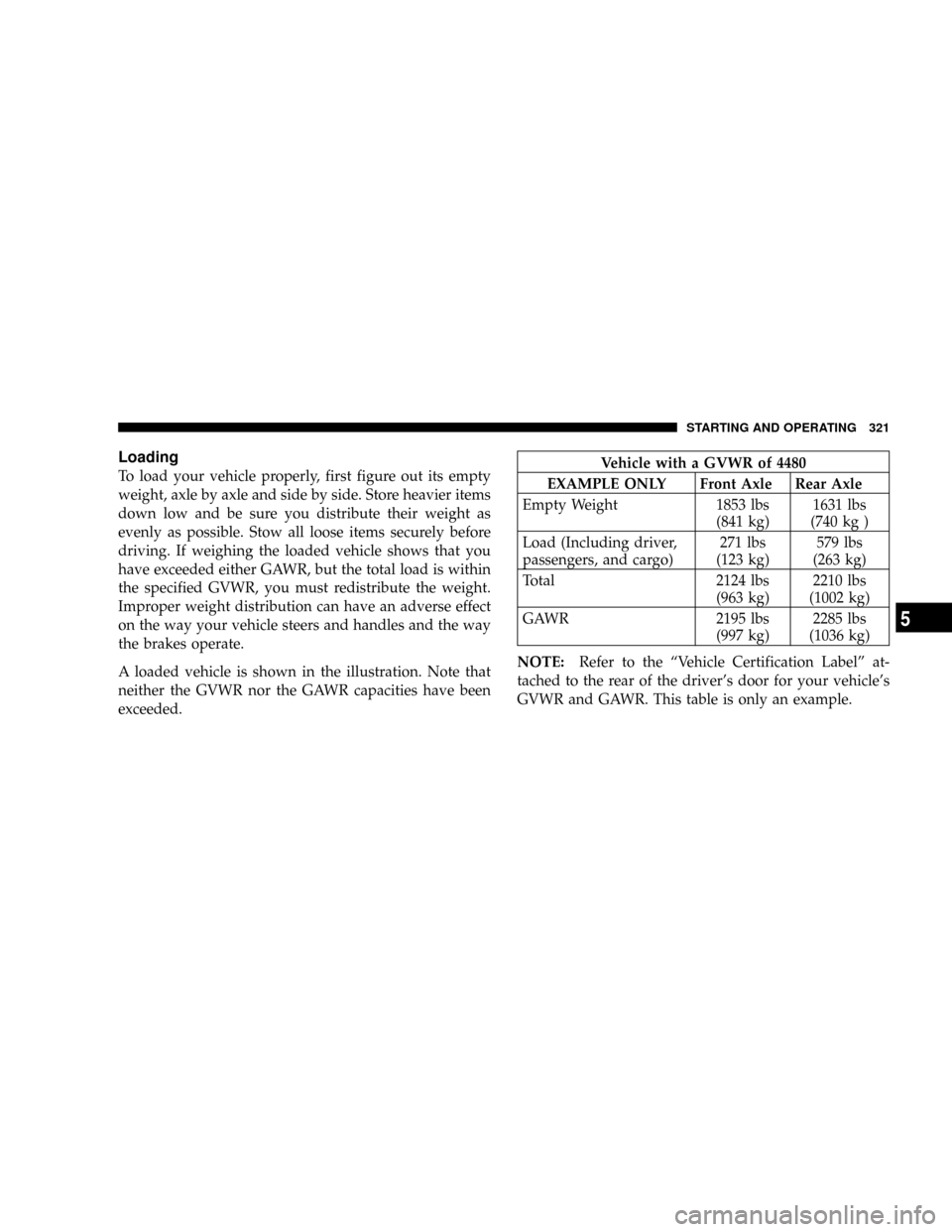
To load your vehicle properly, first figure out its empty
weight, axle by axle and side by side. Store heavier items
down low and be sure you distribute their weight as
evenly as possible. Stow all loose items securely before
driving. If weighing the loaded vehicle shows that you
have exceeded either GAWR, but the total load is within
the specified GVWR, you must redistribute the weight.
Improper weight distribution can have an adverse effect
on the way your vehicle steers and handles and the way
the brakes operate.
A loaded vehicle is shown in the illustration. Note that
neither the GVWR nor the GAWR capacities have been
exceeded.Vehicle with a GVWR of 4480
EXAMPLE ONLY Front Axle Rear Axle
Empty Weight 1853 lbs
(841 kg)1631 lbs
(740 kg )
Load (Including driver,
passengers, and cargo)271 lbs
(123 kg)579 lbs
(263 kg)
Total 2124 lbs
(963 kg)2210 lbs
(1002 kg)
GAWR 2195 lbs
(997 kg)2285 lbs
(1036 kg)
NOTE:Refer to the ªVehicle Certification Labelº at-
tached to the rear of the driver's door for your vehicle's
GVWR and GAWR. This table is only an example.
STARTING AND OPERATING 321
5
Page 370 of 454

Refrigerant Recovery and Recycling
R-134a Air Conditioning Refrigerant is a hydrofluorocar-
bon (HFC) that is endorsed by the Environmental Pro-
tection Agency and is an ozone-saving product. How-
ever, the manufacturer recommends that air conditioning
service be performed by dealers or other service facilities
using recovery and recycling equipment.
NOTE:Use only manufacturer approved A/C System
Sealers, Stop Leak Products, Seal Conditioners, Compres-
sor Oil, and Refrigerants.
A/C Air Filter Ð If Equipped
Refer to the ªMaintenance Scheduleº in Section 8 of this
manual for A/C Air Filter service intervals.
WARNING!
Do not remove the A/C Air Filter while the blower is
operating or personal injury may result.The A/C Air Filter is located in the fresh air inlet behind
the glove box. Perform the following procedure to re-
place the filter:
1. Open the glove box and remove all contents.
2. Push in on the sides of the glove box and lower the
door.
3. Disconnect the glove box door dampener from the slot
on the side of the box. This is done by grasping the
dampener connector (on the outside of the box) and the
end of the connector pin (on the inside of the box) with
your thumb and forefinger and pulling outward while
lightly lifting upward on the door with your other hand.
Once disconnected, the dampener will retract under-
neath the instrument panel if you release it.
4. Pivot the glove box downward.
370 MAINTAINING YOUR VEHICLE
Page 454 of 454

INTRODUCTION INTRODUCTION HOW TO USE THIS MANUAL WARNINGS AND CAUTIONS VEHICLE IDENTIFICATION NUMBER VEHICLE MODIFICATIONS / ALTERATIONS THINGS TO KNOW BEFORE STARTING YOUR VEHICLE A WORD ABOUT YOUR KEYS
Ignition Key RemovalKey-In-Ignition ReminderSENTRY KEY Replacement KeysSentry Key ProgrammingGeneral InformationSECURITY ALARM SYSTEM - IF EQUIPPED Rearming of the SystemTo Arm the SystemTo Disarm the SystemILLUMINATED ENTRY SYSTEM
- IF EQUIPPED REMOTE KEYLESS ENTRY To unlock the doorsTo lock the doorsConvertible Top OperationTo Unlatch the TrunkExpress Down Window FeatureUsing The Panic AlarmProgramming Additional TransmittersBattery ReplacementGeneral InformationREMOTE
STARTING SYSTEM - IF EQUIPPED How To Use Remote StartDOOR LOCKS Manual Door LocksPower Door LocksWINDOWS Power WindowsWind BuffetingTRUNK LOCK AND RELEASE TRUNK SAFETY WARNING Trunk Emergency Release OCCUPANT
RESTRAINTS Lap/Shoulder BeltsLap/Shoulder Belt Untwisting ProcedureSeat Belt PretensionersEnhanced Seat Belt Reminder System (BeltAlert) Automatic Locking ModeSeat Belts And Pregnant WomenSeat Belt ExtenderDriver and Front Passenger Supplemental
Restraint System (SRS) - AirbagEvent Data Recorder (EDR)Child RestraintENGINE BREAK-IN RECOMMENDATIONS SAFETY TIPS Transporting PassengersLock Your VehicleExhaust GasSafety Checks You Should Make Inside The VehiclePeriodic Safety Checks You
Should Make Outside The VehicleUNDERSTANDING THE FEATURES OF YOUR VEHICLE CONVERTIBLE TOP OPERATION Power Convertible Top Usage PrecautionsCargoProtectorPower Convertible Top ControlsLowering the Power Convertible TopRaising the Power
Convertible TopWind StopPower Convertible Top Operation and Warning MessagesMIRRORS Automatic Dimming MirrorOutside MirrorsPower Remote Control MirrorsHeated Remote Control Mirrors - If EquippedVanity Mirror - If EquippedHANDS-FREE COMMUNICATION
(UConnect) - IF EQUIPPED OperationPhone Call FeaturesUConnect System FeaturesAdvanced Phone ConnectivityThings You Should Know About Your UConnect SystemGeneral InformationVOICE RECOGNITION SYSTEM (VR) - IF EQUIPPED Voice Recognition System
(VR) OperationCommandsVoice TrainingSEATS Manual Front Seat AdjustmentsEasy Entry SystemPower Seats - If EquippedHead RestraintsHeated Seats -If EquippedTO OPEN AND CLOSE THE HOOD LIGHTS Exterior and Interior Lighting ControlHeadlights and Parking
LightsAutomatic Headlights - If EquippedHeadlights with Wipers (Available with Auto Headlights Only)Headlight Time Delay - If EquippedDaytime Running Lights (DRL) - If EquippedLights-On ReminderFog Lights - If EquippedTurn SignalsHighbeam/Lowbeam Select Switch
Flash to PassInterior LightsWINDSHIELD WIPERS AND WASHERS Intermittent Wiper SystemMist FeatureHeadlights with Wipers (Available with Auto Headlights Only)Windshield WashersAdding Washer FluidTILT/TELESCOPING STEERING COLUMN ELECTRONIC
SPEED CONTROL - IF EQUIPPED Electronic Speed Control OperationTo ActivateTo Set At A Desired SpeedTo DeactivateTo Resume SpeedTo Vary The Speed SettingTo Accelerate For PassingGARAGE DOOR OPENER - IF EQUIPPED Programming HomeLinkGate
Operator/Canadian ProgrammingUsing HomeLinkReprogramming A Single HomeLink ButtonSecurityTroubleshooting TipsGeneral InformationELECTRICAL POWER OUTLETS Electrical Outlet Use With Engine OffCIGAR LIGHTER AND ASH RECEIVER - IF EQUIPPED Cup Holder Ash Receiver - If EquippedCUP HOLDERS Front Seat Cup HolderHeated or Cooled Cup Holder - If EquippedRear Seat Cup HoldersCONSOLE FEATURES StorageSliding Armrest - If EquippedUNDERSTANDING YOUR INSTRUMENT PANEL INSTRUMENT
PANEL FEATURES BASE INSTRUMENT CLUSTER PREMIUM INSTRUMENT CLUSTER INSTRUMENT CLUSTER DESCRIPTIONS ELECTRONIC VEHICLE INFORMATION CENTER (EVIC)- IF EQUIPPED Electronic Vehicle Information Center (EVIC) DisplaysOil
Change RequiredTrip FunctionsCompass DisplayPersonal Settings (Customer Programmable Features)SETTING THE ANALOG CLOCK RADIO GENERAL INFORMATION Radio Broadcast SignalsTwo Types of SignalsElectrical DisturbancesAM ReceptionFM Reception
SALES CODE REQ - AM/FM STEREO RADIO AND 6-DISC CD/DVD CHANGER
(MP3/WMA AUX JACK) Operating Instructions - Radio ModeOperation Instructions - (DISC MODE for CD and MP3/WMA Audio Play, DVD-VIDEO)Notes On PlayingMP3/WMA FilesLIST Button (DISC Mode for MP3/WMA Play)INFO Button (DISC Mode for MP3/WMA Play)
SALES CODE REN - MULTIMEDIA SYSTEM - IF EQUIPPED Operating Instructions - Satellite Radio (If Equipped)Operating Instructions - Voice Recognition System (VR) (If Equipped)Operating Instructions - Hands-Free Communication (UConnect) (If Equipped)Clock Setting
ProcedureSALES CODE RER - MULTIMEDIA SYSTEM - IF EQUIPPED Operating Instructions - Satellite RadioOperating Instructions - Hands-Free Communication (UConnect) (If Equipped)Clock Setting ProcedureUNIVERSAL CONSUMER INTERFACE (UCI) - IF
EQUIPPED Connecting the iPod DeviceControlling the iPod using Radio ButtonsPlay ModeList or Browse ModeSATELLITE RADIO (RSC) - IF EQUIPPED (RER/REQ/REN RADIOS ONLY) System ActivationElectronic Serial Number/Sirius Identification Number (ENS/SID)
Selecting Satellite ModeSatellite AntennaReception QualityOperating Instructions - Satellite ModeOperating Instructions - Hands Free Phone (If Equipped)Operating Instructions - Video Entertainment System (VES) (If Equipped)REMOTE SOUND SYSTEM CONTROLS
- IF EQUIPPED Right-Hand Switch FunctionsLeft-Hand Switch Functions for Radio OperationLeft-Hand Switch Functions for Media (i.e. CD) OperationRADIO OPERATION AND CELLULAR PHONES CD/DVD DISC MAINTENANCE CLIMATE CONTROLS Manual Air
Conditioning and Heating System Automatic Temperature Control (ATC) - If Equipped Operating TipsREAR WINDOW FEATURES Electric Rear Window Defroster - If EquippedSTARTING AND OPERATING STARTING PROCEDURES Automatic TransaxleNormal Starting
Extremely Cold Weather (below -20 degrees F or -29 degrees C)If Engine Fails to StartAfter StartingENGINE BLOCK HEATER - IF EQUIPPED AUTOMATIC TRANSAXLE Brake/Transaxle Interlock SystemAutomatic Transaxle Ignition Interlock System4 Speed or 6 Speed
(AutoStick) Automatic TransaxleAUTOSTICK - IF EQUIPPED AutoStick OperationAutoStick General InformationPARKING BRAKE BRAKE SYSTEM Anti-Lock Brake System - If EquippedPOWER STEERING DRIVING ON SLIPPERY SURFACES AccelerationTraction
DRIVING THROUGH WATER Flowing/Rising WaterShallow Standing WaterTRACTION CONTROL SYSTEM (TCS) - IF EQUIPPED BRAKE ASSIST SYSTEM (BAS) - IF EQUIPPED ELECTRONIC STABILITY PROGRAM (ESP) - IF EQUIPPED ESP Operating Modes
ESP/BAS Malfunction Indicator Light and ESP/TCS Indicator LightSynchronizing ESPTIRE SAFETY INFORMATION Tire Markings Tire Identification Number (TIN)Tire Loading and Tire PressureTIRES - GENERAL INFORMATION Tire PressureTire Inflation Pressures
Radial-Ply TiresCompact Spare Tire - If EquippedLimited Use Spare - If EquippedTire SpinningTread Wear IndicatorsLife of TireReplacement TiresAlignment And BalanceTIRE CHAINS SNOW TIRES TIRE ROTATION RECOMMENDATIONS TIRE PRESSURE MONITOR
SYSTEM (TPMS) - IF EQUIPPED Base System - If EquippedPremium System - If EquippedGeneral InformationFUEL REQUIREMENTS 2.4L and 2.7L Engines3.5L EngineReformulated GasolineGasoline/Oxygenate BlendsMMT In GasolineMaterials Added to FuelFuel
System CautionsCarbon Monoxide WarningsFLEXIBLE FUEL- 2.7L ENGINES ONLY (EXCEPT CALIFORNIA EMISSION STATES) E-85 General InformationETHANOL FUEL (E-85)Fuel RequirementsSelection Of Engine Oil For Flexible Fuel Vehicles (E-85) and Gasoline
VehiclesStartingCruising RangeReplacement PartsMaintenanceADDING FUEL Fuel Filler Cap (Gas Cap)Loose Fuel Filler Cap MessageVEHICLE LOADING Vehicle Certification LabelGross Vehicle Weight Rating (GVWR)Gross Axle Weight Rating (GAWR)Overloading
LoadingTRAILER TOWING Common Towing DefinitionsTrailer Hitch ClassificationTrailer Towing Weights (Maximum Trailer Weight Ratings)Trailer and Tongue WeightTowing RequirementsTowing TipsRECREATIONAL TOWING (BEHIND MOTORHOME, ETC.) TOWING
THIS VEHICLE BEHIND ANOTHER VEHICLE (Flat towing with all four wheels on the ground)WHAT TO DO IN EMERGENCIES HAZARD WARNING FLASHER IF YOUR ENGINE OVERHEATS Engine Oil Overheating - 2.4L Engine Only (If Equipped)JACKING AND TIRE
CHANGING Preparations For JackingJack LocationSpare Tire StowageJacking InstructionsJUMP-STARTING PROCEDURES FREEING A STUCK VEHICLE TOWING ADISABLED VEHICLE WITHOUT THE IGNITION KEYTOWING THIS VEHICLE BEHIND ANOTHER VEHICLE (Flat towing with all four wheels on the ground)TOWING THIS VEHICLE BEHIND ANOTHER VEHICLE WITH A TOW DOLLYMAINTAINING YOUR VEHICLE 2.4L ENGINE COMPARTMENT 2.7L ENGINE COMPARTMENT 3.5L ENGINE COMPARTMENT
ONBOARD DIAGNOSTIC SYSTEM - OBD II Loose Fuel Filler Cap MessageEMISSIONS INSPECTION AND MAINTENANCE PROGRAMS REPLACEMENT PARTS DEALER SERVICE MAINTENANCE PROCEDURES Engine OilEngine Oil FilterDrive BeltSpark Plugs
Engine Air Cleaner FilterCatalytic ConverterMaintenance-Free BatteryAir Conditioner MaintenanceA/C Air Filter - If EquippedPower Steering - Fluid CheckFront Suspension Ball JointsSteering LinkageBody LubricationWindshield Wiper BladesWindshield WashersExhaust
SystemCooling SystemHoses and Vacuum/Vapor HarnessesFuel SystemBrake SystemAutomatic TransaxleFront and Rear Wheel BearingsAppearance Care And Protection From CorrosionCleaning The Center Console Cup HoldersCONVERTIBLE TOP CARE Soft Top
Weather Strip Care - Soft and Hard TopFUSES (TOTALLY INTEGRATED POWER MODULE) VEHICLE STORAGE REPLACEMENT BULBS BULB REPLACEMENT Low Beam Headlight, High Beam HeadlightFront Turn Signal/Park LightFront Fog LightTail/Stop Light, Rear
Turn Signal Light, Backup LightLicense Plate LightCenter High-Mounted Stop Light (CHMSL)FLUIDS AND CAPACITIES FLUIDS, LUBRICANTS, AND GENUINE PARTS EngineMAINTENANCE SCHEDULES EMISSION CONTROL SYSTEM MAINTENANCE
MAINTENANCE SCHEDULE Required Maintenance IntervalsIF YOU NEED CONSUMER ASSISTANCE SUGGESTIONS FOR OBTAINING SERVICE FOR YOUR VEHICLE Prepare For The AppointmentPrepare A ListBe Reasonable With RequestsIF YOU NEED
ASSISTANCE DaimlerChrysler Motors Corporation Customer CenterDaimlerChrysler Canada Inc. Customer CenterIn Mexico contactCustomer Assistance For The Hearing Or Speech Impaired (TDD/TTY)Service ContractWARRANTY INFORMATION (U.S. Vehicles Only)
MOPAR PARTS REPORTING SAFETY DEFECTS In the 50 United States and Washington D.CIn CanadaPUBLICATION ORDER FORMS DEPARTMENT OF TRANSPORTATION UNIFORM TIRE QUALITY GRADES TreadwearTraction GradesTemperature GradesINDEX